



The fastest read on a Changes tag comes from stacking three clues together: tag material, the exact wording order on the label, and one contextual detail like a phone number or fabric blend. Woven or silk tags with ‘printed in’ before ‘made in’ generally point earlier; papery printed labels with eight-digit local numbers push you into the mid-1990s and beyond. Before you touch anything else, photograph the tag close-up, the whole shirt front and back, and the stitching at the hem and neckline. Vintage Metal Store treats this trio of checks as the backbone of every provenance note we write.
TL;DR:
- Woven or silk tags with ‘printed in’ before ‘made in’ typically date before 1990, while papery labels from the late 1980s indicate cost-cutting shifts.
- Phone number format on the tag is the quickest way to narrow down the manufacturing decade, with eight-digit local numbers pointing to post-1996 production.
- Fabric feel, stitch type, and measurements often contradict or support tag dating, so cross-checking these details prevents misclassification.
- Reproduction tags often mismatch age indicators, such as new tags on heavily worn shirts, which requires close inspection of fabric aging and print techniques.
- Reliable dating combines multiple signals, with the strongest evidence coming from phone numbers, material, print style, and consistency between label and garment aging.
Table of Contents
- Era markers: a year-by-year timeline for Changes-style tags
- Tag features that carry the most dating weight
- Fabric, stitch and construction clues that confirm the tag
- Spotting fakes and reprints that copy Changes-style tags
- The practical checklist: how to inspect and record a Changes-tagged tee
- Notes from the shop floor: tricky tags and when to call in a second opinion
- Buying with ambiguous tags: a collector’s take
- Where to browse authenticated vintage heavy metal tees
- Sources
- FAQ
Era markers: a year-by-year timeline for Changes-style tags
Dating a tag is really about reading manufacturing habits, not just fonts. Labelling standards, fabric sourcing and printing methods all shifted across the 1980s and 1990s, and each shift leaves a fingerprint on the shirt in your hands.
1980s: woven and silk-screened tags, heavier blends
Tags from this decade tend to be woven or silk-screened directly onto a cotton backing, often stiffer and more substantial than what came later. Poly-cotton blends were common because pure cotton was pricier to source and finish at scale. Wording on these tags is usually simple: brand name, a size, and a country of origin with no phone number at all.
Late 1980s to early 1990s: the papery tag takes over
This is the transition window collectors argue about most. Printed tags on thinner, papery stock start replacing woven labels as manufacturers cut costs and outsourced more production overseas. You’ll also see ‘made in’ phrasing shift order and location, often reflecting where a garment was actually assembled rather than where it was printed or distributed. Castledoor Select’s tag guide for Australian vintage shirts documents exactly this kind of material and wording shift as one of the more dependable era markers going.
Mid-1990s onward: standardisation kicks in
By the mid-1990s, sewn-in labels become far more uniform. Cotton content standardises around 100% for band merchandise, and stitch types settle into patterns manufacturers could repeat at volume. Changes-brand tags from this stretch commonly show 100% cotton listed plainly on the label, a detail backed up by Defunkd’s archive of Changes-tagged shirts across dozens of catalogued examples.
Here’s the catch every collector runs into eventually:
- Single-stitch and double-stitch hems overlapped for years rather than switching cleanly on a calendar date.
- Regional manufacturing runs sometimes kept older techniques alive well past when the “canonical” era guides say they should have disappeared.
- A papery tag doesn’t automatically mean late 1990s. Some smaller print runs used cheaper stock earlier than the trend suggests.
- Phone number format is often more reliable than tag material alone for narrowing a decade.
Pro Tip: Never date a shirt off one signal. A woven tag paired with an eight-digit phone number is a contradiction worth photographing and investigating further, not ignoring.
The most reliable collectors treat these markers as overlapping probability bands, not hard boundaries. That’s genuinely how experienced dating guides use photo timelines, stacking multiple weak signals until they agree.
Tag features that carry the most dating weight
Not every detail on a tag matters equally. Some tell you almost nothing on their own; a handful narrow the date range hard when you know how to read them.
- Tag material. Woven or silk tags skew earlier, generally pre-1990. Papery printed labels became common from the late 1980s onward as brands cut costs, though the exact tipping point varies by manufacturer.
- Wording order. Watch for whether ‘printed in’ appears before or after ‘made in’. Castledoor’s research notes this ordering often reflects regional distribution and print-run logistics rather than a strict manufacturing date, so read it as a supporting clue rather than a standalone answer.
- Phone number format. This is the fastest triage tool in your kit. An area code plus seven digits usually points to numbering conventions used before 1996 in Australia; an eight-digit local number suggests a later date. Castledoor’s guide to Australian vintage tag markers treats this as one of the most dependable single checks going, especially when the brand itself is obscure or hard to place.
- RN and CA numbers. These registration numbers, when present, can sometimes be cross-checked against public trademark records to confirm a brand was actively registered in a given window.
- Hidden markings. Flip the tag and check the underside. Some manufacturers stamped supplementary codes or dates that never show on the printed face.
Pro Tip: Phone number format is your shortcut when the brand name itself is unfamiliar or the graphic gives no obvious clues, as it narrows a decade faster than almost anything else on the tag.
Trademark and brand databases add a useful layer here too. The WIPO Global Brand Database lets you check whether a name on a tag was an active, registered trademark during a given period, which helps when you’re dealing with a smaller or regional label that doesn’t show up in the usual collector guides. It won’t replace a close physical inspection, but it’s a solid backstop when tag evidence alone leaves you guessing.
Fabric, stitch and construction clues that confirm the tag
A tag tells you what the manufacturer printed. The fabric and stitching tell you what they actually built, and the two don’t always agree.
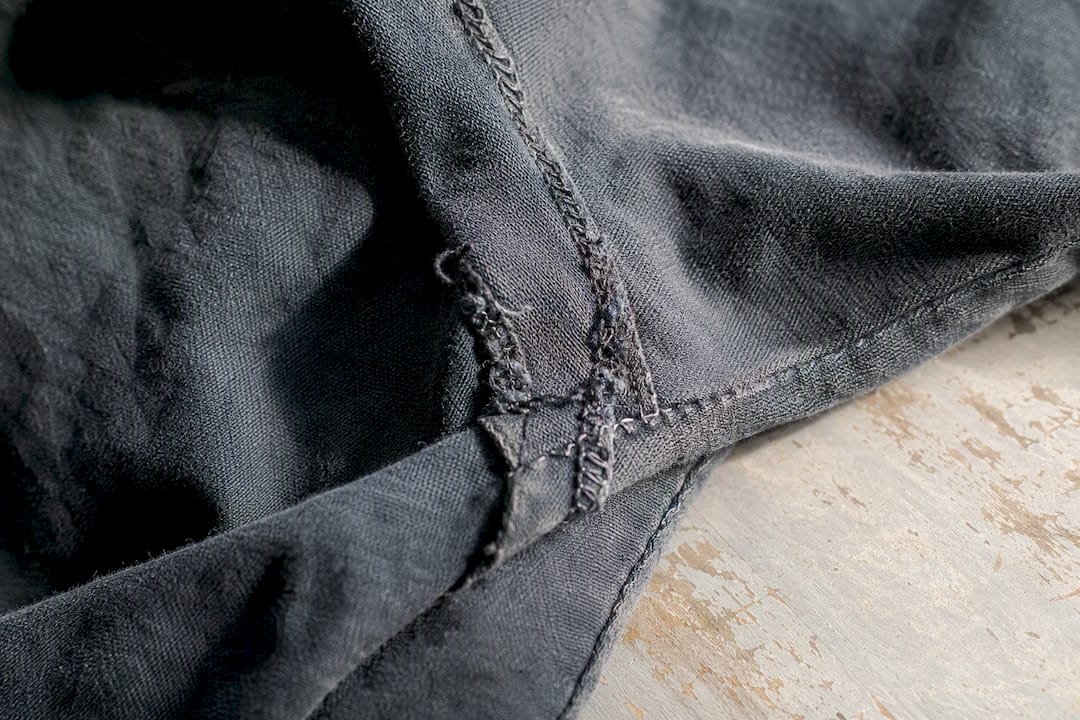
Poly-cotton blends were the norm throughout much of the 1980s because pure cotton cost more to source and finish consistently at scale. If a tag claims a 1980s date but the fabric feels distinctly like a lightweight, modern 100% cotton weave, that’s worth flagging before you accept the tag at face value.
Stitch type is the next check. A single-stitch hem, where the fabric edge is folded once and sewn with a single line of stitching, is the classic marker collectors associate with pre-1990s production. Double-stitch hems, using two parallel lines of stitching for extra durability, became more common through the 1990s as manufacturers standardised construction. That said, single-stitch hems persisted in some regional manufacturing runs well past their supposed expiry date, so treat stitch type as supporting evidence rather than a verdict on its own.
Measurements matter more than most new collectors expect. Pit-to-pit width and body length shift with era-specific sizing conventions, and Defunkd’s catalogued Changes-brand listings show measured examples you can compare directly against a shirt in hand. Always measure the actual garment rather than trusting the tagged size, since decades of washing and shrinkage can pull a size-large down close to a modern medium. Our guide on top fabrics for vintage shirts breaks down blend ratios by decade if you want the fuller picture.
Spotting fakes and reprints that copy Changes-style tags
Reproduction tags have gotten good enough that material and wording checks alone won’t always catch them. You need to cross-examine the tag against the shirt it’s sewn into.
The single biggest tell is an ageing mismatch. A tag that looks crisp, unfaded and stiff sewn into a shirt with heavily worn, sun-bleached fabric and a soft, decades-old hand-feel should raise an immediate flag. Genuine vintage pieces age as a whole garment; a swapped or reproduction tag rarely matches the wear pattern of the fabric around it.
- Compare the print technique on the graphic itself against period-accurate screenprinting. Original-era screenprints show visible ink texture, slight bleed at edges, and saturation that varies with each pass; modern digital prints tend to look flatter and more uniform under close inspection.
- Check wash instructions against what was standard for the claimed era. Modern fibre content disclosures or symbols that didn’t exist yet on the claimed date are a hard giveaway.
- Look closely at typography. Reproduction tags often use a font that’s close but not identical to the original, especially in numerals and registered trademark symbols.
- Cross-check the graphic’s print history against known tour dates or album releases where possible.
Pro Tip: If a tag looks brand new but the collar is stretched and yellowed from decades of wear, trust the fabric over the tag. Ageing doesn’t lie the way a swapped label can.
Our collector’s guide to authenticating vintage band tees runs through five checks in more depth if you want a broader authentication framework beyond tags alone. And if you’re weighing up a reissue against something claiming to be original, our piece on reissues versus originals covers the print and fabric differences that separate the two.
The practical checklist: how to inspect and record a Changes-tagged tee
Whether you’re buying online, inspecting in person, or cataloguing your own collection, a consistent process beats guesswork every time.
- Photograph the tag close-up under even lighting, front and back if there’s underside stamping.
- Photograph the whole shirt, front and back, plus a close-up of both hems and the neckline stitching.
- Photograph the care label separately, capturing wash symbols and fibre content in full.
- Measure pit-to-pit and full body length, recording both even if the tagged size says otherwise.
- Check the phone number format against known Australian numbering conventions to bracket a decade.
- Note the wording order for ‘printed in’ versus ‘made in’ and any RN or CA numbers present.
- Assess fabric weight and blend by feel, then compare against era-typical ratios.
- Compare the print technique on the graphic against period-accurate screenprinting.
- Cross-check against known tour dates, album releases, or existing catalogued listings if the shirt ties to a specific run.
Our tour shirt dating methods guide walks through how we apply this same sequence to tour-specific merchandise, where provenance often carries more weight than the tag alone.
Notes from the shop floor: tricky tags and when to call in a second opinion
We’ve handled shirts where the tag said one thing and the print said another, and sorting that contradiction is where real shop experience earns its keep. A single-stitch hem doesn’t automatically mean pre-1990 if the graphic references a tour that didn’t happen until years later. In cases like that, the print and provenance carry more weight than the tag, because tour-specific graphics are far harder to fake convincingly than a label.
The tag is a starting point, not a verdict. We’ve seen woven tags on shirts with unmistakably later print techniques, and the honest call is to flag the contradiction rather than force the evidence to agree. That’s when a phone number check or a brand database search earns its place, and it’s also when we tell a buyer plainly that certainty has limits.
When the evidence genuinely splits, we document both signals in the listing rather than picking whichever supports a higher price. That transparency matters more to serious collectors than a clean, unambiguous story ever does.
Buying with ambiguous tags: a collector’s take
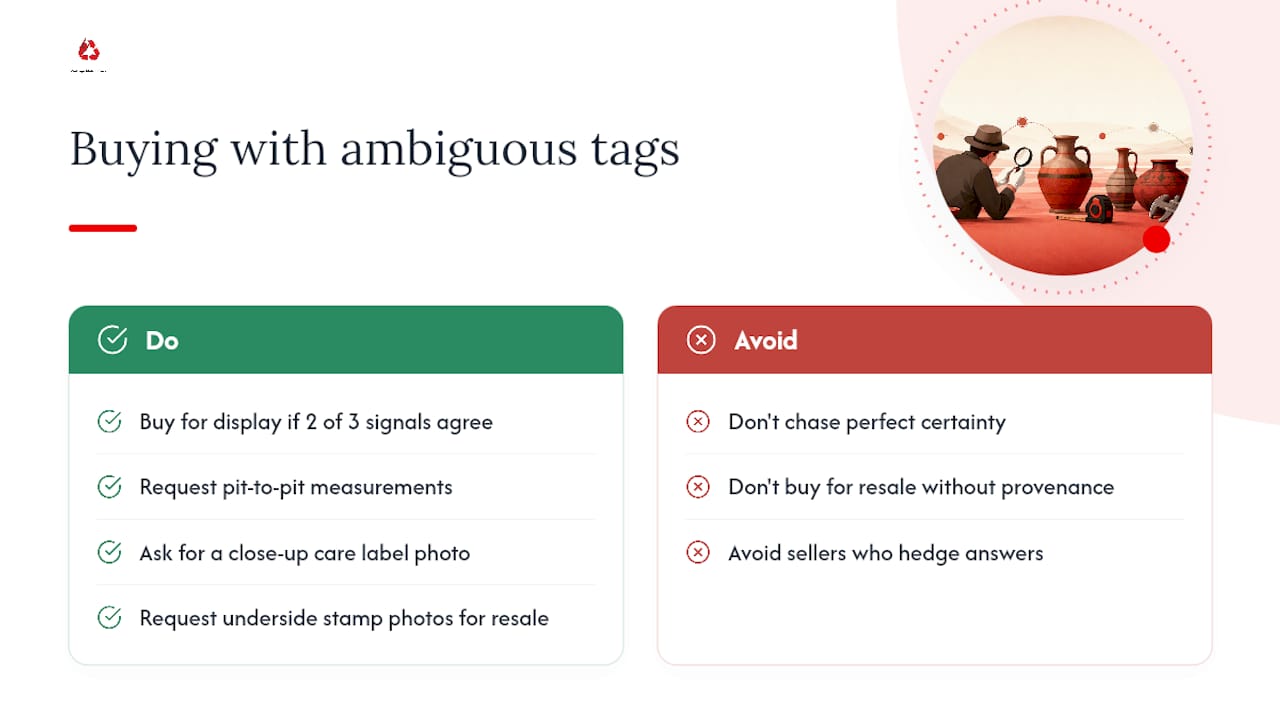
Perfect certainty is rare in this hobby, and chasing it can cost you genuinely good pieces. My rule of thumb: if two of three major signals agree (tag, fabric, print technique), I’m comfortable buying for display. Resale is a different bar. There, I want provenance documentation or a seller willing to photograph the underside stamping and measurements before I commit.
Ask sellers for pit-to-pit measurements, a close-up of the care label, and honest disclosure of any tag replacement. A seller who hedges on these requests is telling you something. One who answers plainly, even when the answer is “we’re not certain,” is usually worth trusting more than one who oversells confidence they don’t have.
— David
Where to browse authenticated vintage heavy metal tees
Every listing at Vintage Metal Store gets the same treatment we’ve walked through here: detailed measurements recorded by hand, provenance notes where we have them, and honest condition grading rather than vague “vintage” labels papering over wear. We don’t guess on tags we can’t verify, and we tell you plainly when a piece’s dating relies on print evidence over the tag itself.

If you want to see what a properly documented listing looks like, the rare Metallica 1992 tour tee shows the full measurement and provenance approach in practice, and the Metallica shirts collection gives you a broader run of era-dated examples across decades. Browse the full range at Vintage Metal Store and you’ll find every piece listed with the same tag, fabric and print scrutiny this guide just walked you through, ready for your next addition to the collection.
Sources
- The Master Guide to Australian Vintage T-Shirt Tags – Castledoor Select
- Vintage Changes t-shirt tags | Defunkd
- WIPO Global Brand Database
FAQ
What is the fastest way to date a Changes tag?
Check the phone number format first. Area code plus seven digits usually points earlier than 1996, while an eight-digit local number suggests a later date, and this single check often narrows the decade faster than material or wording alone.
Does a single-stitch hem always mean a shirt is pre-1990s?
Not always. Single-stitch hems persisted in some regional manufacturing runs well past their typical era, so treat stitching as supporting evidence rather than a standalone verdict.
How can I tell if a Changes tag has been swapped onto a different shirt?
Compare the ageing of the tag against the ageing of the fabric. A crisp, unfaded tag sewn into heavily worn, sun-bleached fabric is a strong sign the tag doesn’t match the garment’s real history.
Where can I buy shirts with properly documented tag dating?
Vintage Metal Store records measurements, provenance notes and condition grading on every listing, applying the same checks outlined in this guide.
Recommended


