



An original band tee is a tour-era or first-run shirt produced in the era it claims, on an era-correct blank, using the print methods of that period. A reissue is a later reprint or reproduction of that graphic, regardless of how faithfully it copies the original design. That single distinction, the difference between reissue and original, is what separates a $50 shirt from a $500 one.
Three signals to check immediately:
- Tag and blank — does the neck tag match a known era-correct brand (Screen Stars, Tultex, Hanes 50/50)?
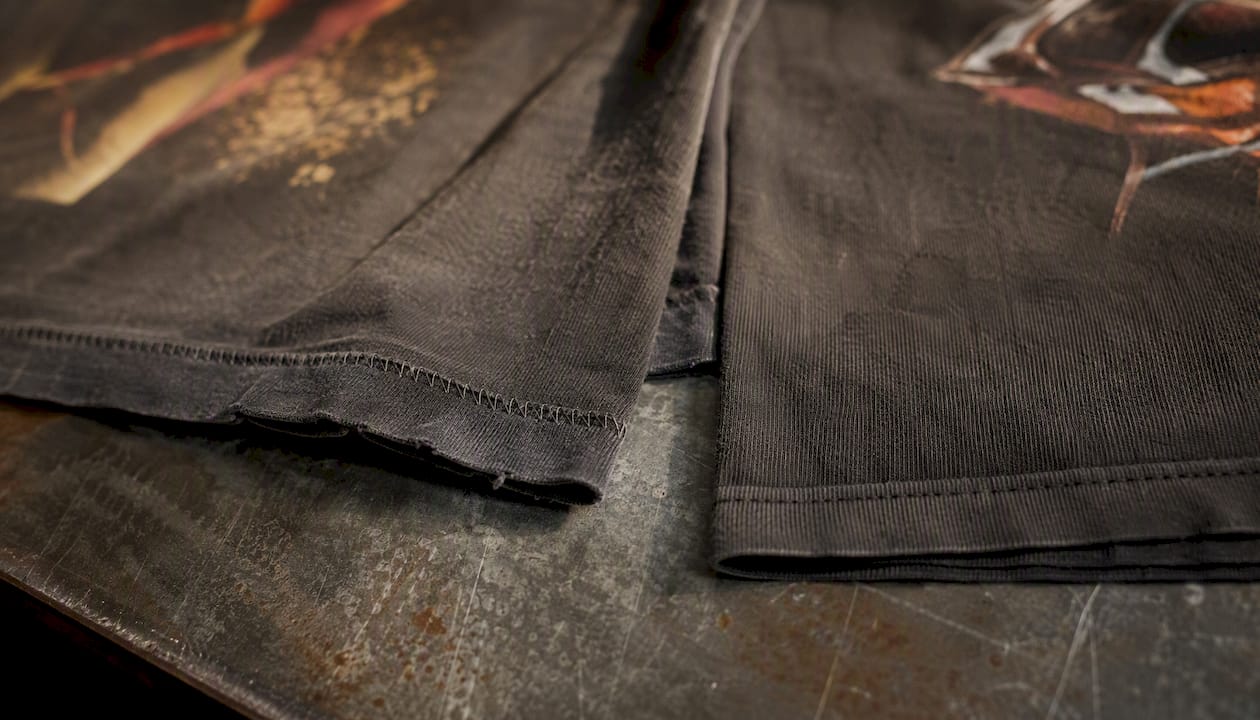
- Stitching — single-stitch on sleeves and hem strongly suggests pre-1996 production.
- Print method and ink texture — plastisol screenprint sits on the fabric surface and cracks with age; DTG soaks in and stays smooth.
Pro Tip: Never rely on one signal alone. A shirt that passes all three checks above is worth investigating further; one that fails two of them is almost certainly a reprint.
The vintage band-tee market contains many reproductions, and experienced collectors treat every listing as guilty until proven innocent.
Key takeaways
The difference between a reissue and an original comes down to era-correct production: the blank, the tag, the stitch and the print method must all align with the claimed period.
| Point | Details |
|---|---|
| Three minimum signals | Tag brand, stitch type and print method must all align before accepting a claimed era. |
| Single-stitch timeline | Single-stitch on sleeves and hem strongly suggests pre-1996 production; combine with tag evidence. |
| Reissue tells | Tagless labels, modern blanks (Gildan, tri-blend) and DTG printing point to post-original production. |
| Provenance matters | Receipts, chain-of-custody emails or tour crew documentation add real value to any claimed original. |
| Vintage Metal Store | Lists authenticated originals and clearly labelled reissues with tag photos and provenance notes. |
Table of Contents
- 1. What visual checks tell you about print and fabric
- 2. How tags, blanks and stitching help you date a shirt
- 3. What print methods reveal about a shirt’s age
- 4. Condition and ageing signs that support authenticity
- 5. How reissues usually differ from originals
- 6. How originality versus reissue changes the value
- 7. Step-by-step verification checklist for buying in Australia
- 8. Red flags and the eight questions to always ask a seller
- Why careful verification is the only honest approach
- Vintage Metal Store: authenticated originals and honest listings
- Sources
- FAQ
1. What visual checks tell you about print and fabric
The print is where most fakes give themselves away, and close-up photos are your best friend.
Ink surface and hand feel: Plastisol screenprint sits proud of the fabric. After decades of washing and wearing, it develops surface cracking, crazing and partial ink loss, especially along fold lines and stress points. DTG prints feel smooth and integrated into the fabric, with no surface texture, and they generally indicate modern production.
- Cracking pattern: Natural cracking follows the shirt’s actual wear lines — collar stress, chest creases, underarm folds. Artificial distressing tends to be uniform and symmetrical.
- Halftone dots and registration: Era-correct screenprints often show visible halftone dot patterns in gradient areas and slight colour misregistration between layers. Perfect registration across multiple colours is a modern tell.
- Underbase opacity: A white or light underbase beneath a dark-ink graphic is common in quality 1980s and 1990s prints. Its presence and thickness can help date the shirt.
- Print placement: Tour-era shirts often feature large back graphics with full tour date lists, lower chest placement on fronts, and sleeve prints. Modern reprints frequently centre everything and reduce the graphic scale.
Uneven fading, ink loss at fold lines, and slight colour shift from washing are signs of a shirt that has actually lived a life. A graphic that looks as sharp as the day it was printed on a 35-year-old shirt deserves serious scrutiny.
Fabric drape and weight: Vintage blanks from the 1980s and early 1990s tend to be open-end cotton, heavier and slightly coarser. After many washes they go thin and papery with a soft drape. A shirt claiming to be from 1989 that feels thick, bouncy and new is worth questioning.
Pro Tip: Ask sellers for a photo of the shirt held up to light — it reveals fabric weight, seam wear and any repairs that flat-lay shots hide.
2. How tags, blanks and stitching help you date a shirt
Tags are the closest thing vintage tees have to a birth certificate. Authenticity means era-correct production on an era-correct blank, so a 1992 graphic on a 2024 Gildan blank is a reprint, full stop.
Era-correct blank brands to look for:
- Screen Stars / Screen Stars Best — Fruit of the Loom’s premium line, common through the late 1970s to mid-1990s.
- Tultex — widely used for band merch through the 1980s and 1990s.
- Hanes 50/50 — polyester-cotton blend, common in the 1980s.
- Fruit of the Loom (open-end) — open-end cotton construction typical of the 1980s and early 1990s.
Later blanks like Gildan, Bella+Canvas and tagless printed-neck labels point to post-2000 production at the earliest.
Stitching timelines: Single-stitch on sleeves and bottom hem strongly suggests pre-1996 production. Double-stitch became the industry standard from the mid-1990s onward. Some premium blanks used double-stitch earlier, so treat single-stitch as a supporting signal, not a standalone verdict.
Reading the tag: Check the care label for country-of-origin (USA, Honduras, Mexico each have typical era windows), RN registration numbers, and the presence or absence of washing symbols. The vintage t-shirt tag database at Underpriced lets you compare tag designs side by side and look up RN numbers against the FTC database to confirm the manufacturer.
Pro Tip: RN number lookups are underused by buyers. Cross-referencing an RN against the FTC database takes two minutes and can confirm or contradict a seller’s claimed era.
3. What print methods reveal about a shirt’s age
The technology used to print a shirt is one of the most reliable era clues available.
Plastisol screenprinting dominated band merch from the late 1970s well into the 2010s. It produces a thick, opaque ink layer that sits on top of the fabric. Over decades, that layer cracks, fades unevenly and loses fine detail, especially in shadow areas. A genuine 1980s or 1990s tour tee will show this decay in a way that is very difficult to fake convincingly.
Discharge printing uses a chemical process to remove dye from the fabric rather than adding ink on top. The result is a soft, almost painted feel with no surface texture. Discharge was used selectively in the 1990s and produces a characteristic faded, washed-in look from day one. It ages differently from plastisol and can be confused with heavy washing, so look for the absence of any surface ink layer.
Direct-to-garment (DTG) and heat transfers are markers of modern reproduction. DTG soaks ink into the fabric fibres, leaving no surface texture and producing photographic-quality detail that plastisol simply could not achieve in the 1980s. If a shirt claiming to be from 1987 has photographic-quality gradients with no halftone dots and no surface texture, it was not printed in 1987.
Halftone dot patterns in gradient areas are one of the clearest era signals in screenprinting. Pre-digital separations produce coarser, more visible dots. If you can see the dot structure in a close-up photo, that is a genuine screenprint signal worth noting.
Pro Tip: Ask for a macro photo of a gradient or shadow area in the graphic. Halftone dots visible to the naked eye point to era-correct screenprinting; smooth photographic gradients point to DTG.
4. Condition and ageing signs that support authenticity
A shirt’s condition tells a story. The question is whether that story is consistent.
- Sun-fade: Genuine UV exposure fades the fabric and the ink together, unevenly, with the back often lighter than the front if stored folded. Chemical distressing tends to fade the ink uniformly.
- Seam stretch and collar wear: Decades of wearing pull the collar and side seams in characteristic ways. A 1980s shirt with a perfectly round, unstretched collar is either deadstock or suspicious.
- Ink cracking along wear lines: Cracking that follows the actual stress points of the garment (chest fold, underarm, collar) is consistent with real wear. Cracking that appears uniformly across the entire graphic is a distressing tell.
- Odour and patina: Storage odour, slight yellowing of white areas, and a general patina of age are hard to fake. They are not proof on their own, but their absence on an alleged 35-year-old shirt is worth noting.
Pro Tip: Deadstock originals can be in near-perfect condition and still be genuine. The key is that the blank, tag, stitching and print method all align with the claimed era. Perfect condition alone is not suspicious; perfect condition plus modern blank is.
Pro Tip: Provenance paperwork, receipts, tour crew notes or photographs of the shirt being worn at the actual event are rare but powerful. Even a chain-of-custody email trail from a seller who bought it from a crew member adds credibility.
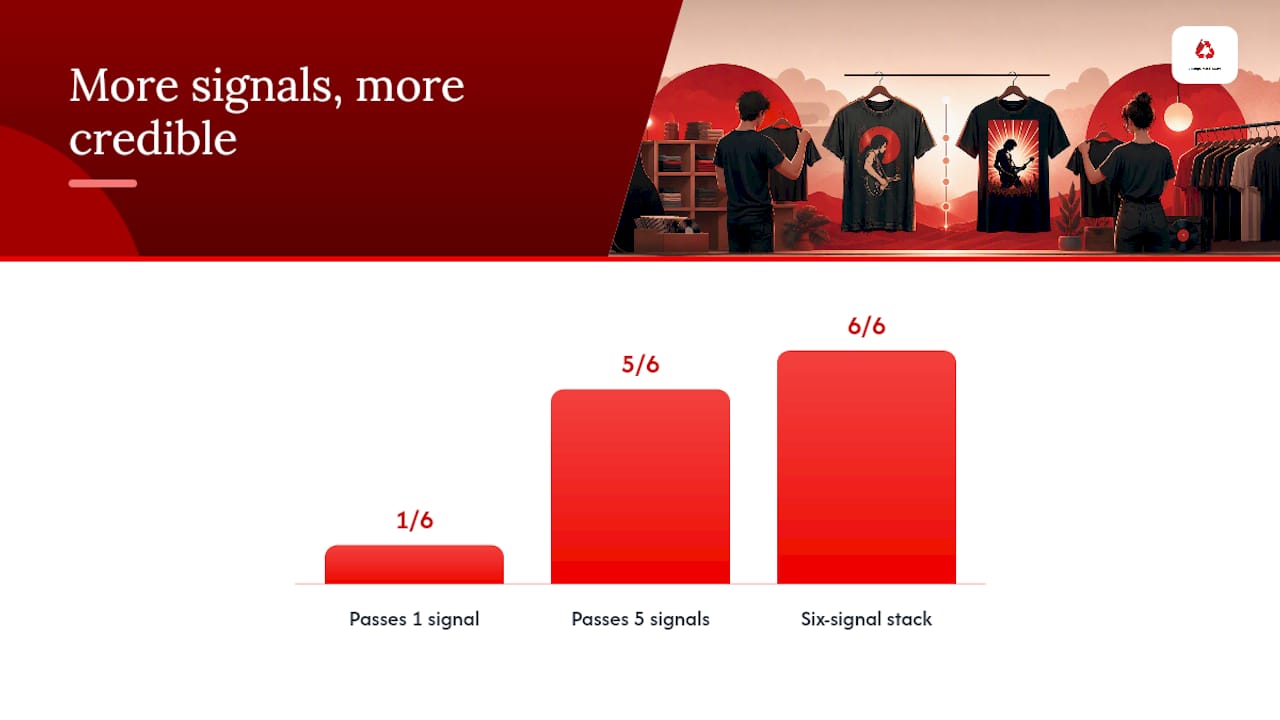
Pro Tip: When weighing multiple small signals, think in terms of consistency: “does this shirt tell a coherent story?” A shirt that passes five of six signals is far more credible than one that passes only one.
Pro Tip: The six-signal stack recommended by Vintage Metal Store — hem/stitch, tag, country of origin, print method, fabric and graphic copyright line — gives you a structured way to record your findings rather than relying on gut feel.
5. How reissues usually differ from originals
Most reissues are easy to spot once you know what to look for. Reissued band tees commonly use modern blanks, tagless printed neck labels, and occasionally include an explicit copyright or reissue year.
Common reissue signals:
- Tagless printed neck label (heat-transferred or screen-printed directly onto the fabric)
- Modern ringspun or tri-blend blank (softer, lighter, more drapey than vintage open-end cotton)
- Perfectly uniform artificial distressing
- DTG or heat-transfer print with photographic detail
- Copyright line showing a year later than the claimed tour era
- Graphic placement that differs from known originals (centred rather than lower-chest, smaller back print)
Licensed vs unlicensed reproductions: Licensed reprints carry a licensing stamp or copyright line from the rights holder. Unlicensed reproductions carry nothing, or worse, they carry a fake copyright line. An honest listing will state clearly that a shirt is a reissue and give the approximate reprint year.
Some mid-era reprints from the 2000s have become collectible in their own right, particularly limited licensed runs. They should be labelled accurately by year, and their value assessed on their own merits rather than confused with the original.
Pro Tip: An honest seller will tell you upfront if a shirt is a reissue. If a listing uses vague language like “vintage style” or “inspired by” without stating the production year, treat it as a reissue until proven otherwise.
6. How originality versus reissue changes the value
The price gap between an original and a reissue of the same design can be significant, and it is driven by a handful of factors.
Core valuation drivers:
- Provenance: A shirt with documented chain of custody commands a premium. Tour crew provenance, original purchase receipts or photographic evidence of the shirt at the event are the gold standard.
- Rarity and limited run: A shirt from a single-city warm-up show or a regional Australian leg of a tour is rarer than a shirt from the main US leg.
- Condition: For originals, condition affects price but does not override authenticity. A well-worn original is still an original.
- Iconic graphic or tour connection: Certain tours and graphics carry outsized collector demand. A shirt from a landmark tour in a band’s history will always attract more interest.
- Era-correct blank: The blank brand itself contributes to value. A Screen Stars original commands more than the same graphic on a generic blank.
Honest labelling changes buyer expectations and market pricing. A reissue listed as an original is fraud; a reissue listed accurately as a 2005 licensed reprint is a legitimate collectible at its own price point.
Pro Tip: Check recent sold listings for comparable shirts, matching tag brand, size, condition and construction. That is the most reliable price anchor available to Australian buyers.
7. Step-by-step verification checklist for buying in Australia
Before committing to any purchase, run through this workflow. The photo checklist and buyer questions below form the core of a safe buying process for Australian collectors.
Photos to request from the seller:
- Clear neck tag (full tag, in focus, with any text readable)
- Inside hem stitch close-up (single or double stitch visible)
- Macro close-up of print texture (showing ink surface or lack of it)
- Full front and back flat-lay
- Care label (washing instructions, country of origin)
- Side seam and underarm area
- Any repairs, stains or notable wear
Eight questions to always ask:
- Where and when did you buy this shirt?
- Do you have an original receipt or any provenance documentation?
- What is the blank brand and can you confirm the tag details?
- Has the shirt been altered, repaired or washed with anything unusual?
- Can you confirm the country of origin on the care label?
- Is this listed as an original or a reissue, and why?
- What is your returns policy if the shirt does not match the description?
- Can you provide additional close-up photos of any area I specify?
Pro Tip: For high-value purchases, ask for a video of the seller handling the shirt. Movement reveals fabric weight, drape and surface texture in ways that flat-lay photos cannot.
For Australian buyers, also ask whether the seller can provide a chain of custody that demonstrates the shirt has been in Australia, particularly for shirts claimed to be from Australian legs of international tours. The buying checklist at Vintage Metal Store covers additional local considerations.
8. Red flags and the eight questions to always ask a seller
Some listings are easy to dismiss. Others require a harder look.
Immediate red flags:
- Tagless shirt claimed to be from the 1980s (tagless labels did not exist in that era)
- Modern tri-blend blank on an alleged 1980s or early 1990s shirt
- Perfectly uniform artificial distressing with no variation
- Copyright line showing a year after the claimed tour date
- Stock photography used instead of actual photos of the item
- Mismatched close-ups (tag from one shirt, print from another)
- Seller unable or unwilling to provide additional photos
Eight seller questions (quick reference):
- “Can you show the neck tag and care label clearly?”
- “When and where did you buy this shirt?”
- “Is there any original receipt or provenance documentation?”
- “What is the blank brand?”
- “Can you confirm single or double stitch on the hem?”
- “Is this an original or a reissue?”
- “What is the country of origin on the care label?”
- “What is your returns policy?”
When a seller cannot answer basic tag and provenance questions, walk away or make a conditional offer that reflects the uncertainty. A lower offer that accounts for reissue risk is always sensible when the evidence is thin.
Pro Tip: If a listing claims “original” but the seller cannot name the blank brand or show a clear tag photo, treat it as unverified. Authentic sellers of genuine originals know their stock.
Why careful verification is the only honest approach
The vintage band-tee market rewards patience and punishes shortcuts. What I keep coming back to, after working through hundreds of listings and authentication queries, is that no single signal is ever enough. A single-stitch hem on a Gildan blank is not a 1980s shirt. A Screen Stars tag on a DTG print is not an original. The signals have to stack.
My practical rule: combine at least three independent signals before accepting a claimed era. Tag brand, stitch type and print method are the minimum. Add country of origin, graphic copyright line and fabric weight and you have a credible case. Miss two of those six and you have a reissue until proven otherwise.
The collector guides on the Vintage Metal Store blog document this stacking approach in detail, and they are worth reading before you spend serious money. One more thing worth saying plainly: a quality reissue worn to a gig is a perfectly honourable choice. Save the originals for display or for the collector who will appreciate what they are. Wear the legacy however it suits you, but know what you are buying.
Vintage Metal Store: authenticated originals and honest listings
Vintage Metal Store specialises in vintage heavy metal tees, ex-tour stock and deadstock from Australian and international metal tours. Every listing is labelled clearly as original or reissue, with the six-signal authentication stack applied before anything goes live.

If you want to see what a properly authenticated original looks like in practice, the rare vintage heavy metal concert shirts collection is a good place to start. Each listing includes tag photos, stitch details and provenance notes where available. For Metallica collectors, the 1992 Don’t Tread on Me USA Tour shirt is an example of how a documented original is presented. Got a shirt you are not sure about? Send photos to Vintage Metal Store and get a straight answer on what you are looking at.
Sources
- How To Authenticate Vintage T-Shirts | Keep It Classic
- Vintage Band Tees: A No-BS Buying Guide for 2026 — WEAR2AM Blog | WEAR2AM
- Vintage T-Shirt Tag Database: Date 6 Major Tag Brands
FAQ
What is the core difference between a reissue and an original band tee?
An original is produced in the era it claims, on an era-correct blank with era-correct print methods. A reissue is a later reprint of the same graphic, regardless of how closely it copies the original design.
Does single-stitch stitching prove a shirt is original?
Single-stitch on sleeves and hem strongly suggests pre-1996 production, but it is not standalone proof. Combine it with the tag brand, print method and country of origin before drawing a conclusion.
Are reissues worth buying?
Reissues can be worth buying when they are honestly labelled and priced accordingly. Some authorised limited reprints have collector value in their own right; the problem is reissues sold as originals at original prices.
How do I verify a vintage band tee before buying online in Australia?
Request clear photos of the neck tag, inside hem stitch, print texture macro, full front and back, care label and seams. Ask the seller for provenance details and confirm the blank brand before committing.
How does originality affect the price of a vintage metal shirt?
Provenance, rarity, condition, iconic tour connection and era-correct blank all drive price. A documented original from a landmark tour commands a significant premium over a reissue of the same design.
Recommended


