



TL;DR:
- Authentic band tees require verifiable construction details and provenance, beyond mere surface wear or fading.
- Understanding these factors protects investments, preserves cultural history, and maintains market integrity for collectors.
Not every faded, cracked band tee is a genuine relic from a 1980s or 1990s heavy metal tour. A widespread assumption among new collectors is that surface wear equals vintage value, and that misconception has cost people real money. Understanding the importance of band tee authenticity goes far beyond spotting a worn graphic. It touches on cultural history, financial investment, and the integrity of the pieces you choose to own. This article walks you through exactly what separates a genuine shirt from a convincing fake, and why that distinction matters more than most collectors realise until it is too late.
Key takeaways
| Point | Details |
|---|---|
| Wear does not equal age | Artificial distressing mimics vintage appearance; physical construction details are the reliable indicators. |
| Tags tell the truth | Era-specific labels from Screen Stars, Hanes, or Fruit of the Loom are among the strongest dating tools available. |
| Provenance lifts value | Documentation, photos, and seller transparency significantly raise collector confidence and auction prices. |
| Reproductions have a place | Licensed reissues are not inherently dishonest, but mislabelling them as originals is where real harm occurs. |
| Knowledge protects your money | Building expertise through reference collections and trusted sources is the most reliable defence against costly mistakes. |
The importance of band tee authenticity for collectors
Band tees entered the collector market through the back door. For decades they were cheap tour souvenirs, worn until they fell apart. Then the secondary market noticed. Nineties band shirts became some of the hottest collectibles of the era, with rare examples fetching prices that rival signed guitars and pressed records. A 1990s Nirvana tee by Backstage Pass sold for over US$13,500 in early 2025, driven almost entirely by verified maker brand and provenance.
That kind of value does not attach itself to just any shirt with a faded graphic. It attaches to verifiable authenticity. And that is precisely why the significance of genuine band merchandise extends well beyond aesthetics.
There are several reasons why authenticity sits at the centre of serious collecting:
- Cultural preservation. An original tour shirt from the Master of Puppets era carries a specific story. It exists as a physical document of a moment in music history.
- Financial protection. Paying collector prices for a reproduction is simply a loss. Knowing how to distinguish real from fake protects your investment directly.
- Market integrity. When reproductions flood the market unlabelled, they distort pricing and erode trust between buyers and sellers.
- Brand and artist protection. Counterfeit suppression safeguards cultural narrative as much as it protects revenue. Bruce Springsteen’s merch partner pursued legal injunctions in 2026 specifically to remove counterfeit tees at tour venues.
“Authenticity protects not just investment value but also helps maintain the cultural narrative fans associate with bands and their merch.” — Billboard reporting on merch enforcement actions
For heavy metal collectors especially, where shirts from early Metallica, Slayer, and Morbid Angel tours represent genuine cultural artefacts, the stakes are high. A deeper look at vintage tee culture makes clear that preservation and authenticity are inseparable concerns.
How to spot authentic band tees
Physical inspection is your primary tool. Once you understand what to look for, the difference between a genuine 1989 tour shirt and a modern distressed reproduction becomes obvious. Here are the core checks, in order of reliability.
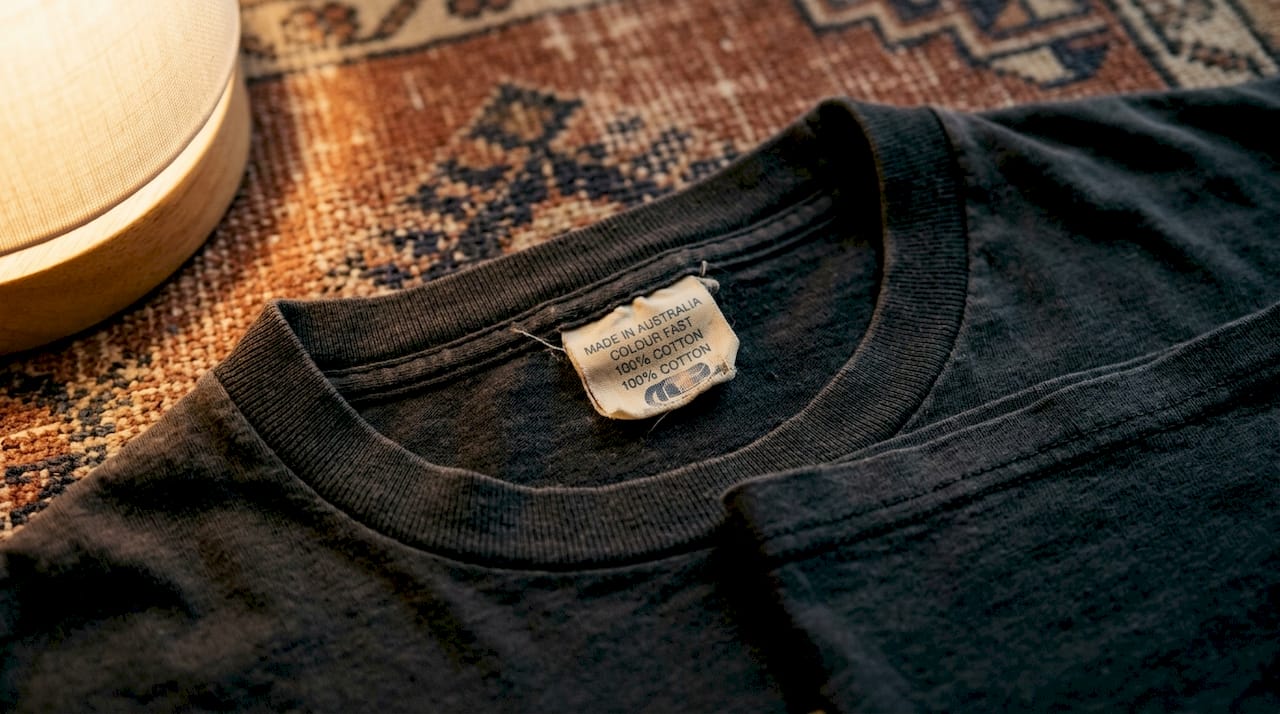
- Check the tag first. Era-specific tags are among the strongest dating indicators available. Screen Stars, Hanes, and Fruit of the Loom tags changed design multiple times across the 1980s and 1990s. Resources like Defunkd allow you to cross-reference tag styles against known production dates. If the tag does not match the claimed era, the shirt does not either.
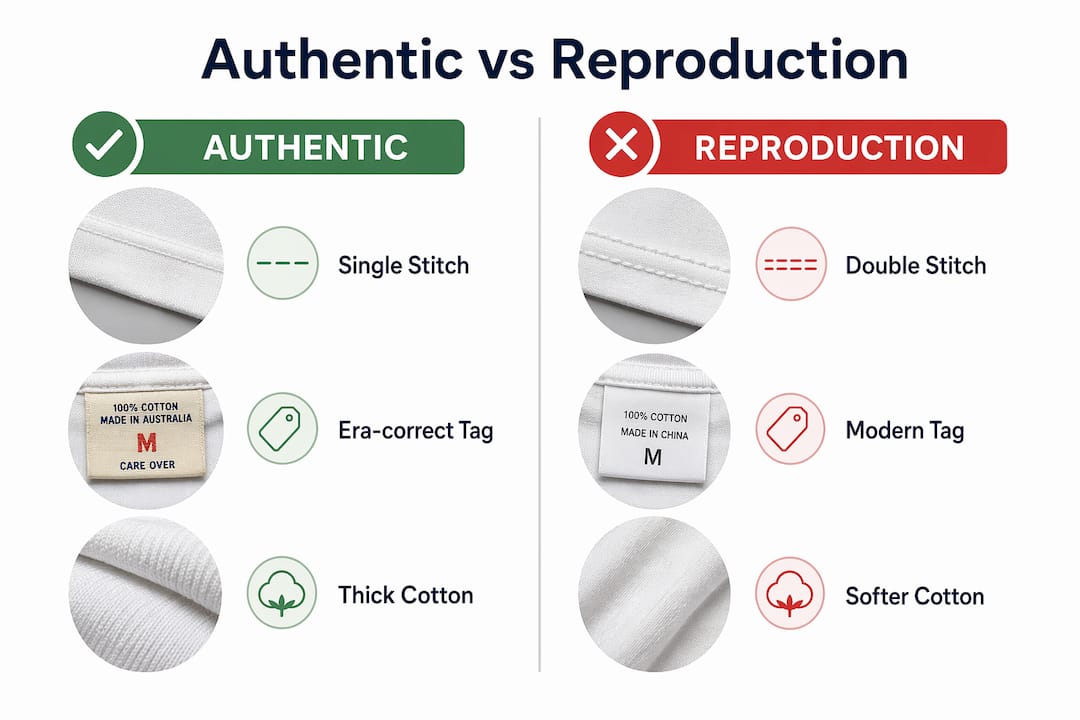
- Examine the hem construction. Vintage tees from the late 1970s through the 1990s were predominantly single-stitch at the sleeve hem and bottom. Double-stitch construction became standard later. A single stitch is not a guarantee of authenticity on its own, but its absence on a claimed vintage piece is a red flag.
- Assess the print quality. Genuine aged screen printing develops a specific cracked texture that occurs from actual fabric movement over time. Artificially distressed shirts use mechanical abrasion and acid washing to mimic this, but the result tends to look uniform rather than naturally worn at points of genuine friction.
- Look at collar construction. Collar width and ribbing styles changed across decades. A narrow rib collar with specific knit patterns is consistent with certain eras and inconsistent with others.
- Request provenance documentation. Kurt Cobain’s Foxes promotional tee achieved bids beyond US$8,000 in part because the auction included a signed authenticity letter. Even informal provenance, such as original purchase receipts or photographic evidence of the shirt being worn at a known event, adds substantial credibility.
Pro Tip: When buying online, always request clear, close-up photographs of the inside collar, hem stitching, and full tag. Sellers of reproductions consistently avoid providing these shots because tag and stitching details are precisely what betray the item’s true age.
| Feature | Authentic vintage tee | Modern reproduction |
|---|---|---|
| Hem stitching | Single stitch | Double stitch |
| Tag design | Era-matched (Screen Stars, etc.) | Generic or blank |
| Print ageing | Naturally cracked at wear points | Uniformly distressed |
| Fabric weight | Heavier cotton, often 50/50 blend | Lighter modern cotton |
| Provenance | Often traceable | Rarely documented |
For a structured approach to all of these checks, the expert authentication guide at Com covers five verified inspection methods in detail.
Authentic tees versus reproductions and reissues
Licensed reproductions occupy a strange position in the collector market. They are not inherently dishonest. When a label officially reissues a classic tour design, that shirt has legitimate value as a piece of contemporary merch. The problem arrives when reproductions are presented, or perceived, as originals.
Modern licensed reissues typically use lighter, softer cotton, double-stitched hems, and digitally processed print files. The result looks similar to the original design but lacks the tactile and construction details that collectors prize. Visually, from a distance, a well-made reissue can deceive. Up close, under a good light, the differences are consistently there.
The impact of fake band shirts on the secondary market is measurable. When reproductions appear alongside originals at similar price points, uninformed buyers overpay and the market’s pricing signals become unreliable. This harms both buyers and the sellers of genuine pieces.
There are some nuances worth understanding:
- Tour bootlegs from the original era are a grey area. A shirt printed and sold outside the venue in 1986 without official licencing is technically bootleg, but it is genuinely old and carries authentic cultural context. Many collectors actively seek these.
- Modern unofficial reproductions of those same designs hold no collector value and are straightforwardly deceptive when sold as originals.
- Official reissues are worth owning as merch but should be clearly identified as such when resold.
Brand authenticity in merch culture broadly follows the same principle. Items carry value when their origin story is honest and verifiable. The moment that story becomes unclear or fabricated, the value collapses.
Collector value hinges on verifiable production details, not merely on age or wear. A rare maker brand like Backstage Pass can multiply the value of a shirt exponentially compared to a common licensed print of the same design.
Buying and selling with confidence
Applying what you know about authenticity requires a practical process, not just theoretical awareness. Whether you are buying at a market stall or through an online platform, these steps protect you.
Before purchasing, run through a fast authenticity checklist for band shirts:
- Confirm the tag matches the claimed production era using a reference database
- Check hem stitching under natural light or a phone torch
- Ask for close-up photographs of the print surface and inside collar
- Request any available provenance, even informal evidence
- Compare asking price against recent sales of verified authentic examples
When something feels off, it usually is. If a seller cannot or will not provide clear photographs of the tag and hem, treat that as a strong signal. Legitimate sellers of genuine vintage tees understand that documentation supports value rather than undermining it.
Price is also a clue. Authentic vintage heavy metal shirts from sought-after tours carry asking prices that reflect their rarity. A shirt being sold at a suspiciously low price relative to comparable authenticated sales is either a reproduction or it carries condition issues the seller has not disclosed.
Pro Tip: Build a small physical reference collection of known authentic pieces from verified sources before spending serious money. Handling real single-stitch, era-tagged shirts trains your eye and hands faster than any photograph can.
Thrift stores and venue stalls carry real risk. Counterfeits circulate in both environments, and neither setting typically allows thorough inspection. If you find something potentially significant in either place, buy at a price that accounts for the risk, then verify before reselling or valuing it as a genuine piece.
For a full structured approach, the buying checklist at Com walks through seven steps in order of inspection priority.
My take on authenticity after years of handling these shirts
I’ve watched collectors make the same expensive mistake repeatedly. They pick up a shirt that looks right at a glance, the faded colours, the cracked graphic, the general feel of something old, and they pay vintage prices without doing the inspection work. Then later, when they look closer or consult someone with more experience, the double-stitched hem and blank tag tell a different story.
What I’ve found is that authenticity does something deeper than protect monetary value. It changes the emotional weight of a piece. Holding a shirt that genuinely existed at a specific tour, that was printed before some of the bands’ most celebrated albums, feels different from holding a competent reproduction. That difference is not sentimental nonsense. It is part of what collectors are actually paying for.
I’ve also seen the reverse problem. People so focused on avoiding fakes that they dismiss genuine pieces because they look too worn, or because the original seller had no documentation. Perfect provenance is rare. Developing the eye and hands to recognise genuine construction is worth more than waiting for paperwork that may never exist.
My honest advice: approach every acquisition as if you are going to resell it to someone who knows more than you do. That mindset forces rigour. It makes you ask the questions, do the inspection, and price your risk accurately. The collectors who build genuinely valuable collections over time are not lucky. They are systematic.
— David
Find verified authentic heavy metal tees at Com
If you are serious about building a collection that holds its value and its story, starting with verified stock matters enormously.
Com specialises in vintage heavy metal tees, including ex-tour stock and dead stock from actual tours and bands. Every piece comes with the kind of transparency that serious collectors need. The rare 1992 Metallica tour shirt is a strong example of what verified authentic stock looks like: a specific tour, a specific era, construction details that hold up to inspection. If Metallica is your focus, the full vintage Metallica collection gives you multiple verified options to compare and consider. For broader browsing across bands and eras, the full catalogue is where to start.
Common questions
What makes a band tee genuinely authentic?
Authentic band tees combine era-correct construction, such as single-stitch hems and period-matched tags, with verifiable provenance connecting the shirt to an original print run or tour.
How do I tell an original from a reproduction?
Check the inside collar tag against a dated reference database, examine hem stitching, and assess the print texture for natural rather than uniform ageing. Sellers avoiding close-up tag photos are a reliable warning sign.
Do reproductions affect the value of authentic tees?
Yes. When unlabelled reproductions enter the market alongside originals at similar prices, they distort buyer expectations and compress prices for genuine pieces, harming both collectors and honest sellers.
How much can authentic band tees be worth?
Significantly more than reproductions. A verified 1990s tee from the right maker can exceed US$13,000 at auction, while a licensed reissue of the same design might sell for under fifty dollars.
What provenance should I ask for when buying?
Request any documentation that links the shirt to its original context: purchase receipts, event photographs, signed statements, or auction records. Even partial provenance strengthens both confidence and resale value.
Recommended
- What Is a Band Tee and Why It Matters for Collectors – Vintage Metal Store
- Collector’s guide to authentic vintage band tees: 5 expert checks – Vintage Metal Store
- Why preserve old band tees? Value, culture and know-how – Vintage Metal Store
- Original vs fake band t shirts: the collector’s guide – Vintage Metal Store


