



TL;DR:
- Checking price, photos, tags, stitching, print ageing, seller provenance, and platform protections is essential before buying vintage heavy metal shirts. Authentic listings feature single-stitch hems, cracked plastisol ink, and clear provenance documentation; beware of stock images, low prices, and evasive sellers. Verification through community vetting or professional authentication helps prevent costly counterfeit purchases.
Before you pay for any vintage heavy metal shirt, run these seven checks: price, photos, tags, stitching and construction, print feel and ageing, seller provenance, and platform dispute protections. That’s the whole game. Every scam in this space exploits at least one of these blind spots.
- Price — a noticeably low asking price compared to documented recent sales
- Photos — stock images, missing close-ups, blurry or cropped shots
- Tags — neck tag font, trademark symbols, manufacturing codes inconsistent with the era
- Stitching and construction — single-stitch vs double-stitch hems, seam quality
- Print feel and ageing — raised plastisol cracking vs flat digital transfer
- Seller provenance — receipts, concert stubs, original packaging, seller history
- Platform protections — 48-hour post-delivery dispute windows, payment method
Pro Tip: Before you message the seller, screenshot every listing photo and run a reverse image search using Google Lens or TinEye. Save the results. If a dispute arises later, that evidence is gold. Vintage Metal Store’s collector guides, curated by David, are a solid benchmark for what authentic listings look like.
Table of Contents
- What listing photos and text tell you before you ask a single question
- Are the tags and stitching era-accurate?
- How authentic screen-prints age versus what fakes feel like
- How to verify sellers and use Australian marketplace protections
- How to value a vintage metal tee in Australia
- Step-by-step pre-purchase verification checklist
- When should you walk away from a listing?
- Where to get authentication help in Australia
- Key takeaways
- The mistake most collectors make, and why provenance beats everything
- Authenticated vintage metal tees, sourced and verified
- FAQ
What listing photos and text tell you before you ask a single question
Start with the photos and listing copy, not the seller. Most fakes reveal themselves here.
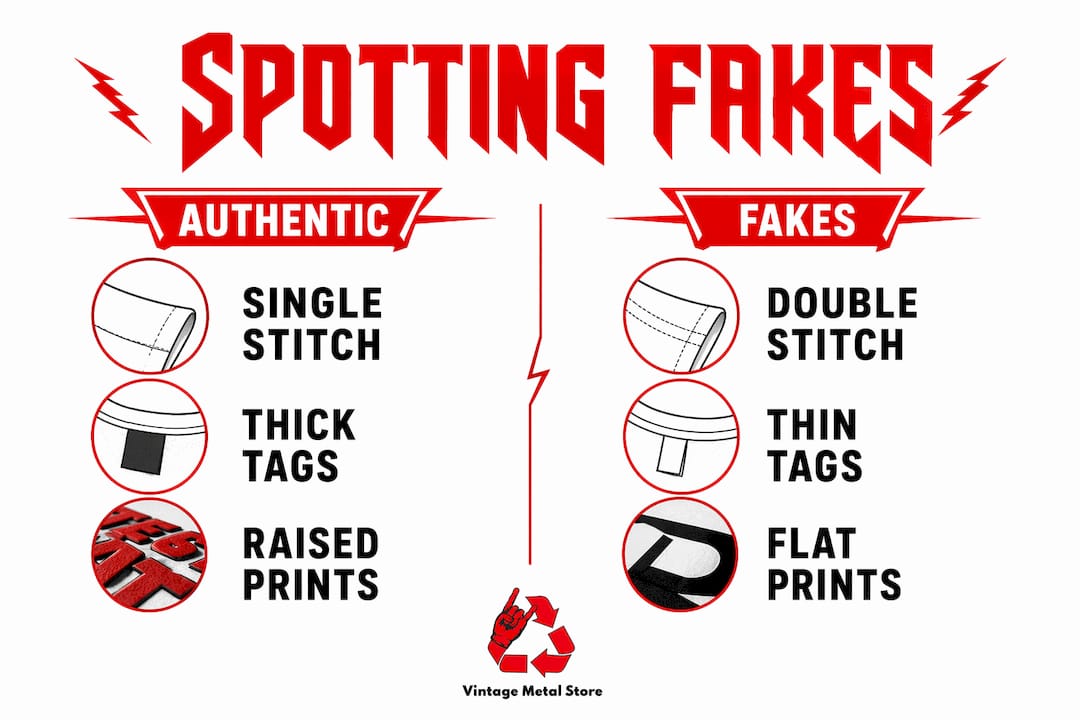
Photo red flags are easy to spot once you know what’s missing. Authentic sellers photograph their own shirt; counterfeit listings often recycle stock images, use watermarked photos lifted from other sites, or show only one angle. Missing close-ups of the neck tag, care label, sleeve hem and print edge are a serious warning sign. Low resolution or obvious cropping around the tag area usually means the seller is hiding something.
Listing text tells its own story. Vague provenance (“bought years ago, not sure where”), mismatched logos in the description, and pressure tactics like “selling tonight only” or “multiple people watching” are all manufactured urgency designed to short-circuit your verification process.
Checklist of photos to request from any seller:
- Neck tag (full frame, high resolution)
- Care/wash label (showing fibre content and stitching)
- Sleeve hem close-up (single or double stitch?)
- Print edge and corners (ink bleed, cracking, registration)
- Full front and back laid flat in natural light
Pro Tip: Run listing photos through Google Lens or TinEye to check if they’ve been reused across multiple listings or lifted from another seller. Tools like C2PA-compatible viewers and Gemini can also flag whether an image carries AI-generation metadata, though absence of a watermark doesn’t prove authenticity on its own.
Are the tags and stitching era-accurate?
Tags and seams are often the fastest proof of age, and the detail counterfeiters most consistently get wrong.
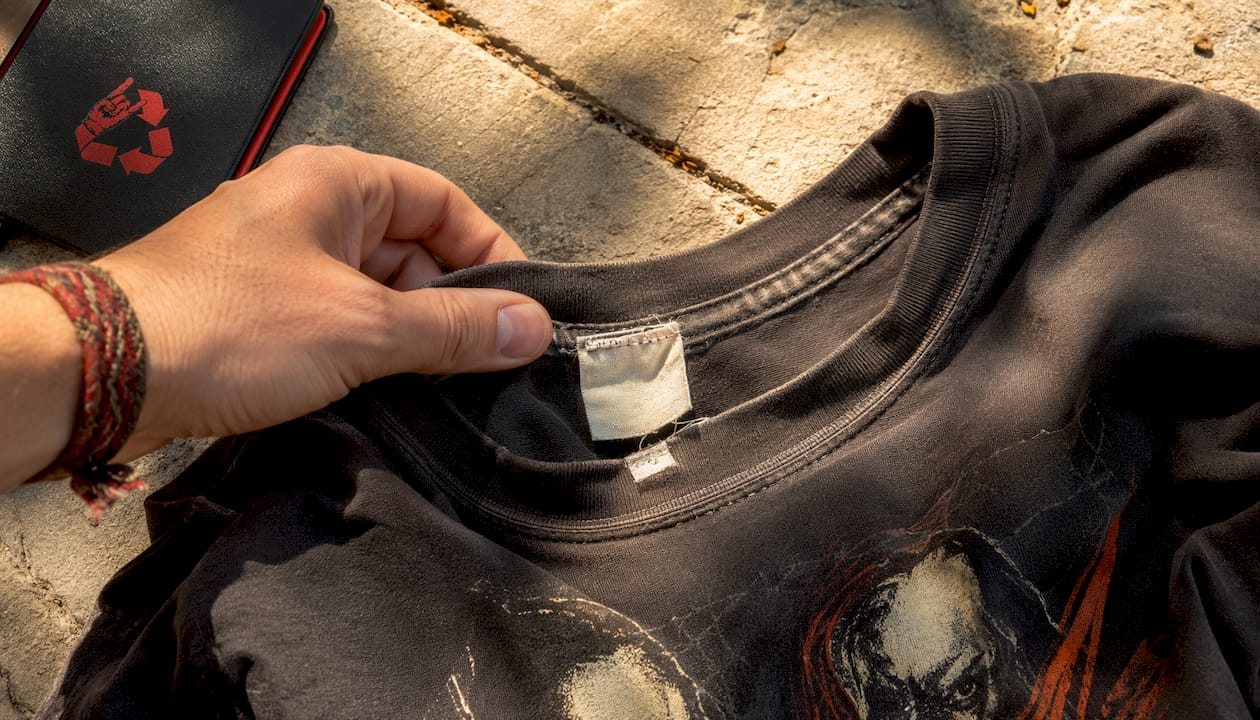
On genuine 1990s tour shirts, neck tags typically show thicker font weight, era-specific trademark symbols (the ® placement and style changed across decades), and manufacturing codes that correspond to the actual print run. A tag that looks unnaturally pristine on a shirt claiming 30 years of age is a red flag. Counterfeiters mimic trust signals like certification marks and logos, so the presence of a tag alone means nothing. Cross-reference the specific font, ink wear and serial codes against known authentic examples.
Care labels shifted in language and placement across decades. Fibre content wording, washing instruction icons and label stitching technique all changed. A shirt claiming to be from 1992 with a care label using post-2000 icon standards is almost certainly a reproduction.
Single-stitch hems on sleeves and the shirt bottom are one of the clearest markers of authentic 1990s production. Modern mass-produced fakes almost always use double-stitch because that’s what contemporary machines run by default. Ask for a close-up of the sleeve hem and the shirt’s bottom hem before you commit.
Pro Tip: Ask the seller to photograph the shirt laid flat next to a dated item, such as a newspaper or a phone home screen showing the date. It’s a simple provenance anchor that honest sellers are happy to provide.
How authentic screen-prints age versus what fakes feel like
Feel and ageing are often more reliable than visual likeness alone. You can fake a design; you can’t easily fake three decades of wear.
Original tour shirts used plastisol inks that sit slightly raised above the fabric surface. After decades of washing and wearing, that ink develops a characteristic crackle or “crazing” texture, and the colour fades unevenly in a way that’s genuinely hard to replicate. Modern direct-to-garment (DTG) prints and heat transfers feel flat and smooth, with uniform colour saturation that looks almost too clean on a shirt claiming to be vintage.
Edge details matter too. Authentic small-run screen prints from the 1990s often show slight misregistration, where the colour layers don’t align with machine-perfect precision. That’s a feature, not a flaw. Perfectly aligned, sharp-edged prints on a “vintage” shirt can indicate a newer mass-produced transfer.
Quick print checks to request:
- Side-angle photo showing print height above fabric
- Close-up of print edges for ink bleed or misregistration
- Photo of any cracking or crazing pattern in the ink
- Comparison shot next to a verified authentic example of the same design
Pro Tip: Ask the seller for a side-by-side photo of their shirt next to a verified authentic example of the same design and era. Serious collectors and reputable sellers can usually provide this, or point you to a reference. David’s guides at Vintage Metal Store are a useful benchmark for identifying bootleg metal tees.
How to verify sellers and use Australian marketplace protections
Verify seller provenance and platform protections before you pay. This step protects your money when everything else looks borderline.
Check the seller’s history: consistent listings over time, prior positive transactions, and a willingness to provide original photos and receipts are all good signs. A seller who has only recently joined a platform, has few reviews, or becomes evasive when asked for provenance documentation is a warning sign worth heeding.
Provenance evidence worth requesting includes the original purchase receipt, a concert ticket stub from the relevant tour, a photo of the seller at the gig wearing the shirt, or original packaging and hangtags. Not every seller will have all of these, but genuine sellers usually have at least one.
Many resale platforms give buyers a short post-delivery window, often 48 hours, to document and report authenticity concerns. Acting within that window is critical for refunds or disputes. Photograph the shirt the moment it arrives, before you wash or wear it.
Extremely low prices relative to market averages are a primary red flag for counterfeit goods. A listing priced well below documented recent sales for the same design and condition is not a bargain. It’s a signal to dig deeper.
Pro Tip: Keep all platform messages and transaction records in one folder. Screenshots of the listing, your messages, and the seller’s responses are your evidence trail if you need to lodge a dispute or request a refund.
How to value a vintage metal tee in Australia
Compare multiple recent sale prices for the same design and condition before you form a view on whether a listing is fairly priced.
Sources for price comparison include completed auction results, finalised marketplace sales (not just asking prices), specialised collector forums, and Vintage Metal Store’s own price history on similar items. Adjust for condition, size and regional demand. Australian buyers sometimes pay a premium for local stock due to import costs, but that premium has limits.
Quick price sanity checklist:
- What did the same design sell for in the last three completed sales?
- Is the condition comparable (fading, cracking, staining)?
- Is the size common or rare for this design?
- Is the asking price more than 30–40% below the average recent sale?
If the answer to that last question is yes, treat it as a red flag and request full provenance before proceeding. Buying from authorised, reputable dealers who provide original photography and transparent sourcing is the best defence against sophisticated fakes. For deeper sourcing guidance, the Vintage Metal Store collector’s guide to buying second-hand metal shirts covers Australian marketplace specifics in detail.
Step-by-step pre-purchase verification checklist
Follow these steps before you pay, every single time.
1. Screen the listing photos
- Check for stock images, watermarks, missing angles
- Note whether tag and hem close-ups are present
2. Request tagged close-ups
- Neck tag, care label, sleeve hem, print edge
- Ask for a flat lay in natural light
3. Run reverse image and provenance checks
- Google Lens, TinEye for reused photos
- Check image metadata for AI-generation flags
4. Compare with known authentic examples
- Use collector forums, archive sites, and Vintage Metal Store guides
- Reference the shirts that defined the heavy metal decade for era benchmarks
5. Request proof of purchase or provenance
- Receipt, concert stub, original packaging, or seller-at-gig photo
6. Confirm seller history and return policy
- Check account age, review count, and willingness to accept returns
7. Use platform payment and note dispute windows
- Pay on-platform to preserve buyer protection
- Note the 48-hour post-delivery reporting window
Pro Tip: Save timestamps and message transcripts immediately after each exchange. If you can pay via platform escrow, do it. Off-platform payments remove almost all your recovery options if the shirt turns out to be a fake.
When should you walk away from a listing?
Walk away when provenance is missing and the seller refuses reasonable proof. That combination is the clearest signal in this hobby.
Common scam tactics to recognise:
- Insistence on off-platform payment (bank transfer, crypto, gift cards)
- Fake urgency: “selling in one hour,” “three other buyers waiting”
- Duplicate or generic listings across multiple platforms at identical prices
- AI-generated or stolen photos (check metadata and run image searches)
- Inconsistent story about item origin that changes when you ask follow-up questions
Non-recoverable risks are real. Off-platform payments offer no dispute mechanism. If a seller is anonymous and the transaction is outside a marketplace, recovering funds after a fraud is extremely difficult. Purchasing a reproduction misrepresented as an original is a loss you carry permanently, because reselling it honestly means disclosing what it is.
Replica demand in adjacent collectables markets, including vintage guitar replicas, shows how sophisticated the reproduction market has become across music memorabilia. The same dynamics apply to vintage tour merch.
Pro Tip: If an offer feels urgent and the seller blocks simple verification steps, that urgency is the signal. Legitimate sellers with genuine stock have no reason to rush you.
Where to get authentication help in Australia
Use a layered approach: community verification first, paid authentication for high-value pieces, and trusted sellers as your baseline.
Steps to take when you need expert verification:
- Post clear photos to active Australian metal collector communities and forums
- Contact specialist authenticators for items valued above a threshold where the fee makes sense
- Submit photos, receipts and message history to the platform’s reporting flow if you suspect fraud after delivery
- Reach out to Vintage Metal Store directly; David and the team are available for authentication queries on vintage and ex-tour stock
For high-value pieces, a professional authentication service is worth the cost. For everyday finds, community vetting from experienced collectors who know the era is genuinely useful and usually free.
Buying from reputable dealers with clear provenance and original photos remains the most reliable defence against sophisticated fakes. Authentication services are worth the cost for high-value pieces.
The same principle applies across vintage apparel collecting. Guides like the vintage hockey shirts collector’s guide from PuckFuel show how authentication layering works in other memorabilia verticals, and the core logic transfers directly to metal tees.
Pro Tip: For high-value pieces, invest in professional authentication before paying. For cheaper items, community vetting is usually sufficient and costs nothing but time.
Key takeaways
Spotting a fake vintage metal tee reliably requires checking price, photos, tags, stitching, print texture, seller provenance, and platform protections before every purchase.
| Point | Details |
|---|---|
| Price as a red flag | A listing priced well below documented recent sales is a primary counterfeit signal. |
| Single-stitch hems | Authentic 1990s tees typically have single-stitch sleeve and bottom hems; fakes usually use double-stitch. |
| Print feel and ageing | Original plastisol screen prints feel raised and show cracking; modern DTG transfers feel flat and smooth. |
| 48-hour dispute window | Document and report authenticity concerns within the platform’s post-delivery window to preserve refund rights. |
| Vintage Metal Store | David’s guides and the Vintage Metal Store catalogue are trusted benchmarks for authenticated vintage metal tees in Australia. |
The mistake most collectors make, and why provenance beats everything
The conventional wisdom says “learn to read the tags.” That’s true, but it’s the second thing to do, not the first. The single most common mistake I see is collectors spending ten minutes studying tag fonts while ignoring the fact that the seller has no provenance whatsoever and is pushing for off-platform payment. A perfect tag on a shirt with no history is still a red flag.
Three mistakes come up again and again. First, overvaluing a low price as a sign of a good deal rather than a warning. Second, ignoring stitch detail because it feels too technical, when it’s actually one of the fastest checks you can run. Third, trusting perfect, high-resolution photos without asking who took them and when, which is exactly what a scammer wants you to do.
My core rule is simple: if provenance is missing and the seller won’t provide it, I walk away. No shirt is worth the risk of funding a counterfeit supply chain or losing money on a reproduction. The legacy of this music deserves better than that.
For deeper reading, David’s guides on finding shirts from the metal radio era and the original vs fake band t-shirts collector’s guide cover the finer points. Contact Vintage Metal Store directly for authentication queries.
Authenticated vintage metal tees, sourced and verified
Vintage Metal Store specialises in authenticated vintage heavy metal t-shirts, ex-tour stock, and deadstock concert merch. Every listing goes through provenance checks, detailed original photography, and condition assessment by collectors who know the era. You get the documentation that private sellers rarely provide.
Whether you’re chasing a rare Metallica 1992 tour tee or browsing the full Metallica vintage shirt collection, every piece comes with the provenance detail this guide has outlined. Browse authenticated listings at Vintage Metal Store and buy with confidence.
FAQ
How do I spot a fake vintage metal t-shirt quickly?
Check the hem stitching first: authentic 1990s tees typically have single-stitch hems, while modern fakes use double-stitch. Then feel the print for raised, cracked plastisol ink rather than a flat, smooth transfer.
What is the 48-hour dispute window on resale platforms?
Many resale platforms give buyers approximately 48 hours after delivery to document and report authenticity concerns. Photograph the shirt immediately on arrival and submit your dispute within that window to preserve refund rights.
Are abnormally low prices always a sign of a fake?
Not always, but significantly low prices relative to documented recent sales are a primary red flag. Treat any listing priced well below the market average as a prompt to request full provenance before paying.
Can I use image search tools to detect fake listings?
Yes. Tools like Google Lens and TinEye reveal whether listing photos have been reused across multiple sellers. AI image detection tools can flag generated images, though absence of a watermark does not confirm authenticity on its own.
Where can I get authentication help for vintage metal shirts in Australia?
Post photos to Australian collector communities for community vetting, contact specialist authenticators for high-value pieces, or reach out to Vintage Metal Store directly. David and the team provide authentication guidance on vintage and ex-tour heavy metal stock.
Recommended
- Identifying bootleg metal tees: a collector’s guide – Vintage Metal Store
- Collector’s guide to vintage heavy metal t-shirts: spot, value, collec – Vintage Metal Store
- Collector’s guide to authentic vintage band tees: 5 expert checks – Vintage Metal Store
- Original vs fake band t shirts: the collector’s guide – Vintage Metal Store


