



TL;DR:
- Authenticating vintage metal tees requires analyzing tags, stitching, print aging, construction, and price to differentiate genuine tour shirts from bootlegs. Experts emphasize cross-referencing details and handling physical shirts to avoid false positives from photos. Genuine tour stock shirts are rare, valuable collectibles, while bootlegs are often produced without authorization and can be identified through these key factors.
A bootleg metal tee is defined as an unlicensed or counterfeit shirt produced without authorisation from the band or their official merchandise partner. Identifying bootleg metal tees is the single most important skill a collector can develop, because the difference between a genuine 1980s Metallica tour shirt and a clever reproduction can be hundreds of dollars. Authentic vintage shirts carry cultural weight that no factory copy can replicate. This guide covers the six key authenticators: tag brands, stitching, print quality, pricing, provenance, and garment construction. Master these, and you will never pay collector prices for a bootleg again.
1. identifying bootleg metal tees through tag brands
The tag inside a vintage metal tee is your first and most reliable clue. Authentic vintage metal tees use tag brands like Screen Stars, Spring Ford, Brockum, Hanes Beefy-T, and Fruit of the Loom, each corresponding to specific production periods. Brockum, for instance, was the official licensed merchandise distributor for major tours throughout the late 1980s and early 1990s. Seeing a Brockum tag on a claimed 1989 Motörhead shirt is a strong positive signal.
Key tag brands by era:
- 1970s: Screen Stars (single colour print, thin cotton)
- 1980s: Hanes Beefy-T, Fruit of the Loom, Brockum (licensed tour merch)
- Early 1990s: Spring Ford, Screen Stars Best, Delta Pro Weight
- Mid-1990s onwards: Gildan, Anvil (common in reproductions)
Tag fading on genuine shirts results from repeated washing over decades, producing a soft, integrated look where the ink has bled slightly into the fabric. Artificial distressing on fakes looks uniform and mechanical. Real fading is uneven, often heavier on the edges of the lettering.
Pro Tip: Cross-reference the tag you find against visual archives on sites like The Vintage Fashion Guild or dedicated collector forums. A Screen Stars tag with the wrong logo variant for the claimed year is an immediate red flag.
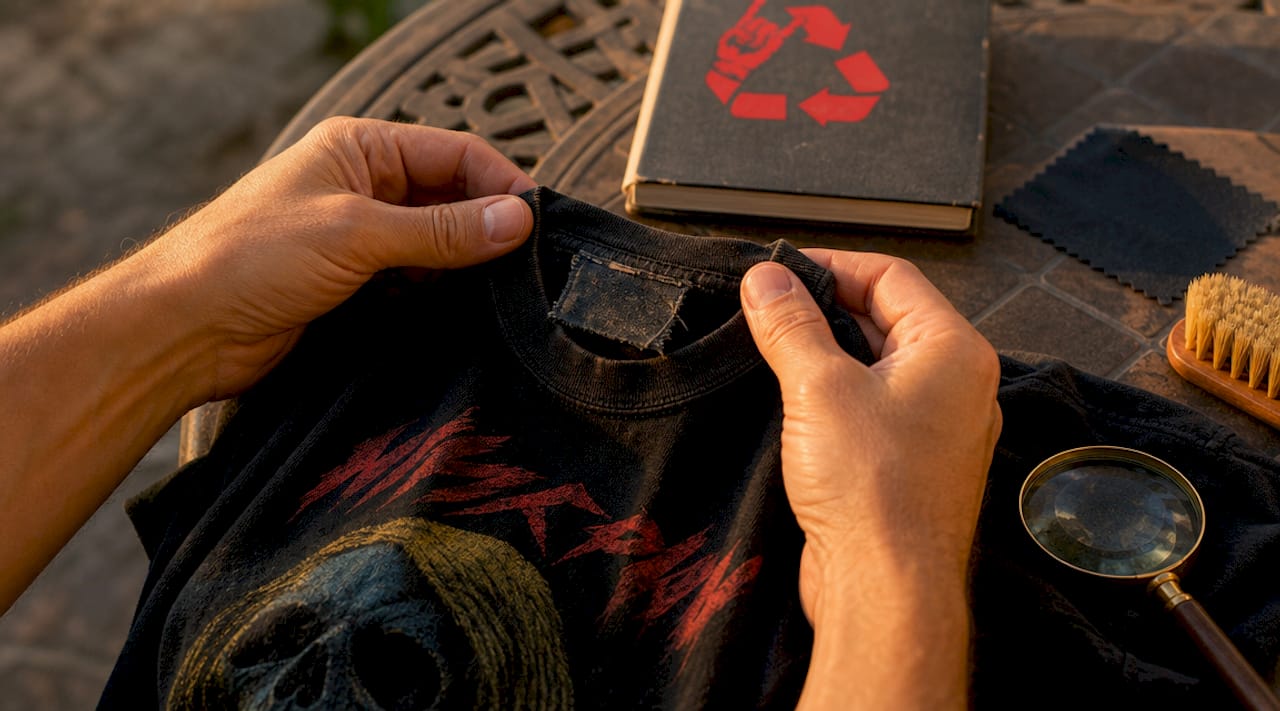
2. how stitching styles reveal fake vintage shirts
Stitching is one of the most overlooked authentication tools, and one of the hardest to fake convincingly. Single-stitch hems on sleeves and bottom hems are the standard for shirts produced before the mid-1990s. Double-stitching became the industry norm after that point. A shirt claiming to be from 1987 with double-stitched hems is almost certainly a reproduction.
What to examine closely:
- Sleeve hems: Single row of stitching on authentic pre-1995 shirts
- Bottom hem: Single stitch, often slightly uneven due to older machinery
- Collar ribbing: Tight, narrow ribbing on 1980s shirts; wider and softer on modern reproductions
- Side seams: Older shirts often have no side seam at all (tubular construction); side seams appear more frequently from the mid-1990s onward
The rarity of genuine single-stitch construction in modern manufacturing is exactly why bootleggers struggle to replicate it convincingly. Most modern blank shirts used for bootleg printing are double-stitched Gildan or Fruit of the Loom stock. That single detail alone can save you from a bad purchase.
Pro Tip: Run your finger along the bottom hem. On a genuine vintage shirt, the single stitch has a subtle ridge and slight irregularity. Machine-perfect stitching on a claimed vintage shirt is a warning sign.
3. what print quality tells you about authenticity
Print examination is where forensic collecting gets genuinely interesting. Authentic vintage prints show natural cracking from years of wear and washing. The cracking follows the natural stress lines of the fabric, appearing at fold points and across areas of heavy flexion. This kind of ageing cannot be perfectly replicated in a factory.
“A print that looks too good on a shirt claiming to be 35 years old is the most reliable red flag in the entire authentication process.”
Warning signs in bootleg prints:
- Digitally smooth graphics: No cracking, no ink bleed, no fading at edges
- Wrong fonts: Modern computer fonts like Arial or Calibri on vintage-era copyright text are an immediate disqualifier
- Incorrect copyright format: Authentic 1980s shirts use specific copyright styles; the year, band name, and licensing body follow a consistent format for the era
- Pre-distressed factory ageing: Uniform cracking applied artificially looks consistent across the entire print; real ageing is concentrated at stress points
- Colour saturation: Genuine vintage prints have muted, slightly faded colour. Bootlegs often use vivid, high-saturation inks that look fresh
The copyright text on the back or sleeve of a genuine shirt is a goldmine of information. Authentic shirts from the 1980s use typefaces consistent with pre-digital print production. Seeing a clean sans-serif font that did not exist until the mid-1990s on a claimed 1983 Iron Maiden shirt tells you everything you need to know.
4. pricing and provenance as authentication tools
Price is a blunt but powerful authenticator. Authentic 1980s and early 1990s tour shirts for major bands command prices in the hundreds of dollars. A listing at $25–$30 for a claimed original Slayer or Black Sabbath tour shirt from that era is not a bargain. It is a bootleg. The market for genuine vintage metal merch is well-established, and sellers who know what they have price accordingly.
Provenance adds a layer of confidence that no physical examination alone can provide. Original purchase receipts, concert tickets, or documented seller history significantly increase confidence in a shirt’s authenticity. A shirt sold by someone who attended the actual tour, with a ticket stub to prove it, carries far more weight than an anonymous listing.
Practical provenance checks:
- Ask the seller directly for documentation or backstory
- Cross-reference tour dates and venues printed on the shirt against historical setlist databases like Setlist.fm
- Check the seller’s feedback history and previous listings for consistency
- Compare the listing against sold prices for similar shirts on platforms like eBay and Discogs
Mismatched tour dates are a classic bootleg tell. A shirt listing a venue or city that was not on the actual tour itinerary was never official tour stock. This kind of error appears regularly in bootleg merchandise because the producers work from incomplete or inaccurate information.
5. garment construction beyond tags and stitching
Advanced collectors go beyond tags and stitching to examine the physical construction of the garment itself. Authentic vintage metal tees use tubular collar construction with no side seams, a feature that distinguishes them from the vast majority of modern blank shirts used in bootleg production. The collar ribbing on genuine 1980s shirts is narrow and dense, typically around 2–3 centimetres wide.
| Construction Feature | Authentic Vintage (Pre-1995) | Modern Reproduction |
|---|---|---|
| Collar construction | Tubular, narrow ribbing | Wider, softer ribbing |
| Side seams | Absent (tubular body) | Present on most blanks |
| Fabric weight | Heavier cotton, 180–220 gsm | Lighter, often blended |
| Fabric texture | Slightly coarser, natural cotton | Smoother, synthetic feel |
| Hem stitching | Single stitch | Double stitch |
Fabric weight and texture are tactile clues that experienced collectors develop a feel for over time. Genuine 1970s and 1980s metal tees use heavier, all-cotton fabric with a slightly coarser hand feel. Modern reproductions frequently use lighter cotton-polyester blends that feel noticeably smoother and more uniform. This difference is immediately apparent when you hold both side by side.
6. comparing bootleg vs tour stock: the full picture
Understanding the differences in bootleg shirts versus genuine tour stock requires looking at all authentication factors together, not in isolation. A shirt might pass the tag test but fail on stitching. Another might have convincing print ageing but wrong fabric weight. Authentic tour stock, sometimes called ex-tour or dead stock, has a consistent profile across every single one of these markers.
Tour stock shirts were produced under contract for specific tours, often by licensed manufacturers like Brockum or Winterland. They were sold at venues, sometimes in limited quantities, and never restocked once the tour ended. That scarcity is precisely what drives collector value. A genuine tour stock shirt from a major 1980s metal tour is a piece of music history. Bootlegs, by contrast, were produced opportunistically, often at the venue gates by unlicensed vendors, or manufactured years later to meet collector demand.
The most reliable authentication method is comparison. Hold a known authentic shirt next to the one you are evaluating. The differences in fabric, print, stitching, and construction become obvious when you have a genuine reference point in hand.
Key takeaways
Authenticating vintage metal tees requires examining tag brands, stitching style, print quality, garment construction, and price together, because no single factor alone is conclusive.
| Point | Details |
|---|---|
| Tag brands confirm era | Screen Stars, Brockum, and Hanes Beefy-T each correspond to specific production decades. |
| Single-stitch is pre-1995 | Any shirt with double-stitched hems claiming to be pre-1995 is almost certainly a reproduction. |
| Print ageing must be natural | Real cracking follows fabric stress lines; factory-distressed prints look uniform across the graphic. |
| Low prices signal bootlegs | Authentic 1980s tour shirts sell for hundreds of dollars; a $25 listing is a red flag. |
| Provenance adds confidence | Concert tickets, receipts, and verified seller history significantly strengthen authenticity claims. |
What 20 years of handling vintage metal shirts has taught me
The biggest mistake I see new collectors make is fixating on one authenticator and ignoring the rest. Someone will spot a Screen Stars tag and assume the shirt is genuine, without ever checking the stitching or the print. Authentication is a system, not a single test.
The second most common mistake is trusting photographs alone. A skilled bootlegger can photograph a shirt to hide every flaw. The fabric weight, the feel of the stitching, the texture of the print under your fingertip — none of that comes through in a listing photo. Whenever possible, buy from sellers who offer returns, or from reputable dealers who have physically handled the shirt.
The detail most collectors overlook is the copyright text. I have seen shirts with otherwise convincing construction fall apart completely because the copyright line uses a font that did not exist until 2003. That one detail, easy to miss at a glance, is often the clearest proof of a reproduction.
My advice for anyone building a collection: start by studying known authentic examples. Visit Vintage Metal Store, handle genuine tour stock, and build a physical reference library in your hands. The knowledge compounds quickly once you have real shirts to compare against.
— David
Find authentic vintage metal shirts at vintage metal store
If you are serious about collecting the real thing, Vintage Metal Store is where Australian metal fans find genuine tour stock and dead stock shirts from the bands that defined heavy metal history.
The collection includes authenticated pieces from Metallica, Cannibal Corpse, Archspire, and more, each sourced and verified for authenticity. Browse the rare vintage concert shirts collection for genuine tour stock from major metal tours, or go straight to the Metallica vintage shirts collection for some of the most sought-after pieces in Australian metal collecting. Every shirt at Vintage Metal Store is the real deal. Wear the legacy.
FAQ
What makes a metal tee a bootleg?
A bootleg metal tee is any shirt produced without authorisation from the band or their licensed merchandise partner. Bootlegs include both vintage unauthorised shirts sold outside venues and modern reproductions made to look old.
How do i spot fake metal tees by the tag alone?
Check the tag brand against known authentic manufacturers for the claimed era. Gildan or Anvil tags on a shirt claiming to be from the 1980s are immediate red flags, as these brands were not standard tour merchandise suppliers of that period.
Are bootleg vintage shirts worth anything to collectors?
Vintage bootlegs from the 1980s sold outside concert venues have their own collector following and cultural value. However, they are worth significantly less than official licensed tour stock, and sellers should always disclose bootleg status clearly.
What is the difference between a bootleg and a reissue?
A bootleg is produced without any authorisation. A reissue or reproduction is sometimes produced officially by the band or their estate but sold as a new product. Reissues are legitimate but should never be sold as original vintage shirts.
How can i verify tour dates printed on a vintage shirt?
Cross-reference the tour dates and venues printed on the shirt against historical records on Setlist.fm or official band discographies. Any venue or date that does not appear in documented tour history is a strong indicator of a bootleg or reproduction.
Recommended
- Collector’s guide to vintage heavy metal t-shirts: spot, value, collec – Vintage Metal Store
- 7 Iconic Types of Heavy Metal T Shirts for Collectors – Vintage Metal Store
- Types of second hand metal tees: collector’s guide – Vintage Metal Store
- What is a bootleg band shirt? A collector’s guide – Vintage Metal Store


