



A vintage item is an original object made in the past. A reprint is a modern copy of an older design. That single distinction separates a piece of living metal history from a factory run that left the warehouse last Tuesday.
When you’re scrolling through listings or holding a tee at a market stall, these are the fastest cues to check first:
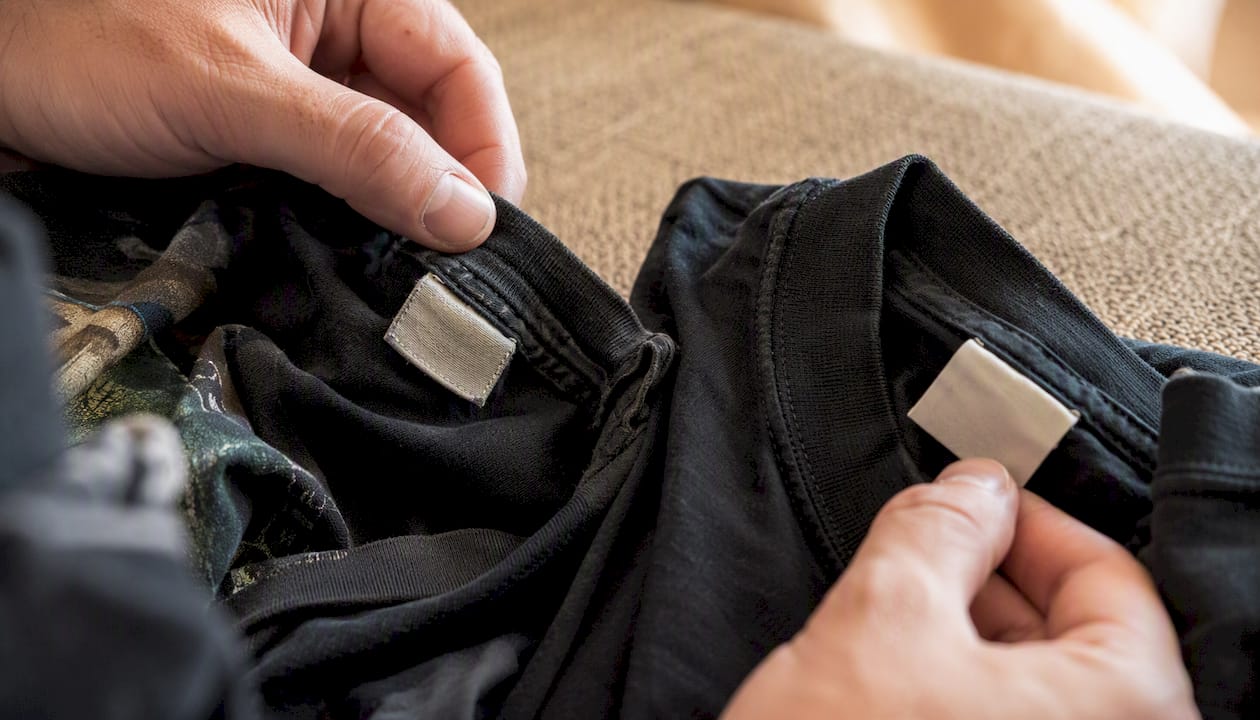
- Tags and labels: Original vintage tees carry woven or printed labels from the era. Modern reprints almost always have clean, bright, printed tags with current sizing conventions and care symbols.
- Stitching: Pre-1990s tees typically use single-stitch hems at the sleeve and body. Double-stitch hems are a strong indicator of a post-1990s manufacture date.
- Print crispness: Genuine vintage prints show ink cracking, softening, and dye penetration into the fabric weave. Reprints look sharp, bright, and almost plasticky by comparison.
- Fabric ageing: Real age shows as yellowing at the collar, thinning along stress points, and a soft, broken-in hand. Artificially aged reprints feel different under your fingers.
Pro Tip: When you only have listing photos, zoom into the collar tag and the hem stitching first. Those two details alone will rule out most reprints before you spend another second on the listing.
Key takeaways
The single most reliable way to separate a vintage original from a reprint is to check the collar tag and hem stitching first: those two details alone eliminate most fakes before you look at anything else.
| Point | Details |
|---|---|
| Check the tag first | Woven labels, union tags, and absent care panels point to pre-1990s manufacture. |
| Single-stitch hems date the garment | Pre-1994 tees typically use single-stitch hems; double-stitch is a modern indicator. |
| Authentic ageing is organic | Real vintage shows UV-consistent fading and irregular ink cracking, not uniform distressing. |
| Provenance adds value | Original receipts, event photos, and owner history increase both confidence and resale price. |
| Reprints are legitimate when labelled honestly | Authorised reissues serve collectors who want the design; the problem is deceptive marketing. |
| Vintage Metal Store | Lists authenticated originals, deadstock, and clearly labelled reissues for Australian collectors. |
Table of Contents
- What do ‘vintage’, ‘reprint’, and ‘reproduction’ actually mean?
- Why the distinction matters to collectors and buyers
- How to identify vintage apparel and prints: a photo-friendly checklist
- Provenance, paperwork and when to seek third-party verification
- When are reprints legitimate, and what makes a copy deceptive?
- Practical tips for buying or selling vintage and reprints
- How condition, rarity and authenticity affect grading and market value
- How we authenticate vintage heavy-metal tees at Vintage Metal Store
- The case for wearing your originals (within reason)
- Authenticated vintage heavy-metal tees for Australian collectors
- Sources
- FAQ
What do ‘vintage’, ‘reprint’, and ‘reproduction’ actually mean?
Collectors use these words with more precision than most buyers realise, and the difference between vintage and reprint starts with getting the terminology right.
Vintage refers to an original object produced in a past era, still in existence today. A garment is typically considered vintage if it is at least 20 years old, a threshold widely used by resale marketplaces and collector communities. A 1994 Pantera tour tee purchased at a show and still in your wardrobe is vintage. The 20-year rule is a practical floor, not a hard legal standard. Some collectors apply stricter criteria for high-value acquisitions, particularly for paper goods and posters.
Antique sits at a different threshold entirely: 100 or more years old. You won’t encounter many antique band tees, but the distinction matters when you’re dealing with concert programmes, promotional posters, or early rock-and-roll ephemera from the 1920s onward.
Reprint carries a nuanced meaning depending on the medium. In traditional printmaking, a reprint can mean a later impression pulled from the original blocks or plates. In Japanese ukiyo-e printmaking, ‘reprint’ (atozuri) refers to later impressions made from original blocks and can be authentic historical prints, while ‘reproduction’ means copies made from entirely new blocks or different processes. In apparel, the term is used more loosely to mean any modern run of a design that originally appeared on an older garment.
Reproduction is a modern copy made using new materials and processes, regardless of how closely it mimics the original. A reproduction band tee might use a scanned version of the original artwork, printed onto new fabric with modern inks.
Reissue typically implies authorisation. A band or label that officially re-releases a classic tour design is issuing a reissue. The design is the same; the garment is new. Bootleg means an unauthorised copy, usually produced without the band or rights-holder’s knowledge or consent. Bootlegs can be vintage themselves if they were made decades ago, which adds another layer of complexity for collectors. For a deeper look at spotting unauthorised copies, the guide to identifying bootleg metal tees covers the key tells.
The Vintage Fashion Guild Label Resource is the standard starting point for dating apparel labels and is widely used by collectors to identify garments by decade.
Why the distinction matters to collectors and buyers
The gap between a vintage original and a reprint is not just semantic. It has real consequences for your wallet, your collection, and your peace of mind.
Market value is the most obvious factor. An original 1992 Metallica tour tee in good condition commands a price that a modern reprint simply cannot approach. Authenticity is the foundation of collectibility, and collectors pay a premium for it. The same principle applies across collecting categories: originals of London Transport posters are significantly more expensive than reproductions, which typically cost a small fraction of original prices. The ratio is comparable in the band tee market.
Beyond price, collectors care about:
- Rarity: An original tour shirt from a specific leg of a 1980s or 1990s tour exists in a finite number. A reprint can be produced indefinitely.
- Provenance and story: A vintage tee carries the history of the person who wore it, the show it came from, and the era it represents. That story is part of the object’s value.
- Wear versus display: Many collectors buy reprints specifically for daily wear, preserving originals for display or long-term storage. Knowing what you have determines how you treat it. The band t-shirt preservation tips guide covers practical steps for protecting originals.
- Investment: Collectors who buy with resale in mind need to know exactly what they hold. A reprint sold as vintage is fraud, not a bargain.
The core risk is deceptive marketing. Reprints and reproductions are entirely legitimate products when sold honestly. The problem arises when a seller presents a modern copy as an original, either through vague language, misleading photos, or outright false claims.
How to identify vintage apparel and prints: a photo-friendly checklist
Work through these checks in order. Each one narrows the field further.
-
Check the neck tag first. The label is the single most reliable dating tool for apparel. Label and care-panel evolution, including the absence of care labels and union tags, is a reliable clue for dating garments and narrowing a piece’s decade. Pre-1971 US garments carry no care label at all. Union tags (ILGWU, ACWA, UNITE) were phased out through the 1990s. Woven labels with country-of-origin text and no RN (Registered Number) or care symbols point to earlier decades. A clean, printed tag with a QR code or modern sizing (S/M/L/XL in a contemporary font) is a reprint flag.
-
Examine the stitching. Single-stitch hems at the sleeve opening and shirt body are characteristic of pre-1994 manufacture. Most vintage band tees from the 1980s and early 1990s are single-stitched. Double-stitch hems became standard after the mid-1990s as manufacturing shifted to lower-cost production. Check the collar rib construction too: older tees often show a different collar attachment method than modern garments.
-
Feel and assess the fabric. Vintage tees were typically made from heavier, single-jersey cotton, often 50/50 cotton-polyester blends in the 1980s. Genuine age produces a specific hand: soft, slightly thin at stress points, with a texture that no new fabric replicates. Look for yellowing at the collar and underarm areas, which is a natural result of body oils and oxidation over decades. Reprints on new fabric feel noticeably different, even through photos where the drape and weight read differently.
-
Inspect the print. Vintage screen-printed tees used plastisol inks that, over time, crack in small, irregular patterns and sink into the fabric weave. The ink edges on a genuine vintage print are slightly soft. Original vintage posters and prints show natural ageing markers including yellowing, minor folding, and printing misregistration, whereas modern reproductions usually look too crisp and bright. The same principle applies to tees: a print that looks factory-fresh on a supposedly 30-year-old shirt is a red flag. Discharge printing, common in some 1990s tees, leaves a softer, more faded look even when new, so context matters.
-
Look at hardware and components. For non-textile items or accessories, check zip stamps (YKK was dominant from the 1970s onward, but the font and stamp style changed by decade), button markings, and rivet details. On denim or workwear, rivet composition and back-stamp style are reliable dating tools. On paper goods, check the printing registration, paper weight, and any embossed or foil elements.
-
Assess fading patterns. Authentic vintage shows UV-consistent fading: the areas most exposed to light fade more than protected areas, and the pattern is organic and uneven. Artificially aged reprints often show uniform fading or distressing that doesn’t follow natural wear logic.
-
When working from photos only, request close-up shots of the collar tag (front and back), the hem stitching, the print surface at an angle (to show ink texture), and the inside of the collar for any additional labels. A seller who won’t provide these shots is a seller worth walking away from.
Pro Tip: Artificial ageing is a known tactic in the counterfeit market. New items are chemically washed, distressed, or have tags replaced to mimic natural wear. Authentic wear patterns are organic: the thinning, cracking, and fading follow the logic of how a garment was actually used. Artificial distressing tends to be uniform or concentrated in obvious places. If the ageing looks too deliberate, trust that instinct.
For a thorough walkthrough specific to band tees, the collector’s guide to authentic vintage band tees covers five expert checks in detail.
Provenance, paperwork and when to seek third-party verification
Provenance is the documented history of an object. For collectors, it’s the difference between a story and a fact.
-
Gather what provenance exists. The most useful documents are the original purchase receipt, photographs of the item being worn or displayed at the time (with a date), a written owner history, and any certificate of authenticity. For tour shirts, a photo of the seller at the actual show wearing the tee is compelling evidence. Not every vintage item comes with paperwork, and absence of documentation doesn’t automatically mean a fake, but presence of it meaningfully increases confidence.
-
Ask the right questions of the seller. Request the full label history: where was it purchased, who owned it, how was it stored? Ask for photos of the tag front and back, the hem stitching, the print surface, and any additional labels inside the collar. A seller with a genuine vintage item will usually have answers and be willing to provide detailed photos. Vague responses (“I just know it’s old”) or reluctance to photograph the tag are warning signs.
-
Cross-reference labels against databases. The Vintage Fashion Guild Label Resource lets you compare the label style, font, and construction against documented examples from specific decades. If a label claims a 1985 manufacture date but matches a label style not used until 1998, that’s a concrete discrepancy.
-
Decide when third-party authentication is warranted. For items under a few hundred dollars, the cost of professional authentication may exceed the item’s value. For significant purchases, a specialist authenticator or conservator is worth the investment. Decision rule: if the asking price is high enough that being wrong would genuinely hurt, get it authenticated. Turnaround times and costs vary by specialist, but most reputable authenticators provide a written report you can use for insurance and future resale. For tour-specific provenance checks, the guide to spotting genuine tour shirts outlines the key markers.
When are reprints legitimate, and what makes a copy deceptive?
Not all reprints are problems. The issue is always about transparency, not the object itself.
Legitimate reprints share several characteristics. They are clearly labelled as reproductions or reissues. They often carry limited-edition numbering, publisher or artist attribution, and are produced using quality archival materials. Museum gift shops sell authorised reproductions of historic posters with full disclosure. Bands and labels release official reissues of classic tour designs, sometimes with updated tags that clearly state the reissue date. In the vintage guitar world, reissues are made precisely because the originals are too rare and expensive for most players, and the same logic applies to apparel: a sanctioned reissue serves fans who want the design without the collector price tag.
Deceptive copies are a different matter entirely. The red flags include:
- Copyright dates on the graphic that don’t match the tag’s manufacture date
- Artificially aged fabric or chemically treated prints designed to mimic decades of wear
- Vague listing language: “vintage style,” “retro design,” “looks old,” or “similar to original”
- No provenance available and no willingness to provide detailed photos
- Prices that seem too low for the claimed rarity (a genuine 1988 Slayer tour tee in excellent condition is not a $30 purchase)
- Tags that have been cut out or replaced
| Dimension | Legitimate reprint | Deceptive copy |
|---|---|---|
| Labelling | Clearly states “reissue,” “reproduction,” or reprint date | Omits or obscures manufacture date; mimics vintage tag style |
| Attribution | Publisher, band, or artist credited | No attribution or false attribution |
| Pricing | Priced as a reproduction | Priced at or near vintage original values |
| Provenance | Seller transparent about origin | Provenance unavailable or fabricated |
| Materials | Quality archival or standard modern materials, honestly described | New materials artificially aged or distressed |
| Numbering | Often limited-edition numbered | No numbering or fake numbering |
Practical tips for buying or selling vintage and reprints
Whether you’re bidding online, visiting a market, or consigning a collection, these steps protect you on both sides of the transaction.
When buying, ask for:
- Close-up photos of the collar tag (front and back), the hem stitching, and the print surface at an oblique angle.
- A full-length shot showing overall condition, plus detail shots of any damage, repairs, or fading.
- The seller’s provenance: where was it purchased, who owned it, how was it stored?
- Confirmation of the return policy in writing before you pay.
When selling, document:
- Photograph every label, seam, and print detail before listing. These photos protect you if a buyer disputes the description.
- Digitise any receipts, event programmes, or photos that support provenance. Store copies separately from the physical item.
- Write a condition report: note every flaw, repair, and area of wear honestly. Accurate descriptions build the kind of reputation that brings repeat buyers.
Walk away when you see:
- A price dramatically below market value for a claimed rare original.
- Photos cropped to avoid showing the tag or hem.
- No returns accepted with no explanation.
- Listing language that hedges on authenticity (“believed to be original,” “appears vintage”).
For era-specific sourcing, the guide to finding shirts from the metal radio era covers the 1980s and 1990s market in detail.
How condition, rarity and authenticity affect grading and market value
Grading is how collectors communicate condition in a standardised way. The five-point scale used across most apparel and paper collecting runs from Mint through to Poor.
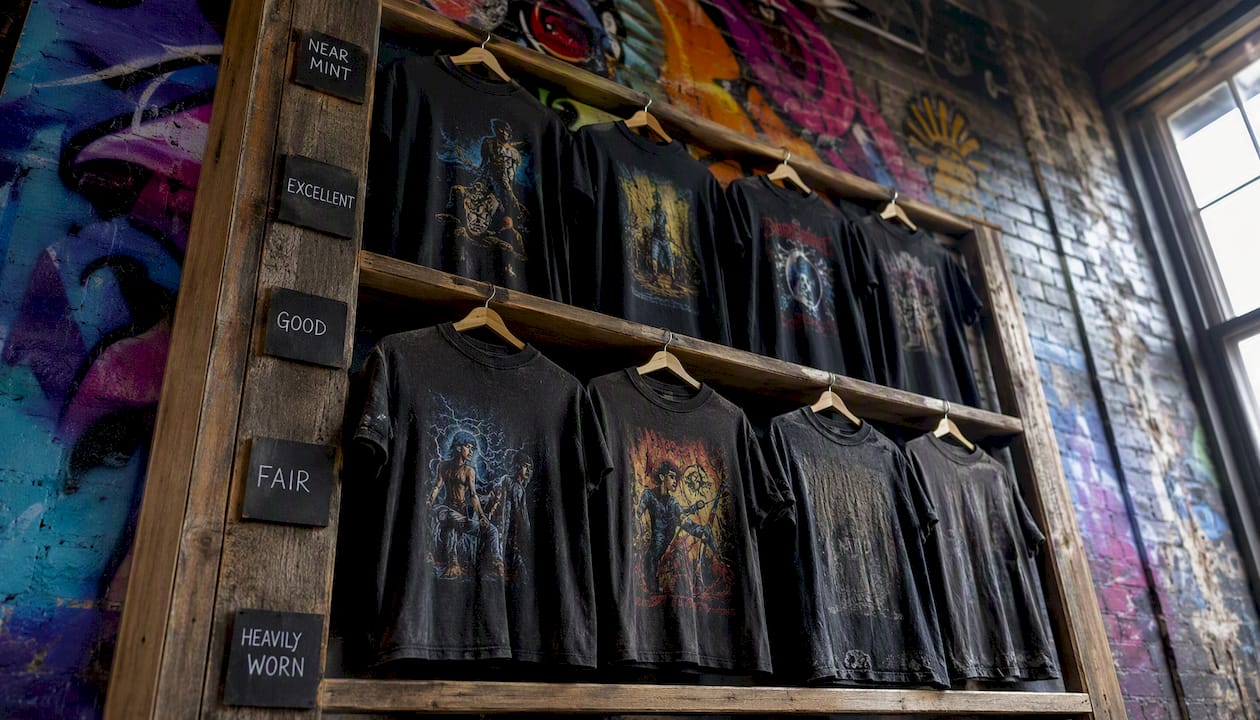
Mint (M): No visible wear, fading, or damage. For vintage apparel, true Mint is rare because most items were worn. Deadstock items that were never sold or worn can qualify.
Very Good (VG): Light wear consistent with age, minor fading, no significant damage. The sweet spot for most serious collectors: authentic age without major condition issues.
Good (G): Moderate wear, visible fading, possible small repairs or minor staining. Still collectible, particularly for rarer pieces where condition is secondary to existence.
Fair (F): Heavy wear, significant fading, repairs, or damage. Value drops substantially. Suitable for display or study, not investment.
Poor (P): Major damage, heavy distressing, or significant loss of print. Primarily of interest for completeness in a collection or as a reference piece.
Authenticity multiplies value at every grade level. A Very Good original commands far more than a Mint reprint. High-quality reproductions, including giclée archival prints, are often far cheaper than unrestored originals, and that gap reflects the market’s valuation of the original artefact, not just the image.
Source: Fab Art — Vintage Art Prints vs. Antique Originals. Currency conversion is approximate.
Minor repairs and conservation work affect value differently depending on the category. Professional conservation framing for paper goods can preserve value and prevent further deterioration. For apparel, repairs are generally disclosed and factored into grading. Undisclosed repairs are a serious problem and a legitimate reason to dispute a purchase. The preserving shirt prints guide covers conservation options for wearable originals.
Originality of components matters too. In vintage guitar collecting, original parts can account for up to 50% of a piece’s value, and the parallel holds for apparel: a vintage tee with its original tag intact is worth more than the same shirt with the tag removed or replaced.
How we authenticate vintage heavy-metal tees at Vintage Metal Store
Every item listed at Vintage Metal Store goes through a documented authentication workflow before it reaches a collector’s hands. Here’s what that looks like in practice:
- Photo check: High-resolution images of the collar tag (front and back), hem stitching, print surface, and full garment are captured and reviewed before listing.
- Label research: Tags are cross-referenced against the Vintage Fashion Guild Label Resource and label-dating guides to confirm the manufacture decade. Union tag presence, RN numbers, care panel format, and country-of-origin text are all checked.
- Fabric hand test: The weight, texture, and ageing pattern of the fabric are assessed in hand. Artificially aged fabric has a different feel to genuinely aged cotton.
- Print examination: Ink cracking pattern, edge softness, dye penetration, and overall print condition are assessed against known examples of the era’s printing methods.
- Provenance intake: Any available provenance, including seller history, purchase receipts, or event photographs, is documented and noted in the listing.
- External referral: Items where in-house assessment is inconclusive, or where the asking price warrants additional certainty, are referred to specialist authenticators before listing.
Every listing clearly states whether an item is an original vintage piece, a deadstock item, or an authorised reissue. That transparency is non-negotiable. For a detailed look at identifying deadstock heavy metal shirts, the step-by-step guide covers the specific markers that separate never-worn originals from reprints.
The case for wearing your originals (within reason)
There’s a debate that runs through every serious collecting community: do you wear the original, or do you preserve it?
My position is that the answer depends entirely on what the item means to you and what you paid for it. A $40 Very Good tee from a mid-tier 1990s tour? Wear it. That’s what it was made for. A $600 Mint deadstock shirt from a band’s final tour before they broke up? That one probably lives in acid-free storage with its own condition report.
The practical compromise most experienced collectors land on is this: buy reprints or authorised reissues for everyday wear, and keep originals for display or long-term preservation. That approach lets you live with the aesthetic you love without degrading an irreplaceable object. It’s also why legitimate reprints have genuine value in the collector ecosystem. They’re not a threat to originals; they’re a different product serving a different purpose.
What I’ve seen go wrong is when collectors buy a reprint thinking it’s an original, wear it for years, and then discover the truth when they try to sell. The financial loss is real, but the frustration of having been misled is worse. That’s why the identification skills in this guide matter: not to make collecting feel like homework, but to make sure you always know exactly what you’re holding.
Authenticated vintage heavy-metal tees for Australian collectors
If you’ve worked through this guide and you’re ready to find the real thing, Vintage Metal Store is where Australian collectors come for authenticated vintage and second-hand heavy metal tees. Every listing carries detailed condition notes, label photos, and honest provenance disclosure. Originals, deadstock, and authorised reissues are clearly labelled so you know exactly what you’re buying.
The shop carries rare ex-tour and deadstock stock from some of metal’s biggest names. The rare Metallica 1992 Don’t Tread on Me USA tour shirt is the kind of authenticated original that collectors in Australia rarely get the chance to own. For collectors browsing by band, the full vintage Metallica shirts collection covers 80s, 90s, and Y2K era tees with detailed listings. Returns are accepted on items that don’t match their description. Browse the full range at Vintage Metal Store and wear the legacy.
Sources
These are the primary resources used in researching this guide and the ones worth bookmarking for ongoing label research and verification.
- Vintage Fashion Guild Label Resource
- How to Identify Vintage Clothing — Shopgoodwill.com
- Vintage Posters or Reproductions: A Collector’s Guide
- Vintage Art Prints vs. Antique Originals: Why Modern Giclée Reproducti
- How to Date Vintage Clothing by Labels and Tags - Sammy D. Vintage
- Original, Reprint, or Reproduction? A Buyer’s Guide to Ukiyo-e Prints | KINTOKI UKIYOE ART STORE
FAQ
What does ‘reprint’ mean in clothing?
In clothing, a reprint is a modern garment produced using an older design, typically a scan or recreation of original artwork printed onto new fabric. It is not the original garment and carries no vintage age or provenance.
Are reprints worth anything?
Reprints have value as wearable items and for fans who want the aesthetic without the collector price. They do not hold the investment or rarity value of an original vintage piece, and the difference between vintage and reprint is reflected directly in market pricing.
What is a vintage print on a shirt?
A vintage print refers to the original screen-printed graphic applied to a garment at the time of manufacture, typically using plastisol inks. Over decades, authentic vintage prints develop characteristic ink cracking, edge softening, and dye penetration into the fabric weave.
How do I tell a vintage tee from a reprint quickly?
Check the collar tag and hem stitching first. A woven label with no care symbols, a union tag, or single-stitch hems strongly suggest a pre-1994 original. A clean printed tag with modern sizing and double-stitch hems points to a reprint or recent manufacture.
Where can Australian collectors buy authenticated vintage metal tees?
Vintage Metal Store lists authenticated original vintage, deadstock, and clearly labelled reissue heavy metal tees for Australian collectors, with detailed condition notes and provenance disclosure on every listing.
Recommended
- Vintage vs. reissue shirts: the collector’s guide – Vintage Metal Store
- Original vs reissue band tees: the collector’s guide – Vintage Metal Store
- What is a reprint shirt: the collector’s guide – Vintage Metal Store
- Collector’s guide to authentic vintage band tees: 5 expert checks – Vintage Metal Store


