



TL;DR:
- Washing vintage band shirts only when necessary and in cold water inside out significantly prolongs their lifespan. Proper drying, storage, and handling combined with professional conservation techniques help prevent print cracking, color loss, and fabric damage. Regular inspections and careful packing are essential for maintaining the condition of a valuable collection.
Wash only when necessary, always in cold water and inside out. That single habit does more for a vintage band tee’s longevity than any specialist product you can buy. After reading this guide, you will know exactly how to wash, dry, store, repair and pack your collection, whether you have three shirts or three hundred.
The six things to do right now:
- Wash only when the shirt is soiled or smells, not on a schedule
- Turn inside out before every wash, cold water only
- Skip the tumble dryer entirely, air-dry flat in the shade
- Fold, never hang, for storage
- Slip acid-free tissue between stacked shirts
- Keep stored pieces away from direct light, heat and damp
| Action | Do this |
|---|---|
| Washing frequency | Only when soiled or odorous |
| Water temperature | Cold only, every time |
| Orientation | Inside out before washing and storing |
| Drying method | Flat air-dry, shaded, away from direct sun |
| Storage position | Folded, not hung |
| Interleaving material | Acid-free tissue between each shirt |
Table of Contents
- 1. How to wash band t-shirts safely without wrecking the print
- 2. Drying and heat handling: what actually damages your shirts
- 3. Protecting printed designs from cracking and colour loss
- 4. Short- and long-term storage that actually works in Australia
- 5. How to pack shirts safely for moving or shipping
- 6. Minor repairs you can do yourself, and when to call a conservator
- 7. Common mistakes that cause irreversible damage
- 8. Why modern wash cycles are particularly hard on vintage shirts
- 9. Your preservation checklist and inspection timeline
- Key takeaways
- The real trade-off most collectors don’t talk about
- Preserve what you love. Shop the legacy.
- FAQ
1. How to wash band t-shirts safely without wrecking the print
The safest rule for band tee maintenance is to wash less, not more. Friction, water and detergent chemistry all degrade cotton fibres and print binders over time, so every unnecessary wash shortens a shirt’s life. Air a shirt after wearing it, let it breathe overnight on a hanger, and only commit it to a wash when there is visible soil or genuine odour.
When washing is unavoidable, hand washing is the gold standard. Fill a clean basin with cold water, add a small amount of pH-neutral, enzyme-free liquid detergent (look for fragrance-free options at any Australian supermarket or pharmacy), submerge the shirt inside out, and gently agitate for two to three minutes. Rinse twice in fresh cold water. That second rinse matters: residual detergent alkalinity accelerates dye hydrolysis in cotton, hitting reds and purples hardest.
If you must use a machine, select the delicate or gentle cycle, the lowest available spin speed, and place the shirt inside a mesh laundry bag. Never use powder detergents, bleach, fabric softener or brightening agents. Powder detergents leave alkaline residue even after rinsing, and fabric softener coats print surfaces with a film that accelerates flaking over time.
Spot treatment for stains: test any solution on an inconspicuous inside seam first. Diluted white vinegar or plain cold water handles most fresh stains without chemical risk. Avoid solvents, acetone and dry-cleaning agents containing perchloroethylene, which can strip plastisol inks.
“Cold hand-wash plus flat air-dry shows negligible fade and no print cracking after 12 or more washes, whereas warm machine washing produces severe damage after just one or two cycles.” How to Launder Vintage Band Tees Safely
Pro Tip: For sweat odour without washing, seal the shirt in a zip-lock bag and freeze it overnight. Freezing kills odour-causing bacteria without any water or chemical contact, making it ideal for archival pieces you want to wear occasionally.
Australian supply list: pH-neutral liquid detergent (Ecostore, Aware or similar), mesh laundry bags (Kmart, Woolworths or Bunnings), acid-free tissue (Eckersley’s Art & Craft, Officeworks), archival boxes (Gaylord Archival or local art supply stores).
2. Drying and heat handling: what actually damages your shirts
Heat is the single biggest accelerant of print failure. Plastisol inks, which coat the surface of most vintage band tees rather than soaking into the fibre, become brittle when repeatedly exposed to high temperatures. A tumble dryer running at standard heat can initiate cracking in a plastisol print within a handful of cycles. The damage is cumulative and irreversible.
Air-dry flat on a clean towel or a low-angled drying rack, always in the shade. Direct sunlight bleaches dyes and degrades cotton fibres at the same time. Do not hang a wet shirt by its shoulders: wet cotton is heavy, and gravity pulls the collar and shoulder seams out of shape permanently.
Avoid the tumble dryer entirely for vintage pieces. Even a “low heat” setting generates enough warmth to accelerate plastisol embrittlement, and the tumbling action adds mechanical stress on top of the thermal damage.
To speed drying without heat, roll the shirt loosely in a clean absorbent towel and press gently to wick moisture, then lay it flat. A fan directed at the drying area (not at the shirt directly) moves air without heat.
Safe ironing rules when you genuinely need to press a shirt:
- Set the iron to its lowest cotton setting
- Place a sheet of baking parchment or a clean cotton cloth between the iron and the fabric
- Never iron directly over a printed area
- Move the iron constantly, never rest it in one spot
- Iron the reverse (inside) of the shirt wherever possible
3. Protecting printed designs from cracking and colour loss
Understanding how vintage inks fail helps you protect them. Plastisol, the thick, opaque ink used on most 1980s and 1990s metal tees, sits on top of the fabric rather than bonding into it. It cracks when the binder becomes brittle from heat, repeated flexing or abrasion. Water-based and discharge inks penetrate the fibre more deeply, so they fade rather than crack, but they are especially vulnerable to UV exposure and alkaline detergents. Vintage silkscreen prints often use multiple ink layers, and each layer ages at a slightly different rate.
For daily handling, turn shirts inside out for both washing and storage. When stacking shirts, place a sheet of acid-free tissue between each one to prevent prints from sticking together, particularly in warm or humid conditions. Prints can bond to adjacent fabric under pressure and peel away when separated.
“Avoid direct ironing over prints, place acid-free tissue between layers, and consider framing for display instead of regular wear.” Preserving shirt prints guide for vintage collectors
Pro Tip: If a plastisol print is beginning to lift at the edges, do not attempt to peel it further or apply heat to re-bond it yourself. Lay the shirt flat, cover the area loosely with acid-free tissue, and consult a textile conservator before doing anything else. Amateur heat-pressing often causes more separation.
If a print is actively flaking, stop washing the shirt entirely until you have a conservation plan. Document the current state with photographs before any intervention. For high-value pieces, the print preservation guide at Vintage Metal Store covers specific stabilisation techniques in detail.
4. Short- and long-term storage that actually works in Australia
Australia’s climate adds a layer of complexity to band shirt storage advice. Coastal humidity, hot summers and the temperature swings common in older homes create conditions that accelerate yellowing, mould growth and insect damage. The goal is a stable, cool, low-humidity environment, ideally between 15°C and 20°C with relative humidity around 45–55%.
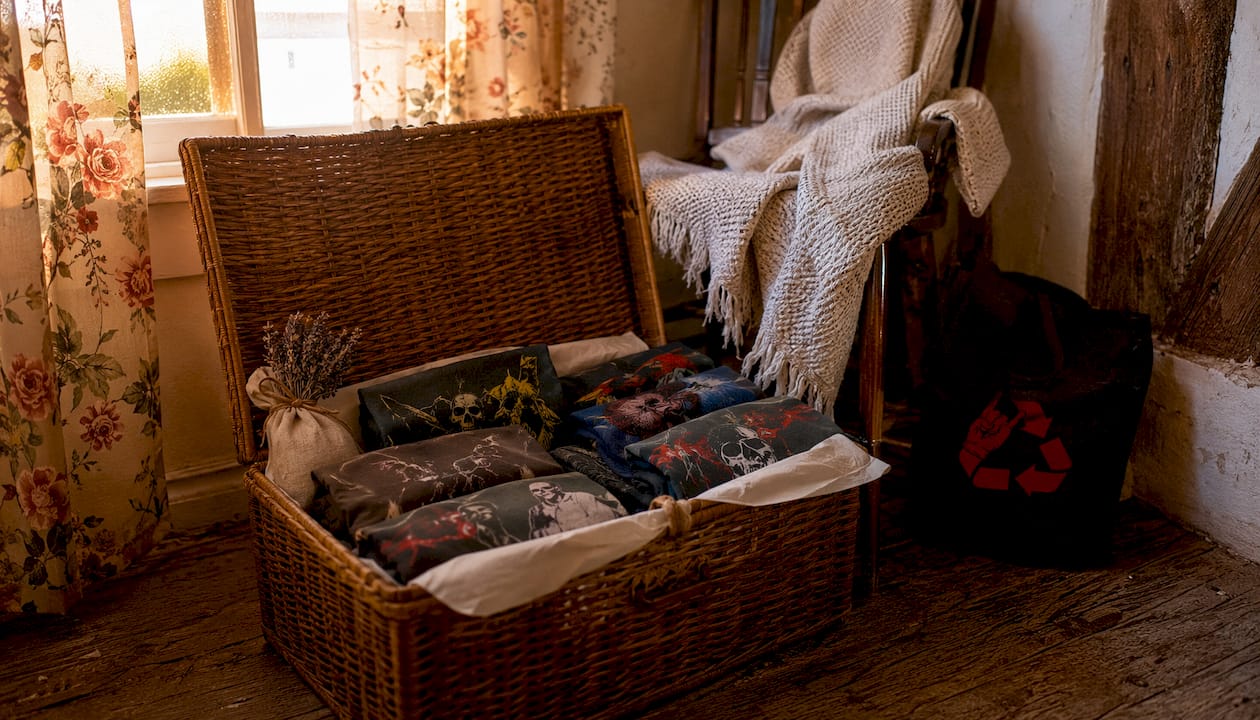
Avoid attics (too hot in summer), garages (temperature swings and pests) and damp basements. A wardrobe on an internal wall, away from exterior brick that absorbs heat, is often the best option in a typical Australian home.
| Material | Best use | Where to buy in Australia |
|---|---|---|
| Acid-free tissue paper | Between shirts and around folded pieces | Eckersley’s, Officeworks, art supply stores |
| Archival cardboard boxes | Long-term storage of multiple shirts | Gaylord Archival, art supply stores |
| Breathable garment bags | Short-term or rotation storage | Kmart, Target, Myer |
| Silica gel desiccant packs | Humidity control inside boxes | Bunnings, Kmart, online |
| Humidity indicator cards | Monitoring storage environment | Bunnings, photography stores |
Folding technique: fold shirts in thirds lengthways, then fold from the bottom up so the print faces inward. This keeps the graphic protected and reduces stress on collar and shoulder seams. Interleave each shirt with a sheet of acid-free tissue before placing it in the box.
- Never store shirts in airtight plastic bags or vacuum-seal bags: trapped moisture causes yellowing and mould
- Avoid wire hangers for long-term storage; if hanging is necessary, use padded hangers and breathable cotton garment bags
- Check stored boxes for pest activity (silverfish, moths) every quarter
- Rotate the fold position of each shirt annually to prevent permanent crease lines
Pro Tip: Place a cedar block or lavender sachet (not in direct contact with fabric) inside the storage box as a natural pest deterrent. Avoid mothballs entirely: the chemicals off-gas onto fabric and are extremely difficult to remove.
For a deeper look at long-term storage materials, Vintage Metal Store’s storage guide covers archival box selection and environmental recommendations specific to Australian conditions.
5. How to pack shirts safely for moving or shipping
Packing a high-value tee for transit requires more care than dropping it in a satchel. The goal is to prevent compression damage, moisture ingress and abrasion during handling.
Single shirt packing workflow:
- Fold the shirt using the thirds method described above, print facing inward
- Wrap in a sheet of acid-free tissue, then a second sheet if the print is fragile
- Place inside a rigid cardboard mailer or small archival box, not a soft poly mailer
- Add a silica gel desiccant pack inside the box
- Fill any void space with crumpled acid-free tissue, not bubble wrap directly against the fabric
- Seal and label the outside with “fragile” and “do not bend”
For a box of multiple shirts, interleave each shirt with tissue, stack them print-to-back rather than print-to-print, and place the heaviest shirts at the bottom. Do not overfill the box: compression is a real risk for plastisol prints.
Never vacuum-seal vintage shirts for storage or shipping. Vacuum compression forces fabric layers together under sustained pressure, which can permanently bond adjacent prints and crush collar structures that took decades to develop their shape.
Pro Tip: Include a handwritten condition note inside the package describing the shirt’s current state. If the recipient is a buyer or conservator, this gives them a baseline and protects you if a pre-existing issue is later disputed.
Avoid plastic wrapping directly against the fabric for anything longer than a few days in transit. Breathable tissue is always the better inner layer, with plastic only on the outside of the box as a moisture barrier.
6. Minor repairs you can do yourself, and when to call a conservator
Small interventions done well can stabilise a shirt for decades. Done badly, they can cause irreversible damage. The boundary is straightforward: if the repair is structural and invisible, you can likely do it yourself. If it involves the print, the dye, or significant fabric loss, get professional advice first.
DIY repairs that are low risk:
- Small holes in the body fabric: use fine cotton thread in a matching colour, sew from the inside with small running stitches, and keep tension light to avoid puckering
- Seam separation at side seams or hem: re-stitch from the inside using a needle and thread, matching the original stitch length as closely as possible
- Fragile neckline ribbing: a few stabilising stitches on the inside of the collar can prevent further unravelling without altering the front appearance
- Light patching on the inside: use a thin cotton patch cut slightly larger than the hole, adhered with a textile-safe fusible web on the inside only
Pro Tip: Document every repair with a photograph before and after. Note the thread type, stitch used and date. This record adds provenance value to the shirt and helps any future conservator understand what has already been done.
When to stop and call a conservator: extensive print flaking, chemical staining that has altered the dye, structural fabric failure across a large area, or any situation where the repair would be visible from the front. The restoration workflow guide at Vintage Metal Store outlines the standard collector approach to documentation and professional referral. Professional textile conservation in Australia typically starts around $80–$150 per hour for assessment and minor work, though complex print stabilisation can run significantly higher.
7. Common mistakes that cause irreversible damage
Most damage to vintage band tees happens not from neglect but from well-intentioned care applied incorrectly. These are the errors worth stopping immediately.
Heat exposure is the most common and most damaging. Running a vintage tee through a standard dryer cycle, even once, can initiate plastisol cracking that compounds with every subsequent wash. If you have already done this, stop using the dryer and switch to flat air-drying from this point forward. The existing damage cannot be reversed, but further cracking can be slowed.
Over-washing degrades both the fabric and the print faster than almost any other single factor. Washing after every wear is a habit carried over from modern fast-fashion, where fabrics are designed to handle it. Vintage cotton and vintage inks are not. Wash only when genuinely necessary.
“Permanent press cycles and modern high-speed spins generate enough tumbling and mechanical force to break down ageing fabric and initiate print cracking.” How to Launder Vintage Band Tees Safely
Storage in plastic bags is a widespread mistake. Sealed plastic traps moisture against the fabric, creating the humid, dark conditions that mould and yellowing need. Switch to breathable cotton garment bags or archival boxes with acid-free tissue immediately.
Baking soda as a “natural” cleaner is a myth worth addressing directly. Baking soda is alkaline and disrupts reactive dyes, particularly on older cotton. It is not a safe alternative to pH-neutral detergent for vintage pieces. Freezing is a far safer odour-control method for archival shirts.
Pro Tip: If you have shirts currently stored in plastic tubs in a garage or attic, move them now. Retrieve them, air them in a shaded, ventilated space for 24 hours, check for mould or pest damage, and re-store in breathable archival boxes with desiccant packs.
8. Why modern wash cycles are particularly hard on vintage shirts
This is the technical detail most general care guides skip, and it explains why even a “gentle” machine cycle can harm a shirt that survived thirty years in a wardrobe.
Modern washing machines commonly exceed 600 RPM on spin, producing mechanical shear forces that split plastisol binders and create microfractures in prints. The tumbling action during the wash phase adds further stress: fabric is repeatedly compressed and stretched against the drum wall, which is particularly damaging to aged cotton where individual fibres have already lost elasticity.
The chemical side is equally significant. Most commercial detergents are formulated at a slightly alkaline pH to lift grease and protein stains from modern synthetic fabrics. On vintage cotton, that residual alkalinity accelerates dye hydrolysis, the chemical breakdown of the dye-fibre bond. Reds and purples are most vulnerable because the reactive dyes used for those colours are particularly sensitive to alkaline conditions. A second cold rinse after washing reduces residual alkalinity and measurably slows colour loss.
Using a mesh laundry bag and double rinsing in cold water significantly reduces both the mechanical shear and the chemical residue that damage vintage prints and fibres in modern machines.
Pro Tip: If you use a machine, select the shortest available cycle at the lowest spin speed, and always use a mesh bag. The bag acts as a physical buffer between the shirt and the drum wall, reducing abrasion by a meaningful margin on every cycle.
The “permanent press” cycle, which many people assume is gentle, actually uses a higher spin speed than the standard cycle to reduce creasing. For a vintage band tee, it is one of the worst settings you can choose. Delicate or hand-wash cycle only, every time.
For more on collector-focused care, Vintage Metal Store’s 2026 care guide covers these technical points alongside practical supply recommendations.
9. Your preservation checklist and inspection timeline
Turn everything in this guide into a repeatable schedule. Consistency matters more than any single intervention.
Immediate actions (do these today):
- Move any shirts stored in plastic bags or airtight containers to breathable archival boxes
- Check the storage area for signs of moisture, pests or direct light exposure
- Photograph the condition of your most valuable pieces as a baseline record
Quarterly checks:
- Inspect stored boxes for pest activity (look for small holes, frass or shed insect casings)
- Check desiccant packs and replace or recharge them if the indicator has changed colour
- Re-fold stored shirts to a different fold position to prevent permanent crease lines
- Air shirts briefly in a shaded, ventilated space before refolding
Washing before long-term storage and using acid-free interleaving prevents both chemical transfer damage and print adhesion in boxes over time. How to Store Band T-Shirts Long Term
Annual deep-check:
- Inspect every seam, collar and hem for signs of stress or unravelling
- Check prints for new cracking, lifting edges or colour shift
- Update your condition notes with photographs
- Wash any shirt that has been in storage for more than 12 months before returning it to the box (body oils and invisible soil accelerate yellowing in storage)
- Replace acid-free tissue that has yellowed or become brittle
Pro Tip: Keep a simple spreadsheet or notebook with one row per shirt: acquisition date, condition at purchase, any repairs done, and the date of each inspection. This record is invaluable if you ever sell, insure or donate a piece.
For shirts on active rotation (worn occasionally), inspect after each wear for new damage and air thoroughly before returning to storage. The preservation best practices guide at Vintage Metal Store includes a downloadable-style checklist format collectors can adapt.
Key takeaways
The single most effective band t shirt preservation habit is washing only when necessary, in cold water, inside out, and air-drying flat in the shade.
| Point | Details |
|---|---|
| Cold wash, inside out | Every wash in cold water, shirt reversed, prevents print abrasion and colour loss. |
| Air-dry flat, no heat | Tumble dryers accelerate plastisol cracking; flat air-drying in shade is always safer. |
| Archival storage materials | Acid-free tissue between shirts and breathable archival boxes prevent yellowing and print transfer. |
| Stable environment | Store at 15°C–20°C, 45–55% relative humidity, away from light, heat and pests. |
| Inspect quarterly | Check desiccant packs, re-fold shirts and look for pest activity every three months. |
The real trade-off most collectors don’t talk about
There is a tension at the heart of collecting vintage band tees that no care guide fully resolves: the shirts that matter most are often the ones you most want to wear. A 1991 Metallica tour shirt is not just a textile artefact. It is a piece of metal history, and part of its power is that it was made to be worn.
My honest position is that preservation and wearability are not opposites, but they do require a deliberate choice for each shirt in your collection. For the truly irreplaceable pieces, the ones with significant monetary or personal value, the right call is usually archival storage with occasional, careful display. For everything else, rotating wear with proper care is entirely reasonable and keeps the connection to the music alive.
One practical rule of thumb: if a shirt would be genuinely difficult or impossible to replace, store it. If you can find another in comparable condition within a year of looking, wear it thoughtfully and care for it well. Using a heavyweight modern tee for everyday wear while preserving the original is a strategy more collectors should adopt. The modern piece takes the friction; the vintage piece keeps its integrity.
The other thing worth saying plainly: most damage to vintage shirts happens in the first few washes after acquisition, before the new owner has adjusted their habits. If you have just added a rare piece to your collection, the single most important thing you can do is slow down and resist the urge to wash it immediately. Air it, assess it, photograph it, and then decide whether it needs washing at all.
Preserve what you love. Shop the legacy.

The shirts in your collection deserve the care this guide describes. If you are looking to add to it, Vintage Metal Store carries genuine vintage Metallica shirts from Australian and international tours, alongside a deep range of Australian metal band shirts that belong in any serious collection. Every piece is second-hand, ex-tour or deadstock. Real history, not reproductions.
Browse the full range at Vintage Metal Store and find the piece worth preserving.
FAQ
How often should you wash a vintage band tee?
Wash only when the shirt is visibly soiled or genuinely odorous. For archival pieces worn occasionally, freezing overnight in a sealed bag is a safer alternative to washing for odour control.
What is the safest way to dry a band t-shirt?
Air-dry flat on a clean towel or low-angled rack in the shade. Never use a tumble dryer: heat accelerates plastisol cracking, and tumbling adds mechanical stress that damages aged cotton and print binders.
How do you stop band shirt prints from cracking?
Wash inside out in cold water using a pH-neutral, enzyme-free detergent, avoid direct heat, and store with acid-free tissue between shirts. Never iron directly over a print.
How do you preserve a band t-shirt long term?
Fold (do not hang), wrap in acid-free tissue, store in a breathable archival box at 15°C–20°C and 45–55% relative humidity, away from light and pests. Inspect quarterly and replace desiccant packs as needed.
Can you hang vintage band shirts for display?
Short-term display on a padded hanger in a UV-filtered frame or away from direct light is acceptable. For long-term storage, always fold and box. Hanging wet or heavy cotton shirts causes permanent shoulder and collar distortion.
Recommended
- Preserving shirt prints guide for vintage collectors – Vintage Metal Store
- Best practices for vintage shirt preservation: collector’s guide – Vintage Metal Store
- How to Store Vintage Metal T Shirts for Lasting Quality – Vintage Metal Store
- Restoring old band shirts: your workflow guide – Vintage Metal Store


