



TL;DR:
- Reprint shirts are modern reproductions made to resemble original vintage heavy metal tees, often produced years after the initial release. Authentic vintage shirts typically feature heavier fabric, single-stitch hems, and tags indicating manufacturing in the USA, Mexico, or Honduras, while reprints often have modern tags, lighter fabric, and digital printing. Understanding these differences helps collectors avoid misrepresentations and preserve the integrity of their vintage heavy metal apparel.
You’ve found what looks like a killer vintage Metallica tee listed online for $40. The distressing looks right, the design checks out, and the seller says it’s “vintage.” Then it arrives and something feels off. The fabric is too smooth, the print too clean, and the tag reads “Made in Bangladesh.” Welcome to one of the most common frustrations in vintage heavy metal collecting. Understanding what is a reprint shirt, and how it differs from a genuine original, is the difference between building a real collection and accumulating clever fakes.
Table of Contents
- Key takeaways
- What is a reprint shirt in heavy metal collecting
- How to identify reprint shirts
- Market value and collector perspectives
- Practical advice for buying and verifying shirts
- Comparing shirt types: a quick reference
- My take on reprints and the collecting culture
- Authentic vintage metal shirts from Com
- FAQ
Key takeaways
| Point | Details |
|---|---|
| Reprint shirts are modern reproductions | They copy original vintage designs but are made decades after the original production run. |
| Tags and stitching reveal the truth | Manufacturing origin, tag font, and stitch construction are the most reliable authenticity markers. |
| Reprints rarely hold collector value | Genuine vintage shirts command significantly higher prices; reprints are for wearability, not investment. |
| Misrepresentation is the real problem | Reprints are legitimate products when sold honestly, but become problematic when mislabelled as vintage. |
| Always verify before you buy | Cross-check fabric weight, print quality, and provenance documentation before purchasing any “vintage” shirt. |
What is a reprint shirt in heavy metal collecting
The reprint shirt definition, in its simplest form, is a modern reproduction of an original vintage garment design. In the heavy metal collecting world, this typically means a shirt that copies artwork, typography, and tour details from a specific original tee, usually produced years or even decades after the genuine article rolled off the press.
Reprints are not the same as bootlegs, originals, reissues, or retro tees, and the differences matter enormously to collectors.
- Original vintage shirt: Produced at or around the time of the tour, album release, or band activity it references. Genuine article, genuine collectible.
- Reprint: A modern copy made to resemble an original, sometimes officially licensed, sometimes not.
- Bootleg: An unauthorised reproduction made without any band or label permission, often produced during the original era itself.
- Reissue: An officially sanctioned re-release, often by the band’s current merchandise partner, sometimes with updated materials or minor design tweaks.
- Retro tee: A new shirt designed to evoke a vintage aesthetic without copying any specific original design directly.
The origins of reprint culture in band merchandising stretch back to the late 1990s, when demand for vintage tour shirts began outpacing supply. Labels and licensing companies recognised that fans who missed the original tour still wanted to wear the shirt. Licensed reprints produced by companies like Bravado offer quality replicas but feature modern materials and tags, distinct from original vintage shirts. The business logic is sound. The problem arises when reprints are passed off as the real thing.
How to identify reprint shirts
This is where the practical knowledge separates experienced collectors from everyone else. Sophisticated distressing and reprint manufacturing have made visual inspection challenging, shifting collector focus to sew and tag details as more reliable authenticity markers. Here is what to examine.
Fabric and construction
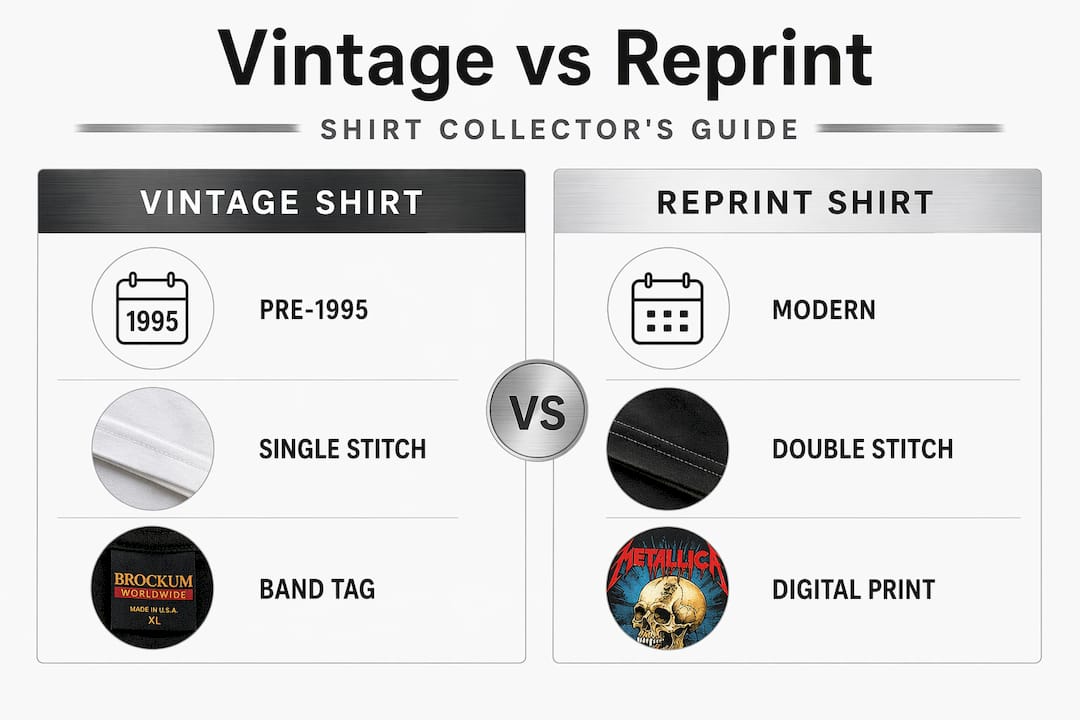
Authentic vintage shirts from the 1980s and early 1990s typically used heavier cotton blends, often with a rougher, looser weave. Modern reprints tend to use lighter, softer poly-cotton blends that feel noticeably different in your hands. Authentic vintage band tees typically have single-stitch hems, narrower collar bands, and tags characteristic of their production era. Run your thumb along the sleeve hem. Double stitching is a strong indicator of a post-1995 garment.
| Feature | Authentic vintage | Reprint |
|---|---|---|
| Hem stitching | Single stitch | Double stitch |
| Fabric weight | Heavier, rougher cotton | Lighter, softer blend |
| Tag manufacturing origin | USA, Mexico, Honduras | China, Bangladesh, Vietnam |
| Print appearance | Slightly imperfect, raised ink | Clean edges, flat digital print |
| Collar band | Narrow, sometimes worn | Wider, structured |
| Distressing | Natural fading, cracking | Artificial, even, too consistent |
Print quality and ink texture
Reissue shirts produced today are often made with digital screen printing, resulting in crisp edges and perfectly aligned colours unlike the imperfect manual prints of vintage shirts. On a genuine 1988 Slayer shirt, you will see slight misalignment in colour layers, a faint white gap or halo around design elements, and an ink texture you can feel with a fingertip. Reprints look too perfect. That perfection is the tell.

Tag and label details
Band tees made before the mid-1990s were mostly produced in USA, Mexico, or Honduras. A “Made in China” or “Made in Bangladesh” tag almost always indicates a reprint or modern production. Beyond country of origin, look at the font style on the tag, whether a washing instruction strip is sewn separately, and whether the brand label matches what was used by Hanes, Fruit of the Loom, or Screen Stars in the relevant decade.
Artificial distressing
Modern manufacturers use acid washing, enzyme treatments, and mechanical abrasion to simulate decades of wear, making surface appearance unreliable for vintage identification. The tell with artificial distressing is its consistency. Real wear is random and follows how a shirt was actually used. Artificial fading tends to be evenly distributed, particularly concentrated at fold lines and print edges in a way that looks manufactured because it is.
Pro Tip: Hold the shirt up to bright light and examine print cracking under magnification. On genuine vintage shirts, cracking follows the natural movement and stress points of the garment. On reprints with artificial distressing, cracking patterns tend to be uniform and suspiciously photogenic.
Market value and collector perspectives
Genuine vintage shirts can command hundreds of dollars while honest reprints sell for considerably less. A 1986 Metallica “Master of Puppets” tour shirt in good condition can fetch $500 or more from serious collectors. A well-made reprint of the same design might sell for $30 to $60. The gap exists because collectors are not just buying a graphic. They are buying a physical object that was present at a moment in music history.
Reprints serve a legitimate purpose by keeping iconic designs accessible to new generations, but conflict arises when misrepresented as authentic vintage to inflate prices. This is the ethical fault line in the market. A fan who wants to wear an Iron Maiden “Killers” design without spending $400 is entirely reasonable to buy a quality reprint. The problem is the seller who charges $300 for that reprint and calls it vintage.
“The collectibility issues in vintage heavy metal apparel originate more from misrepresentation than from the existence of reprints themselves.”
Licensed reprints with certificates of authenticity occupy an interesting middle ground. They have value as officially sanctioned pieces and are preferred by collectors who want wearable versions of rare designs without risking damage to genuine originals. But they should never be confused with original vintage shirts in terms of investment or historical significance.
Reprints also affect resale market trust. When buyers get burned once by a mislabelled piece, it creates hesitancy across the entire market. Sellers of genuine vintage shirts then face additional scrutiny, making transparent provenance documentation more important than ever. Original receipts and concert ticket stubs build buyer confidence beyond garment physical features alone.
Practical advice for buying and verifying shirts
Buying vintage heavy metal apparel without a clear process is how collections fill up with expensive reprints. Here is a practical checklist for evaluating any shirt before money changes hands.
- Check the tag first. Country of manufacture, fabric blend description, and tag font are your quickest filters. A “Made in USA” Hanes tag with a separate washing strip points toward pre-1995 production.
- Feel the fabric weight. Heavier, slightly coarser cotton suggests genuine vintage. If it feels like a modern t-shirt from a chain store, it probably is one.
- Examine the stitching. Collectors value original fabric weight, stitch construction, and tag fonts as authentic markers; reprints may simulate some features but usually lack full authenticity. Single-stitch hems are your friend.
- Study the print up close. Look for slight imperfection in colour alignment, visible ink texture, and natural fading patterns. Too-clean prints are a warning sign.
- Ask for provenance documentation. Sellers of genuine vintage should be able to provide photos of the full tag, and ideally some history of the shirt’s origin.
- Research comparable sales. Check sold listings on reputable platforms to understand realistic price ranges. If a “vintage” shirt is priced like a reprint, be suspicious either way.
- Know when a reprint is fine. For wearing to shows, daily use, or casual display, a quality licensed reprint is a perfectly reasonable choice. A truly identical match to an original vintage shirt is often impossible due to changes in manufacturing, fabric dye lots, and printing technology. For investment collecting, only originals will hold or grow in value.
When buying online, look for sellers who provide close-up tag photos, detailed fabric descriptions, and honest listings. Resources like the vintage tour shirt guide at Com offer detailed identification criteria to cross-reference before purchasing.
Pro Tip: If a seller cannot or will not photograph the tag in detail, treat that as a red flag. Reputable sellers of genuine vintage shirts are proud of their tags. It is usually the first photo they provide.
Comparing shirt types: a quick reference
| Shirt type | Production era | Licencing status | Typical market value | Best use for collectors |
|---|---|---|---|---|
| Original vintage | Era of the band activity | Official at time of production | $100 to $1,000 or more | Investment and display collecting |
| Licensed reprint | Modern production | Officially licensed | $30 to $80 | Wearable versions of rare designs |
| Bootleg | Mostly original era | Unauthorised | $20 to $200 depending on rarity | Historical curiosity, era-specific interest |
| Reissue | Modern production | Officially licensed with updates | $40 to $100 | Wearability, entry-level collecting |
For a deeper look at how these categories are defined within the collecting community, the reissued band tees guide from Com is worth bookmarking.
My take on reprints and the collecting culture
I’ve spent years handling genuine vintage heavy metal shirts and watching the reprint conversation evolve. My honest view is that the market’s frustration with reprints is mostly misdirected.
Reprints are not the enemy. Dishonesty is. I’ve seen beautifully preserved original Anthrax shirts from the “Among the Living” tour dismissed because buyers had been burned so many times they stopped trusting everything. That’s a real loss for the culture, and it traces directly back to sellers who couldn’t be bothered to list accurately.
What I’ve learned is that expertise is the only real protection. The more time you spend with genuine vintage garments, the more a reprint reveals itself almost immediately through touch alone. That knowledge compounds. A collector who has handled 50 authentic 1980s shirts develops an intuition that no checklist can fully replace.
I also think reprints have genuine value when positioned honestly. They play a dual role: preserving the visual legacy of bands for casual fans while creating tension with collectors over authenticity and value. Both things can be true. The casual fan wearing a Pantera reprint to a gig is not your adversary. The seller charging vintage prices for that reprint is.
Buy with knowledge. Sell with honesty. The culture is better for it.
— David
Authentic vintage metal shirts from Com
If you’re ready to move beyond reprint uncertainty and invest in pieces with verified provenance, Com carries a curated selection of genuine vintage heavy metal apparel sourced directly from ex-tour stock and deadstock.
Every shirt in the collection is assessed for authenticity before listing, with detailed tag photography and honest descriptions. Whether you’re chasing iconic vintage Metallica shirts from the 1980s or hunting down rare vintage Anthrax pieces from Australian tours, Com’s inventory is built for collectors who know the difference. Explore the full range of verified vintage heavy metal shirts and build your collection on solid ground.
FAQ
What is a reprint shirt in simple terms?
A reprint shirt is a modern reproduction of a vintage garment design, made to look like an original but produced years or decades after the genuine article. It copies the artwork and style of the original without being the original.
How do I tell a reprint from an authentic vintage shirt?
Check the tag for manufacturing country, examine the hem stitching (single stitch indicates pre-1995 production), and assess the print quality. Vintage shirts show slight print imperfections and raised ink texture that modern digital prints cannot replicate.
Are reprint shirts worth collecting?
Reprints generally do not hold investment value compared to genuine vintage shirts. They are best suited for wearing rather than collecting, unless they are officially licensed limited editions with documented provenance.
What is the difference between a reprint and a bootleg?
A bootleg is an unauthorised reproduction typically made without band or label permission, often during the original era. A reprint is a modern copy, sometimes officially licensed, made well after the original production run.
Where can I buy genuine vintage heavy metal shirts without being misled?
Look for specialist retailers who provide close-up tag photography, detailed authenticity descriptions, and source their stock from verified tour or deadstock inventory. Checking resources like the heavy metal buying checklist from Com before purchasing helps you ask the right questions.
Recommended
- Reissued band tees: collector essentials explained – Vintage Metal Store
- Sample band t-shirts: Rare finds and collector value – Vintage Metal Store
- Why fans collect old shirts: Cultural power of vintage metal tees – Vintage Metal Store
- Spot genuine dead stock shirts: A collector’s guide – Vintage Metal Store


