



Some of the most valuable heavy metal tees ever made were never sold at a single concert, never stocked in a single store, and never seen by the general public. These are sample band t-shirts, and for serious collectors they represent the holy grail of metal memorabilia. A sample band t-shirt refers to a promotional or pre-production tee made for staff, not for public sale. If you have ever stumbled across one without knowing what you were holding, you are not alone. This article breaks down exactly what these shirts are, why they matter, and how to spot the real thing.
Table of Contents
- Defining the sample band t-shirt
- Why collectors crave sample shirts
- Sample vs retail: The collector’s comparison
- Spotting a genuine sample band t-shirt
- Edge cases: Misprints, venue exclusives, fakes, and anomalies
- Explore and collect iconic sample and vintage heavy metal shirts
- Frequently asked questions
Key Takeaways
| Point | Details |
|---|---|
| Samples defined | Sample band t-shirts are non-retail promos or pre-production shirts made for staff or industry use. |
| True rarity | Collectors value sample shirts for their extreme scarcity and unique history. |
| Authentication matters | Tags, stitching, and graphic checks are crucial to confirm a shirt is a genuine sample. |
| Watch for fakes | Misprints and reprints are everywhere—buy only with trusted verification and seller history. |
| Collector’s value | Genuine samples can command significantly higher prices than tour retail tees due to exclusivity. |
Defining the sample band t-shirt
A sample band t-shirt is not simply a rare tour shirt. It is a garment produced specifically for a non-public audience, whether that is road crew, label staff, band management, or industry insiders attending a showcase. These shirts were never intended to reach a merch stand, let alone a collector’s hands.
“Sample band t-shirts are typically not for public sale and are produced in minimal quantities for staff or industry use.”
The origins of sample tees are varied. Some were created as pre-production prototypes to test print quality or graphic layouts before a full retail run was approved. Others were made exclusively for tour crew as a form of identification or acknowledgement of their work on a specific run. A small number were produced for label or management use during album promotion cycles.
Here is what typically defines a sample shirt:
- Produced in runs of fewer than 50 units, sometimes as few as 10 to 20
- Tagged with “sample,” “promo,” or “not for resale” labels
- Features graphics, colourways, or layouts that differ from the retail version
- Distributed directly to crew, staff, or label contacts rather than through merch channels
These shirts entered the collector market through a handful of routes. Former crew members sold them, estate sales surfaced them, and occasionally a label employee would offload a collection decades later. Understanding why vintage shirts are collectible starts with recognising that scarcity and provenance are the twin engines driving value. The deeper story of why vintage t-shirts matter to collectors is inseparable from the cultural weight these garments carry.
Why collectors crave sample shirts
Collector psychology is straightforward: the rarer the object, the more it is desired. Sample shirts sit at the extreme end of that spectrum. A standard Metallica tour shirt from the 1988 Damaged Justice tour might have been printed in the tens of thousands. A crew sample from that same tour? Perhaps a couple of dozen exist in the world.
Sample band t-shirts, due to extreme scarcity, are worth significantly more to serious collectors than standard tour merch. That is not just collector sentiment. It is a market reality reflected in auction results and private sales across the globe.
Consider these value drivers:
- Exclusivity: The shirt was never meant for you, which makes owning it feel genuinely significant
- Provenance: A shirt worn by a Slayer crew member during the Reign in Blood tour carries a direct connection to metal history
- Unique graphics: Sample versions of Judas Priest or Halford solo tour shirts sometimes feature artwork that was rejected for retail, making them one-of-a-kind visual artefacts
- Condition: Because samples were not sold, many were stored rather than worn, meaning condition is often exceptional
Pro Tip: When evaluating a sample shirt’s value, always research whether the graphic on the shirt matches any known retail version. If the design is entirely unique, that is a significant premium indicator. Cross-referencing with resources on what makes a shirt vintage will sharpen your eye considerably.
Authentication is the other side of the coin. Before you assign value, you need to be certain of what you have. Developing a working knowledge of t-shirt authenticity is non-negotiable for anyone serious about this corner of the market.
Sample vs retail: The collector’s comparison
The merch stand shirt and the sample shirt may look similar at a glance. Up close, they are worlds apart. Retail tour shirts were produced to move volume. Sample shirts were produced to serve a specific, limited purpose. That difference shows up in the physical object.
Sample shirts have unique tags, construction, and graphics not found on retail versions. Here is a direct comparison:
| Feature | Sample shirt | Retail tour shirt |
|---|---|---|
| Production quantity | Under 50 units | Hundreds to thousands |
| Tag type | Promo, sample, or blank | Standard licensed merch tag |
| Construction | Single-stitch, era-specific blank | Single or double-stitch depending on era |
| Graphics | Unique, prototype, or rejected artwork | Approved retail design |
| Distribution | Staff, crew, label contacts | Merch stands, mail order, stores |
| Condition found | Often unworn or lightly worn | Frequently well-worn |
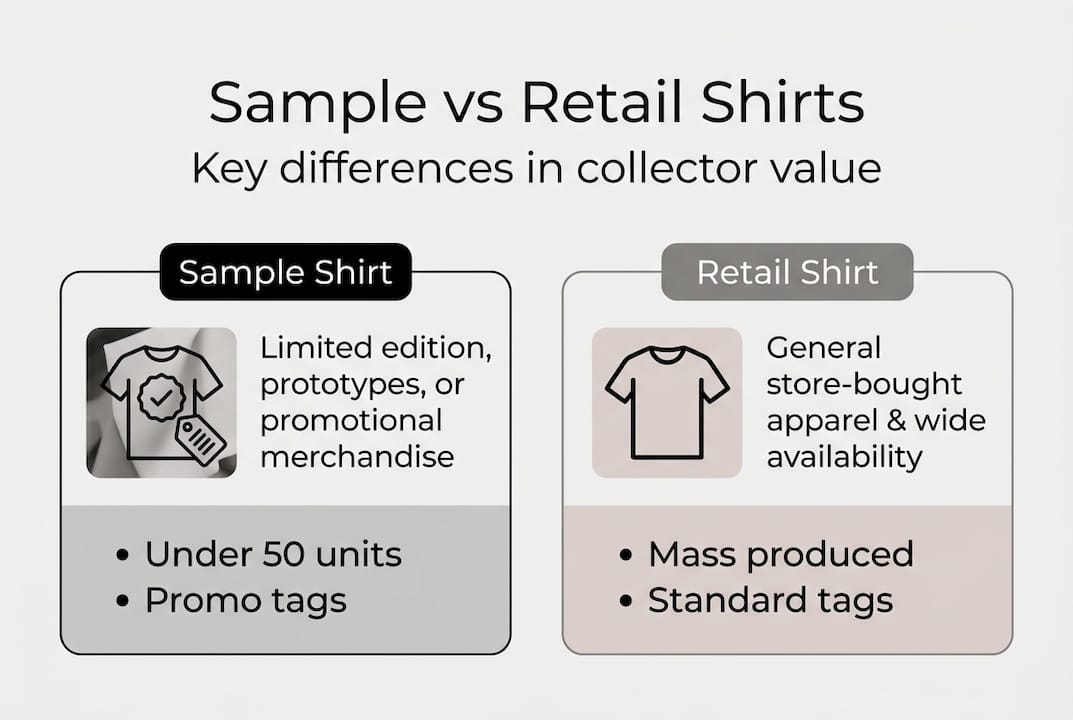
The most common pitfall for collectors is the reprint claiming to be a sample. Bootleg operators have caught on to the premium that sample shirts command, and some are now producing shirts with fake “sample” or “promo” tags sewn in. This is where attention to vintage shirt design elements becomes critical.
Here is a numbered checklist for comparing a potential sample against a retail shirt:
- Examine the tag. Genuine sample tags from the 1980s and 1990s have a specific look and feel. Reproduction tags are often too crisp or use modern fonts.
- Check the blank. Era-specific blanks like Fruit of the Loom, Hanes Beefy-T, or Screen Stars have known characteristics for each decade.
- Compare the graphic. If you can find a retail version of the same shirt, look for any differences in colour, layout, or artwork detail.
- Assess the construction. Single-stitch seams on the sleeves and hem are a strong indicator of pre-1994 production.
- Research the seller. Use the heavy metal shirts buying checklist to vet any purchase before committing.
Pro Tip: Never pay a sample premium based on a tag alone. The tag is the easiest thing to fake. The combination of blank, construction, graphic, and provenance is what confirms authenticity.
Spotting a genuine sample band t-shirt
Authentication is part science, part experience. The more genuine samples you handle, the faster your eye develops. But there are concrete markers that separate the real from the reproduction every time.
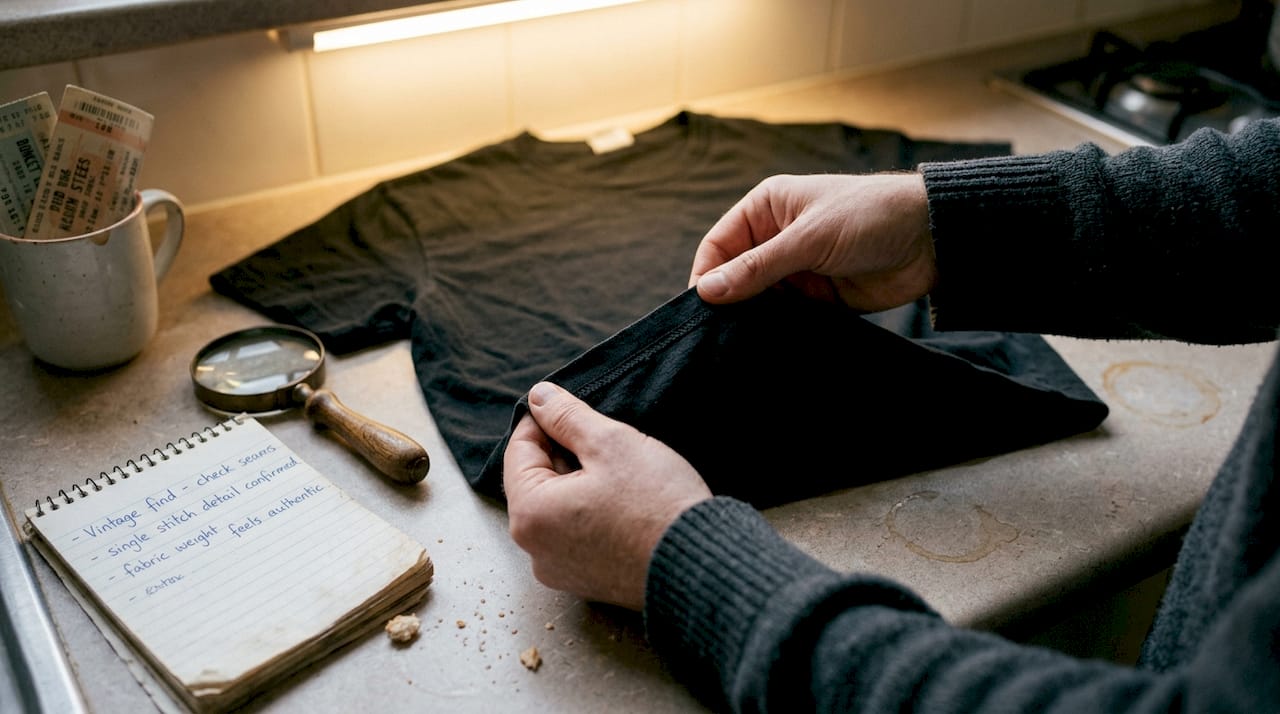
Promo and sample tags, single-stitch construction, era-specific blanks, and non-public graphics are the key authentication elements. Here is a data table of common tag and blank combinations by era:
| Era | Common blank | Tag indicators | Construction |
|---|---|---|---|
| Early 1980s | Screen Stars, Fruit of the Loom | Plain or minimal text tags | Single-stitch throughout |
| Mid to late 1980s | Hanes Beefy-T, Stedman | “Sample” or “Not for resale” text | Single-stitch sleeves and hem |
| Early 1990s | Fruit of the Loom, Delta | Promo tags, sometimes blank | Single or transitional stitch |
| Mid 1990s onward | Gildan, Anvil | Licensed merch tags become standard | Double-stitch increasingly common |
Beyond the physical markers, here is what to look for when assessing authenticity:
- Ink feel: Vintage screen printing has a specific texture. It sits on top of the fabric rather than being absorbed into it. Modern reprints often feel flat or plasticky.
- Fading patterns: Genuine age produces uneven, organic fading. Artificially distressed reprints tend to fade in suspiciously uniform ways.
- Graphic accuracy: Cross-reference the artwork against known tour programmes, concert posters, or documented merchandise from the same period.
- Provenance documentation: A shirt with a verifiable chain of ownership, such as a receipt, photograph, or written account from the original owner, is worth significantly more.
For a structured approach to buying, the heavy metal shirt buying workflow is an excellent resource. When shopping online, knowing trusted alternatives to mainstream marketplaces reduces your exposure to fakes considerably. A detailed guide on spotting fake vintage band tees is also worth bookmarking before you make any significant purchase.
Edge cases: Misprints, venue exclusives, fakes, and anomalies
Once you understand the core authentication process, the edge cases become fascinating rather than confusing. These are the shirts that sit outside the standard sample definition but carry equal or greater value.
Fakes are common, while misprints or venue exclusives yield especially rare samples. A misprint occurs when a production error creates a shirt that differs from the approved design. Maybe the ink bled, the graphic was off-centre, or the wrong colourway was used. These shirts were typically destroyed, but some escaped. When they surface, they are extraordinary finds.
Venue exclusives are another category entirely. These are shirts made for a single night at a specific venue, sometimes in quantities of fewer than 20. A shirt made for the crew of a one-night-only show at a legendary venue carries a story that no retail shirt can match.
Here is a breakdown of the edge cases worth knowing:
- Production misprints: Off-register graphics, wrong ink colours, or printing errors that were meant to be discarded
- Venue crew exclusives: Made for staff at a single show, often featuring the venue name or date
- Label showcase shirts: Produced for industry events where a band was being promoted to radio or press
- Rejected artwork samples: Pre-production shirts featuring artwork that was ultimately not approved for retail
- Tour rehearsal shirts: Made for the band and crew during pre-tour rehearsals, before the official tour design was finalised
“The line between ‘vintage-inspired’ and authentic sample is where most collectors get burned. A shirt that looks old is not the same as a shirt that is old.”
The “vintage-inspired” market has grown significantly, and some sellers use the aesthetic of age to imply authenticity without ever making a direct claim. This is where your knowledge of vintage shirt trends in 2026 becomes a practical defence. Knowing what is currently being reproduced tells you exactly what to scrutinise most carefully.
Explore and collect iconic sample and vintage heavy metal shirts
You now have the knowledge to identify, evaluate, and appreciate sample band t-shirts at a level most collectors never reach. The next step is putting that knowledge to work with a trusted source of genuine vintage and sample stock.
At Vintage Metal, we specialise in ex-tour stock, deadstock, and genuine vintage heavy metal shirts sourced directly from tours and industry contacts. Our catalogue includes vintage Metallica shirts spanning multiple eras, as well as a curated selection of rare vintage heavy metal shirts that serious collectors will not find anywhere else. If you want a specific example of tour-era rarity, the Metallica 1996 tour shirt with Korn is a standout piece that illustrates exactly what makes tour-era stock so compelling. Whether you are building a collection or hunting a single grail piece, our stock is worth exploring.
Frequently asked questions
What makes a sample band t-shirt more valuable than a standard tour shirt?
Sample tees are made in much smaller quantities and often feature exclusive designs or tags, making them extremely rare and desirable among collectors. Their extreme scarcity means demand consistently outpaces supply in the collector market.
How do I know if my band t-shirt is a true sample or just a reprint?
Check for sample or promo tags, single-stitch seams, era-accurate blanks, and unique graphics not seen on retail versions. The combination of all these factors, rather than any single element, confirms authenticity. Key authentication elements include construction details that are very difficult to replicate convincingly.
Are there fakes and how can I avoid them when buying online?
Yes, fakes are common; always verify seams, tag type, tour details, and consider the seller’s reputation before purchasing. A practical guide on spotting fake vintage tees online is an essential resource for any collector buying through digital marketplaces.
Do misprints count as samples?
Yes, production misprints can be considered sample variants and are often highly sought after for their extreme rarity. Production errors create rare variations that were never intended to exist, which is precisely what makes them so valuable to serious collectors.
Recommended
- Why collect band t-shirts: a heavy metal guide 2026 – Vintage Metal Store
- Collect rare 1990s heavy metal tees: expert guide 2026 – Vintage Metal Store
- 7 Iconic Types of Heavy Metal T Shirts for Collectors – Vintage Metal Store
- 7 Types of Vintage Band Tees Every Collector Should Know – Vintage Metal Store


