



TL;DR:
- Dead stock shirts are original, unworn, and untouched items from past decades, retaining crisp fabric and vivid prints. Proper verification involves examining tags, print quality, fabric, smell, and storage evidence using specialized tools and reference resources. Patience, community knowledge, and provenance context are crucial for avoiding counterfeit or reprinted shirts and building a genuine collection.
You paid good money for what the seller called “original 1990s dead stock,” and the shirt arrived smelling of fabric softener with a print that cracked the moment you unfolded it. It’s a gut punch every serious collector knows. Mislabelled shirts are flooding the market, and the difference between a genuine unworn tour tee and a clever reprint can be the difference between a centrepiece to your collection and an expensive mistake. This guide gives you the practical markers, hands-on tests, and insider knowledge to confidently verify every shirt you buy.
Table of Contents
- What makes a shirt ‘dead stock’?
- Essential tools and reference points for identification
- Step-by-step: How to inspect your shirt like an expert
- Expert verification: Avoid common mistakes and fakes
- What most collectors miss: The patience and context behind true dead stock
- Find verified dead stock and rare vintage metal shirts
- Frequently asked questions
Key Takeaways
| Point | Details |
|---|---|
| Dead stock defined | Dead stock shirts are unworn, original stock from the past, not simply old or second hand. |
| Inspection musts | Essential signs include era-correct tags, crisp fabric, vibrant prints, and absence of wear or wash. |
| Verify authenticity | Cross-check provenance and consult community experts to avoid costly mistakes and fakes. |
| Community matters | Patience and engagement with fellow collectors increase your chances of finding true dead stock shirts. |
What makes a shirt ‘dead stock’?
Before you check for fakes, you need to know exactly what qualifies as dead stock and why it’s a league apart from simple “vintage.”
Dead stock shirts are original, unworn inventory from past decades, typically 20 or more years old, never worn or washed, distinguishing them from worn vintage tees which show natural wear, fading, and cracking. In plain terms, dead stock is warehouse or tour truck inventory that never made it onto a body. It sat in a box, sometimes for 30 years, waiting for someone like you to find it.
The distinction matters enormously in band tee collecting. A worn vintage shirt tells a story of the shows it attended. Dead stock tells a different kind of story: the overstock from a world tour that ended, the unsold merch table boxes that a roadie stashed away. Understanding the difference between vintage and second hand is a solid starting point for every collector, because these categories are not interchangeable.
Here’s a quick breakdown of the three main categories you’ll encounter:
| Category | Condition | Key characteristics | Typical value |
|---|---|---|---|
| Dead stock | Never worn, never washed | Crisp fabric, vivid print, fold lines | Highest |
| Vintage | Worn, potentially washed | Some fading, softness, minor cracking | Moderate to high |
| Second hand | Used, condition varies | Visible wear, fading, possible damage | Lower |
Why does the collector market prize dead stock so heavily? Because pristine condition on a shirt that is 25 or 30 years old is genuinely extraordinary. The graphics remain exactly as they were the day they left the screen printer. The fabric holds its original weight and structure. For 1990s metal tour shirts in particular, where runs were often small and tour schedules brutal, the survival of unworn stock is a minor miracle.
“Dead stock is not just about condition. It’s about the shirt existing in its most original, uncompromised form. That’s what collectors are really chasing.”
- Dead stock: Never worn, never washed, often still folded from manufacture
- Vintage: Authentically old but may show signs of wear
- Reprint or bootleg: Newly made but styled to look old, the category you most need to avoid
Essential tools and reference points for identification
With a clear definition in mind, gather the supplies and knowledge you’ll need for a thorough inspection.
You don’t need a laboratory. But you do need a few specific items and a reliable bank of reference material before you start pulling shirts apart looking for clues.
Physical tools:
- A quality magnifying glass or loupe (10x is ideal for examining print dots and tag stitching)
- Cotton gloves to prevent skin oils from transferring to the fabric during inspection
- A portable UV torch, which can reveal newer inks that fluoresce differently to period-correct screen printing
- Natural daylight or a daylight-balanced LED lamp for accurate colour assessment
- A notebook or phone for documenting and comparing details across shirts
Reference sources:
This is where collectors often underinvest. The best identification tool you have is a thorough catalogue of confirmed authentic shirts. Specialist forums, auction records, and curated guides for authenticating vintage band tees give you a benchmark. Without a reference point, you’re essentially guessing.
Dead stock shirts are original, unworn inventory from past decades, which means their tags, fabrics, and inks all carry period-specific traits. Knowing what those traits looked like in 1993 versus 1997 versus 2005 is knowledge you build over time, but you can fast-track it by consulting resources like our dead stock heavy metal shirt guide.
Pro Tip: Start a digital archive of confirmed authentic shirts by brand, tour, and year. Photograph every tag, print corner, and seam detail. Over time, this becomes your own reference library and makes spotting anomalies dramatically faster.
| Reference source | What it tells you | Best for |
|---|---|---|
| Specialist collector forums | Tag evolution by year, known fakes | Quick community validation |
| Auction records with photos | Price benchmarks, condition standards | Valuation and comparison |
| Curated specialist guides | Fabric, print, and tag specifics | Structured learning |
| Seller provenance documents | Storage history, ownership chain | Provenance verification |
Step-by-step: How to inspect your shirt like an expert
Once you’re equipped, move through these steps systematically to avoid missing subtle but crucial signs.
Dead stock shirts are unworn, original inventory from past decades, with key characteristics that differ sharply from worn vintage tees. Every one of those characteristics is inspectable with the right approach.
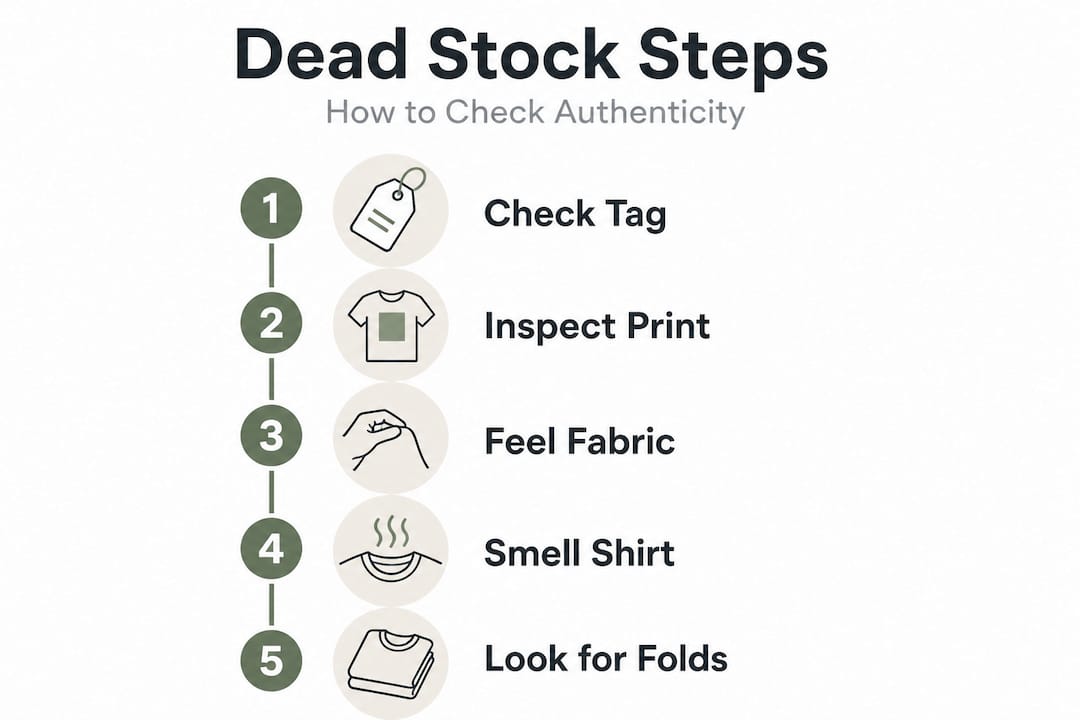
1. Examine the neck tag first
The tag is your primary data point. Check the brand (Fruit of the Loom, Hanes Beefy-T, and Screen Stars were all common 1990s blanks with distinct era-specific tag designs). Look at the font style, the stitching pattern, and the way the tag is attached. A single-stitch hem on the tag is a strong indicator of a pre-2000s garment. Size text should match fonts from the correct decade. A modern sans-serif font on what’s supposed to be a 1994 Pantera tour shirt is a red flag.
2. Assess the print quality and vibrancy
On genuine dead stock, the print should be bright, opaque, and show no cracking or fading. This is one of the most telling signs because even carefully stored worn shirts show some print degradation. If the graphic looks almost too perfect, that’s not necessarily a problem on dead stock, but compare it to reference photos. Modern reprints sometimes oversaturate colours in ways that look slightly off against a real 1990s original.
3. Examine the fabric feel and structure
Authentic dead stock from the 1990s often has a slightly starchy or crisp feel, depending on how it was stored. It hasn’t been through washing cycles that soften cotton fibres. The shirt should feel dense and structured. If it’s soft and drapey straight out of the seller’s packaging, that’s worth noting as a potential flag.

4. Smell the shirt carefully
This sounds unusual, but smell is one of the most reliable dead stock indicators. Long-term warehouse or box storage produces a distinctive musty or slightly chemical smell from the dyes and sizing compounds used in the original manufacturing process. A shirt that smells of modern laundry products has almost certainly been washed, regardless of what the seller claims.
5. Check for fold lines and packaging evidence
Factory fold lines are another strong indicator. Dead stock shirts often retain crisp fold marks from being packaged at manufacture. These are different from the random folds a shirt develops from being worn and washed. Warehouse marks, original poly bag remnants, or even original price stickers can further confirm authentic storage history.
Pro Tip: After inspection, proper care matters. Learn the right way to approach storing vintage shirts to preserve dead stock condition after you’ve acquired it. Incorrect storage can degrade even the most pristine find within a few years.
“The smell test is underrated. Experienced collectors can often tell within seconds whether a shirt has been washed, just from the way it smells. It’s one of those things you only develop by handling hundreds of genuine pieces.”
For an even deeper technical approach, specialist resources on authenticating metal shirts walk you through the finer details of print dot patterns and single versus double stitching that can further confirm authenticity.
Expert verification: Avoid common mistakes and fakes
Even with careful inspection, some pitfalls catch out even seasoned collectors. Here’s how to guard against costly mistakes.
Dead stock shirts are distinguishable from worn vintage by their pristine, unworn condition and the absence of wash or wear signs. But modern fakes are increasingly sophisticated, and some mistakes are surprisingly easy to make even when you think you’re being thorough.
Common mistakes collectors make:
- Trusting the seller’s claim without independent verification
- Focusing only on the print and ignoring the tag and fabric
- Overlooking print defects that indicate modern screen printing techniques
- Confusing a well-preserved worn vintage shirt for dead stock
- Skipping provenance questions entirely
| Warning sign | What it likely means | Action to take |
|---|---|---|
| Digital-looking tag with barcode | Post-2000 manufacture | Cross-reference tag type with era |
| Suspiciously vivid, even colour | Modern digital printing | Compare to reference originals |
| Synthetic or laundry odour | Washed or recently produced | Smell test fails, seek further proof |
| No fold lines at all | Likely worn and re-folded | Not necessarily dead stock |
| Seller unable to provide provenance | Unknown history | Proceed with caution or pass |
Modern bootlegs have become genuinely challenging to spot at a glance. Digital-printed tags that mimic vintage designs are now common. Artificially distressed fabric treatments can simulate storage ageing. Some operators even apply chemical treatments to produce a musty smell. The way to stay ahead is consistent reference checking and community consultation before committing significant money.
Pro Tip: Reverse image search the shirt’s graphic online. If identical prints appear on new merchandise sites or in recent listings without provenance, you’re likely looking at a reprint. Also consult resources like our step-by-step retro shirt shopping guide before purchasing from unfamiliar sellers.
Advanced collectors build relationships with other specialists who can provide a second opinion. If you’re ever considering selling your own pieces, understanding what buyers look for also sharpens your own eye. A solid understanding of how to sell vintage metal tees gives you perspective on both sides of the transaction.
What most collectors miss: The patience and context behind true dead stock
Here’s an opinion you might not find in a standard identification checklist: technical inspection alone is not enough, and relying purely on it is actually a beginner’s approach dressed up as expertise.
The most experienced collectors we know don’t just inspect shirts. They ask questions. Where did this shirt come from? Who had it before? Was it tour merch that a road crew member kept? Did it come from a storage unit clearance? Was the seller a former concert promoter? Context doesn’t just add colour to a purchase. It often provides the clearest authentication path available.
This matters because a shirt that passes every physical inspection check might still have a murky provenance. Conversely, a shirt with a scratched tag and unusual fold pattern might be absolutely genuine because the seller can trace it directly to a warehouse source with documentation. Physical checks and provenance together are what give you genuine confidence.
The other thing most collectors miss is the community aspect of this hobby. Identifying dead stock is genuinely a community effort. The collectors who are best at it are not necessarily those with the most technical knowledge, they’re the ones who engage with other serious collectors, share reference photos, discuss suspicious finds openly, and build reputations for accuracy over time. Deep engagement with resources like the collector’s guide to authentic vintage band tees is part of that process.
Patience also separates good collectors from great ones. Real dead stock finds are rare. The 1990s metal market is finite. If a deal seems almost too good to be true, it very likely is. The willingness to walk away from a suspicious purchase, even one you desperately want to be real, is what keeps your collection genuinely valuable over time.
Find verified dead stock and rare vintage metal shirts
If you want to skip the risk and go straight to authenticated dead stock and rare metal tees, there’s an easier way.
At Vintage Metal, every shirt in our collection is assessed for authenticity before it goes anywhere near a product listing. We specialise in genuine ex-tour stock, dead stock, and rare vintage heavy metal tees from the 1990s and beyond. Whether you’re after a specific band, tour, or era, our curated collection means you’re buying with confidence rather than hope. Browse our range of certified rare and dead stock shirts and add pieces to your collection that you can genuinely stand behind. For collectors who take authenticity seriously, we’re the shortcut that doesn’t compromise on standards.
Frequently asked questions
What’s the difference between dead stock and vintage for band shirts?
Dead stock shirts are unworn inventory that has never been worn or washed, whereas vintage simply means authentically old but may well have been worn and washed many times over.
Can you still find 1990s dead stock shirts in Australia?
Yes, but they are increasingly rare and typically found through specialist vintage stores or seasoned collectors with established networks and sourcing relationships.
How can I tell if a shirt is a modern reprint passed off as dead stock?
Check for era-correct tags and production details alongside fabric feel and print quality, and compare against reference photos of originals, since modern fakes almost always fail in at least one of these areas.
What’s the value premium for a dead stock 1990s shirt over a worn vintage one?
Dead stock shirts usually command a significantly higher price due to their rarity and pristine condition, with premium examples fetching multiples of what a comparable worn vintage piece would sell for.
Recommended
- 7 Iconic Types of Heavy Metal T Shirts for Collectors – Vintage Metal Store
- Identifying Dead Stock Heavy Metal Shirts Step-by-Step – Vintage Metal Store
- How to spot genuine vintage tour shirts: collector’s guide – Vintage Metal Store
- The real value of tour stock shirts for collectors – Vintage Metal Store


