



TL;DR:
- Authenticating vintage heavy metal shirts requires careful inspection of tags, print, stitching, and fabric.
- Using precise measurements and knowledge of era-specific details helps differentiate genuine items from fakes.
- Provenance documentation and community verification are essential for confident authentication.
Few feelings in collecting are worse than the slow realisation that the shirt you paid serious money for is a modern reproduction. You turn it inside out, squint at the tag, and something just feels off. The ink crackle looks too uniform. The blank is wrong. The single-stitch hem that should have sealed the deal suddenly feels like it proves nothing. Authenticating vintage and rare heavy metal shirts from the 1980s and 1990s is genuinely difficult, and the fakes have only gotten better. This guide gives you a practical, evidence-based workflow to assess any shirt with confidence, from the first glance to the final verdict.
Table of Contents
- Prepare for authentication: What you need and prerequisites
- Step-by-step authenticity workflow: From first look to detailed evaluation
- Troubleshooting and edge cases: Spotting fakes and ambiguous shirts
- Verification and confidence: Documenting results and making final decisions
- The uncomfortable truth about vintage shirt authenticity
- Ready to start your authentic vintage metal shirt collection?
- Frequently asked questions
Key Takeaways
| Point | Details |
|---|---|
| Use objective measurements | Pit-to-pit and shoulder-to-hem measurements are vital for spotting authentic vintage blanks, not just relying on photos. |
| Work through multiple signals | Authenticity is proven by cross-checking tag, blank, construction, ink, and provenance—no single detail guarantees a shirt’s origin. |
| Document your workflow | Keep clear records of your findings and evidence to support future resale or defend against ambiguous signals. |
| Expect some uncertainty | Even seasoned collectors must acknowledge risk; confidence comes from evidence, collective wisdom, and continuing education. |
Prepare for authentication: What you need and prerequisites
Before you examine a single shirt, you need the right tools and a solid understanding of what you are actually looking for. Walking in unprepared is how experienced collectors still get burned.
Essential tools for the job
Gather these before you start:
- Measuring tape (fabric, not metal): for objective pit-to-pit and shoulder-to-hem measurements
- Camera or smartphone: to capture high-resolution images of the tag, collar, print, and stitching
- Reference shirt: a known authentic example from the same era, ideally same blank or band
- Ultraviolet torch: helpful for spotting modern optical brighteners in fabric
- Magnifying glass or macro lens attachment: for close inspection of print dot patterns and stitching
- Notebook or spreadsheet: to record signals and build a decision log
The measuring tape is more important than most new collectors realise. Vintage blanks vary considerably between eras and manufacturers, and listing photos alone can be deeply misleading. Sellers who specialise in vintage stock will almost always provide pit-to-pit and shoulder-to-hem numbers, and if a seller cannot or will not, that reluctance is itself a signal. Always capture those measurements on shirts you already own so you build a reference library over time. For practical guidance on sizing vintage band shirts, comparing your known shirts against new purchases is the fastest way to build a reliable baseline.
Critical knowledge you need first
Tools only work if you know what you are measuring against. Spend time learning:
- Era-specific blanks: Fruit of the Loom, Hanes, Screen Stars, and Anvil each had distinct tag designs and fabric weights that changed across decades. A Screen Stars tag printed in a certain style places a shirt firmly in the late 1980s. A different variant signals mid-1990s.
- Tag construction evolution: heat-transfer tags replaced woven tags at different times for different manufacturers. Knowing when a specific brand made that switch matters.
- Printing techniques: plastisol screen printing on vintage shirts ages in a very specific way. The ink sits on top of the fabric, cracks as the shirt is washed, and the crackle pattern should be consistent with actual wear rather than artificially applied.
| Feature | Authentic 1980s/early 1990s shirt | Modern reproduction |
|---|---|---|
| Tag type | Woven or early heat-transfer | Often heat-transfer or printed |
| Stitching | Single-stitch hem common | Double-stitch more common |
| Ink feel | Raised, cracked with wear | Smooth, uniform, or artificially aged |
| Fabric weight | Heavier, often 50/50 blend | Lighter, often 100% cotton |
| Blank branding | Screen Stars, Fruit of the Loom vintage | Modern blank or no blank branding |
Pro Tip: Build your reference library before you start spending big. Acquire a few low-cost, clearly authentic shirts first and study them obsessively. That physical familiarity is worth more than any checklist.
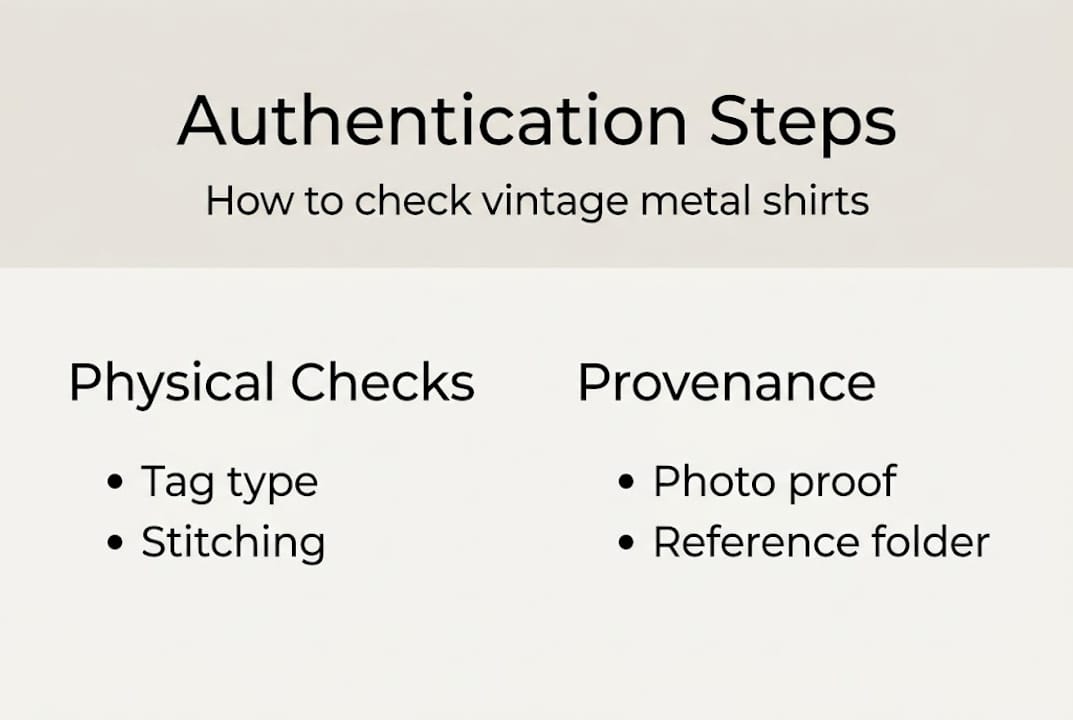
Step-by-step authenticity workflow: From first look to detailed evaluation
With your tools and knowledge ready, it is time to walk through the actual authentication workflow in real detail. Treat this as a sequence, not a menu. Each step informs the next.
-
Measure first: Record pit-to-pit and shoulder-to-hem before you do anything else. Compare these to known authentic blanks from the era. A Metallica 1988 tour shirt on a Screen Stars blank should fall within a certain size range. If it does not, note the discrepancy and keep it in mind.
-
Inspect the tag: Photograph the tag front and back, inside collar stitching, and any sizing label. Research the specific tag format for your suspected blank and era. Note any anachronistic features such as a barcode that did not exist on that blank until years later, or a country of origin label that conflicts with the supposed manufacture date.
-
Examine the print: Look at the ink with a magnifying glass. Authentic vintage plastisol printing has a distinct crackle and fade that is very hard to replicate convincingly at scale. The fade should be uneven and consistent with where the shirt was worn and washed most. Look at the dot structure of the print under magnification. Older screen printing shows a coarser dot pattern than modern digital or discharge prints.
-
Analyse construction: Check the hem stitch, sleeve attachment, and collar construction. Single-stitch hems are associated with pre-1995 garments, but this alone is not definitive. Look at the consistency of stitching across the whole shirt. Authentic vintage shirts show wear at stress points such as the underarm and collar seam, and that wear should look natural rather than deliberate.
-
Evaluate provenance: Does the seller have documentation? A receipt, a tour ticket stub from the correct city and date, or a history of ownership that can be verified? Experienced collectors seek provenance and request close-up photos of tag front and back, stress-point stitching, and inside collar construction before committing to high-value purchases.
| Workflow stage | What to look for | Red flag |
|---|---|---|
| Measurement | Matches era blank dimensions | Way outside expected range |
| Tag inspection | Era-correct format, consistent font | Barcode or label anachronism |
| Print examination | Natural crackle, uneven fade | Uniform crackle, sharp edges |
| Construction | Consistent wear at stress points | Deliberate distressing, clean stress points |
| Provenance | Documentation, seller history | No history, vague origin story |
For a consolidated reference when you are buying, this spotting genuine band shirts checklist runs through the key markers efficiently. If you are specifically chasing ex-tour or warehoused stock, the dead stock shirt guide covers the distinct characteristics of unworn old stock versus worn vintage. Before any major purchase, running through a shirts buying checklist takes only a few minutes and can save you from costly mistakes.
Pro Tip: Request photos of the shirt inside out. The inside seams, interior collar stitching, and reverse of the print reveal details that sellers of fakes almost never volunteer.
Troubleshooting and edge cases: Spotting fakes and ambiguous shirts
After following the workflow, you will inevitably encounter shirts where signals are mixed or confusing. This is where most collectors struggle, and where the most expensive mistakes happen.
Single-stitch hems are probably the most over-relied-upon signal in vintage shirt authentication. Many collectors treat a single-stitch hem as near-proof of a pre-1995 garment, and sellers who know this exploit that assumption. Modern reproductions are made on single-stitch blanks specifically because the market rewards that construction detail. A single-stitch hem tells you something, but only when combined with a consistent set of other signals.
The signals you want to see working together are:
- Era-appropriate tag and blank: The blank should match what was actually used for licensed band merchandise in that specific year and region
- Consistent print aging: Ink that has aged at a rate consistent with 30 to 40 years of washing and wearing, not aged artificially with sandpaper or chemical treatments
- Construction consistency throughout: Not just the hem, but collar, sleeves, and interior seams all showing the same characteristics
- Licensing details: Official licensed merchandise from the late 1980s often included specific copyright notices, licensing body references, and country of manufacture details that match historical records for that band and that tour
“Even if a garment looks vintage by construction, authentic aging cues can be counterfeited; the workflow must include a consistency check across tag, construction, print aging, and era-appropriate licensing details rather than any single indicator alone.”
Common fake signals to cross-check immediately include ink that has been deliberately distressed to look cracked (it usually looks too uniform or too heavy in areas that would not normally receive wear), tags that have been removed or replaced, and size labels that are too clean compared to the age claimed. For detailed guidance on how veteran collectors handle these ambiguous cases, this vintage tees expert checks resource covers the nuance well. Understanding the difference between truly aged vintage and items sold as vintage is covered thoroughly in this comparison of vintage vs second hand shirts.
Pro Tip: When signals conflict, do not try to talk yourself into a comfortable answer. Document the conflict, note which signals support and which contradict, and let the weight of evidence guide you rather than the signals you want to believe.
Verification and confidence: Documenting results and making final decisions
Once you have tackled ambiguous shirts and possible fakes, it is time to finalise your findings and make an informed decision.

Documenting your authentication process is not optional for serious collectors. Whether you are buying for personal enjoyment or with resale in mind, a written record of the signals you observed, the photos you captured, and the conclusions you reached has real value.
Here is how to bring it all together:
- List every signal observed: Write down every positive and negative indicator you found. Do not cherry-pick the ones that support your preferred conclusion.
- Weight the signals: Not all signals are equal. Era-correct tag on a known blank carries more weight than a single-stitch hem. Natural print aging across the whole garment carries more weight than a single faded spot.
- Check for internal consistency: Does everything align with the same period? A shirt cannot be authentically from 1988 if the tag style was not introduced until 1992.
- Research corroboration: Cross-reference with collector communities, band shirts collector guides, historical tour records, and known examples of the same shirt. If ten authenticated examples of this specific design all share certain characteristics and yours does not, that is significant.
- Make a confidence-weighted decision: Assign yourself a rough confidence level. High confidence means multiple corroborating signals with no major contradictions. Moderate confidence means mostly consistent signals with minor ambiguities. Low confidence means significant gaps or contradictions in evidence.
Counterfeiting is more sophisticated than most collectors expect. Counterfeiters mimic single-stitch and other construction traits specifically because collectors look for them. Combining signals and checking era expectations reduces risk, but even with thorough research, risk remains. The goal is not certainty. The goal is informed, confidence-weighted decision-making.
Specific vintage shirt design elements such as the graphic style, colour palette, and typography used by specific bands during specific tours can also serve as corroborating evidence. A graphic that uses design conventions that did not exist until years after the supposed tour date is a strong disqualifier.
Pro Tip: Keep a digital folder for each significant shirt you authenticate. Include photos, measurements, tag research, and your written verdict. This record becomes invaluable if you ever sell, trade, or need to re-evaluate the shirt years later.
The uncomfortable truth about vintage shirt authenticity
Here is something most authentication guides will not tell you plainly. There is no test, no checklist, and no amount of experience that produces absolute certainty. Every veteran collector has been wrong. Every reputable dealer has passed a fake they believed was genuine. That is not a failure of method. That is the nature of the field.
The real value of blank and tag styles lies in the fact that they are linked to specific manufacturing eras in ways that are genuinely difficult to replicate perfectly. But construction traits are the easiest thing to copy, which is exactly why they should always be secondary evidence rather than primary proof. The collectors who get this consistently right are the ones who treat authentication as ongoing education rather than a problem to be solved once.
Community matters more than any single technique. Talking through ambiguous shirts with other collectors, sharing photos in trusted groups, and contributing your own knowledge to the shared pool is what actually raises the standard. A retro shirt shopping guide can get you started, but the real depth comes from years of conversation with people who care as much as you do.
Accept uncertainty. Embrace the learning. The passion is what keeps this community honest.
Ready to start your authentic vintage metal shirt collection?
Putting these authentication skills into practice is far easier when you are buying from a source that has already done the work. Every shirt stocked here is selected with a collector’s eye: ex-tour stock, genuine deadstock, and second-hand shirts that have been assessed against the same signals covered in this guide.

If you want to see what a properly authenticated vintage metal shirt looks like in the hand, the Metallica 1992 tour tee is a strong example of era-correct construction, print, and provenance. Browse the full Metallica shirts collection for more reference-quality pieces, or explore the full range of vintage metal shirts to find exactly what you are looking for.
Frequently asked questions
What measurements are most critical for authenticating vintage metal shirts?
Pit-to-pit and shoulder-to-hem measurements are the most useful because they give objective, comparable sizing that helps identify the specific blank and flag inconsistencies with known authentic examples. Vintage blanks vary significantly between eras, so measurement discrepancies are often the first sign something is wrong.
Can single-stitch construction alone verify a shirt was made pre-1995?
No. Single-stitch hems are one indicator but are present on modern and altered shirts as well, so you need corroborating evidence including era-appropriate tag and blank, a plausibly aged ink and crackle pattern, and consistent construction throughout the
How do collectors handle ambiguous shirts where signals do not match?
Collectors cross-check tag, blank, print, and construction, then request provenance documentation and weigh all signals together. Even then, ambiguity and risk remain, and the decision is always confidence-weighted rather than definitive.
What is provenance and why is it important?
Provenance is the documented history of a shirt, including receipts, tour stubs, and ownership records. It adds significant context and can increase confidence in an authentication verdict, especially when physical signals alone leave room for doubt.
Recommended
- Collector’s guide to vintage heavy metal t-shirts: spot, value, collec – Vintage Metal Store
- How to Buy Second Hand Metal Shirts for Collectors – Vintage Metal Store
- Identifying Dead Stock Heavy Metal Shirts Step-by-Step – Vintage Metal Store
- 7 Steps to the Ultimate Heavy Metal Shirts Buying Checklist – Vintage Metal Store


