



TL;DR:
- Authentic 90s heavy metal shirts are identified by single-stitch hems, period-specific tags, and authentic fading patterns. Collectors seek iconic designs with genuine artwork, tour-specific details, and heavy fabric, as these features ensure authenticity and value. Regional and lesser-known band shirts with proven provenance are increasingly rare and highly collectible in the vintage market.
There’s a particular thrill in pulling a genuine 1990s heavy metal shirt from a pile at a vintage market, turning it over, and realising it’s the real thing. That feeling doesn’t come cheap or easy. With modern reprints, artificial distressing, and lookalike products flooding the market, tracking down authentic 90s band shirts has become a skill in itself. Whether you’re chasing a Metallica tour relic or a Slayer graphic from the height of thrash metal, this guide arms you with the knowledge to find, identify, and collect the shirts that matter most.
Table of Contents
- How to identify authentic 90s band shirt styles
- Most famous 90s band shirt styles: The icons collectors seek
- 1990s band shirt design trends: Graphics, sizes and fits
- Side-by-side comparison: Most collectible 90s band shirts
- Pro tips for building your 90s band shirt collection
- What most collectors miss about 90s band shirt styles
- Where to find rare and vintage 90s band shirts in Australia
- Frequently asked questions
Key Takeaways
| Point | Details |
|---|---|
| Authenticity matters | Single-stitch hems, vintage tags, and genuine graphics help spot real 90s shirts. |
| Tour shirts are prized | Limited tour prints from major bands are the most collectible and valuable. |
| Trends define value | Oversized fits, bold all-over prints, and original artwork shape what collectors want. |
| Smart buying tips | Check provenance and avoid fakes to build a collection with real long-term value. |
How to identify authentic 90s band shirt styles
As collectors begin their hunt, knowing how to spot the real deal is crucial. The differences between a genuine vintage shirt and a modern reproduction can be subtle, but once you know what to look for, they become obvious.
The most reliable starting point is the hem stitching. Authentic 90s shirts often feature single-stitch hems and distinctive tag brands, which immediately separate them from the double-stitched construction used in shirts made after roughly 1997 to 2000. Single stitching runs a single thread along the sleeve hem and bottom edge. Hold the hem up to the light and count the rows of stitching. One row means you’re likely dealing with something from the right era.
Neck labels tell you everything. The key manufacturers supplying officially licenced band shirts in the 90s were Brockum, Giant, Winterland, and Anvil. These names carried genuine tour merch from the era’s biggest acts. If the label says Fruit of the Loom with modern branding, it’s almost certainly a reproduction. Understanding vintage apparel definition within the collector context helps here. A shirt printed after the fact on a modern blank isn’t vintage, regardless of how distressed it looks.
Print feel and fade are equally telling. Original 90s screen prints have a cracked, slightly raised texture that comes from decades of genuine wear and washing. Reproductions often fake this with a soft, even ink treatment that looks faded but feels too consistent. Real fading is irregular, concentrated where fabric flexes and rubs.
Fabric weight matters too. Most legitimate 90s tour shirts used heavier cotton or cotton poly blends, generally around 180 to 200 gsm. Understanding 90s band shirt fabrics helps distinguish authentic construction from the thinner, softer blanks common today.
Key authenticity markers to check:
- Single-stitch sleeve and bottom hems
- Tag brands: Brockum, Giant, Winterland, Anvil, Screen Stars
- Cracked or faded ink with natural wear patterns
- Copyright date on the print matching the tour or album year
- Heavier fabric weight with a stiffer hand feel
Pro Tip: Run your finger across the print. Genuine vintage ink has a texture that feels part of the fabric, not sitting on top of it. If it feels like a thin, smooth film, treat it with caution.
Most famous 90s band shirt styles: The icons collectors seek
Having covered what makes a shirt authentic, it’s time to spotlight the 90s shirts every collector dreams of owning.
The decade produced an extraordinary range of heavy metal shirts, and not all are equal in desirability. Iconic shirts from 90s tours include Metallica’s 1992 Don’t Tread on Me and Iron Maiden’s Fear of the Dark, both of which regularly appear at the top of collector wishlists and command serious prices at auction and in specialist stores.
What makes a shirt truly iconic isn’t just the band name. It’s the combination of artwork, tour specificity, and cultural moment. A Metallica shirt from their 1992 North American leg carries weight because the Black Album era was a turning point in metal history. Iron Maiden’s Fear of the Dark tour coincided with a crucial period of the band’s evolution, and the Eddie artwork from that run is unmistakable.
Slayer’s Decade of Aggression shirts are another tier unto themselves. Released alongside their live album, they captured the band at a ferocious peak. Sepultura’s Chaos AD era shirts, featuring bold tribal imagery, are increasingly rare and represent one of the most visually striking graphic programmes of the decade. Understanding why band tees are iconic comes down to this intersection of art, moment, and scarcity.
“A vintage band shirt isn’t just clothing. It’s a document of a moment in music history that can’t be recreated, only discovered.”
Most sought-after 90s heavy metal shirts include:
- Metallica Don’t Tread on Me 1992 USA tour (Brockum tag)
- Iron Maiden Fear of the Dark 1992 European and world tour versions
- Slayer Decade of Aggression (both the tour and album release versions)
- Pantera Vulgar Display of Power era shirts (1992 to 1994)
- Sepultura Chaos AD and Roots era tribal prints
- Megadeth Countdown to Extinction tour shirts
Look for dates and venue lists on the reverse as confirmation of tour-specificity. Original copyright notices printed inside or on the sleeve are another strong authenticator. Some collectors seek top vintage band tees across multiple bands to create a complete picture of the decade’s output.
Pro Tip: Tour-specific shirts with full venue lists on the back are more valuable than general album shirts. A shirt that lists Australian tour dates from 1992 is extraordinarily rare and worth far more than an equivalent US print.
1990s band shirt design trends: Graphics, sizes and fits
Recognising the names is one step, but understanding design and fit completes the collector’s skillset.
Oversized fits and all-over prints became a hallmark trend for 90s heavy metal shirts, particularly from 1991 onwards. This wasn’t an accident. The oversized fit matched the culture of the genre, where bigger, bolder, and more confrontational was always the right direction.
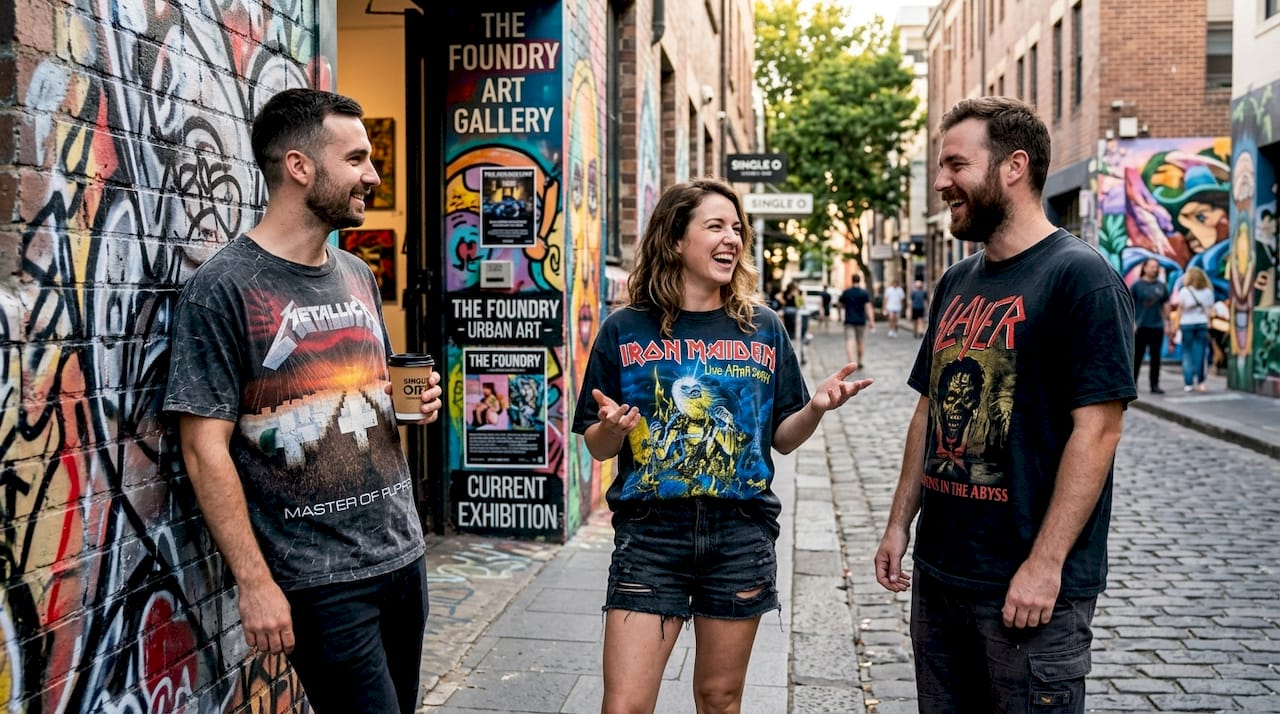
The early part of the decade carried over some 80s conventions: standard block sizing, centred chest prints, and relatively clean back graphics. By 1993 and 1994, the trend had shifted decisively. All-over prints that wrapped around sleeves, over-shoulder graphics, and enormous back panels became standard for major tour merch. Bands like Obituary and Morbid Angel were producing shirts that felt almost more like wearable posters than garments.
Key design trends across the decade:
- Early 90s: Classic block prints, single graphic front and back, standard sizing
- Mid-90s: Oversized fits, bolder dark imagery, full venue lists on reverse
- Late 90s: All-over prints, photorealistic artwork, double-sided full-bleed graphics
| Era | Typical fit | Print style | Common tags |
|---|---|---|---|
| 1990 to 1992 | Standard to slightly large | Single graphic, chest and back | Brockum, Giant, Winterland |
| 1993 to 1995 | Oversized | Bold full-back, photo prints | Giant, Anvil, Screen Stars |
| 1996 to 1999 | Oversized to XL dominant | All-over, double-sided heavy | Fruit of the Loom, Delta |
The shift in tag brands from Brockum and Giant to Fruit of the Loom tracks directly with the commercialisation of band merch in the later part of the decade. This is why many serious collectors focus on shirts from 1990 to 1995. Check the shirt fabrics and tags section of collector guides for full breakdowns by year.
Cotton weight also evolved. Heavier shirts from the early part of the decade feel more substantial and hold their prints better over time. Cross-reference your finds against a tour shirt checklist to make sure all the details line up.
Statistic: Vintage market data consistently shows that shirts from the 1990 to 1995 period, in verified original condition, command 30 to 50 per cent higher prices than equivalent late-90s prints, even for the same band and tour.
Side-by-side comparison: Most collectible 90s band shirts
Armed with an understanding of styles and trends, let’s compare the true icons side-by-side.
Collectors value shirts by band, rarity, iconic artwork, and tour history. This comparison captures the shirts most likely to hold and grow in value.
| Band | Tour/era | Artwork style | Rarity | Typical collector value |
|---|---|---|---|---|
| Metallica | Don’t Tread on Me, 1992 | Bold eagle and snake graphic | High | $300 to $700+ AUD |
| Iron Maiden | Fear of the Dark, 1992 | Eddie full-back print | Very high | $250 to $600 AUD |
| Slayer | Decade of Aggression, 1991 | Dark pentagram and logo | High | $200 to $500 AUD |
| Pantera | Vulgar Display, 1992 to 1993 | Fist impact graphic | Medium to high | $150 to $400 AUD |
| Sepultura | Chaos AD, 1993 | Tribal and band imagery | Very high | $300 to $650 AUD |
| Megadeth | Countdown to Extinction, 1992 | Vic Rattlehead graphic | High | $200 to $450 AUD |
Checklist for evaluating a shirt’s desirability:
- Confirm single-stitch hems and period-accurate tag brand
- Verify copyright year on print matches claimed tour or release year
- Check for venue list or tour dates on reverse as tour-specific evidence
- Assess print condition, looking for authentic cracking rather than artificial distressing
- Research the specific artwork to confirm it matches known genuine versions
- Review rare 1990s shirt examples to benchmark your find against verified pieces
- Compare sizing against era-specific norms for the claimed year
Pro tips for building your 90s band shirt collection
Once you’re equipped with knowledge of what to look for, these expert tips will set you on the path to building a truly enviable collection.
Collectors often find the best deals at vintage shops and specialised online sellers rather than general marketplace listings. Specialist sellers have already done the authentication work and price accordingly, but you’re also far less likely to receive a convincing fake. General auction and marketplace platforms require much more scrutiny.
Avoiding the most common pitfalls:
- Modern reprints are the biggest trap. Many major labels and bands have reissued classic shirt designs on new blanks. These are legitimate products, but they are not vintage and should never be sold as such.
- Artificial distressing involves chemically or mechanically treating a new shirt to appear worn and faded. Feel the fabric carefully and examine whether fading is consistent across the whole shirt (artificial) or concentrated at wear points (genuine).
- Wrong tag for the era. If a shirt claims to be from 1992 but carries a post-2000 tag brand, it isn’t what it claims to be. Period.
- Oversized sizing labelled as vintage. Many current reprints use an oversized fit to mimic 90s style, but the fabric, stitching, and tags will give them away.
Use a collector’s tour shirt checklist every time you evaluate a new piece, even once your eye is well trained. It keeps your standards consistent and protects your investment.
For care and preservation, always wash vintage shirts inside out in cold water on a gentle cycle. Avoid tumble drying entirely. Air dry flat or on a padded hanger away from direct sunlight, which degrades both fabric and print over time. For display, UV-protective acrylic frames prevent fading and allow you to show the shirt as the artwork it truly is.
Pro Tip: Store shirts you’re not displaying in acid-free tissue paper inside a sealed container. Avoid plastic bags, which trap moisture and accelerate fabric degradation. A collection treated with this level of care retains far more value long term.
What most collectors miss about 90s band shirt styles
Here’s the truth that serious collectors have worked out over years of hunting: the biggest gains in this market rarely come from Metallica shirts everyone already knows about.
The next tier of collectibility sits with smaller-run items from regional bands and support acts. A shirt from a 1993 Australian tour by a lesser-known thrash act might have been printed in quantities of 200. That’s a documented piece of local music history that can’t be replicated, and its value has nowhere to go but up as collectors exhaust the obvious targets and start digging deeper.
Provenance also matters in ways the mainstream conversation often ignores. A shirt with a story, one documented as worn by a crew member on a specific tour or pulled from genuine deadstock in a former band manager’s storage, carries weight beyond its print and stitching. That narrative is part of what you’re collecting. Vintage tee examples from lesser-known acts often surface with compelling provenance precisely because they weren’t mass-produced and passed through fewer hands.
The myth that only headline acts produce valuable shirts is holding many collectors back. Obituary, Crowbar, Eyehategod, and regional touring acts produced shirts in genuinely limited runs through the 90s. These shirts rarely appear at major auction houses yet, which is exactly when experienced collectors go looking. Think of the collector who bought Nirvana bootleg shirts in 2002 because they weren’t yet fashionable. The principle is identical in heavy metal collecting.
The uncomfortable truth is that perceived rarity and actual collectibility are different things. A shirt can be scarce because it was never desirable, or because it genuinely documented a significant cultural moment. Learn to tell the difference and you’ll find opportunities that most collectors walk straight past.
Where to find rare and vintage 90s band shirts in Australia
Now that you’re inspired and equipped, securing your next piece is the real priority.
At Vintage Metal, we source directly from ex-tour stock, deadstock holdings, and specialist collections built over decades. Every piece in our range has been assessed against the exact criteria covered in this guide. Right now you can explore the rare Metallica 1992 tour shirt, one of the most recognisable pieces of 90s tour history, or browse the full range of vintage Metallica shirts to find the specific era or tour that matches your collection. For those building across multiple acts and eras, the full vintage shirt catalogue is the place to start your next hunt.
Frequently asked questions
What are the rarest 90s heavy metal band shirts?
Original tour tees and limited edition prints are most collectible, with rare shirts including original Metallica 1992 tour tees, Iron Maiden’s Fear of the Dark, and limited edition Sepultura prints. Shirts from smaller regional tours and support acts can be rarer still.
How can I tell if my 90s band shirt is genuine?
Check for single-stitch hems and original tags like Brockum or Giant, and look for period-accurate graphics with genuine cracking and wear patterns consistent with decades of use.
Are all 90s band shirts valuable?
Not all are valuable. Collectors value shirts by band, rarity, iconic artwork, and tour history, meaning major band shirts from significant tours in original condition consistently command the highest prices.
Where can I buy authentic 90s band shirts in Australia?
Look for specialist vintage sellers that focus on heavy metal memorabilia and verified tour stock, as vintage shops and specialised online sellers offer the best combination of authenticity and selection.
Recommended
- Essential 90s metal band shirts every collector needs – Vintage Metal Store
- Iconic 1990s heavy metal shirts: collector picks – Vintage Metal Store
- Band t-shirts in metal culture: identity, value and collecting – Vintage Metal Store
- Fabric types in 1990s band shirts: a collector’s guide – Vintage Metal Store


