



TL;DR:
- 1990s band tees are historical artifacts tied to iconic tours and music culture.
- Authenticity is verified by stitching, fabric, labels, and print aging indicators.
- Their resurgence in fashion highlights their cultural and collectible value beyond mere trendiness.
If you think 1990s band tees are just a fashion trend that keeps cycling back, you’re missing the real story. These shirts carry the weight of entire musical movements, tour memories, and fan identities that no reprint can replicate. For heavy metal collectors and enthusiasts, a genuine 1990s band tee is not a costume or a style choice. It’s a piece of living history. The graphics, the faded cotton, the tour dates printed on the back — every detail tells you something real about where music was at a specific moment in time. This article breaks down the origins, authenticity markers, fashion resurgence, and practical collecting wisdom you need to truly appreciate these shirts.
Table of Contents
- The origins and cultural significance of 1990s band tees
- What makes a 1990s band tee authentic and valuable
- The resurgence of 1990s band tees in modern fashion
- Collecting, wearing, and preserving your 1990s band tees
- Why the true value of 1990s band tees goes beyond fashion trends
- Find your next authentic 1990s band tee today
- Frequently asked questions
Key Takeaways
| Point | Details |
|---|---|
| Cultural icons | 1990s band tees capture the history and spirit of heavy metal and music subcultures. |
| Authenticity matters | Recognising true vintage tees comes down to details like tags, stitching, and original graphics. |
| Resurgence in fashion | Vintage band tees are prominent in modern streetwear and increasingly valuable. |
| Collect and preserve | Proper care keeps rare 1990s band tees in wear-ready and investment-worthy condition. |
The origins and cultural significance of 1990s band tees
Band tees didn’t start in the 1990s, but that decade is where they became something else entirely. The heavy metal scene of the era was exploding across arenas and stadiums, and concert merchandise became the primary way fans connected their identity to the music they loved. You bought the shirt at the show. That was the point. It proved you were there.
But there was another layer to it. Bootleg vendors set up outside venues, selling unlicensed tees with their own wild graphics and interpretations of band imagery. These bootlegs, often printed on cheap single-stitch cotton, have since become some of the most sought-after pieces in the collector market. They represent a rawness and a street-level energy that official merchandise sometimes lacked.
“1990s band tees are closely tied to the identity of heavy metal subcultures and music history.”
What made these shirts so powerful was what they signalled to other fans. Wearing a Pantera or Sepultura tee in 1994 was a declaration. It told people which tribe you belonged to, what shows you’d attended, and how deep your commitment to the music ran. The graphics weren’t just decoration. They were visual shorthand for an entire worldview.
Some of the most iconic tees from this era came from landmark tours:
- Metallica’s 1992 “Don’t Tread on Me” USA tour
- Slayer’s Decade of Aggression tour merchandise
- Pantera’s Vulgar Display of Power era shirts
- Sepultura’s Chaos A.D. tour tees
- Megadeth’s Countdown to Extinction tour merchandise
Each of these shirts documented a specific cultural moment. The back-print tour dates, the city listings, the graphic art — all of it was a snapshot. If you want to understand why collect band t-shirts matters to serious enthusiasts, it starts here. These weren’t just garments. They were mementoes of a music scene at its peak. And if you’re still getting your head around the broader category, understanding what is a band tee gives you a solid foundation before you start hunting.
What makes a 1990s band tee authentic and valuable
Knowing the history is one thing. Being able to spot a genuine 1990s shirt in a pile of reproductions is another skill entirely. Collectors rely on specific details to authenticate and evaluate vintage band shirts, and once you know what to look for, fakes become obvious fast.
The most reliable indicators of authenticity are physical. Genuine 1990s tees were almost always made from single-stitch construction, meaning the hem and sleeves are sewn with a single row of stitching rather than the double-stitch used on modern shirts. The cotton itself feels different — heavier, softer, and with a natural fade that no artificial distressing can truly replicate.
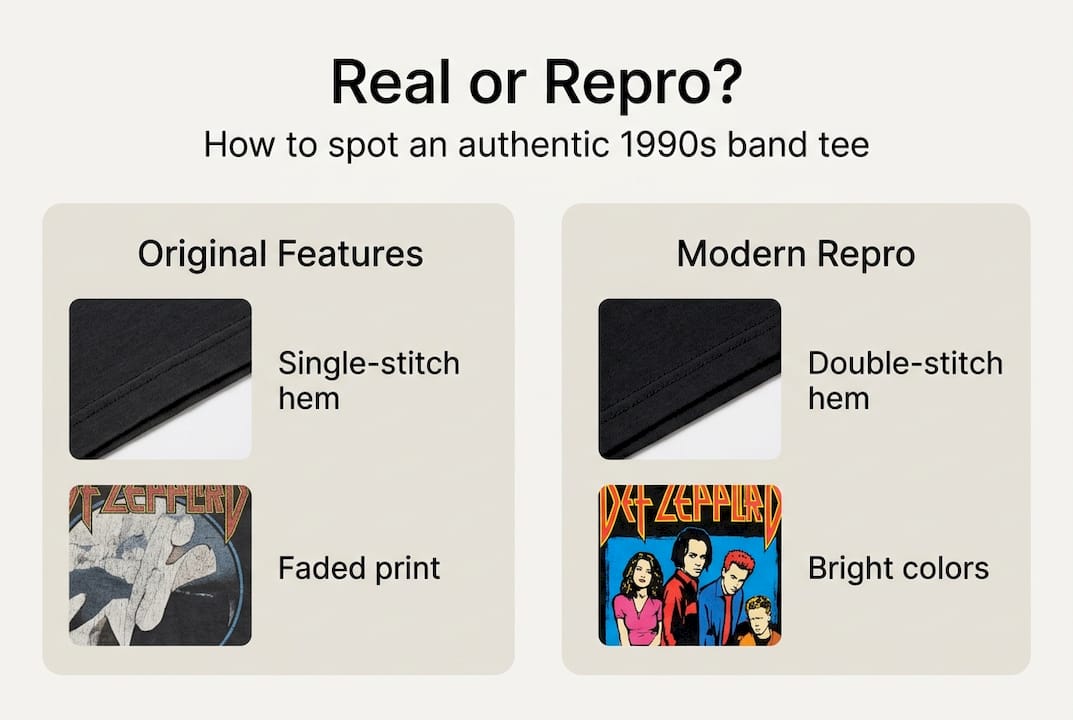
| Feature | Authentic 1990s tee | Modern reproduction |
|---|---|---|
| Stitching | Single-stitch hem | Double-stitch hem |
| Label | Fruit of the Loom, Hanes, Screen Stars | Gildan or generic modern label |
| Print texture | Cracked, faded, raised | Flat, smooth, even colour |
| Cotton weight | Heavier, pre-shrunk | Lighter, uniform |
| Smell | Aged cotton, sometimes musty | Fresh chemical or new fabric smell |
The tag is one of the first things experienced collectors check. Labels from manufacturers like Fruit of the Loom, Hanes, and Screen Stars from the 1990s have specific fonts and designs that changed over the years. Knowing defining vintage apparel criteria helps you date a shirt accurately.
Here’s a practical checklist for evaluating a potential purchase:
- Inspect the hem stitching — single-stitch is a strong indicator of pre-2000 manufacture
- Check the label manufacturer and cross-reference with known production years
- Examine the print for natural cracking and fading consistent with age
- Research the specific tour dates printed on the shirt to confirm historical accuracy
- Look for any inconsistencies in graphic colour that suggest modern reprinting
For a deeper breakdown, the keys for collectors guide covers authentication in thorough detail, and the tour shirt checklist is an invaluable tool when you’re at a market or browsing online.
Pro Tip: Never wash a rare tee in a machine. Hand washing in cold water with no agitation preserves both the print and the cotton integrity far longer.
The resurgence of 1990s band tees in modern fashion
Something shifted in the mid-2010s and it hasn’t reversed. Vintage 1990s tees are now regularly featured in mainstream and alternative fashion circles, and the prices on resale platforms reflect exactly how serious that demand has become.

Celebrities wearing Metallica, Iron Maiden, and Slayer shirts to red carpet events and in paparazzi shots did something unexpected. They introduced these shirts to an entirely new audience that had no direct connection to the original music scene. Fashion editors started calling them “statement pieces.” Luxury streetwear brands began producing their own band-inspired graphics, which ironically drove collectors back to the real thing.
| Band | Average resale price (2026) | Demand trend |
|---|---|---|
| Metallica | $180 to $600 AUD | Strong and rising |
| Pantera | $150 to $450 AUD | Consistent high demand |
| Slayer | $200 to $700 AUD | Increasing sharply |
| Sepultura | $120 to $350 AUD | Growing collector interest |
| Megadeth | $140 to $500 AUD | Steady collector demand |
The resale market for rare 1990s band tees has grown dramatically. Some individual shirts have sold for over $1,000 AUD at auction when the combination of rarity, condition, and band significance aligns perfectly.
The key insight here: fashion drove awareness, but authenticity drives value. People who bought vintage tees purely as fashion items are now sitting on pieces worth multiples of what they paid, while the collector community has always understood this.
Pro Tip: If you’re new to styling vintage metal tees, pair them with simple, neutral pieces. The shirt should do the talking — not compete with everything else you’re wearing.
Collecting, wearing, and preserving your 1990s band tees
So you’ve found a genuine 1990s band tee. Now what? The decisions you make next will determine whether it stays in great condition for decades or deteriorates into something unwearable.
Expert collectors recommend thoughtful storage, minimal washing, and careful display to maintain band tee quality. The best approach depends on whether you’re collecting to preserve or collecting to wear — and both are entirely valid.
Here’s how to source authentic pieces effectively:
- Attend swap meets, record fairs, and vintage markets where sellers often don’t know what they have
- Search estate sales and op shops in areas with strong music history
- Use specialist online platforms and verify seller reputation before purchasing
- Build relationships with other collectors who may trade or sell from their own collections
- Follow dedicated vintage metal communities on social media where rare finds are posted regularly
For storage and preservation:
- Fold shirts flat rather than hanging them, which can stretch the cotton over time
- Store in acid-free tissue paper inside sealed plastic containers away from light
- Keep away from humidity, which accelerates fabric degradation and print cracking
- Never use wire hangers if you do display them — padded hangers only
Some collectors never wear their rarest shirts. That’s a completely legitimate choice. A mint-condition Slayer tour tee from 1994 is worth more unworn, and some collectors treat their pieces the way art collectors treat paintings. For practical guidance on examples of vintage band tees and what condition grades actually mean, that resource is worth bookmarking.
If you do wear them, check out how to style vintage metal tees without compromising the shirt’s integrity. And for tracking down expert tips for finding vintage shirts, the hunt itself is half the enjoyment.
Pro Tip: Photograph every shirt in your collection from multiple angles before wearing or storing it. This creates a condition record that’s invaluable for insurance or future resale.
Why the true value of 1990s band tees goes beyond fashion trends
Here’s the perspective that most fashion articles miss entirely. The resurgence of 1990s band tees in mainstream culture is real, but it’s also temporary in the way all fashion cycles are temporary. What isn’t temporary is the reason serious collectors have always cared about these shirts.
Every authentic 1990s band tee is a primary source document. It tells you what a band was doing, where they were touring, and what their visual identity looked like at a specific moment. That’s not nostalgia. That’s music history in cotton form.
Wearing one of these shirts is also an act of connection across generations of fans. When someone sees your rare tees from a 1992 Metallica tour and their eyes light up, that’s a genuine human moment. The shirt created it. No reproduction can do that with the same weight.
The emotional legacy tied to each shirt is what makes them irreplaceable. Someone wore that shirt to a show that changed their life. That energy doesn’t wash out.
Find your next authentic 1990s band tee today
If reading this has sharpened your appetite for the real thing, you’re in the right place. We stock verified vintage heavy metal tees sourced directly from ex-tour stock, dead stock, and trusted collections — shirts with genuine provenance and the kind of condition that serious collectors expect.
Start with something iconic. The rare Metallica 1992 tour shirt is exactly the kind of piece that defines a collection. Browse the full range of vintage Metallica shirts or explore all vintage band tees across every major metal act from the era. Every shirt we carry is the genuine article — no reproductions, no compromises.
Frequently asked questions
How can you tell if a 1990s band tee is authentic?
Check labels, stitching, print quality, and research the original tour dates and designs to avoid modern reproductions. Manufacturing details like single-stitch hems and period-correct tags are the most reliable indicators.
Why do collectors value 1990s band tees so highly?
These tees mark music history, represent iconic tours, and have become rare cultural artefacts sought after by enthusiasts. Cultural significance and rarity drive collector interest far beyond simple nostalgia.
Are 1990s band tees still popular in fashion today?
Yes, they are a staple in streetwear and are regularly styled by celebrities and fashion influencers. The fashion world has fully embraced vintage 1990s band tees, pushing resale prices higher each year.
What is the best way to care for vintage band tees?
Store them in cool, dry conditions away from sunlight, and wash sparingly with gentle methods to preserve prints and cotton. Careful storage and gentle washing are the two most important habits any serious collector can develop.
Recommended


