



Plenty of collectors have been burned by a shirt labelled “vintage” that turned out to be a reprint from five years ago. The word gets thrown around loosely, and for anyone serious about authentic 1990s heavy metal tour gear, that confusion is more than frustrating — it can cost real money. Knowing exactly what qualifies as vintage, what separates an original tour shirt from a later reproduction, and why provenance matters is the foundation of smart collecting. This guide cuts through the noise and gives you the clear benchmarks you need to buy, trade, and collect with confidence.
Table of Contents
- What does vintage really mean in apparel?
- Originals, reproductions, and reprints: Not all old shirts are vintage
- How to spot authentic 1990s heavy metal vintage: Collector benchmarks
- Why authenticity and provenance matter in vintage collecting
- The uncomfortable truth about vintage: What most miss
- Find authentic 90s heavy metal vintage shirts
- Frequently asked questions
Key Takeaways
| Point | Details |
|---|---|
| True age matters | To be vintage, apparel needs to be at least 20 years old but less than 100. |
| Origins over age | Original production and provenance define true vintage, not just the date on the label. |
| Collector benchmarks | Key 1990s heavy metal shirt markers are single-stitch construction and Brockum tags. |
| Avoid fakes | Knowing the difference between originals and reproductions prevents costly mistakes for collectors. |
What does vintage really mean in apparel?
The word “vintage” gets misused constantly, especially in online marketplaces where sellers slap the label on anything that looks a bit worn. In the apparel world, there is an accepted industry standard: vintage apparel is generally defined as garments at least 20 years old but under 100 years old. Anything older than a century moves into antique territory. Anything newer is simply secondhand or used clothing.
For heavy metal collectors, this means a shirt from a 1994 Metallica tour is firmly vintage in 2026. A shirt from 2010 is not, regardless of how faded it looks. The age threshold is the starting point, but it is far from the whole story.
Here is how the three main categories break down:
| Category | Age range | Examples |
|---|---|---|
| Modern | Under 20 years | Current band merch, recent reprints |
| Vintage | 20 to 99 years | 1990s and early 2000s tour shirts |
| Antique | 100 years or older | Pre-WWII garments, early 20th century clothing |
For collectors focused on what makes a shirt vintage, the key traps are easy to fall into. A shirt can be old without being vintage in any meaningful collecting sense. Reproductions, reissues, and bootlegs all age over time, but ageing does not make them authentic. The distinction matters enormously when you are paying collector prices.
A few common traps to watch for:
- Faded colours do not confirm age. Artificial distressing is a well-known technique used by manufacturers to simulate wear.
- Worn-out tags can be deliberately damaged to obscure production dates.
- “Vintage style” labelling is a marketing term, not a factual description of age or origin.
The 20-year rule is your baseline. Everything else is about verifying that the shirt is genuinely what it claims to be.
Originals, reproductions, and reprints: Not all old shirts are vintage
This is where collecting gets serious. Even if a shirt clears the 20-year age threshold, it is not automatically vintage in the collector’s sense. Age alone is insufficient; reprints or reproductions over 20 years old are not vintage if they were not part of the original production run. An archival release, where a brand revisits a past design, is also different from genuine vintage.
So what makes a shirt an original? It comes down to production context. An original tour shirt was manufactured and sold during a specific tour or release window, typically through official merchandisers or at the venue itself. It carries the marks of that era: the printing methods, the blank shirt manufacturers, the licensing details, and the physical construction techniques of the time.
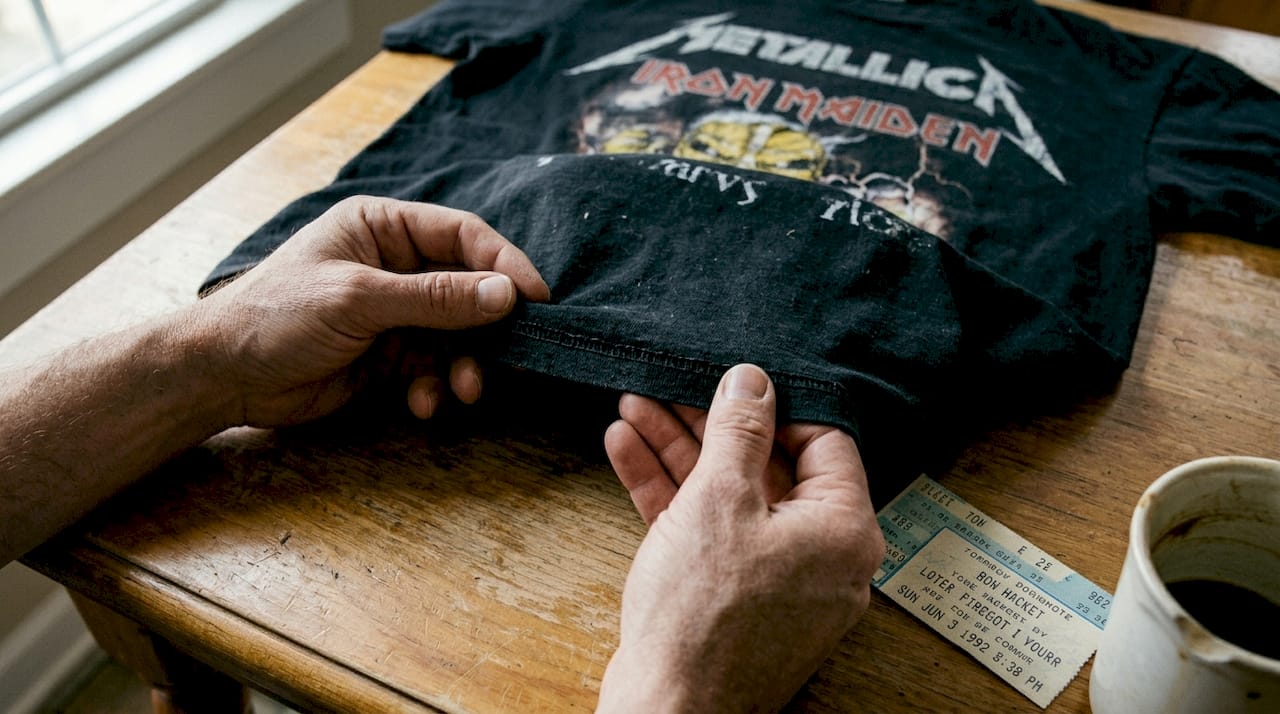
Reproductions are copies of original designs, sometimes made years or even decades later. They might look nearly identical to the untrained eye, but the materials, stitching, print quality, and tags will differ. Some reproductions are made with good intentions as tribute pieces, but they hold a fraction of the collector value of an original.
Here is a quick comparison:
| Feature | Original vintage | Reproduction |
|---|---|---|
| Production date | During tour/release | After original run |
| Tag details | Period-correct licensee | Modern or generic |
| Construction | Single-stitch, period fabrics | Double-stitch, modern blanks |
| Collector value | High | Low to moderate |
How to identify originals in practice:
- Check the tag for the original licensee name, such as Brockum, Giant, or Winterland.
- Examine the hem stitching. Single-stitch construction was standard for shirts made before the mid-1990s.
- Look at the print itself. Vintage screen prints have a specific texture and slight imperfection that modern digital prints do not replicate.
- Research the specific tour dates and compare against known production records.
- Cross-reference with collector communities and databases for known authentic examples.
Pro Tip: When identifying dead stock shirts, look for shirts that show no wear but still carry all the period-correct construction details. Dead stock means the shirt was never sold or worn, making it exceptionally rare and valuable.
Understanding [why provenance matters for collectors](https://vintagemetal.com.au/blogs/news/why vintage shirts collectible) is the difference between building a meaningful collection and accumulating expensive mistakes.
How to spot authentic 1990s heavy metal vintage: Collector benchmarks
Now you know how to distinguish originals from mere reprints, let’s break down the collector’s checklist for 90s heavy metal shirts. The 1990s was a golden era for heavy metal tour merchandise, and the physical details of shirts from that period are well-documented among serious collectors.
The single most important construction detail is the single-stitch hem. Before roughly the mid-1990s, most band shirts were constructed with a single row of stitching along the sleeves and bottom hem. After that period, double-stitch became the industry standard. A genuine 90s shirt will almost always show single-stitch construction on the sleeve cuffs and body hem.
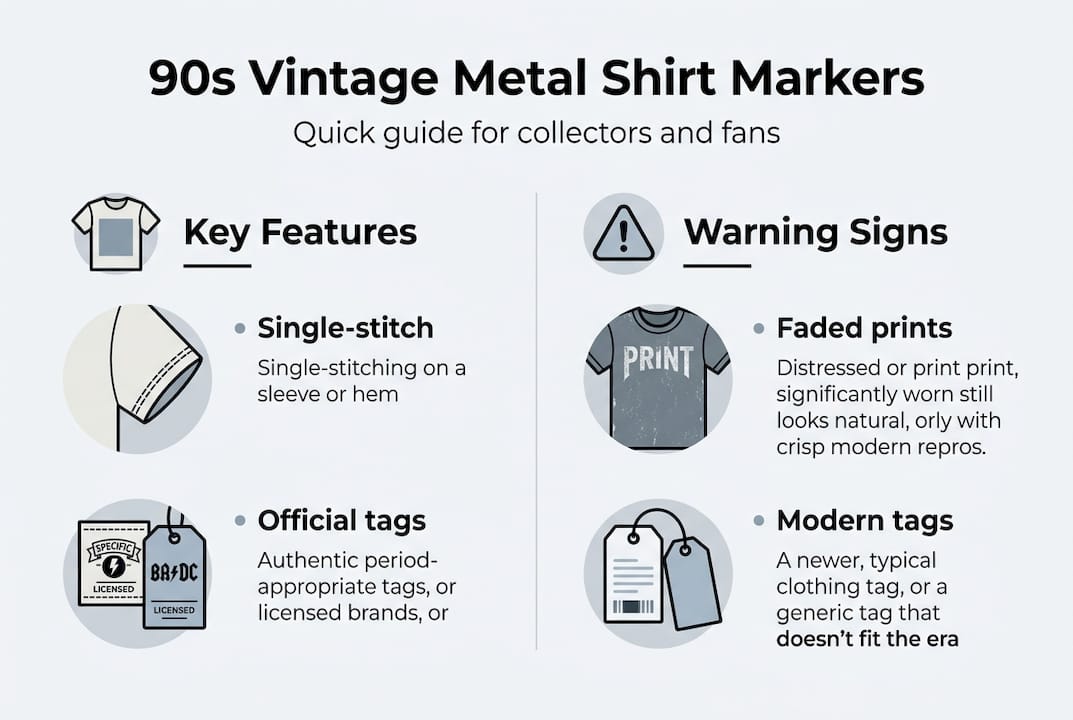
Tag identification is equally critical. Single-stitch and Brockum tags are key benchmarks for true vintage tour merch from the 1990s. Brockum was one of the dominant official tour merchandisers of the era, handling licensing for major acts including Metallica, Guns N’ Roses, and Motörhead. Other legitimate tags from the period include Giant, Winterland, and Changes.
Key collector benchmarks at a glance:
- Single-stitch hem and sleeves: Standard construction pre-mid-1990s.
- Period-correct licensee tags: Brockum, Giant, Winterland, Changes.
- Screen print texture: Slightly raised, cracked with age, not digitally smooth.
- Blank shirt brand: Fruit of the Loom, Hanes, or Anvil labels from the correct era.
- Official licensing marks: Copyright symbols with the correct year and band management details.
“For 1990s heavy metal enthusiasts, single-stitch and Brockum tags are key benchmarks for true vintage tour merch.”
Artificial distressing is a real problem in this market. Sellers sometimes wash shirts repeatedly with abrasives, bleach selectively, or use heat treatments to simulate decades of wear. The tell is in the consistency of the ageing. Natural wear concentrates at collar edges, underarms, and fold lines. Artificial distressing tends to be more uniform or appears in unusual places.
For more detail on [iconic tour shirt tips](https://vintagemetal.com.au/blogs/news/famous heavy metal tour merchandise tips), the specifics of construction and licensing are well worth studying before you spend serious money. A solid tour shirt checklist is an invaluable tool for any collector, and if you are serious about [collecting rare 1990s tees](https://vintagemetal.com.au/blogs/news/collect rare 1990s heavy metal tees expert guide 2026), building your knowledge base now will save you from costly errors later.
Why authenticity and provenance matter in vintage collecting
Collectability is not just about the look or even the year. The deeper story behind a shirt is what separates a true collector’s piece from a decorative item. Provenance, meaning the documented or traceable history of an object, is what gives a vintage shirt its real weight.
Vintage garments at least 20 years old carry cultural context that newer items simply cannot replicate. A shirt from the 1994 Metallica “Shit Hits the Sheds” tour was physically present at those shows. It was worn by someone in the crowd, or sold at a merch table, or sat in a box in a warehouse for three decades. That physical history is embedded in the object itself.
Reprints, even well-made ones, carry none of that. As age alone is insufficient to establish vintage status, a reprint from 2001 of a 1994 design is not vintage, even though it is now over 20 years old. It was not part of the original cultural moment.
Why provenance drives value and passion:
- Financial value: Authentic originals consistently command higher prices at auction and in private sales.
- Cultural connection: Owning an original piece connects you directly to a specific moment in music history.
- Rarity: Original production runs were finite. Reprints can be made indefinitely.
- Community credibility: Serious collectors recognise and respect provenance. It is the currency of the collecting world.
- Storytelling: Every authentic shirt has a potential story, from the band that wore the design to the fans who queued for hours to buy one.
“Provenance is not just a collector’s buzzword. It is the difference between owning a piece of history and owning a copy of one.”
Understanding ex tour shirts value is crucial when assessing what to pay and what to pass on. Browsing [examples of vintage tees](https://vintagemetal.com.au/blogs/news/examples of vintage band tees collectors) from verified collections also helps calibrate your eye for what genuine provenance looks like in practice.
The uncomfortable truth about vintage: What most miss
Here is something the technical guides rarely say out loud. Collectors who focus exclusively on tags, stitching, and production dates sometimes miss the bigger picture entirely. Technical markers are essential tools, but they are not the whole story.
We have seen collectors dismiss genuinely rare shirts because a tag was slightly unusual, only to find out later the shirt was from a regional pressing with different licensing. We have also seen people pay top dollar for technically perfect fakes because everything looked right on paper.
The real edge in collecting comes from community knowledge. The people who have been buying and selling [vintage shirts in collector culture](https://vintagemetal.com.au/blogs/news/why vintage shirts collectible) for years carry contextual knowledge that no checklist can fully capture. They know which tours had unusual merch runs, which bootlegs are convincing, and which sellers are trustworthy.
Personal meaning also matters more than many collectors admit. A shirt that belonged to someone who was at a specific show carries emotional weight that transcends technical definitions. That is not a reason to overpay for a fake, but it is a reason to think beyond the checklist when you find something that genuinely resonates. The best collections are built on both rigorous knowledge and genuine passion.
Find authentic 90s heavy metal vintage shirts
Arming yourself with the right knowledge is only half the battle. The other half is finding trusted sources where authenticity is already verified and the provenance is real.
At Vintage Metal Store, every shirt is sourced from genuine ex-tour stock, dead stock, and verified secondhand collections. Whether you are hunting for vintage Metallica shirts or browsing the broader range of vintage heavy metal shirts, you are looking at pieces that have already been assessed for authenticity. No reprints. No artificial distressing. Just genuine 90s metal history, ready to add to your collection.
Frequently asked questions
How old does an item need to be to be considered vintage in apparel?
Vintage apparel is generally defined as garments at least 20 years old but under 100 years old. Anything older is considered antique.
Are reprinted 90s band shirts considered vintage if they’re over 20 years old?
No. Reprints and reproductions are not genuine vintage even if they are over 20 years old, because they were not part of the original production run.
What are the key indicators that a 1990s heavy metal shirt is authentic vintage?
Look for single-stitch and Brockum tags, along with official licensing marks from the original tour years. These are the most reliable physical benchmarks.
Why does provenance matter more than just the year of production?
Provenance confirms the shirt was part of the original cultural moment, giving it authentic collector value that a reprint or reproduction simply cannot replicate, regardless of its age.
Recommended


