



Rarity increases value because limited supply combined with active demand raises what buyers are willing to pay, driven by psychological scarcity, social signalling, and self-reinforcing market feedback loops. Before you assume a scarce item is worth serious money, three things need to stack up:
- Confirm production numbers and survival rates. Low mintage or a small surviving population is the foundation of real scarcity.
- Check active buyer depth. An obscure item with no buyer base may sit unsold indefinitely, regardless of how few exist.
- Verify provenance and documentation. A 2024 academic study on luxury goods found natural rarity predicts functional, emotional, and social value — but only when authenticity is traceable.
Key takeaways
Rarity increases value reliably only when limited supply intersects with active demand, verified provenance, and strong condition — scarcity alone is never enough.
| Point | Details |
|---|---|
| Production rarity is measurable | Confirm original mintage or print run with documentation, not seller estimates. |
| Natural rarity outperforms artificial scarcity | The 2024 luxury-goods study found natural rarity predicts functional, emotional, and social value; virtual scarcity can reduce emotional appeal. |
| Condition multiplies the premium | A pristine rare example can be worth multiples of a worn one in the same category. |
| Liquidity determines realisable value | Buyer pool depth and comparable sales history determine how much of a rarity premium you can actually achieve at sale. |
| Legal and ethical checks are non-negotiable | Australian import rules and CITES controls apply to natural-material items; missing provenance is both a legal and valuation risk. |
Table of Contents
- Why does rarity increase value? The core mechanisms
- What types of rarity actually drive market premiums?
- What does the evidence say about rarity and price?
- How does rarity shape price over time?
- Practical valuation checklist before you buy
- When does rarity become harmful or illegal?
- Rare heavy-metal shirts: how the framework applies
- How to avoid rarity traps and speculation bubbles
- A collector’s perspective on rarity and value
- Sources
- FAQ
Why does rarity increase value? The core mechanisms
Supply constraint plus sustained demand is the engine. When fewer units exist than buyers want, competition pushes prices upward until a new equilibrium forms — or until demand collapses. That is basic economics, but the psychology underneath it is what makes scarcity so powerful in collector markets.
The scarcity principle describes how perceived limited availability triggers competitive desire: buyers want something more intensely when they believe others are competing for the same item. Layer on the snob effect — where exclusivity itself becomes the product — and prices can climb well beyond what utility alone would justify. Owning a piece that almost nobody else can own carries social currency.
Market feedback loops amplify this further. Rising prices attract status-seeking buyers, which pushes prices higher still, which draws more attention. Information asymmetry plays a role too: when buyers cannot easily verify how rare something truly is, sellers with knowledge hold pricing power.
Manufactured scarcity can spike short-term demand, but the 2024 luxury-goods study found that artificial scarcity may raise functional value while actually reducing emotional and social appeal — the very qualities that sustain collector premiums long-term.
For limited-run shirts, this distinction matters enormously in practice. A shirt printed in a run of 200 for a single tour date carries genuine production rarity. A shirt artificially “limited” through marketing without real supply constraints tends to fade in perceived value once buyers catch on.
What types of rarity actually drive market premiums?
Not all scarcity is equal. Understanding which kind you are looking at changes how you should value an item.
- Production rarity: Low original mintage or print run. Fewer units were ever made. This is the most straightforward form and the easiest to verify with documentation.
- Survival rarity: Many were made, but few survived in any condition. Age, wear, and disposal reduce the effective supply over time.
- Variant rarity: A sub-version within a larger run — a misprint, a regional edition, a colour variant. These can command significant premiums when the variant is market-recognised.
- Natural/intrinsic rarity: Limited by the natural world — rare minerals, specific animal materials, or geographically restricted resources.
The 2024 luxury-goods study found that natural rarity positively predicts all three value dimensions: functional, emotional, and social. Production and survival rarity tend to follow a similar pattern when demand is durable. Variant rarity is powerful but fragile. It depends entirely on whether the collector community recognises and values that specific variant.
Pro Tip: Prioritise variants with market-recognised identifiers: edition numbers, stamp codes, dated provenance, or documented auction history. A variant nobody can verify is a variant nobody will pay a premium for.
What does the evidence say about rarity and price?
The academic record here is consistent. Economic analysis of rare coins shows that original production quantity (mintage) is a strong predictor of price when quality is held constant — rarer mintages command higher prices than common ones across comparable grades. Production quantity, not vague “collectibility,” is the measurable driver.
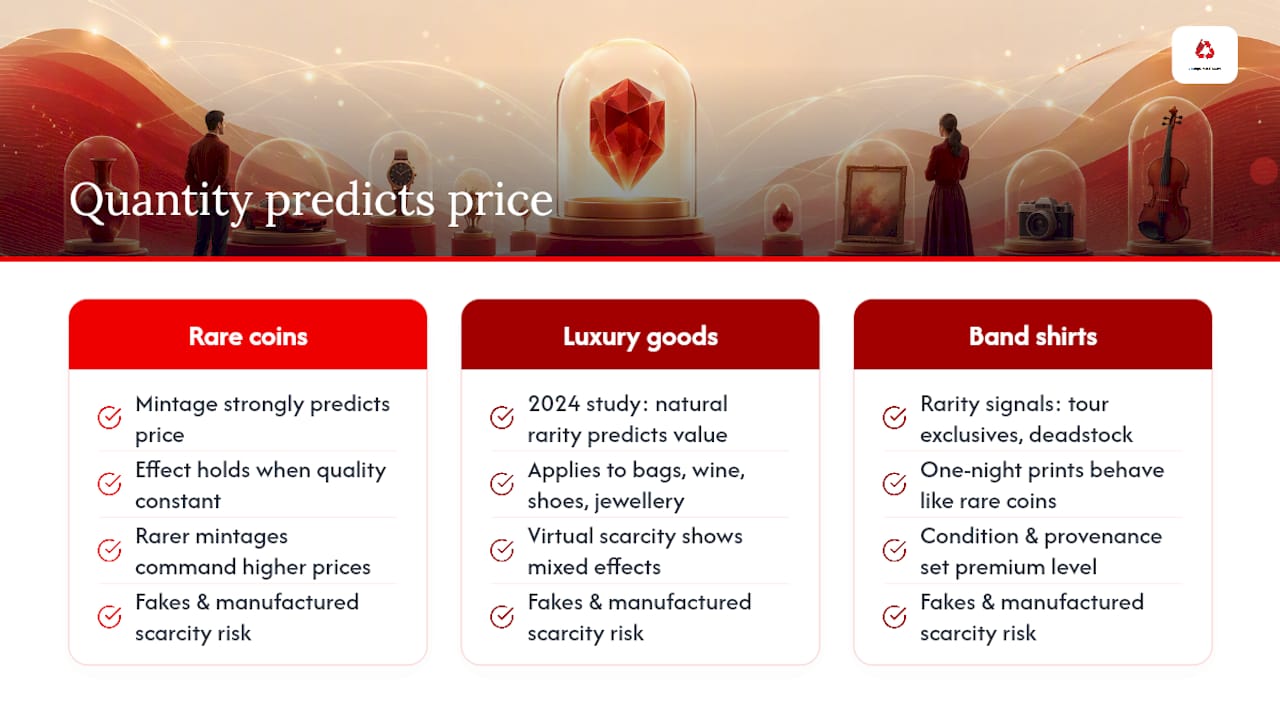
The 2024 luxury-goods study reinforces this across categories including bags, wine, shoes, and jewellery. Natural rarity predicts value reliably. Virtual scarcity shows mixed effects — it can lift functional value but often undermines the emotional resonance that keeps collectors paying premiums over time.
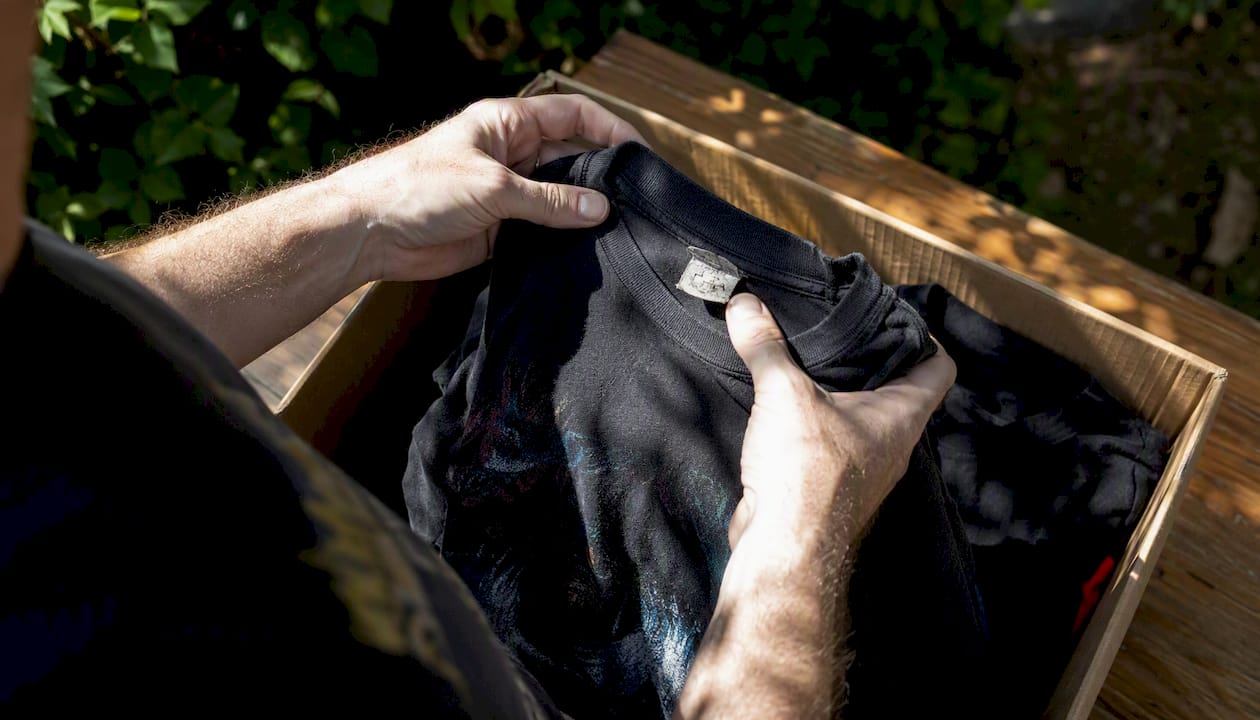
In apparel markets, the pattern holds. Band shirt rarity signals — tour exclusives, deadstock, single-date prints — follow the same logic as coin mintage. A shirt from a one-night show in 1992 with a small documented print run behaves like a rare coin: condition and provenance determine where within the premium range it lands.
The caution from the anthropogenic Allee effect literature is worth noting here: when rarity drives demand high enough, it can create perverse incentives for exploitation. In biological markets, this means harvesting rare species to near-extinction. In collector markets, it means fakes, stolen provenance, and manufactured scarcity.
How does rarity shape price over time?
Rarity raises potential price, but liquidity determines how much of that premium you can actually realise. A genuinely rare item with thin buyer depth may appraise high and sell low — or not sell at all.
Typical price trajectories follow a recognisable pattern:
- Discontinuation or end of production. Supply is now fixed. Early buyers may not yet recognise the significance.
- Early spike. Word spreads. Demand from informed collectors pushes prices up quickly.
- Consolidation. The market finds a new equilibrium as more sellers enter and price discovery improves.
- Long-term plateau or further appreciation. Determined by demand durability. Items with cultural staying power keep climbing; hype-driven items flatten or fall.
Liquidity factors that shape this path include the number of active buyers, auction participation rates, transparency of comparable sales, and ease of authentication. Collector guides consistently stress that condition and liquidity together determine whether rarity translates into a realisable premium or just a theoretical one.
Practical valuation checklist before you buy
Use this checklist to assess whether scarcity is likely to translate into durable value:
- Confirm edition or mintage. Get documented production numbers, not seller estimates.
- Verify provenance. Chain of ownership matters — gaps are red flags.
- Assess condition grade. A pristine rare example can be worth multiples of a worn one in the same category.
- Check documented sales history. Comparable sales (comps) from auctions or trusted marketplaces anchor your valuation.
- Gauge buyer pool size. Search active forums, auction results, and dealer interest to confirm real demand exists.
- Confirm resale channels. Know where you would sell it and at what cost before you buy.
- Check Australian legal requirements. CITES listings, import/export controls, and local wildlife protection rules apply to items made from protected materials. The Australian Border Force and the Department of Agriculture, Fisheries and Forestry administer these at the border.
Red flags: missing provenance, inconsistent edition numbers, seller claims of rarity without independent verification, and opaque supply narratives.
When does rarity become harmful or illegal?
The anthropogenic Allee effect, documented in peer-reviewed modelling and empirical research, shows that human preference for rarity can sustain harvesting pressure even as populations decline — creating a feedback loop that pushes rare species toward extinction. Higher prices for rarer items can make exploitation economically rational long past the point of ecological sustainability.
For Australian collectors, this has direct legal implications. Items made from protected species — certain corals, shells, ivory, exotic skins — are subject to CITES controls and Australian import/export law. Buying or importing such items without proper documentation can result in seizure, fines, and criminal liability.
Responsible collecting means:
- Verifying that any natural-material item has legal provenance documentation before purchase.
- Avoiding markets where provenance is opaque or where the supply chain cannot be traced.
- Preferring items whose rarity comes from production or survival factors rather than ongoing exploitation.
Rare heavy-metal shirts: how the framework applies
This is where the theory gets real. A vintage heavy-metal concert shirt from a single Australian tour date in the early 1990s carries both production rarity (small print run for a limited audience) and survival rarity (three decades of wear, loss, and disposal). Those two factors together, backed by a passionate and growing collector base, produce genuine price premiums.
The signals that matter in this niche:
- Tour exclusivity. Shirts sold only at specific shows, not through general merchandise channels.
- Deadstock condition. Unworn, original tags intact — condition acts as a force multiplier on an already scarce item.
- Documented provenance. A receipt, a photograph from the show, or a credible chain of ownership.
- Variant details. Regional prints, back-print variations, or crew-only editions within a larger tour run.
Pro Tip: Photograph every detail — front, back, tags, any print variations — and store those images alongside any provenance documents. This catalogue becomes your liquidity tool: buyers pay more when they can verify what they are getting before they commit.
For sourcing in Australia, check local auction platforms, dedicated metal merch communities, and specialist stores. Shipping and import costs affect net value on international purchases, so factor those in before bidding.
How to avoid rarity traps and speculation bubbles
Verify everything independently. Seller claims of rarity are a starting point, not a conclusion.
- Request documentation first. Edition numbers, original receipts, auction records.
- Use third-party grading or authentication where services exist for your category.
- Pull comparable sales from at least two independent sources before agreeing on a price.
- Use escrow or trusted marketplace protections for high-value purchases.
- Check seller reputation across multiple platforms and communities.
Common red flags to watch for:
- Serial or edition numbers that do not match known records.
- Provenance that begins with “I bought it from a guy who…” and goes no further.
- Deliberate scarcity marketing (“only 3 left!”) without verifiable supply data.
- Prices significantly above recent comps with no clear explanation.
Return policies and independent expert opinions are your best protection when buying premium rare items. Never let urgency override due diligence.
A collector’s perspective on rarity and value
Watching the market for rare shirts over many years, the pattern is consistent: the pieces that hold and grow in value are the ones where scarcity and demand reinforce each other, and where the provenance story is airtight. A shirt nobody can authenticate is a shirt nobody will confidently bid on. The collectors who do best are the ones who treat documentation as seriously as condition.
The academic findings covered here match what you see in practice. Natural, production-based rarity with a durable fan base outperforms manufactured scarcity every time over a long horizon. For deeper reading on what makes specific shirts valuable, the Vintage Metal Store blog covers category-specific signals in detail.
If you are ready to own a piece of metal history, Vintage Metal Store carries authenticated ex-tour stock and deadstock shirts with documented provenance. Browse the rare Metallica 1992 tour tee or explore the full vintage Metallica shirts collection — real scarcity, real history, ready to wear.
Sources
- 2024 study on natural rarity and luxury goods
- The market value of rarity (economic analysis of rare coins)
- Rarity value and species extinction: the anthropogenic Allee effect
- Understanding the scarcity principle
- What makes a collectible worth more? (CollectorsPrice)
FAQ
Why does rarity increase value?
Rarity increases value because limited supply combined with active demand forces buyers to compete, raising willingness to pay. The scarcity principle and social signalling amplify this effect beyond what utility alone would justify.
Why are rare things valuable?
Rare things are valuable when scarcity intersects with genuine demand, verified authenticity, and good condition. Scarcity without buyer interest produces no premium — an obscure unique object with no audience may never sell.
Does scarcity always increase prices?
Not always. Scarcity raises potential price, but liquidity and demand depth determine whether that premium is realisable. The 2024 luxury-goods study found artificial scarcity can reduce emotional and social value even while lifting functional value.
Why does original production quantity matter for collectibles?
Economic analysis of coin markets shows that original mintage is a strong predictor of price when quality is held constant — rarer production runs command higher prices than common ones across comparable grades.
Recommended


