



TL;DR:
- Vintage metal band shirts earn value through rarity, provenance, and cultural significance.
- Authenticity checks focus on tags, print quality, stitching, and fabric weight to verify originals.
- Emotional connection, storytelling, and historical context drive collector passion beyond resale price.
A single vintage Soundgarden shirt from 1989 recently sold for $1,349 at resale, and a Metallica 1996 Load tee fetched $1,250. Most people assume old band shirts are just nostalgic junk gathering dust. They’re wrong. The vintage heavy metal tee market is driven by real cultural weight, genuine scarcity, and a collector community that takes provenance seriously. Whether you’re sitting on a box of old tour shirts or actively hunting for rare pieces, understanding what makes a metal tee truly collectible can change how you see every shirt hanging in your wardrobe.
Table of Contents
- Where collectibility starts: band, tour, and era influence
- Authenticity and rarity: the heart of value
- Condition, wear, and the collector psyche
- Culture, storytelling, and why wearers seek metal tees
- What most collectors miss about metal tee value
- Find your next collectible metal tee
- Frequently asked questions
Key Takeaways
| Point | Details |
|---|---|
| Band and era matter | Tees from major bands and historic tours fetch the highest prices among collectors. |
| Authenticity is crucial | Expert verification and rarity distinguish valuable originals from reproductions. |
| Condition debates | Wear can tell a story or reduce value, depending on collector philosophy. |
| Cultural connection | Metal tees represent identity and music heritage, not just apparel. |
| Market is strong | Vintage metal shirts regularly command high resale values in the collector market. |
Where collectibility starts: band, tour, and era influence
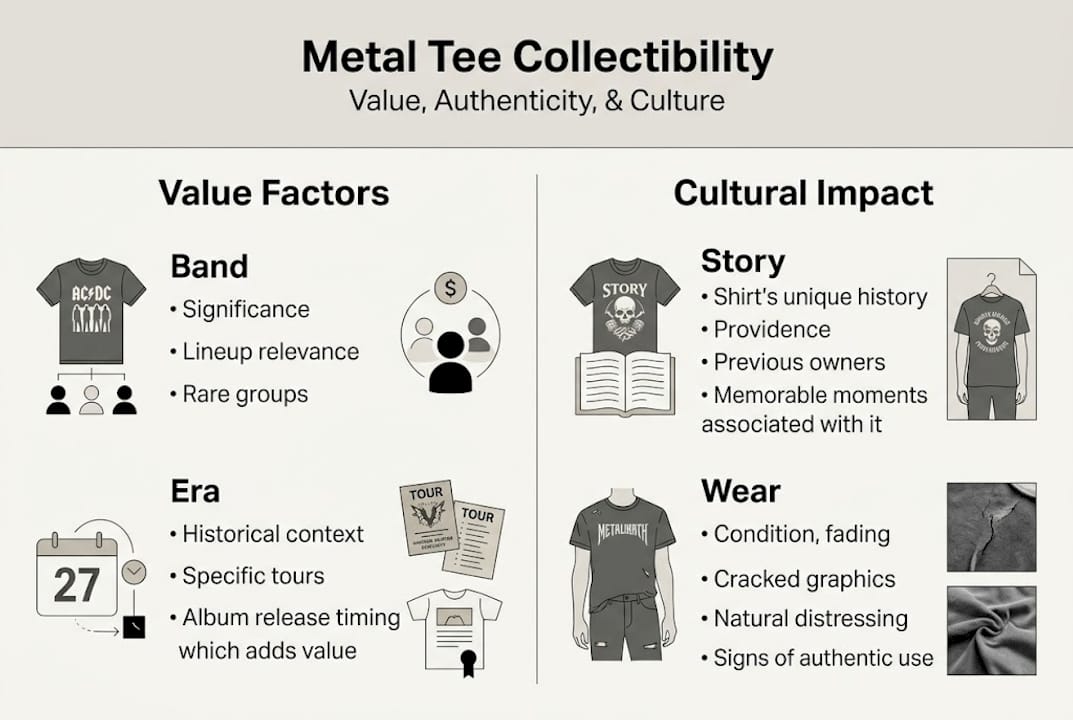
Not every old band shirt is worth chasing. The bands that consistently pull the highest resale prices share a few things in common: they shaped the genre, they toured relentlessly, and their merchandise was produced in limited quantities for specific shows. Metallica and Soundgarden sit at the top of the vintage tee market values because their cultural footprint is undeniable and their early-era shirts are genuinely scarce.
Tour-specific shirts are especially prized because they were only available at particular venues on particular nights. A shirt from a 1989 Soundgarden club show is a physical record of a moment in music history. That specificity is irreplaceable. Understanding the full story behind these pieces is something our history of metal band shirts resource covers in depth.
Here’s what drives collectibility at the foundational level:
- Band significance: Bands that defined subgenres or influenced generations command premium prices
- Tour provenance: Shirts tied to specific tours, especially early or farewell tours, carry extra weight
- Production volume: Small-batch or single-venue prints are far rarer than mass-produced merch table stock
- Era of release: Pre-internet era shirts (pre-1995) are harder to source and more likely to be genuine originals
- Graphic uniqueness: One-off designs created for a single show or region are the holy grail
| Band | Shirt era | Recorded resale value |
|---|---|---|
| Metallica | 1996 (Load tour) | $1,250 |
| Metallica | 1992 (Don’t Tread On Me) | $990 |
| Soundgarden | 1989 | $1,349 |
| Rock genre average | Top tees | $179.54 |
The rock genre average of $179.54 for top resale tees tells you the floor is already high. But the ceiling, as those Metallica and Soundgarden figures show, is significantly higher for the right shirt. If you’re new to this world, our band tee collecting guide is a strong starting point for building your knowledge base.
Authenticity and rarity: the heart of value
Beyond band fame and age, the tee’s authenticity and scarcity take centre stage. A shirt can look the part and still be a reproduction. The market is flooded with convincing fakes, and reproductions require expert verification to identify correctly. This is where many collectors get burned.
Authentic vintage metal tees carry physical evidence of their era. The tag is your first checkpoint. Brands like Screen Stars, Fruit of the Loom, and Hanes used specific tag designs across different decades, and collectors have catalogued these in detail. Print alignment matters too. Vintage screen printing was done by hand, so slight imperfections and ink bleed are normal. A suspiciously perfect print on an allegedly 1987 shirt should raise your guard immediately.
“The difference between a $40 reproduction and a $1,200 original often comes down to details most buyers overlook entirely.”
Our guide on authenticity in metal tees breaks down exactly what to look for, and our vintage identification tips page covers era-specific markers in practical detail.
Pro Tip: Always check the stitching at the collar and sleeves. Vintage shirts used single-needle stitching in most cases, while modern reproductions often use overlocking or double-needle construction that wasn’t common in the 1980s and early 1990s.
| Feature | Authentic vintage | Reproduction | Modern tribute |
|---|---|---|---|
| Tag style | Era-specific (Screen Stars etc.) | Generic or faked | Current brand tag |
| Print quality | Hand-screen, slight imperfections | Too clean or digitally printed | High-resolution digital |
| Fabric weight | Heavier cotton, pre-shrunk | Lighter, modern blend | Standard modern cotton |
| Resale value | $200 to $1,300+ | Minimal ($20 to $50) | Low ($30 to $80) |
| Collectibility | High | None | Low |
For real-world examples of what authentic pieces look like in practice, browse our authentic collector examples to train your eye before you spend serious money.
Condition, wear, and the collector psyche
Once authenticity is established, condition introduces a nuanced layer to valuation and personal taste. This is where the collector community genuinely splits. Some buyers want a shirt that looks like it was worn to every show on the Ride the Lightning tour, sweat-stained and sun-faded. Others want a shirt that’s never been unfolded.
Both positions are valid, and both have a market. Collector philosophies differ sharply on this point: wear can be authentic storytelling, or it can be a liability depending on who’s buying. A shirt with documented tour wear, especially if you can trace it to a specific person or show, can actually command a premium over a generic mint-condition piece.
“Wear tells a story. The question is whether that story adds value or subtracts from it, and the answer depends entirely on your buyer.”
What you need to watch out for is artificial distressing. Some sellers deliberately fade, hole, or wash shirts to simulate age. Genuine vintage wear has a consistency to it. Fading appears where the sun actually hit the fabric. Holes form at stress points like collar edges and underarms. Artificial distressing tends to be uneven and concentrated in places that look dramatic rather than natural.
Here’s what experienced collectors assess when evaluating condition:
- Fading pattern: Natural UV fading is gradual and consistent across exposed areas
- Hole placement: Genuine wear holes appear at seams, collar edges, and underarm stress points
- Print integrity: Some cracking is expected; complete print loss significantly reduces value
- Odour: Musty storage smell is normal; chemical smell may indicate artificial treatment
- Overall structure: Fabric should feel aged, not artificially softened or treated
For guidance on keeping your existing pieces in the best possible shape, our resource on preserving band tees covers storage, washing, and long-term care. And if you’re debating whether a worn piece qualifies as vintage, our article on defining vintage gives you a clear framework.
Culture, storytelling, and why wearers seek metal tees
Now that you know what drives price and authenticity, it’s time to explore why collectors and fans seek out these shirts year after year. The answer goes well beyond investment logic. Vintage metal tees are wearable history. They represent a subculture that built itself on raw sound, community, and a deliberate rejection of mainstream culture.

For many collectors, the shirt is a connection to a specific moment in their life or in music history. A 1991 Metallica shirt isn’t just a shirt. It’s a document of where that band was creatively, what the world looked like, and who was there. Heavy metal tees average high resale figures partly because that emotional weight is real and shared across a global community.
The 90s tee market trends show that demand has only grown as the generation who lived through that era now has the disposable income to chase the pieces they remember. New collectors are entering the space too, drawn by the aesthetic and the stories these shirts carry.
The top reasons collectors seek original metal tees:
- Subcultural identity: Wearing a genuine vintage tee signals real knowledge and belonging within the community
- Nostalgia: Reconnecting with formative musical experiences through a physical object
- Wearable art: The graphic design of 1980s and 1990s metal shirts is genuinely striking and unique
- Investment potential: Documented appreciation in resale values makes collecting financially sensible
- Historical preservation: Keeping physical records of music history alive and accessible
Pro Tip: Document the provenance of every shirt you acquire. Note where you bought it, any information about its previous owner, and any details about the tour or show it came from. A shirt with a story attached to it is worth more than an identical shirt with no history.
For broader collecting insights on what’s moving in the market right now, our news section tracks trends and notable finds across the vintage metal tee world.
What most collectors miss about metal tee value
Here’s the perspective most price guides won’t give you. The collector community can become obsessed with resale figures to the point where the actual object loses meaning. A shirt that some value for authentic wear and others want pristine is ultimately valuable because of what it represents, not just what it sells for.
We’ve seen collectors pass on genuinely rare shirts because the condition wasn’t perfect for resale. That’s a mistake. The shirts that hold the deepest value in any serious collection are the ones tied to real moments, real people, and real music history. A faded, cracked Metallica shirt from a 1988 club show in Melbourne is a piece of Australian heavy metal history. No reproduction can replicate that.
The heritage behind band tees is what separates a true collection from a rack of expensive fabric. Financial value matters, but it’s a byproduct of cultural significance, not the source of it. Collect for the story first. The market will follow.
Find your next collectible metal tee
If this article has sharpened your eye for what makes a metal tee genuinely collectible, the next step is putting that knowledge to work. At Vintage Metal Store, every piece we carry is hand-verified for authenticity, sourced from ex-tour stock, dead stock, and genuine second-hand collections from around the world.
Whether you’re after a rare Metallica 1992 tour tee or want to browse our full range of shop Metallica shirts and iconic band pieces, you’ll find shirts with real provenance and real stories. No reproductions. No guesswork. Just genuine vintage metal.
Frequently asked questions
What makes a metal tee more valuable than others?
Value is driven by band significance, rarity, authenticity, era, and condition. Tour-specific and limited-print shirts are generally worth the most, with documented Metallica pieces reaching $1,250 and above.
How can you tell if a metal tee is authentic?
Check the tag style, print quality, stitching construction, and fabric weight against known era-specific details. Reproductions flood the market, so consulting expert guides or verified sellers is strongly recommended before purchasing.
Does damage or fading lower a metal tee’s value?
Not always. Some collectors value authentic wear as part of the shirt’s story, while others prioritise mint condition for investment purposes. The buyer’s intent determines which condition commands a premium.
Are all vintage metal tees considered collectibles?
No. Only shirts tied to influential bands, limited tours, or key music eras, and verified as genuine vintage, truly qualify. Certain bands and eras consistently pull the highest resale values, while generic or mass-produced shirts rarely reach collectible status.
Recommended
- Why 1990s Heavy Metal Tees Appreciate Up to 2750% Value – Vintage Metal Store
- Why preserve old band tees? Value, culture and know-how – Vintage Metal Store
- Why collect band t-shirts: a heavy metal guide 2026 – Vintage Metal Store
- Classic metal t shirt examples for authentic collectors – Vintage Metal Store


