



TL;DR:
- Rarity depends on scarcity, desirability, and authenticity, not just age.
- Limited runs, exclusivity, unique artwork, and provenance significantly enhance a shirt’s value.
- Streetwear and pop culture have increased demand and prices for vintage metal band shirts.
Age is the first thing most people point to when they argue a band shirt is rare. It’s an easy assumption, and it’s mostly wrong. Some shirts from the late 1980s sell for a few dollars at a garage sale, while a specific 1992 tour tee in the right condition can fetch hundreds, even thousands. The real drivers of rarity are far more nuanced, and understanding them separates serious collectors from casual buyers. This article breaks down exactly how rarity is defined, which factors genuinely push value up, and what you should be looking for before you spend serious money on a piece of heavy metal history.
Table of Contents
- How rarity is defined in heavy metal t-shirt collecting
- The key factors that make a shirt rare
- How streetwear and pop culture impact rarity and value
- Condition, provenance and authenticity: the triad of true rarity
- The uncomfortable truth: why most collectors get rarity wrong
- Explore and secure your next rare find
- Frequently asked questions
Key Takeaways
| Point | Details |
|---|---|
| Rarity isn’t just age | True rarity comes from limited runs, exclusivity, and collector demand, not just how old a shirt is. |
| Streetwear boosts value | Pop culture and streetwear influence have made vintage metal shirts hotter commodities than ever. |
| Proof drives collector value | Condition, authenticity and provenance are critical to securing real worth in the vintage market. |
| Stay smart about hype | Not every ‘rare’ shirt is a wise investment—focus on history and originality for lasting value. |
How rarity is defined in heavy metal t-shirt collecting
Rarity in heavy metal shirt collecting is not simply about how old a shirt is. It’s about how few exist in a desirable state, how many people want one, and whether the shirt carries genuine cultural weight. A shirt pressed in a run of 200 for a regional support act in 1987 might be objectively scarce, yet attract almost no collector interest. Meanwhile, a shirt from a Metallica stadium run that sold tens of thousands of units can still command serious money because demand is enormous.
True rarity is a combination of three forces: scarcity, desirability, and authenticity. Scarcity means limited physical supply. Desirability means enough collectors actively want the item. Authenticity means the shirt is a genuine original, not a bootleg or a later reprint.
“Value is driven by supply and demand, and the streetwear crossover has pushed prices for 80s and 90s metal tees well beyond simple nostalgia.”
Here’s what collectors actually weigh when assessing rarity:
- Production numbers: How many shirts were originally made?
- Survival rate: How many have survived in wearable or display condition?
- Cultural moment: Is the shirt tied to a landmark album, tour, or event?
- Collector recognition: Does the wider collector community agree on its significance?
- Authenticity markers: Can the shirt be verified as an original pressing?
If you’re just getting started, understanding why collectors value band t-shirts gives you the foundation to read the market properly. For a closer look at what’s actually trading hands, rare finds and collector value is worth your time.
The key factors that make a shirt rare
With those market concepts in mind, let’s break down exactly what features or backgrounds actually make a shirt stand out as rare.
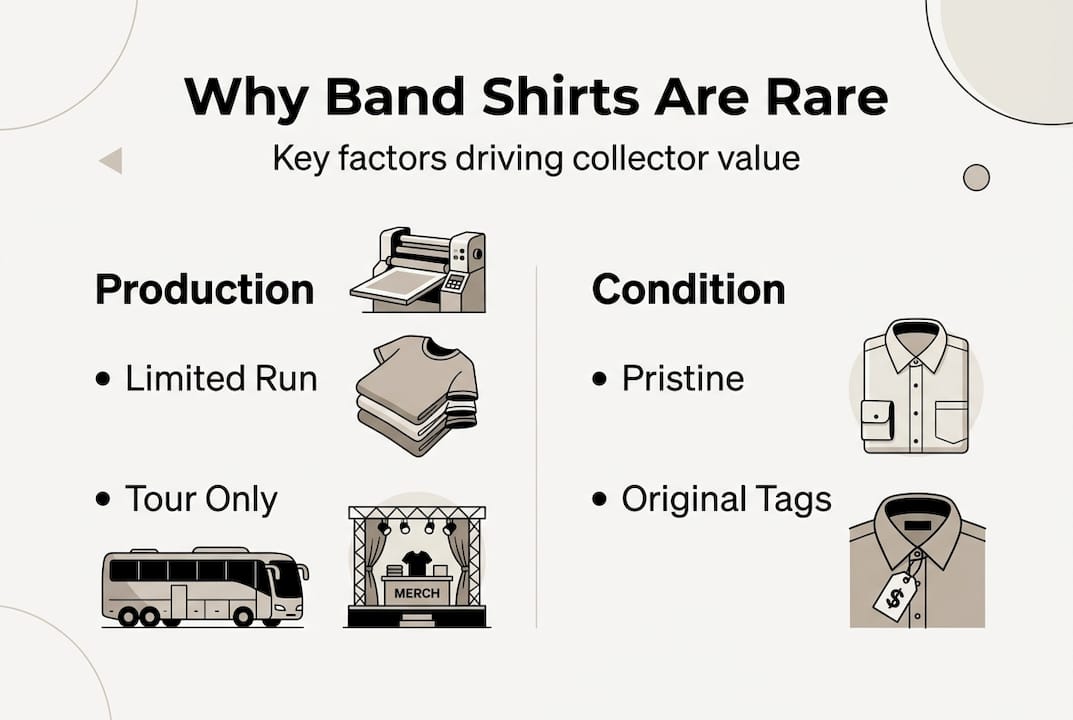
Not all rarity is created equal. Some shirts are rare because of deliberate decisions made at the time of production. Others become rare by accident, through low survival rates, print errors, or regional exclusivity. Knowing the difference helps you spot genuine value.
Limited production runs, exclusive artwork, tour-only availability, and print errors all contribute to a shirt’s rarity in meaningful ways. Here are the core factors, ranked by impact:
- Production quantity: Shirts pressed in small numbers for specific events, venues, or markets are inherently scarcer. A shirt sold only at a single-night show in a regional city is a different beast entirely from a standard merch table staple.
- Tour exclusivity: Region-specific releases, country-only designs, and venue-exclusive prints are highly prized. A shirt that only appeared on the Australian leg of a world tour, for example, is genuinely hard to source outside that market.
- Artwork and design uniqueness: Shirts featuring original artwork by known illustrators, or designs that were changed or pulled mid-tour, carry extra weight. The design itself becomes part of the story.
- Print errors and anomalies: Misprints, colour variations, and stitching irregularities that slipped through quality control are often more valuable than the standard version. Collectors love a documented mistake.
- Band and event significance: A shirt tied to a final tour, a reunion show, or a performance at a landmark festival carries emotional and historical weight that generic merchandise simply doesn’t.
Pro Tip: Always ask for provenance documentation when buying. A shirt with a photo of the original owner at the concert, or a receipt from the merch stand, is worth considerably more than one with no story attached. Check out iconic metal t-shirt types and vintage band tees every collector should know to sharpen your eye for what’s genuinely significant.
How streetwear and pop culture impact rarity and value
Collectors know rarity starts in the metal scene, but the explosion of streetwear changed the landscape in ways worth dissecting.
For decades, vintage metal shirts were traded almost exclusively within the metal community. Prices were set by fans who understood the music, the tours, and the cultural context. Then streetwear happened. Fashion-forward buyers, stylists, and celebrities started wearing vintage band tees as aesthetic statements, and the market shifted permanently.
Streetwear crossover has sharply increased the value of 80s and 90s metal tees, pushing prices well beyond what music-only collectors would have paid. A shirt that a dedicated Slayer fan might have valued at $80 a decade ago can now fetch $400 or more because a fashion buyer in Tokyo or New York wants it for the aesthetic.
| Factor | Music collector value | Streetwear/fashion value |
|---|---|---|
| Band significance | Very high | Moderate |
| Graphic design quality | High | Very high |
| Age and era | High | High |
| Tour exclusivity | Very high | Low to moderate |
| Celebrity association | Low | Very high |
Factors fuelling price surges in the current market:
- Celebrity sightings: When a high-profile musician or athlete is photographed in a specific vintage tee, demand spikes almost immediately.
- Designer collaborations: Fashion houses referencing or reproducing metal imagery push the originals into luxury territory.
- Social media exposure: A single viral post can double the search volume for a specific shirt overnight.
- Scarcity amplification: Once streetwear buyers enter a market, genuine originals become even harder to find, pushing prices further.
Browse all shirts in the collection or go straight to rare concert shirts to see what’s currently available at the intersection of metal history and collector demand.
Condition, provenance and authenticity: the triad of true rarity
Rarity is nothing without authenticity and story. Here’s what makes provenance and condition so critical.

You can have the rarest shirt in the world, but if it’s falling apart, faded beyond recognition, or can’t be verified as genuine, its value collapses. Condition, provenance, and authenticity are the three pillars that separate a trophy piece from a curiosity.
Documentation, proof of origin, and shirt condition are critical to achieving premium collector value. Here’s how to assess each one:
- Check the label: Original vintage shirts carry era-specific labels from manufacturers like Fruit of the Loom, Screen Stars, or Hanes. The label style, font, and country of origin can date a shirt precisely.
- Examine the print: Vintage screen printing has a distinct texture and ink bleed that modern digital prints don’t replicate. Run your fingers across the design and look at the edges under good light.
- Inspect the stitching: Single-needle stitching on the collar and sleeves is a hallmark of older garments. Double-needle stitching became standard later and can help date a shirt.
- Look for fading patterns: Genuine age produces uneven, natural fading. Artificially distressed shirts often fade too uniformly or in the wrong places.
| Condition grade | Description | Value impact |
|---|---|---|
| Mint | No wear, original tags, never washed | Maximum value |
| Excellent | Minimal fading, no holes, light wear | High value |
| Good | Some fading, minor wear, no major damage | Moderate value |
| Fair | Visible wear, fading, small holes | Reduced value |
| Poor | Heavy damage, major fading, structural issues | Low value |
Pro Tip: Build a photo archive for every shirt you own or plan to sell. Images of the label, the print, the stitching, and any provenance items like ticket stubs or concert photos are your best defence against disputes and your strongest sales tool. Explore preserving old band tees and how to collect rare 1990s metal tees for practical guidance.
The uncomfortable truth: why most collectors get rarity wrong
After mastering the ins and outs of identifying genuine rarity, it’s time to reflect on where many collectors go wrong.
Here’s what we’ve seen repeatedly in this market: collectors, even experienced ones, confuse hype with rarity. A shirt gets worn by a celebrity, a forum thread blows up, and suddenly everyone is calling it rare and paying inflated prices. Six months later, the hype fades and the value drops back to earth. The collectors who bought at the peak are left holding an overpriced shirt with no lasting demand.
True rarity is not a trend. It’s a permanent condition rooted in limited supply, genuine cultural significance, and sustained collector demand. A shirt from a pivotal tour, with verified provenance and strong condition, will hold its value across decades because the reasons people want it don’t change. A shirt that’s only popular because someone famous wore it last season is a different story entirely.
We’d also push back on the idea that every shirt labelled “rare” in a listing deserves that tag. Sellers use the word loosely, and buyers pay for it. Do your research, cross-reference with trusted collector communities, and focus on metal tee identity and lasting value rather than short-lived market noise. The shirts worth owning are the ones with a real story, not just a trending hashtag.
Explore and secure your next rare find
Ready to put your knowledge to work and track down your own piece of heavy metal history?
At Vintage Metal, we source ex-tour stock, deadstock, and second-hand heavy metal shirts with genuine provenance. Every piece in our catalogue has been assessed for authenticity and condition, so you’re not guessing. If you’re after something specific, the rare Metallica 1992 tour tee is a strong example of the kind of verified, historically significant piece we carry. Explore the full vintage Metallica shirts collection or browse all available vintage shirts to find your next serious acquisition.
Frequently asked questions
How can I tell if my band shirt is a genuine rare release?
Check for original era-specific labels, vintage screen print texture, and any tour-specific markings, then cross-reference with verified collector databases and documentation to confirm authenticity.
Does a reprint or reissue affect my shirt’s rarity or value?
Yes, reprints increase supply and reduce collector value significantly, as authenticity and scarcity are central to what makes an original desirable.
Why do some shirts from the 90s cost more than much older ones?
Desirability, sustained demand, and pop culture crossover can push 90s shirts well above older items, especially when tied to iconic tours or limited regional runs.
Is the band or the artwork more important for rarity?
Both contribute, but shirts combining iconic art with event significance and limited availability are consistently the most sought after among serious collectors.
Recommended


