



TL;DR:
- A crew tour shirt is staff-issued apparel from live music tours, not intended for public sale, and holds significant collectible value due to its rarity and provenance. It is distinguished by role-specific back prints and color coding, representing crew members who handle logistics rather than fans or performers. Proper identification, care, and understanding of its tour context elevate these shirts from mere garments to authentic metal artefacts capturing tour history.
If you’ve been chasing down rare heavy metal memorabilia and stumbled across the term “crew tour shirt,” you’re not alone in wondering exactly what that means. A crew tour shirt is not simply a shirt with a crewneck collar, and that confusion trips up new collectors constantly. These pieces are staff-issued apparel from live tours, given to the people who actually made the shows happen, and they carry a completely different weight to standard fan merchandise. Understanding the crew tour shirt definition is the difference between spotting a genuine piece of tour history and walking past it.
Table of Contents
- Key takeaways
- What is a crew tour shirt, really?
- Crew tour shirt vs. crewneck: clearing up the confusion
- Types of crew tour shirts
- The purpose of crew tour shirts on a live show
- How to wear and care for crew tour shirts
- My take on crew shirts as metal artefacts
- Find authentic crew and tour shirts at Com
- FAQ
Key takeaways
| Point | Details |
|---|---|
| Crew means staff, not style | A crew tour shirt refers to apparel issued to tour personnel, not a shirt with a crewneck neckline. |
| Not sold to the public | These shirts were provided only to stagehands and crew, making them genuinely scarce on the collector market. |
| Colour coding matters | Crew shirts are often colour coded by role, so the colour itself tells you about the shirt’s origin and function. |
| Collector value is real | Limited distribution and a provenance story push prices significantly above standard tour merchandise. |
| Context is everything | Reading the shirt’s text carefully, looking for words like “local crew” or “production,” tells you more than the design alone. |
What is a crew tour shirt, really?
To understand what sets a crew tour shirt apart, you need to understand who “the crew” actually are on a major tour. They are not the band. They are not the fans. They are the stagehands, riggers, lighting technicians, sound engineers, truck drivers, catering staff, and production managers who keep the entire operation moving. On a large heavy metal tour, that crew can number in the hundreds.
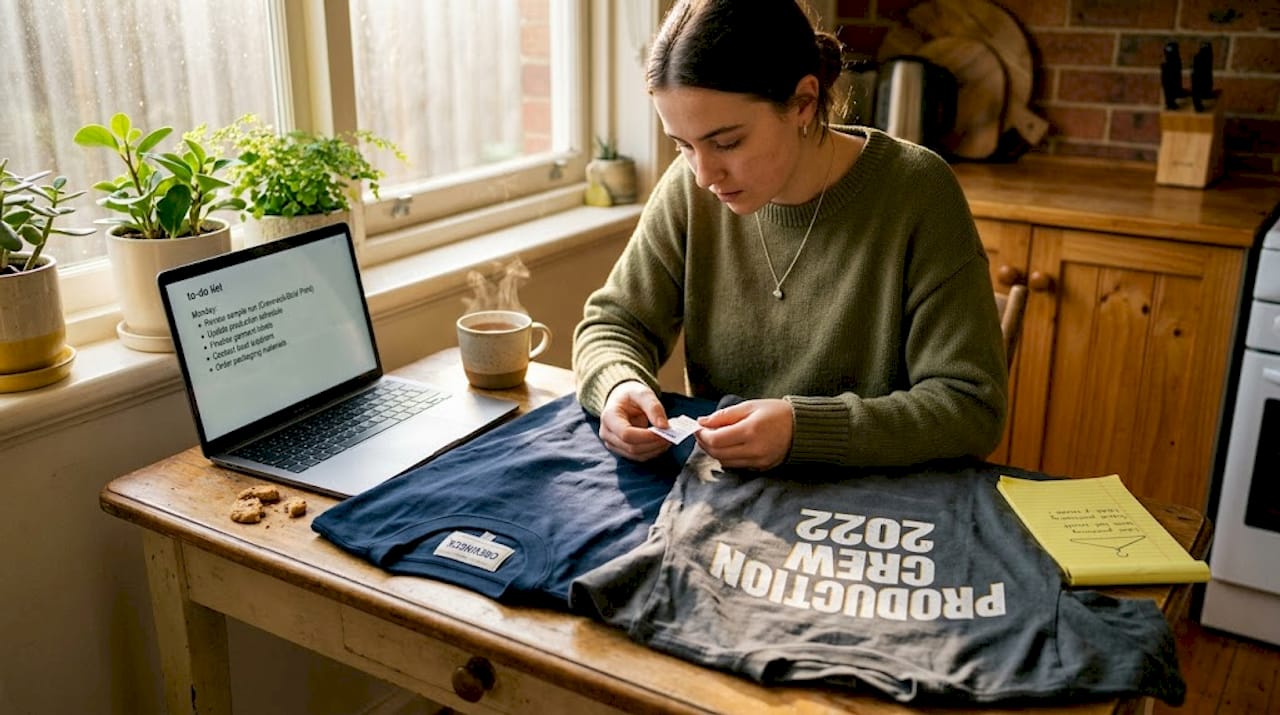
Crew tour shirts were created as functional staff apparel. They were issued before or during a tour run so that crew members could be identified quickly on site. The shirts typically carry the band name, the tour name, and often a year or run of dates. What they almost never have is a price tag or a retail outlet, because they were not available to the public. That is the core of the crew tour shirt definition: staff-only, tour-specific, and never meant to end up in anyone’s hands but the people working the show.
This is what separates crew merchandise shirts from the shirts sold at the merch booth outside the venue. Fan merch is produced in large runs, priced to move, and designed for maximum sales. Crew shirts are printed in small numbers for a defined group of people, often with specific role-based text printed on the back.
Pro Tip: When assessing a potential crew shirt, flip it over and look for text like “Production,” “Local Crew,” or “Catering” on the back. That back-print is the clearest marker that separates a genuine crew shirt from a standard tour tee.
The Rolling Stones 1972 tour crew long sleeve is a well-documented example of crew apparel surviving decades to become a serious collectible. It carries tour-specific branding that marks it unmistakably as staff apparel. Heavy metal tours from the 1980s and 1990s produced the same category of shirts, and those are among the most sought-after pieces in the current collector market.
Crew tour shirt vs. crewneck: clearing up the confusion
This is where a lot of people trip. The word “crew” appears in both terms, but the connection ends there completely.
A crewneck refers to a neckline style. The crewneck style dates to 1930 and describes a collarless, rounded neck opening. It has nothing to do with concert staff or touring. The term came from rowing, where athletes wore close-fitting, round-necked tops. The crewneck T-shirt was developed in 1932, first issued by the US Navy as an undershirt, known then as a “Gob Shirt,” and eventually became a universal casual garment. When someone says “crewneck,” they are describing the shape of a collar.
A crew tour shirt, by contrast, is defined entirely by who received it and why. The neckline is irrelevant. A crew tour shirt could have a crewneck collar, a V-neck, or be a long sleeve. The “crew” in the name refers exclusively to the workforce behind a live tour.
Here is a direct comparison to make this completely clear:
| Feature | Crewneck shirt | Crew tour shirt |
|---|---|---|
| Defines a neckline | Yes | No |
| Issued to tour staff | No | Yes |
| Available for retail purchase | Yes | Rarely |
| Tour-specific printing | No | Yes |
| Collector value from scarcity | Low | Often high |
For collectors, reading context around “crew” is the critical skill. A vintage shop listing “crewneck band tee” is describing the cut of the shirt. A listing describing a “crew shirt” from a specific tour is describing its origin and who it was made for. The difference in value between those two items can be enormous.
Types of crew tour shirts
Not all crew tour shirts are the same, and understanding the distinctions helps you identify what you are actually looking at when one crosses your path.
The broadest split is between production crew and local crew. The touring production crew travels with the band for the entire run. These are the core team: monitor engineers, lighting directors, the tour manager’s crew, and the band’s personal crew. Their shirts typically reflect the full tour, often listing multiple dates or regions.
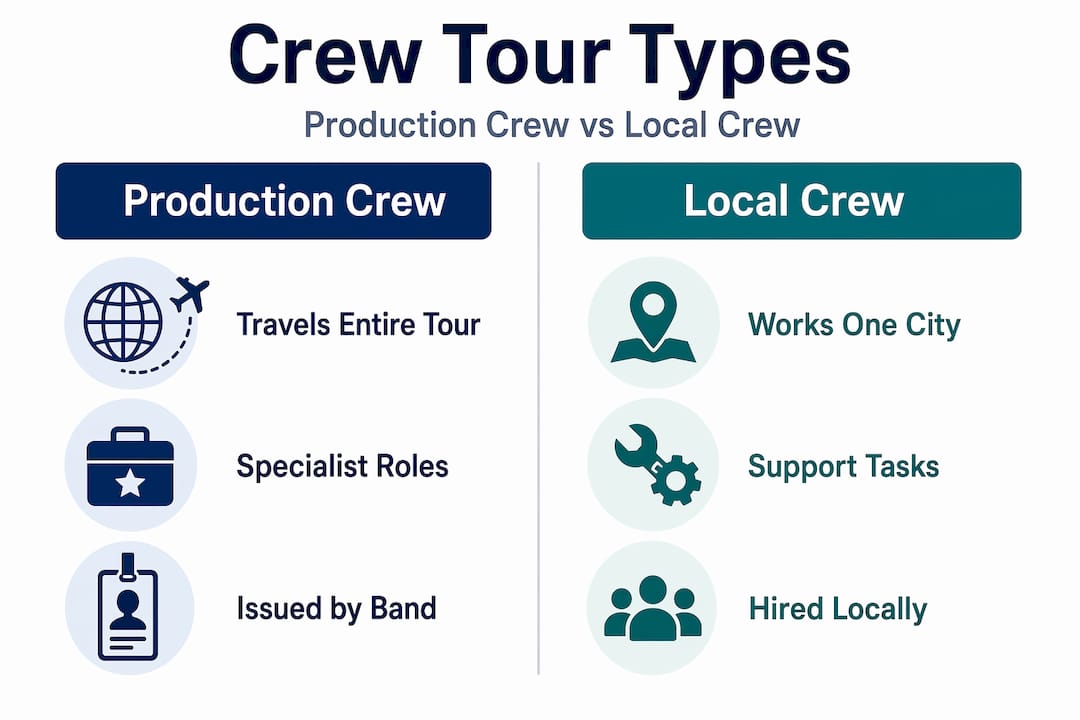
Local crew are stagehands hired in each city to assist with load-in and load-out. They work one show, then they’re done. Local crew tour shirts are sometimes colour coded differently from production crew shirts, and they often include city-specific or venue-specific details. This local angle actually increases collector interest because those shirts exist in even smaller numbers.
Beyond that core split, you encounter shirts differentiated by:
- Role-based back prints. Catering, security, merchandise crew, riggers, and audio staff sometimes received shirts specific to their department.
- Colour coding by function. Crew shirts are colour coded to organise people during load-out efficiently. A black shirt might mean audio, a grey shirt might indicate lighting, and so on. On a well-run metal tour, you could identify someone’s role from across an arena floor just by their shirt colour.
- Tour leg variations. Long tours broken into regional legs sometimes produced separate shirts for each leg. A North American leg shirt and a European leg shirt from the same tour are technically different items.
- Deadstock and ex-tour stock. Some crew shirts never reached their intended recipients due to last-minute logistical changes, roster cuts, or overprinting. These enter the secondary market as deadstock, in original condition, never worn. They are particularly prized by serious collectors.
The tour-specific branding on crew shirts, including band logos, tour names, and local crew graphics, is what gives each shirt its identity as a historical artefact rather than just a garment.
The purpose of crew tour shirts on a live show
Crew tour shirts were not designed for nostalgia. They had a job to do, and understanding that job explains a great deal about why they are so interesting as collectibles today.
-
Instant identification. At any major concert venue during setup, there are dozens of people moving through the same spaces at the same time. Security staff, venue employees, visiting press, and multiple tour crew departments all overlap. A crew shirt with a specific colour and back print tells everyone in the building who that person is and what they are authorised to be doing.
-
Access control. Wearing the right crew shirt was, in many cases, a form of backstage credentialing. It did not replace a laminate pass, but it reinforced it. Someone in a plain shirt could not casually blend into a crew that had matching tour-issued apparel.
-
Load-in and load-out coordination. The colour coding of crew shirts during load-out made it possible for production managers to direct large numbers of people efficiently. When you have 50 people moving flight cases through a venue at 2am, colour-coded shirts reduce the communication overhead dramatically.
-
Team cohesion and morale. On a six-month touring run, issuing matching crew shirts is a low-cost way to build a sense of shared identity. It communicates that the production values the people doing the physical work.
Pro Tip: A crew shirt’s colour can be a research starting point. If you acquire a shirt and want to verify its role, look for photographs from that specific tour online. Production staff often appear in the background of behind-the-scenes footage and press photos, and matching shirt colours to roles is very achievable for well-documented tours.
The purpose of crew tour shirts goes beyond function once the tour is over. The backstage access symbolism those shirts carry is exactly what collectors pay a premium for today.
How to wear and care for crew tour shirts
Crew tour shirts occupy a dual role for heavy metal fans. Some people wear them. Some display them. Both are legitimate approaches, and both require knowing how to look after the garment.
For wearing, the fit and styling options are straightforward:
- Pair with dark denim or black jeans. Crew shirts are typically no-frills in design and hold their own against simple bottoms. The text and graphics speak for themselves without needing busy accessories.
- Layer under an open flannel or denim jacket. This is a classic metal wardrobe move that also protects a vintage shirt from excess wear and UV fading when you are outdoors.
- Avoid mixing with other band shirts. If the crew shirt is the feature, let it be the feature. Wearing it alongside other band merchandise can dilute the visual impact of what is actually a rare piece.
- Check the print condition before washing. Vintage screen printing becomes brittle over time. Turn the shirt inside out, wash in cold water on a gentle cycle, and never machine dry. Flat drying preserves the print and prevents shrinkage.
For collectors who prefer to display rather than wear, folding acid-free tissue between garment layers and storing in a sealed archival bag away from direct light will keep the shirt in stable condition. Framing is also an option for particularly significant pieces. Use UV-filtering glass and keep the frame away from direct sunlight. A vintage tour shirt worth displaying is worth protecting properly.
My take on crew shirts as metal artefacts
I’ve handled a lot of band shirts over the years, and crew tour shirts occupy a different category in my mind entirely. A fan tee is a souvenir. A crew shirt is a document.
When you hold a genuine crew shirt from a significant tour, you are holding something that was issued to a person who was physically present for the production of that show. They wore it while moving gear into a stadium, while running cable during soundcheck, while working the load-out at midnight. That shirt absorbed the actual labour of the tour, not just the spectacle of it.
What I find most compelling about crew merchandise shirts in the heavy metal world specifically is how they connect the underground ethos of the music to the very real, often brutal logistics of touring. Bands like Metallica and Sepultura built their reputation on relentless touring. The crew shirts from those runs are physical proof of that effort.
I’ve also learned to be honest with people: authenticity matters more than rarity. A shirt with a genuine provenance story and solid documentation is worth more in every meaningful sense than a shirt with a sensational claim and no evidence. When you find one that checks out, the thrill is real and it is well-earned.
— David
Find authentic crew and tour shirts at Com
Com sources directly from ex-tour stock and deadstock from heavy metal tours, which means the shirts in the catalogue have genuine provenance rather than vague secondhand history. If you’ve been trying to build a collection that actually means something, that distinction matters.
For a concrete example of the kind of rarity available, the Metallica 1992 Don’t Tread on Me USA tour shirt is a verified piece from one of the most significant tours in heavy metal history. The 1996 Metallica and Korn tour shirt represents a moment when two generations of metal crossed paths on the same stage. These are not reproductions or fan-made items. They are original pieces from the tours themselves.
If you are serious about collecting, browse the full vintage metal shirt catalogue at Com. There is also a rare Sepultura 1992 tour shirt from the Third World Posse Europe and UK run for those who know how important that era was. These pieces do not stay available for long.
FAQ
What is a crew tour shirt in heavy metal culture?
A crew tour shirt is staff apparel issued to the production and stagehands working on a live music tour, not sold to the public. In heavy metal culture, these shirts are valued as rare artefacts that connect directly to the physical reality of touring.
Is a crew tour shirt the same as a crewneck shirt?
No. A crewneck shirt describes a neckline style with a rounded collar, while a crew tour shirt refers to apparel given to tour staff. The two terms share the word “crew” but describe entirely different things.
Why are crew tour shirts valuable to collectors?
Crew tour shirts are issued in small numbers to specific personnel and are rarely available publicly, which drives scarcity. Their direct connection to a specific tour and role gives them provenance that standard fan merchandise simply cannot match.
How do I identify a genuine crew tour shirt?
Look for back-print text identifying a role such as “Local Crew,” “Production,” or “Catering,” along with tour-specific graphics and dates. Colour coding is another indicator, as crew shirts are often colour coded by function on professional tours.
How should I care for a vintage crew tour shirt?
Wash inside out in cold water on a gentle cycle and dry flat to protect the print. For storage, use archival bags away from direct light, or frame behind UV-filtering glass if displaying.
Recommended


