



The printed year on a heavy metal tour shirt most often marks the tour itself or the year the merch was produced — not an album copyright date alone. Explaining band tour years correctly is what separates a confident buy from an expensive mistake.
Pro Tip: A Brockum tag places the shirt before the mid-1990s with high confidence — that single detail rules out most modern reprints instantly.
Tour dates on the back graphic are one of the strongest authenticity signals; if the listed tour never happened or the dates don’t match known itineraries, you’re looking at a reproduction or a fantasy design. Single-stitch construction on sleeves and hem strongly suggests production before the late 1990s, while double-stitch became standard from the late 1990s onward.
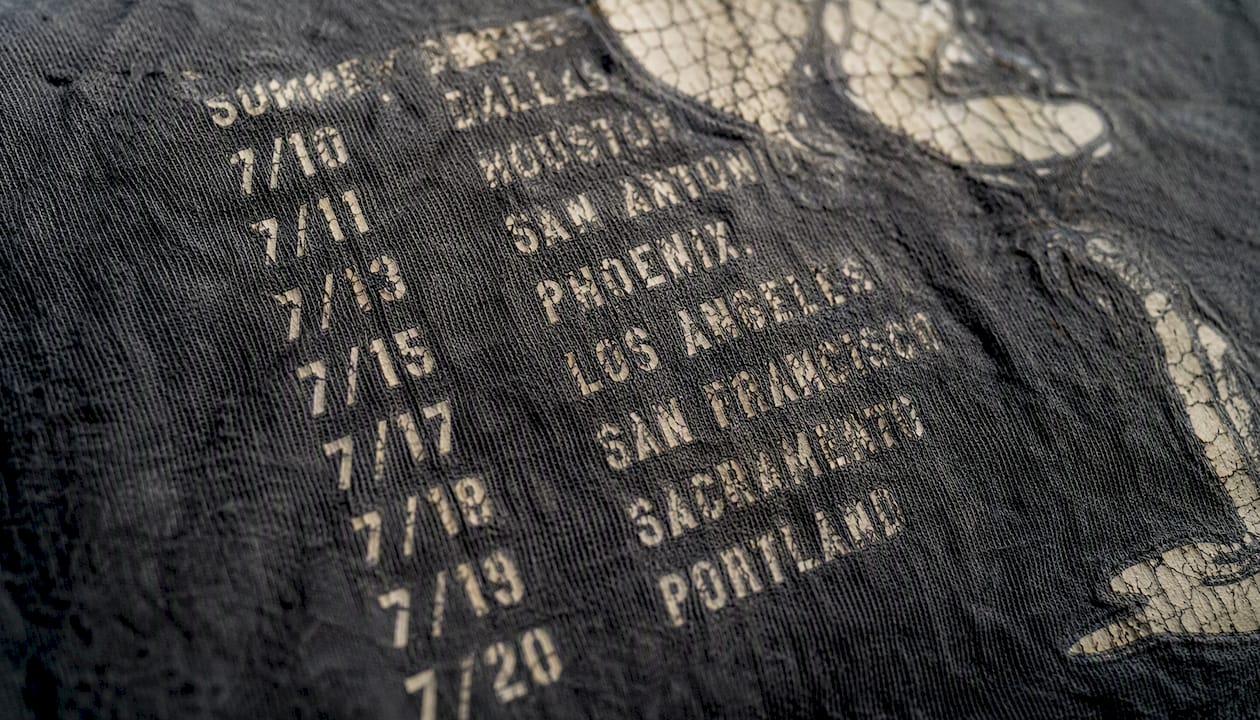
Table of Contents
- Ten visual things to scan in 60 seconds
- Step-by-step dating method collectors use
- Physical signs that point to ex-tour stock or deadstock
- Red flags that suggest a reproduction or mislabelled shirt
- When professional authentication is worth the cost
- Worked example: dating a Metallica 1992 tour tee
- Vintage Metal Store’s verified listings and what we document
- Sources
- FAQ
Ten visual things to scan in 60 seconds
Before you spend a dollar or send a message to a seller, run this checklist across the listing photos:
- Tag brand and text. Look for Giant, Brockum, Screen Stars, Hanes, or Tultex. “Made in USA” wording is a strong period signal for pre-mid-1990s pieces.
- Back print and city list. A full tour date list on the back is typical of authentic tour shirts; cross-check it against setlists, posters and local archives to confirm the routing makes sense.
- Copyright/print year. The © line on the graphic should align with the claimed tour year. A 2005 copyright on a claimed 1991 shirt is an immediate red flag.
- Stitching. Single stitch on sleeves and hem points to pre-1996. Mixed stitching (single sleeve, double hem) is transitional evidence from the 1993–1998 window.
- Print type and wear. Plastisol screen prints crack and sink into the fabric over decades. Modern soft-hand prints sit on top of the weave and feel smooth even when “distressed.”
- Fabric weight and composition. Vintage blanks were often 50/50 cotton-polyester or heavyweight 100% cotton. Lightweight modern blanks like Gildan feel noticeably thinner.
- Spellings and venue names. Typos in city names or odd abbreviations can indicate a bootleg run. Authentic shirts from major tours were produced under licence and proofread.
- Manufacturer style numbers. These are printed on the tag and can be cross-referenced against known tag-era timelines to narrow the production window.
- Print placement. Era-correct graphics sit centred or slightly lower on the chest. Unusually high or off-centre placement is worth querying.
- Seller signals. Multiple dated photos, a provenance note, an original receipt, or a venue stamp all raise confidence. A single stock-style photo with no context is a warning sign.
Pro Tip: Ask the seller for a close-up of the inside collar seam. The stitching there ages distinctively and is rarely faked on reproduction pieces.
Step-by-step dating method collectors use
A repeatable workflow removes guesswork and gives you a defensible confidence rating.
- Photograph everything first. Front, back, neck tag, hem, inside seams, and a macro shot of the print. Timestamp the photos. This creates your evidence record before you handle the shirt further.
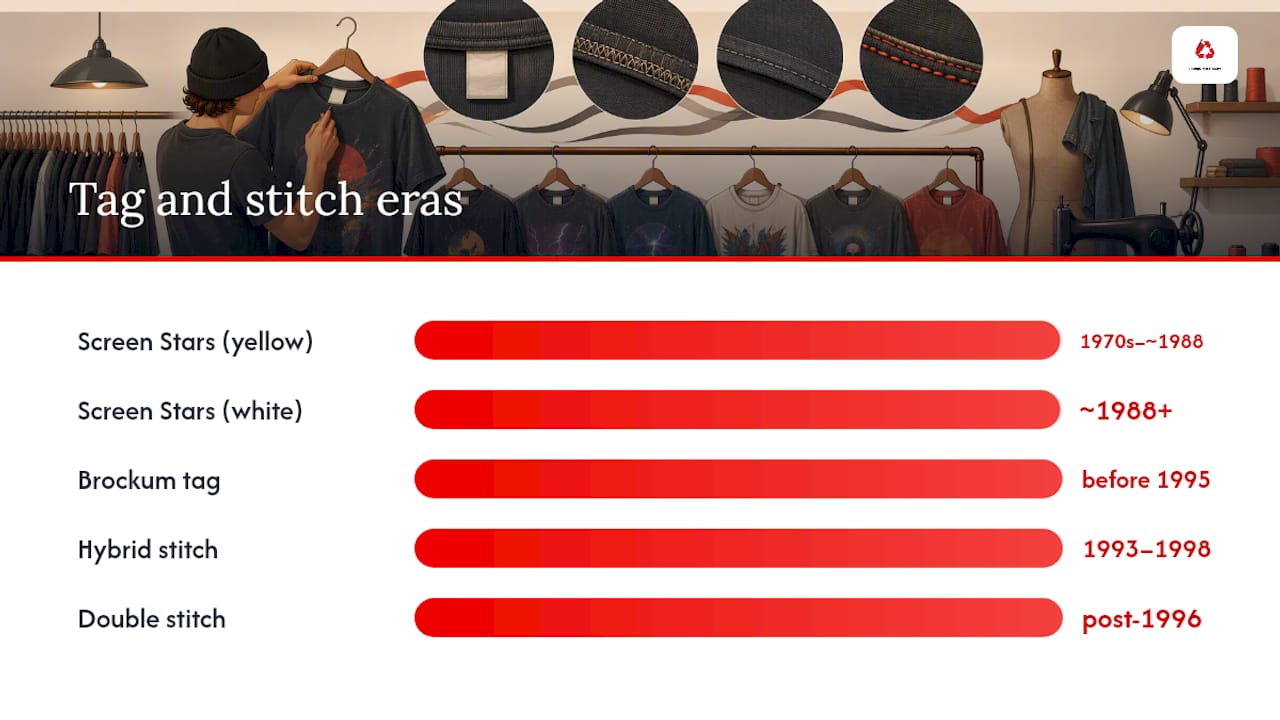
- Read the tag. Note the brand, country of manufacture, and any style or lot numbers. Certain tag eras provide reliable manufacturing windows: Screen Stars yellow tags run from the mid-1970s to around 1988; the white Screen Stars tag appears from roughly 1988 onward; a Brockum tag places production before 1995.
- Check construction. Single stitch on sleeves and hem is a classic 1980s/early-1990s marker. Hybrid patterns (single sleeve, double hem) sit in the 1993–1998 transition. Double stitch throughout suggests post-1996.
- Analyse the print. Plastisol ink sinks into the weave over time and cracks along fold lines. Check registration — slight misalignment between colour layers is normal on vintage screen prints. Look for a copyright or licence line; its absence on a major-band shirt warrants extra scrutiny.
- Cross-reference the tour dates. Match the printed dates against independent sources (see the next section). If every date checks out, your confidence rises sharply.
- Apply a confidence scale. Low: one or two signals align. Medium: tag era, stitch type, and print copyright all agree. High: all physical signals plus independent source confirmation of the tour dates.
- Write a short provenance note. Record tag brand, stitch type, print copyright year, sources checked, and your confidence rating. This note travels with the shirt for future buyers or authenticators.
Pro Tip: When the print lacks a copyright line, weight the tag and stitch evidence more heavily. Unlicensed bootleg shirts from the era are still genuinely vintage — they just need the physical signals to carry the dating argument.
See the Vintage Metal Store guide on identifying tour years for a deeper breakdown of tag timelines by decade.
Physical signs that point to ex-tour stock or deadstock
Ex-tour and deadstock shirts carry distinct physical artefacts that separate them from shirts that simply survived in a wardrobe.
Ex-tour stock indicators:
- Venue stamp or sticker on the tag or inside hem
- Original hanging tags with venue-specific branding or pricing
- Small retail price stickers in the currency and format of the tour country
- Limited-run notes or batch numbers on the tag
Deadstock indicators:
- Factory fold lines pressed into the fabric (sharp creases that don’t wash out easily)
- Original poly bag with printed stock codes still present
- Paper packing tags attached to the collar or sleeve
- Unwashed fabric stiffness — vintage plastisol on an unwashed shirt has a particular rigidity
- Unused hangtags still attached
Documentation that strengthens provenance:
- Original purchase receipt from the venue or merch stand
- Consignor note from the original buyer
- Venue programme scan showing the merch table
- Verified estate provenance with a statutory declaration
Evidence strength runs: physical item artefacts > contemporaneous photo of the item at the venue > seller statement > unverifiable claims. Original tour shirts from earlier decades typically command higher prices than modern reprints, so provenance documentation directly affects what a shirt is worth.
Pro Tip: Factory fold lines on a deadstock shirt run in a consistent grid pattern from the original folding machine. Random creases from home storage look completely different — learn to tell them apart from photos alone.
Red flags that suggest a reproduction or mislabelled shirt
- Double stitching or modern tag fonts paired with a claimed 1980s or early-1990s tour year
- A copyright year on the print that post-dates the claimed tour, or a modern print studio credit
- Perfectly new-looking tags on a print showing heavy cracking and wear (tag age and print wear should be consistent)
- Incorrect city lists, misspelt venue names, or routing that makes no geographic sense for that era
- Soft-hand reprints on modern blanks without licensing marks — the hand feel alone is a giveaway
- Seller evasiveness when asked about provenance, source, or original receipts
Ask these questions before committing:
- Where did the shirt come from originally — venue, estate, collection?
- Do you have any original receipts or documentation?
- Were these shirts sold at the venue during the tour?
- Can you provide additional photos of the tag, seams, and print close-up?
- Has the shirt been washed or altered since purchase?
See the heavy metal tour merchandise tips guide for more seller questions worth asking before you buy.
When professional authentication is worth the cost
When to seek it:
- The shirt’s estimated value exceeds $300–$500 AUD
- Provenance is disputed or the seller’s story has gaps
- You need documentation for insurance or resale at auction
Who to contact in Australia:
- Textile conservators with experience in printed garments (check the Australian Institute for the Conservation of Cultural Material directory)
- Independent music-memorabilia authenticators who specialise in printed tour merch
- Auction house specialists at major Australian houses who handle entertainment memorabilia
- Experienced vintage dealers with a documented track record in band shirts
Typical cost and timeline:
- Visual report based on high-res photos: roughly $75–$250 AUD, turnaround 1–2 weeks
- Full textile analysis or lab-based fibre dating: higher cost, 4–8 weeks depending on the conservator’s workload
What to provide:
- High-resolution photos of front, back, tag, seams, and print close-ups
- Full transcription of all tag text including style numbers
- Any provenance documents, receipts, or consignor notes
- Your own dating notes and confidence assessment
Choosing an authenticator:
- Ask for sample reports before engaging
- Confirm their specific experience with printed tour merch, not just general textiles
- Get a clear written scope of work and refund policy if the report is inconclusive
Pro Tip: Send your own provenance note alongside the shirt. Authenticators work faster and more accurately when the collector has already documented the physical signals — it shows you’ve done the groundwork and focuses their attention on the contested points.
Worked example: dating a Metallica 1992 tour tee
Here’s how the method plays out on a real item.
- First glance. The listing shows a black tee with a large front graphic and a back print listing North American and Australian tour dates. The seller claims it’s from the 1992 “Wherever I May Roam” tour.
- Tag inspection. The tag reads “Brockum” with “Made in USA.” Brockum operated from 1979 to 1994, so this immediately places the shirt before 1995 — consistent with a 1992 claim.
- Stitch check. Single stitch on both sleeves and the hem. This aligns with pre-1996 production and raises confidence.
- Print copyright. The graphic carries a © 1992 line with a Metallica licensing credit. The copyright year matches the claimed tour year exactly.
- Tour date cross-reference. The back print lists Australian dates including Melbourne and Sydney. A Trove search for “Metallica Melbourne 1992” returns contemporary newspaper listings confirming the shows. The dates on the shirt match.
- Confidence rating: HIGH. Four independent signals (Brockum tag, single stitch, 1992 copyright, confirmed Australian tour dates) all align. No contradictions found.
Pro Tip: Always include your Trove search query and the newspaper title in the provenance note. Future buyers and authenticators can replicate your research in minutes.
Browse verified Metallica tour shirts at Vintage Metal Store to see how documented provenance looks on a live listing.
What years of handling tour shirts have taught me
The single most common mistake collectors make is trusting the seller’s story over the physical evidence. A confident, detailed backstory is easy to construct; a Brockum tag with single-stitch construction and a matching 1992 copyright line is not. When the physical signals and the story agree, you have something worth buying. When they conflict, the shirt tells the truth and the story doesn’t.
Conservative dating protects everyone. If the evidence supports “probably 1991–1993” rather than “definitely 1992,” say so in your provenance note. That honesty raises long-term value because future buyers trust the documentation. A shirt sold with an overstated claim eventually gets questioned; a shirt sold with an honest confidence rating holds its reputation.
One cautionary note: seller claims without independent corroboration are the weakest form of evidence, regardless of how detailed or sincere they sound.
Vintage Metal Store’s verified listings and what we document
At Vintage Metal Store, every verified listing includes tag photos, seam close-ups, a written provenance note, and an authenticity confidence rating — so you know exactly what you’re buying before it arrives. You can request additional photos or a short provenance report on any item before purchase; just reach out through the product page.
The rare Metallica 1992 tour tee on the site is a good example of how we document tour years: Brockum tag, single-stitch confirmation, and cross-referenced Australian dates all recorded in the listing. Browse the full range of rare vintage heavy metal concert shirts to find verified ex-tour and deadstock pieces with documented provenance. Ready to add a piece of metal history to your collection? Shop now and wear the legacy.
Key takeaways
Accurate dating of a vintage tour shirt depends on aligning physical signals (tag era, stitch type, print copyright) with independently verified tour history — no single signal is enough on its own.
| Point | Details |
|---|---|
| Tag era is your fastest check | A Brockum tag places production before 1995; Screen Stars yellow tags indicate mid-1970s to around 1988. |
| Stitch type confirms the era | Single stitch on sleeves and hem strongly suggests pre-1996; double stitch throughout points to post-1996. |
| Cross-reference with Trove | Australian tour dates on a shirt can be verified against contemporary newspaper listings in the Trove archive. |
| Deadstock has distinct physical clues | Factory fold lines, original poly bags, and unwashed fabric stiffness are the clearest deadstock indicators. |
| Vintage Metal Store documents provenance | Every verified listing includes tag photos, seam close-ups, a provenance note, and a confidence rating. |
Sources
- How To Authenticate Vintage T-Shirts | Keep It Classic
- Vintage Band Tee or Reprint? Check the Hem | NOSTOS
- Vintage Band Tees: A No-BS Buying Guide for 2026 — WEAR2AM Blog | WEAR2AM
- Band Shirt Collecting Guide | Rockabilia
FAQ
What does the printed year on a tour shirt actually mean?
The printed year most often indicates the tour year or the year the merch was produced. It rarely refers to an album copyright date alone, though the two sometimes coincide.
How do I know if a shirt is genuinely from the tour year printed on it?
Align at least three independent signals: the tag manufacturer era, stitch construction type, and the copyright year on the print. Then cross-reference the back-print tour dates against a source like Trove or a setlist database.
What is a Brockum tag and why does it matter?
Brockum was a major licensed merch manufacturer that operated from 1979 to 1994. A Brockum tag places a shirt’s production before 1995, making it one of the most reliable single-tag date ceilings for vintage heavy metal shirts.
When should I pay for professional authentication in Australia?
Seek professional authentication when a shirt’s estimated value exceeds roughly $300–$500 AUD, when provenance is disputed, or when you need documentation for insurance or auction resale.
Where can I buy verified vintage tour shirts in Australia?
Vintage Metal Store lists verified ex-tour and deadstock heavy metal shirts with documented provenance, including tag photos, seam close-ups, and confidence ratings on each item.
Recommended
- How to identify tour years on vintage heavy metal t-shirts – Vintage Metal Store
- Cross referencing tour date shirts: the collector’s guide – Vintage Metal Store
- Vintage tour shirt checklist for 90s metal collectors – Vintage Metal Store
- Original vs fake band t shirts: the collector’s guide – Vintage Metal Store


