


TL;DR:
- Authentic vintage tour shirts feel smooth, breathable, and show high-quality construction, unlike fakes.
- Online purchases require verifying seller credibility, detailed photos, and community input to avoid counterfeits.
You already know the sinking feeling. You score what looks like a genuine 1994 Slayer tour shirt, only to hold it up in decent light and realise the print is fractionally off, the cotton feels wrong, and the sleeve seams don’t match. Knowing how to avoid counterfeit tour shirts before you hand over your money is the difference between building a collection worth something and filling a drawer with worthless knockoffs. This guide covers the physical checks, online precautions, and verification tools that serious metal collectors actually rely on.
Table of Contents
- Key takeaways
- How to avoid counterfeit tour shirts: your starting point
- Physically inspecting a shirt step by step
- Online buying and remote purchasing precautions
- Advanced verification and reporting fakes
- Common mistakes that get collectors caught out
- My take on fakes in the metal community
- Find genuine vintage tour shirts at Com
- FAQ
Key takeaways
| Point | Details |
|---|---|
| Physical feel reveals fakes fast | Authentic shirts use quality cotton that feels smooth and breathable; fakes feel flimsy or strangely heavy. |
| Construction beats print | Modern counterfeits can copy a design well but fail on seams, collar build, and finish quality. |
| Seller credibility matters online | Verifying seller history and avoiding steep discounts reduces the risk of buying fake merch remotely. |
| Document everything before buying | Screenshots, URLs, and seller details protect you if a dispute arises and support formal reporting. |
| Professional authentication exists | AI tools like Entrupy verify apparel authenticity in under five minutes with near-perfect accuracy. |
How to avoid counterfeit tour shirts: your starting point
Before you assess any shirt, you need a baseline. Authentication, which is the formal term professionals use for this process, starts with knowing what you’re comparing against. If you’ve never held an original 1980s Metallica concert tee, you’re working without a reference point, and that’s exactly where counterfeiters win.
What to gather before you inspect:
- Reference photos from verified collectors, auction records, or reputable archives showing the correct print placement, font, and graphic for the specific tour
- Knowledge of the blank typically used for that era (Hanes Beefy-T for many 80s and 90s shirts, for example)
- A jeweller’s loupe or magnifying glass for checking print detail up close
- Good natural lighting or a daylight lamp
- A camera or phone with a macro lens setting for documentation
Useful tools and what they reveal:
| Tool | What it checks |
|---|---|
| Magnifying loupe | Ink dot pattern, screen print layering, fine detail accuracy |
| UV torch | Some era-specific inks fluoresce; fakes may respond differently |
| Daylight lamp | Reveals colour inconsistencies invisible under warm indoor lighting |
| Reference database or collector forums | Cross-checks specific tour artwork and label types |
| Camera with macro setting | Documents evidence and sends detail shots to experts |
Pro Tip: Join active collector communities on dedicated forums before you spend serious money. Members regularly post verified examples of authentic shirts alongside known fakes, which gives you a living reference library far more useful than any single guide.
Receipts and certificates of authenticity add weight to any purchase, but they’re easy to fake too. Cross-referencing with community knowledge is what separates a confident buy from a gamble.
Physically inspecting a shirt step by step
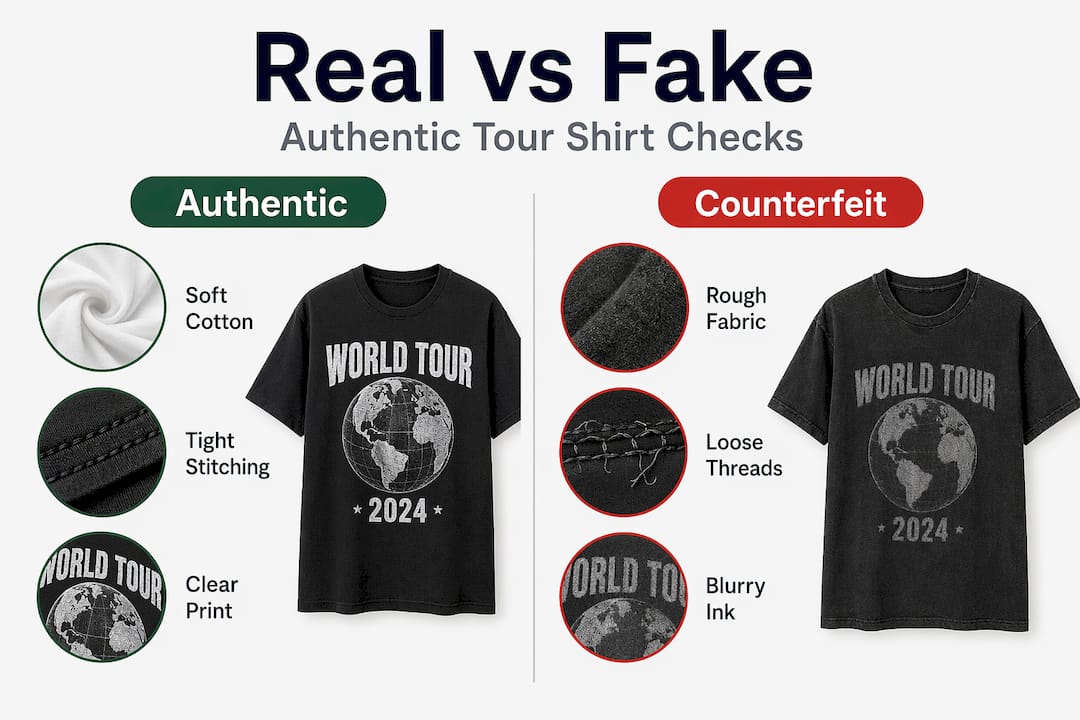
This is where you separate the genuine from the bogus. Authentic shirts feel lightweight, smooth, and breathable, while counterfeits often feel flimsy, cheap, or oddly heavy. That tactile difference is your first signal, but it’s never the only one. Work through these steps methodically.
-
Feel the fabric. Run the shirt through your hands. Genuine vintage cotton has a softened, worn-in quality from age and washing. A fake using synthetic blends or low-grade cotton will feel either plasticky or uncomfortably stiff straight off the rack.
-
Examine the print closely. Authentic screen prints from major tours show clean ink layering with crisp edges. Cheap counterfeits often bleed at the edges, look flat, or have a plasticky coating that sits on top of the fabric rather than sinking into it. Use your loupe here.
-
Check stitching and seams. Look at the side seams, sleeve attachment, and collar. Poor finishing quality such as uneven seam tape, mismatched thread colour on sleeves, or inconsistent stitch density is a reliable giveaway. Genuine shirts from established manufacturers are consistent throughout.
-
Look for glue marks and loose threads. Run your finger along the inner seams. Counterfeits often use adhesive where proper sewing should be, and the raw edges may fray because quality finishing was skipped.
-
Inspect the label. The care label and neck tag tell a story. For vintage shirts, the label style, font, and washing instruction format should match the era. A shirt supposedly from 1992 with a label format that wasn’t used until 2005 is a red flag you can’t ignore.
-
Compare graphic placement. Authentic tour prints land in specific positions on the chest and back. A design sitting too high, too low, or noticeably off-centre suggests it was printed without the original template.
Pro Tip: Photograph every part of the shirt under your daylight lamp before buying. Send those photos to two or three experienced collectors for a quick opinion. Ten minutes of community verification has saved collectors hundreds of dollars.
Quick comparison checklist:
| Feature | Authentic | Suspect |
|---|---|---|
| Fabric feel | Soft, breathable, age-appropriate | Stiff, plasticky, or unusually heavy |
| Print edges | Sharp and clean | Bleeding, flat, or raised coating |
| Seam stitching | Even, matching thread colour | Uneven, mismatched, or adhesive used |
| Care label | Era-appropriate format | Wrong font, wrong era, or missing |
| Graphic placement | Centred, correct position | Off-centre or incorrect height |
Online buying and remote purchasing precautions
Buying remotely is where most collectors get burned. You can’t feel the fabric or hold it to the light, which means verifying seller credibility and scrutinising every available photo becomes the entire game. Here’s what to prioritise.
Seller verification:
- Check how long the account has been active. A seller with 400 transactions and consistent positive feedback is a fundamentally different risk from an account created three weeks ago with two reviews.
- Look for sellers who specialise in vintage metal merch rather than those with eclectic, randomly assembled listings. Specialists have reputations to protect.
- Sellers outside official distribution networks and listings with incomplete or vague descriptions are common sources of counterfeits. Treat vague listings as a warning sign, not a curiosity.
Photo analysis:
Zoom into every image provided. Look for stitching detail, label photos, and close-ups of the print. If the seller only provides wide shots or refuses to photograph the label and inner seams, ask directly. A legitimate seller with nothing to hide will accommodate reasonable requests.

Price signals:
A shirt with genuine provenance from a major 1980s or 1990s metal tour carries real market value. Steep discounting on what’s described as a rare original should trigger immediate scepticism. If it looks too good to be true at that price, it almost certainly is.
Pro Tip: Always use a payment method with buyer protection when purchasing online. Document the listing with a full screenshot including the URL, price, date, and seller name before you pay. If the shirt arrives and doesn’t match the description, you have evidence ready.
Your buying guide for second hand shirts should include a non-negotiable return policy requirement. Any credible seller will offer one. If they won’t, walk away.
Advanced verification and reporting fakes
When you need certainty beyond your own inspection, professional authentication tools are available and worth knowing about. Entrupy’s AI authenticates apparel in under five minutes with 99.86% accuracy and backs its results with a one-year financial guarantee on mistaken validations. It uses machine learning and microscopic imaging to detect what the human eye misses.
For high-value pieces, this kind of verification makes financial sense. Paying a small authentication fee on a shirt worth several hundred dollars is basic due diligence, not overkill.
When you encounter what looks like a counterfeit, reporting it protects the wider collector community. Here’s how to do it properly:
- Capture full evidence first. High-resolution screenshots with the URL, date, seller name, price, and all listing photos give enforcement actions their best chance of success. Save everything before you report, because listings disappear fast once sellers sense scrutiny.
- Report to the platform. Every major marketplace has a counterfeit reporting process. Use it with the evidence you’ve gathered. Vague reports without documentation rarely result in action.
- Contact the band’s official management or merch company. Bands and their representatives can pursue legal action that a single buyer cannot. They want to know where their brand is being exploited.
- Notify Trading Standards or your country’s consumer protection body if you believe the counterfeit merchandise poses a safety risk. Counterfeit merch may use harmful dyes and toxic materials that can cause allergic reactions, which makes this a legitimate safety concern, not just a collector dispute.
Pro Tip: Keep a running folder of any suspicious listings you encounter, even ones you choose not to report immediately. Patterns across multiple listings from the same seller or source build a stronger case for enforcement than a single isolated report.
Common mistakes that get collectors caught out
Knowing the traps is half the battle. These are the errors that experienced collectors have made and that you can skip entirely.
- Relying only on the front print. This is the single most common mistake. Modern counterfeits can replicate a tour graphic convincingly. Insiders authenticate on construction and finishing, not just the artwork.
- Buying from unofficial sellers at shows. The bloke selling shirts from a duffel bag in the car park is not your friend. Ex-tour stock and dead stock from official sources look and feel completely different from what he’s offering.
- Ignoring price signals. The market for genuine vintage metal tour shirts is well established. A real 1989 Slayer Seasons in the Abyss tour shirt commands real money. Anything priced suspiciously low deserves suspicion.
- Skipping documentation. No receipt, no photos before purchase, no record of the seller. This leaves you with no recourse if the shirt turns out to be a fake.
- Overlooking the authenticity of vintage shirts as a learning process. Every shirt you authenticate properly teaches you something that makes the next assessment faster and sharper.
Pro Tip: Always buy with an authenticity guarantee or a clear return policy in place. A seller confident in their stock will never object to this condition.
My take on fakes in the metal community
I’ve been handling vintage heavy metal shirts for a long time, and the one thing that still gets under my skin is how sophisticated the fake market has become. I’ve had shirts in my hands that fooled me on the print, but the moment I turned them inside out and felt the seams, everything fell apart.
What I’ve learned is that physical inspection isn’t something you can outsource entirely to photos or descriptions. You have to develop the feel for it yourself over time. That comes from handling genuine pieces, which is exactly why I’d encourage anyone building a collection to spend time with verified authentic shirts before they spend serious money on anything they haven’t touched.
The metal community is tight. When collectors share knowledge about known fakes, patterns emerge and sellers get exposed. I’ve seen community documentation take down prolific counterfeit operations faster than any formal complaint process. Your willingness to report what you find and share what you learn is genuinely valuable.
Supporting authentic merch also matters for bands directly. When money flows to counterfeit sellers instead of official channels, the artists and crew who made those tours happen see nothing from it. That’s worth keeping in mind every time you choose where to buy.
— David
Find genuine vintage tour shirts at Com
If you’ve done the work of understanding what authentic looks like, you deserve to buy from a source that matches that standard. Com specialises in verified vintage heavy metal shirts including ex-tour stock and dead stock sourced directly from bands and tour operations.
Every shirt in the collection has been assessed for authenticity before it’s listed, which means you’re not doing the verification alone. For collectors after the real thing, the rare 1992 Metallica tour tee is the kind of piece that defines a serious collection. If Metallica is your era, browse the full vintage Metallica shirts collection for verified pieces across multiple decades. Your collection’s value starts with where you buy.
FAQ
How do I physically spot a counterfeit tour shirt?
Check fabric feel, seam stitching, print edge quality, and the care label format. Loose threads, glue marks, and sleeve colour mismatches are reliable physical indicators of a fake.
Are online purchases of tour shirts riskier than buying in person?
Yes. Online authentication relies heavily on seller credibility and photo analysis rather than direct physical inspection, which makes verifying stitching, materials, and labels considerably harder.
What should I do if I suspect I’ve bought a fake tour shirt?
Document the listing with screenshots, the URL, and seller details, then report the item to the platform and consider contacting the band’s official merch representative. Evidence collected before reporting significantly improves the chances of a successful takedown.
Can AI tools reliably authenticate a band shirt?
Yes. Entrupy’s apparel authentication tool works in under five minutes with 99.86% accuracy and includes a financial guarantee on incorrect validations, making it a legitimate option for high-value purchases.
Where are the safest places to buy authentic vintage metal tour shirts?
Specialist sellers with verifiable track records, established collector communities, and stores like Com that source directly from ex-tour and dead stock are the most reliable options for buying authentic tour merchandise without the counterfeit risk.
Recommended
- The real value of tour stock shirts for collectors – Vintage Metal Store
- Why Tour Dates on Shirts Matter for Metal Fans – Vintage Metal Store
- Tour stock shirts explained: Value, rarity and collector secrets – Vintage Metal Store
- Collecting tour shirts: their cultural value and impact – Vintage Metal Store


