



TL;DR:
- An archive shirt is a band tour or era-defining piece with verifiable provenance, not just an old graphic tee. The term is often overused, making provenance checks essential for authentic collecting. Genuine archive shirts require careful research, documentation, and patience to find.
An archive shirt, in band merch terms, is a tour- or era-defining piece with verifiable provenance and genuine cultural significance — not just any old tee with a faded print. For heavy metal collectors, the label carries real weight when it can be backed by evidence: original tour dates in the design, datable tags, ex-tour or deadstock origin, and a seller history that holds up to scrutiny. When it cannot, it is marketing.
- What it is: A shirt tied to a specific tour, era, or culturally significant moment in a band’s history, with provenance to prove it.
- What it is not: A reprint, a post-tour generic, or any shirt a seller calls “archive” without documentation.
- The verdict: The label matters when provenance is verifiable. Without that, archival collecting requires more than money — it requires research.
- Where to start in Australia: Vintage Metal Store curates verified ex-tour and deadstock heavy metal shirts, making it one of the few local sources where the label is applied with collector-grade standards.
Table of Contents
- What does ‘archive’ mean, and how does it differ from vintage, deadstock, and ex-tour?
- Why is ‘archive’ so overused, and what does that cost you as a collector?
- How do you authenticate an ‘archive’ shirt before you buy?
- What actually drives value, and how long does it take to find genuine pieces?
- Where do Australian collectors find genuine archival heavy metal shirts?
- How do you care for and preserve an archival band tee?
- Pre-purchase checklist: is this shirt genuinely archive?
- Key takeaways
- The archive label means nothing without the story behind it
- Vintage Metal Store: curated archival heavy metal shirts in Australia
- Useful sources
- FAQ
What does ‘archive’ mean, and how does it differ from vintage, deadstock, and ex-tour?
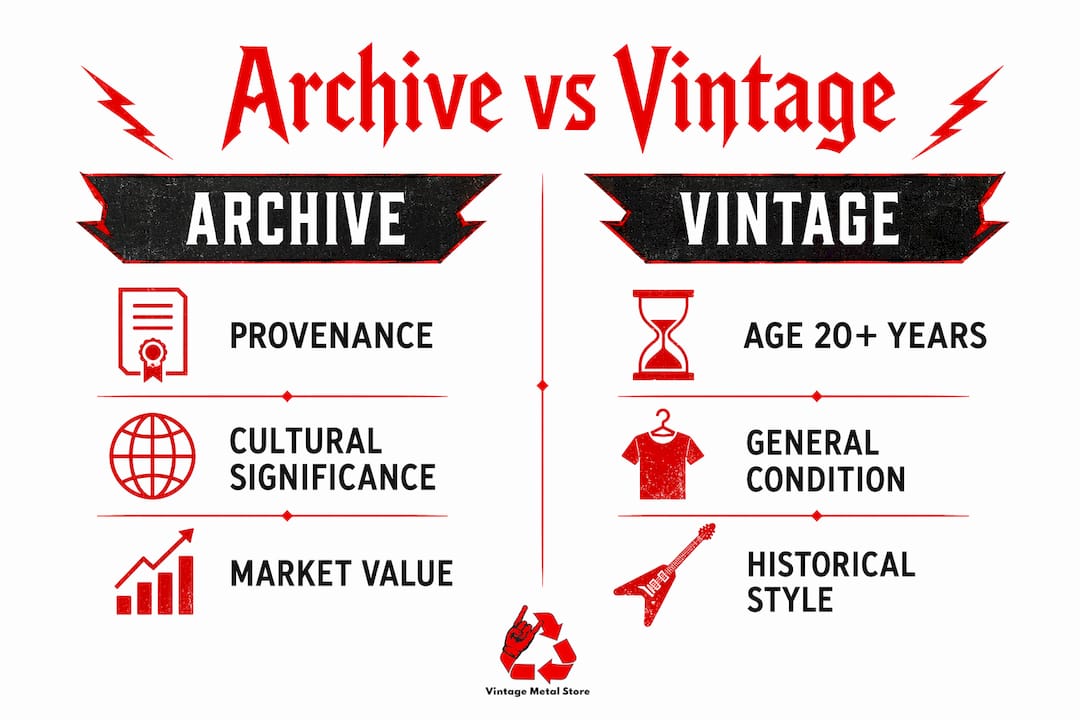
The word “archive” gets thrown around loosely, but for serious collectors it has a precise meaning. An archival shirt is one of a band’s greatest hits from their back catalogue — a piece from a seminal tour or culturally defining moment, not simply something old. Think a Metallica Black Album tour tee from 1991, screen-printed with the actual tour dates, sold at the venue. That is archive. A generic band tee printed five years after the tour is not.
The related terms each mean something distinct:
- Vintage: Generally accepted as 20+ years old, but age alone does not make a shirt archival. A 1998 tee from a forgettable support act is vintage; it is not necessarily archive.
- Deadstock: Unworn, original-era stock that was never sold or distributed — often ex-warehouse or ex-label inventory. Deadstock can be archival if it is from a significant tour run, but the two terms are not interchangeable.
- Ex-tour: Stock that was part of the official merch run for a specific tour, sometimes returned unsold from venues. Ex-tour pieces carry strong provenance because their origin is traceable to a specific event.
The archive label functions as shorthand for “collectible design” in marketplace listings, but that subjectivity is exactly the problem. Prioritise provenance, rarity, and era over the label itself.
Pro Tip: When assessing a listing, ignore the word “archive” entirely and ask: can the seller prove when and where this shirt was made? If the answer is vague, treat it as vintage until proven otherwise.
Why is ‘archive’ so overused, and what does that cost you as a collector?
The term has been stretched to the point of near-meaninglessness. Dr Valerie Steele warns that overuse is eroding the original meaning, making it genuinely harder for collectors to distinguish true historical pieces from inflated listings.
The market effect is real. Marketplace listings labelled “archival” range from US$49 to US$20,000, with no consistent standard separating them. That price variance is not driven by genuine rarity — it is driven by label inflation. For heavy metal collectors, this means a bootleg reprint with a worn-out print can sit alongside a genuine 1992 tour tee at similar asking prices, simply because both carry the word “archive” in the title.
Pro Tip: Treat “archive” as a search term, not a quality signal. Use it to find listings, then apply your own provenance checklist to decide whether the piece actually qualifies.
How do you authenticate an ‘archive’ shirt before you buy?
Authentication is where serious collectors separate themselves from casual buyers. The process mirrors stamp or rare-card collecting — success depends on elimination and deep research into origin, season, and context.
Provenance checklist
- Original receipts or purchase records from the tour era or original point of sale.
- Dated photographs showing the shirt at or near the time of the tour — fan photos, press shots, backstage images.
- Tour passes, laminates, or ticket stubs that corroborate the shirt’s claimed origin event.
- Ex-tour or deadstock documentation from the seller, including how they acquired the stock.
- Seller history: How long have they been selling? Do they specialise in verified merch? Are previous buyers satisfied?
Authentication checklist
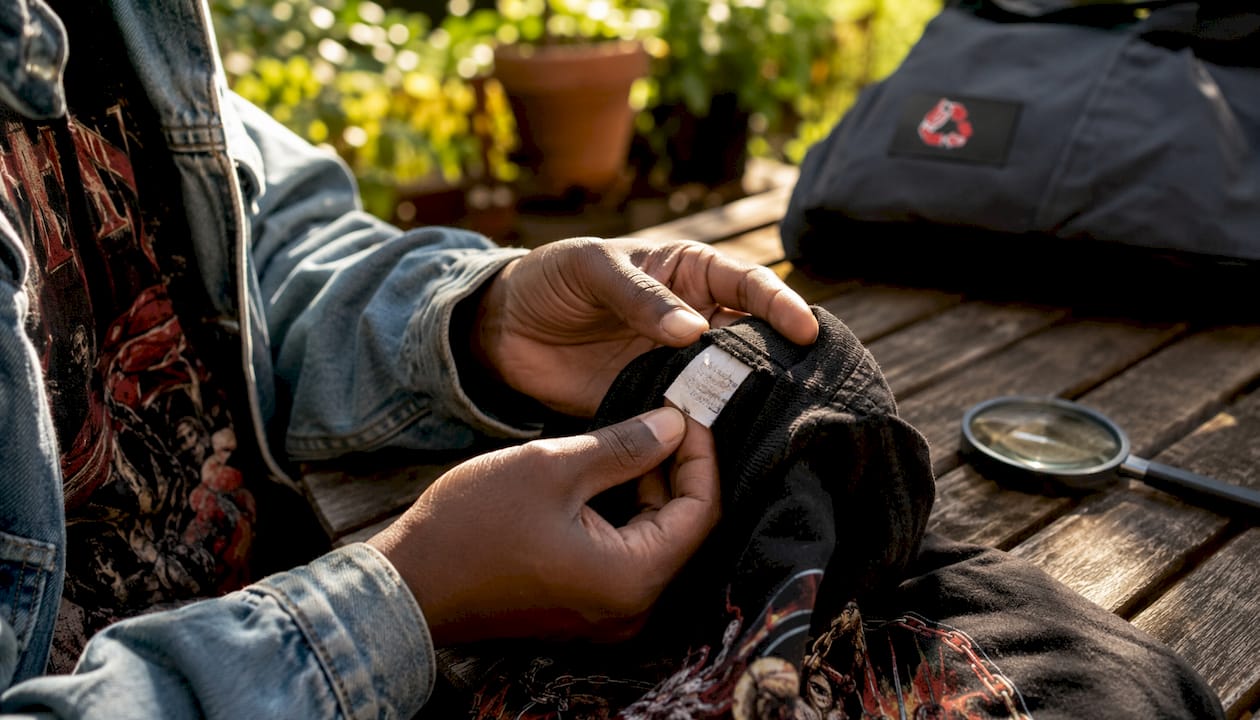
- Tag dating: Single-stitch tags, Hanes Beefy-T labels, and Fruit of the Loom tags all have datable production windows. A tag inconsistent with the claimed era is a red flag.
- Care tags: Pre-1994 US-made shirts often lack the fibre content care tag required after regulatory changes. Presence or absence can help date a piece.
- Print technique: Discharge printing (which bleaches the fabric) and early plastisol prints have distinct textures. Modern reprints typically use water-based inks that look and feel different.
- Stitch patterns: Single-needle stitching on the sleeves is consistent with 1980s–1990s production. Overlocked or serged edges suggest later manufacture.
- Tour dates in the design: A shirt listing specific concert dates is far harder to fake convincingly than a generic band graphic.
Cross-reference tour dates against setlist archives and band discographies. Our guide to cross-referencing tour date shirts walks through this step by step. For spotting bootlegs specifically, the bootleg metal tees guide covers the most common tells.
Pro Tip: Ask the seller for photos of the tag, the inside seam, the print up close, and the full back. A legitimate seller of genuine archive pieces will have these ready. Hesitation or stock photos are a red flag.
What actually drives value, and how long does it take to find genuine pieces?
Provenance, year, and collection context are often more decisive than age alone. For heavy metal merch, the core value drivers are:
- Tour significance: A shirt from a band’s career-defining tour (a first world tour, a reunion, a farewell) commands more than a generic annual run.
- Graphic impact: Iconic artwork — think early Pushead designs for Metallica or the original Morbid Angel Altars of Madness print — carries independent collector value.
- Rarity: Limited venue-only runs, regional variants, and ex-tour stock that never reached retail are inherently scarcer.
- Condition: Print integrity, fabric weight, and absence of repairs all affect grading. A shirt with 80% print retention in a size XL will always outprice the same shirt in tatters.
- Cultural moment: Archival pieces are the “greatest hits” of a band’s catalogue — items tied to a sea change in the genre’s history.
Genuine archive pieces take time to find. Expect months to years for specific grails, with the best stock surfacing around major collector events, estate sales, and seasonal clearances from long-running specialist stores. Pricing extremes in the broader archival market illustrate just how wide the range can be:
| Item | Approximate price | Context |
|---|---|---|
| Raf Simons parka | — | Benchmark for archival price variance in fashion |
| Genuine 1990s heavy metal tour tee (grail condition) | AU$300+ | Verified ex-tour, original tags, iconic graphic |
| Generic 1990s band tee (no provenance) | AU$40+ | Vintage age, no tour-specific evidence |
The Raf Simons figures come from ThriftCon’s archival fashion guide and illustrate how provenance and cultural significance can push prices into extreme territory. Heavy metal merch operates on a smaller scale, but the same logic applies.
Where do Australian collectors find genuine archival heavy metal shirts?
Trusted channels in Australia include specialist vintage clothing stores in Melbourne and Sydney, collector networks on local Facebook groups and Discord servers, and vetted online shops that focus exclusively on band merch. Auction houses occasionally surface significant pieces, though provenance documentation varies.
Vintage Metal Store is an Australian-based online shop specialising in verified vintage and second-hand heavy metal shirts, ex-tour stock, and deadstock from heavy metal tours and bands. The curation is collector-focused: pieces are individually listed with condition notes, and the inventory includes rare items from prominent bands and Australian metal acts. For collectors who want to browse verified ex-tour stock without trawling through inflated marketplace listings, it is a practical starting point.
Seller red flags to watch for in any channel:
- Photos that are clearly stock images or do not show the actual tag and print up close.
- Provenance described as “believed to be from the tour” or “looks original” without documentation.
- Seller accounts created recently with no feedback history in band merch specifically.
- Prices that sit well above market rate for the condition shown, justified only by the word “archive.”
How do you care for and preserve an archival band tee?
Preservation is as important as authentication. A shirt that degrades in storage loses both condition grade and value.
- Storage: Fold (do not hang) archival tees to avoid stress on the fabric and print. Use acid-free tissue between folds and store in breathable, archival-grade boxes. Hanging causes shoulder distortion over time, particularly in lighter 1990s cotton.
- Temperature and humidity: Australia’s climate varies significantly. Aim for a stable environment below 20°C with relative humidity between 45–55%. Avoid garages, attics, and anywhere subject to seasonal temperature swings, which accelerate fabric degradation.
- Cleaning: Hand-wash in cold water with a pH-neutral detergent, inside out, and air-dry flat away from direct sunlight. Never machine-wash a shirt with significant print loss or fragile discharge printing.
- Display: If you display a shirt, use UV-filtering glass or acrylic and rotate pieces out of light exposure regularly. Direct sunlight fades plastisol prints within months.
- Repairs: Avoid DIY repairs on high-value pieces. A textile conservator can stabilise fabric tears without compromising authenticity. Our restoration workflow guide covers when professional help is worth the cost.
Pro Tip: For pieces worth AU$300 or more, consult a professional textile conservator before attempting any cleaning or repair. The cost of a consultation is far less than the value lost from a damaged print.
Pre-purchase checklist: is this shirt genuinely archive?
Work through these in order — the earlier checks eliminate the most listings fastest.
- Provenance proof first: Does the seller have receipts, dated photos, or ex-tour documentation? No documentation means no archive claim.
- Tag dating: Does the label match the claimed era? Check against known tag production windows for the manufacturer.
- Tour dates in the design: Are specific concert dates printed on the shirt? This is the single strongest authenticity signal for tour merch.
- Print type and condition: Is the print consistent with the claimed era’s technique? Is print retention above 70%?
- Condition grading: Assess for holes, repairs, fading, and fabric thinning. Grade honestly: excellent, good, fair, or poor.
- Seller history: Does the seller have a track record in verified band merch? Check feedback, ask questions, and look for specialist knowledge in their responses.
- Return policy: A seller confident in their stock offers returns. No returns on a high-ticket item is a red flag.
Walk away if provenance is vague and the price is high. Negotiate hard if provenance is solid but condition is lower than the asking price reflects. Our heavy metal shirts buying checklist expands on each step.
Key takeaways
An archive shirt is only as valuable as the provenance behind it — without documentation, the label is just marketing.
| Point | Details |
|---|---|
| Archive shirt definition | A tour- or era-defining piece with verifiable provenance, not simply any old band tee. |
| Top authentication checks | Verify tag dating, tour dates in the design, print technique, and seller history before committing. |
| Main value drivers | Tour significance, graphic rarity, condition grade, and cultural moment determine collector value. |
| Buyer caution | “Archive” listings range from genuine grails to inflated reprints — provenance documentation is the only reliable filter. |
| Vintage Metal Store | Curates verified ex-tour and deadstock heavy metal shirts in Australia, with individual condition notes on each listing. |
The archive label means nothing without the story behind it
The word “archive” has become one of the most abused terms in the collector market, and heavy metal merch is not immune. Sellers know it signals value, so it gets applied to anything with a faded print and a decade of age. The collectors who build genuinely significant collections are the ones who treat the label as a starting point for investigation, not a conclusion.
What actually separates an archival piece from a vintage one is the story you can prove. A 1991 Metallica Black Album tour shirt with the original Brockum tag, the European tour dates on the back, and a seller who can trace it to ex-venue stock — that is archive. The same shirt with none of that context is a great vintage tee, but the premium is not justified. Curating to that standard takes patience, and it means walking away from a lot of listings that look right but cannot be verified.
Vintage Metal Store: curated archival heavy metal shirts in Australia
If you have spent any time trawling general marketplaces for genuine archive metal shirts, you know how much noise there is. Vague provenance, inflated prices, and the word “archive” on listings that would not survive a basic tag check.
Vintage Metal Store cuts through that. Every piece in the collection is individually sourced and listed with condition notes, and the inventory focuses on what collectors actually want: verified ex-tour stock, genuine deadstock, and rare shirts from the bands that defined heavy metal. From a rare Metallica 1992 tour tee to the broader vintage Metallica collection, the stock is curated for collectors who know the difference between a genuine archive piece and a well-aged reprint. Browse the full collection at Vintage Metal Store and find the piece that belongs in your collection.
Useful sources
- Farfetch style guide: archive clothing and archival fashion brands — Comprehensive overview of what archival fashion means, the collector mindset, and how “greatest hits” pieces are defined.
- The New York Times: why everything is being called ‘archival’ all of a sudden — Features Dr Valerie Steele’s expert critique of label overuse and its impact on collector markets.
- The Star: what counts as ‘archive’ in fashion — Marketplace commentary on the subjectivity of the archive label and price variance in listings.
- ThriftCon: the what, when, and how of archive fashion — Practical guide to archival fashion collecting, including price benchmarks and provenance principles.
- British GQ: why everyone makes such a big deal about archival fashion — Explains why provenance, season, and collection context outweigh age alone in determining archival status.
- Vintage Metal Store blog — Practical how-tos on authentication, deadstock identification, bootleg spotting, and care for heavy metal collectors in Australia.
FAQ
What is the archive shirt definition for band merch?
An archive shirt is a band tee tied to a specific, culturally significant tour or era, with verifiable provenance such as original tags, tour dates in the design, or ex-tour documentation. Age alone does not qualify a shirt as archival.
How do archive shirts differ from vintage band tees?
Vintage refers to age (generally 20+ years); archival refers to cultural and historical significance backed by provenance. A shirt can be vintage without being archival, but a genuine archive piece will almost always be vintage too.
Why is the ‘archive’ label so common on marketplace listings?
The term has been overused as a marketing shorthand for “collectible,” with listings ranging from genuinely rare pieces to ordinary reprints. Dr Valerie Steele has noted this erosion of meaning, and marketplace data shows listings labelled “archival” spanning an enormous price range with no consistent standard.
What is the most important check when buying an archive shirt?
Provenance documentation is the single most decisive factor. Tour dates printed in the design, datable tags, and a seller who can trace the shirt’s origin to a specific tour or stock source all carry far more weight than the word “archive” in a listing title.
Where can Australian collectors buy verified archive heavy metal shirts?
Vintage Metal Store is an Australian online shop specialising in verified ex-tour stock, deadstock, and rare heavy metal shirts, with individual condition notes on each listing and a focus on collector-grade curation.
Recommended


