



When collectors talk about “RN numbers band tees,” they’re really talking about one thing: genuine vintage, ex‑tour, and deadstock heavy metal shirts, not the five‑digit tag code the clothing industry uses for manufacturer identification. That’s a different subject entirely, and it won’t help you spot a real 1991 Sepultura tour shirt from a reprint sold last Tuesday.
If you want an original, you’ve got two paths. Run the forensic authentication checklist below yourself, or buy from a specialist like Vintage Metal Store, where the vetting is already done. Before you hand over money on any listing, ask for two things:
- Deadstock status. Is the shirt genuinely unworn old stock, or worn vintage with history?
- Provenance evidence. A ticket stub, an original owner’s photo from the tour, or a seller with a documented collection history.
Get those two answers and you’ve already filtered out most of the junk on the market.
Key Takeaways
Authenticating a vintage metal tee comes down to triangulating tag era, print behaviour, construction, and provenance together, never relying on one indicator alone.
| Point | Details |
|---|---|
| Use triangulation, not single checks | Cross‑reference tag era, print behaviour, and construction together before trusting any one indicator. |
| Provenance beats condition | A documented history (ticket stubs, owner photos) often matters more than a flawless appearance. |
| Know deadstock vs vintage | Deadstock is unworn old stock and can still show storage ageing; vintage may be worn but carries genuine history. |
| Watch for pressure and vague photos | Scarcity pressure and stock photography instead of real close‑ups are the most common scam signals. |
| Buy from vetted specialists when in doubt | Vintage Metal Store applies the same authentication checks to curated Australian and international metal tees. |
Table of Contents
- How do you authenticate rn numbers band tees before buying?
- Deadstock, vintage or reissue: what should you actually buy?
- Where do serious collectors actually find these shirts?
- What condition factors change the value of a vintage tee?
- Do RN tag numbers matter when dating a band tee?
- What scams should you watch for when buying vintage metal tees?
- Why the forensic approach beats trusting any single “tell”
- Why buy your vintage metal tees from Vintage Metal Store
- Sources
- FAQ
How do you authenticate rn numbers band tees before buying?
Counterfeiters have gotten good. Single‑stitch hems, faded ink, a “vintage” tag, none of these prove anything on their own anymore, because high‑quality reproductions now mimic all of them. Authentication experts recommend a triangulation method instead: cross‑checking multiple independent indicators at once rather than trusting any single cue, since professional workflows evaluate tag history, print characteristics, fabric ageing, and licensing accuracy together.
Here’s the sequence worth following, in order:
- Check the tag first. Look at the brand history behind it (Screen Stars, Fruit of the Loom, Hanes all had distinct label eras), the font used, and whether the fibre content listed matches what was standard for that manufacturing period.
- Inspect the print, not just the design. Genuine period prints show specific ink behaviour: slight oxidation, natural cracking that follows fabric movement, and halftone dot patterns consistent with the screen printing technology of that decade. Reprints often show ink sitting too crisply on top of the fabric with no layering or registration drift.
- Look at construction. Collar geometry, seam stitching, and hem construction all shift across eras. Single‑stitch hems are common on genuine 80s and 90s tees, but plenty of fakes now replicate that too, so treat it as one data point, not proof.
- Chase the provenance. Original owner history, a ticket stub from the actual tour, or a receipt trail carries more weight than any physical feature, because authentication workflows treat original‑owner history and documentation as core evidence.
- Cross‑reference tour dates. If the shirt lists a date or venue, check it against verified tour schedules before you believe the story attached to it.
Before you commit to any private sale, ask the seller for close-up photos of the tag, the print’s underside, and the collar seam, plus a written note of where the shirt came from.
Pro Tip: Never rely on one “tell” alone. A genuine tag on a reprinted body, or a genuine print transplanted onto a newer blank, both happen more often than you’d think. Triangulate across tag, print, construction, and story before you trust any listing.
Deadstock, vintage or reissue: what should you actually buy?
Deadstock means unworn old stock. It never sold, never got put on, and has sat in storage since the original production run. Vintage means genuinely old but possibly worn, carrying whatever patina and history that implies. A reissue is a modern reprint of an old design, sometimes licensed, sometimes not, and it should never be priced or sold as an original.
These distinctions change what you should expect to pay and how the shirt should look. Deadstock often commands a premium for preservation, since it’s the closest you can get to the shirt as it existed the day it was printed. Worn vintage can still hold serious value if the wear tells a genuine story, particularly ex‑tour pieces with a documented chain of ownership.
Six things drive the price you should expect to pay, according to established collecting guides:
- Rarity of the print run or event.
- Tour significance (a farewell tour or a one‑off festival date carries more weight than a generic album‑cycle shirt).
- Condition, from deadstock through to heavily worn.
- Artwork, with iconic or controversial designs commanding premiums.
- Provenance, meaning documented history beats an unverifiable claim every time.
- Artist demand, since a defunct or legendary act typically outpaces a band still touring and printing new merch.
Before buying, insist on measurements, close-up photos of both tag and print, and a clear return policy. If a seller won’t specify whether a shirt is deadstock or worn vintage, treat that vagueness as a warning sign rather than a minor omission. Market confusion between these terms leads directly to mispricing, and it’s usually the buyer who pays for that confusion.
Where do serious collectors actually find these shirts?
The best pieces rarely sit in the first search result you find. Serious collectors work multiple channels, each with its own reliability profile.
- Specialist vintage stores carry curated stock with authentication already done, usually at a fair premium for that certainty.
- Auctions can surface genuinely rare pieces, but provenance documentation varies wildly between listings, so read the fine print.
- Estate sales and garage sales are unpredictable but occasionally produce untouched deadstock lots from someone’s basement.
- Long‑running screen printers are an underrated source. Persistent, direct contact with printers who’ve operated for decades can turn up leftover deadstock that never made it to retail.
- Collector networks and forums trade on reputation, so a seller’s history within the community matters more than any single listing.
Whichever channel you use, insist on close‑up photos of the tag, the print’s reverse side, and any seams before money changes hands. For cross‑border or private-seller purchases, use a payment method with buyer protection, and be wary of anyone pushing bank transfer or unconventional payment methods, since that’s a persistent scam pattern in this market. The collector’s guide to spotting reproductions is worth running through before you finalise any purchase, no matter which channel it came from.
What condition factors change the value of a vintage tee?
Condition isn’t just cosmetic. It shifts price, wearability, and long-term value all at once, so run through this before you buy:
- Fabric hand. Does it still feel like fabric, or has it gone stiff and papery from age or poor washing?
- Collar stretch. A blown-out collar signals heavy wear and lowers value even if the print looks fine.
- Seam integrity. Loose or reinforced seams tell you whether the shirt has been repaired.
- Print cracking and colour fade. Some cracking is expected and even desirable on a genuine vintage piece, but heavy fade across the whole design usually means storage damage, not charm.
- Stains, odour, and prior repairs. These should be disclosed upfront, not discovered after you’ve paid.
Patina cuts both ways. A soft, honestly worn tour shirt with visible history can be more desirable to some collectors than a stiff deadstock piece, because it proves the shirt actually went to the show. But heavy staining, holes, or a musty smell that won’t air out will drag the price down regardless of rarity.
Even unworn stock isn’t automatically flawless. Deadstock can still show oxidation, yellowing, or brittle prints from decades in storage, so inspect it the same way you would a worn piece.
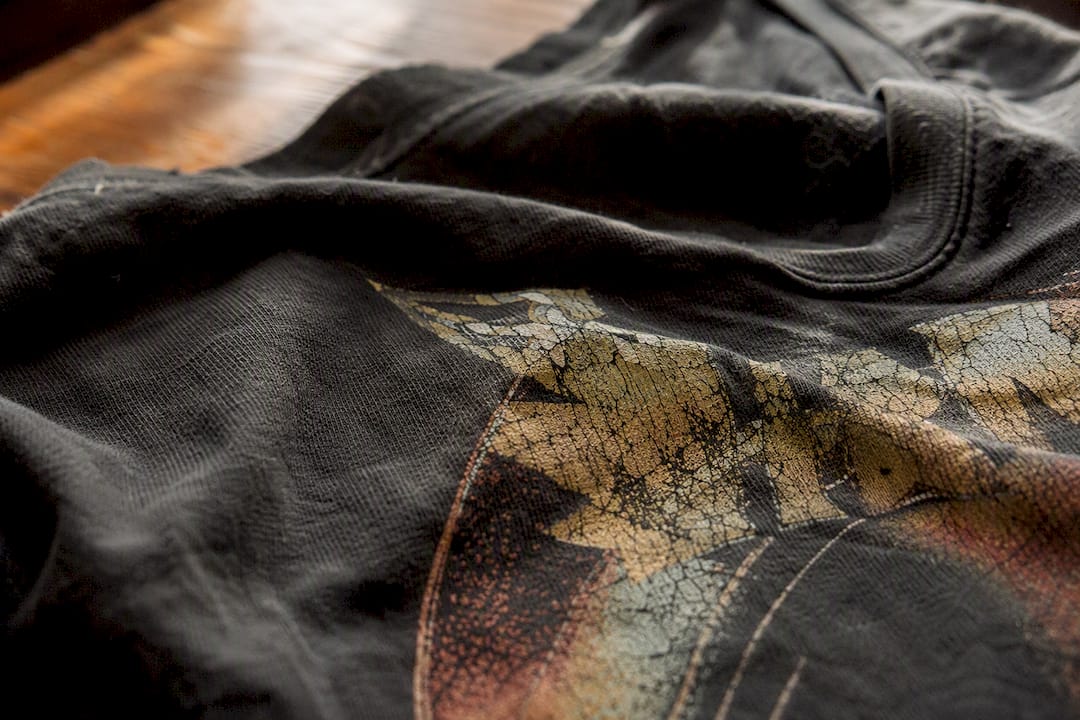
Pro Tip: Store your shirts folded, not hung. Hanging stretches the shoulders and collar over years, which is exactly the kind of damage that tanks resale value on an otherwise mint piece. Keep them somewhere dry and out of direct sunlight, and skip the dry cleaner entirely.
Do RN tag numbers matter when dating a band tee?
Not much, and definitely not on their own. The RN number system was built for general apparel manufacturer identification, not for dating a specific tour print or verifying a band’s licensing. Relying on it as your main authentication tool misses the point entirely.
What actually matters for dating a band tee is the combination of the tag’s brand era, the print’s manufacturing method, and whether the design matches a documented tour or release period. A Screen Stars tag from the mid‑80s looks and feels different to a Hanes tag from the late 90s, and that era gap tells you far more than any registration number stitched into the collar.
If you’re trying to pin down when a shirt was actually made, focus on:
- The tag brand and its known production window. Certain labels only existed for specific stretches of years.
- The print method. Multi‑colour screen printing techniques evolved, and halftone dot patterns from the 80s look different under close inspection than digital reproductions do today.
- The design’s release context. Does the artwork match a specific album cycle or tour that’s independently documented?
None of this replaces the triangulation approach covered earlier. Treat any single data point, RN numbers included, as one small piece of a larger puzzle rather than a shortcut to certainty.
What scams should you watch for when buying vintage metal tees?
The market for rare band shirts attracts opportunists, and the same handful of tricks show up again and again.
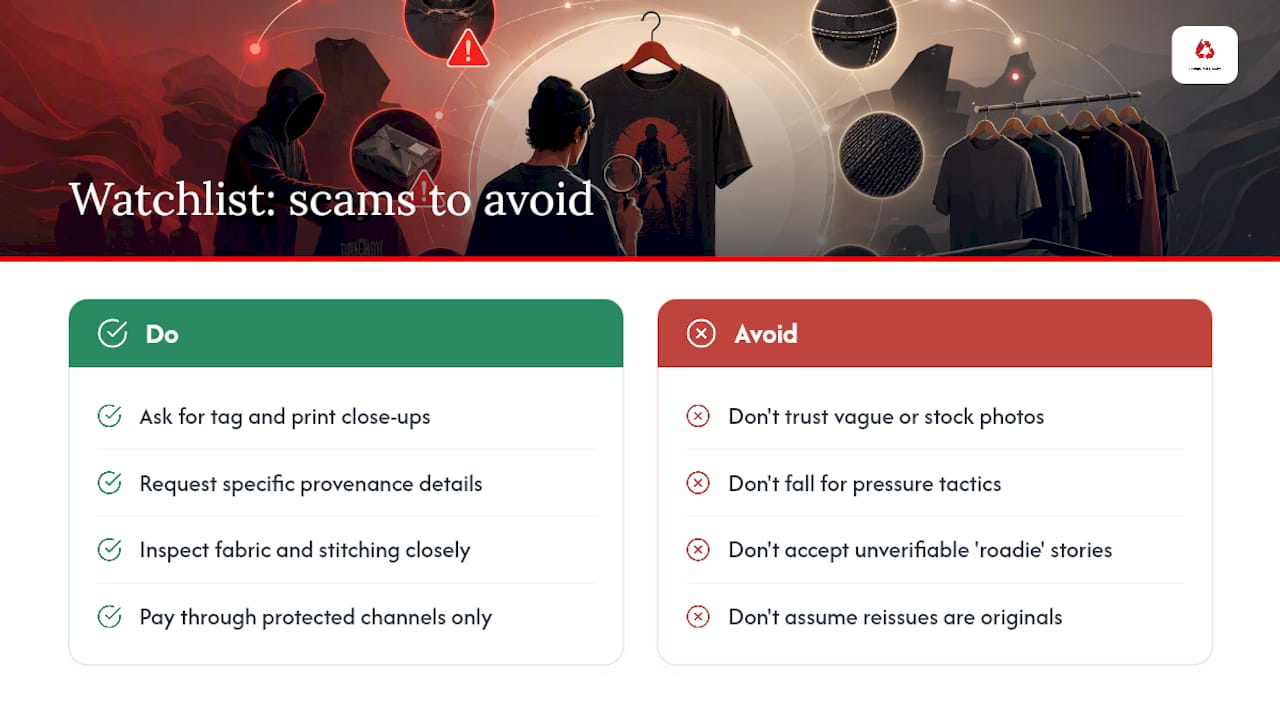
Mislabelled reissues. A modern reprint sold as an “original” is the most common issue, often because the seller genuinely doesn’t know the difference rather than intending to deceive. Either way, you’re the one who ends up overpaying.
Vague or stock photography. Listings using generic photos instead of shots of the actual item, or refusing to provide close-ups of the tag and print, should raise your guard immediately.
Pressure tactics. “Only one left, three other people are watching this” language pushes you to skip due diligence. Genuine sellers with real provenance rarely need to rush you.
Unverifiable provenance stories. Anyone can claim a shirt came from “a roadie’s collection.” Ask for specifics: which date, which venue, what supporting evidence exists.
Payment outside protected channels. Requests for bank transfer, gift cards, or cryptocurrency on a private sale are a hard no, since you lose any recourse if the item doesn’t match the listing.
Franken‑shirts. A genuine tag stitched onto a different body, or a genuine print transferred to newer fabric, is harder to spot but shows up under close fabric and stitching inspection.
None of these require special expertise to catch, just patience and a willingness to walk away from a listing that won’t answer direct questions.
Why the forensic approach beats trusting any single “tell”
Most advice on this topic still leans on one shortcut: check the stitching, check the tag, check the print, pick one and call it done. That’s exactly the habit counterfeiters now exploit, because reproductions have gotten specific enough to fool a single-point check almost every time.
What the evidence actually supports is layering checks: tag era, print behaviour, construction, and provenance, cross‑referenced against each other rather than trusted in isolation. That’s more work than glancing at a hem, and it should be. A shirt that’s survived thirty years of storage, tours, and resales deserves more scrutiny than a five‑second scroll past a listing photo.
Where most buyers go wrong isn’t laziness, it’s assuming provenance is a bonus rather than the priority. A shirt with a documented history and average condition is usually a safer buy than a “flawless” shirt with no story behind it at all. If you take one thing from this, prioritise the story and the paperwork before you fall for the print.
Why buy your vintage metal tees from Vintage Metal Store
Vintage Metal Store runs the same triangulation checks outlined above on every shirt before it goes up for sale, so you’re not the one left cross‑referencing tour dates and tag fonts at midnight. Every listing comes with condition photos, provenance notes where available, and honest disclosure of deadstock versus worn vintage status, which cuts out the guesswork that trips up so many private-sale buyers.
The inventory runs deep on Australian metal acts alongside international heavyweights, including pieces like the Rare Metallica 1992 Tour Tee and the curated rare vintage heavy metal concert shirts collection for anyone chasing ex‑tour rarities specifically. If you’re after home‑grown history, browse the Australian metal band shirts range, including deadstock pieces like the Triple Kill Australian Band Logo Shirt and the Hollow World Australian Metal Band Shirt.
Browse the full curated collection now, and if you want extra photos or provenance detail on a specific shirt before you buy, just ask, that’s a normal part of how collectors buy here.
Sources
- DJR Expert Guide Series, Vol. 266 — Real vs. Fake: Counterfeit Vintage Band T-Shirts — DJR Authentication
- Deadstock vs vintage: why streetwear collectors pay more | Prism News
- What is a DEADSTOCK vintage T-SHIRT? – T-Shirt Time Machine
- Band shirt collecting guide | Rockabilia
FAQ
What does “rn numbers band tees” actually mean for collectors?
In this context, it refers to vintage, ex‑tour, and deadstock heavy metal band shirts, not the manufacturer identification code found on modern clothing tags.
Is deadstock always worth more than worn vintage?
Not always. Deadstock often commands a premium for preservation, but a worn vintage shirt with strong documented provenance can outvalue an unremarkable deadstock piece.
What’s the single biggest red flag when buying online?
A seller who won’t provide close-up photos of the tag and print, or who pushes payment outside protected channels, is the clearest warning sign to walk away.
Can I trust single‑stitch hems as proof of authenticity?
No. Single‑stitch construction is common on genuine vintage tees, but reproductions now replicate it too, so it should only ever be one piece of a larger check.
Where should I start if I want a guaranteed authenticated shirt?
Buying from a specialist that already runs forensic checks, like Vintage Metal Store’s curated collections, removes most of the authentication risk from the process.
Recommended


