



TL;DR:
- Tour exclusive merch is specially designed or sold for specific concert tours, limited by location and timing, creating scarcity. Its value comes from limited production, regional restrictions, and verifiable provenance through SKU coding, making it highly collectible. Artists strategically enforce these limits to boost demand, resale prices, and fan loyalty, blending physical and digital authenticity layers.
Tour exclusive merch is defined as merchandise designed or sold specifically for a particular concert tour or live event, with availability restricted by location, timing, or production run. These are not items you find at a general retailer or on a band’s permanent online store. The Nike and BTS “ARIRANG” world tour collaboration is a textbook example: exclusive T-shirts, hoodies, and a Korea-only cap were made available only in select cities and through a time-limited online window in China. For music enthusiasts and collectors, that combination of unique design and hard-to-replicate availability is precisely what makes tour exclusive merch worth chasing.
What is tour exclusive merch and how does it differ from regular merchandise?
Tour exclusive merch occupies a distinct category within concert swag. Standard retail merchandise, the kind you buy from a band’s website year-round, is produced in large runs and restocked regularly. Tour exclusives are the opposite: they carry tour-specific graphics and limited SKUs that encode the specific leg, venue, or region of a tour, making each item a document of a particular moment in time.
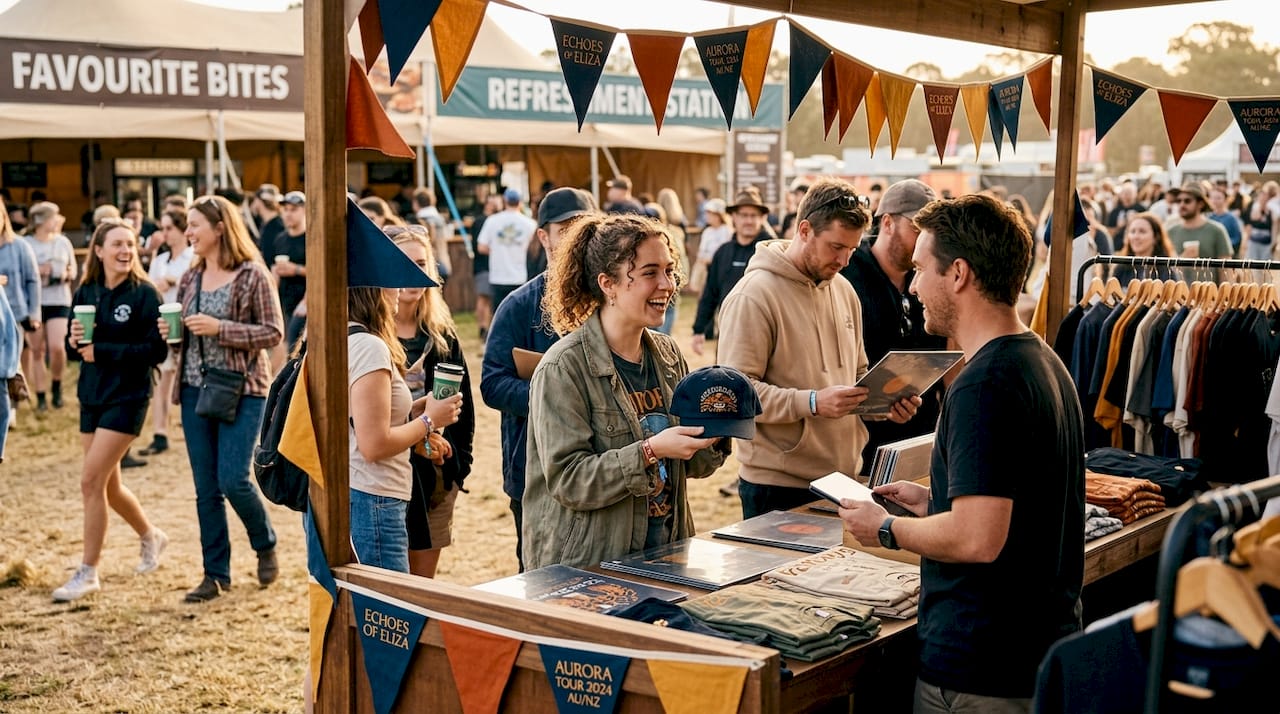
The distribution channel is the clearest dividing line. Tour exclusives are sold at venue merch booths, sometimes at pop-up stores near the venue, and occasionally through limited-time online sales that open briefly after shows conclude. Warner Music Store’s tour section operates on exactly this model: the same styles sold at the merch booth go online for a short window, then disappear. That window closes, and the item is gone. General retail merch has no such deadline.
The table below captures the key differences at a glance.
| Feature | Tour exclusive merch | Standard retail merch |
|---|---|---|
| Design | Tour-specific graphics, dated artwork | Generic band branding |
| Availability | Venue, select cities, or timed online | Permanent online and retail stores |
| Production run | Limited, often numbered | Large, regularly restocked |
| Pricing | Premium, reflects scarcity | Standard retail pricing |
| Collector value | High, increases post-tour | Low to moderate |
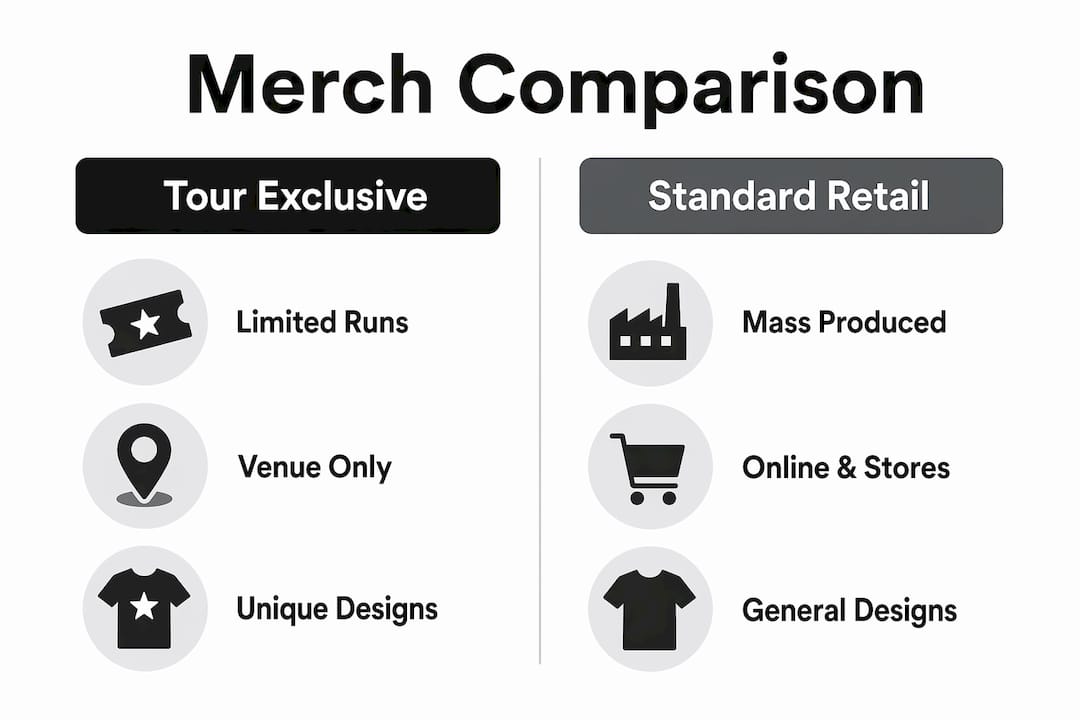
The pricing gap is worth noting. Because production runs are deliberately short and distribution is controlled, tour exclusives command a premium at point of sale and often appreciate significantly on the secondary market once the tour ends.
How do artists and labels enforce tour merch exclusivity?
Exclusivity is not accidental. It is engineered through a combination of product design, regional sales restrictions, and operational controls at the venue level.
The most direct method is regional restriction. The BTS “ARIRANG” tour cap sold only in Korea, with no equivalent available in other markets. That single geographic constraint transforms an otherwise ordinary cap into a collector’s object. Artists and their management teams use this approach deliberately to reward fans in specific markets and to generate regional buzz.
Timed releases add another layer. Rather than selling everything at once, merch teams schedule on-sale windows city by city or venue by venue. EXILE THE SECOND’s 2026 live tour took this further with electronic numbered admission tickets at their merch stores during peak hours. Fans received a numbered ticket to queue, which capped the number of people who could purchase at any given time. The result was practical scarcity layered on top of limited production.
SKU architecture is the third pillar. Each exclusive item carries a product code that encodes the tour leg, venue, or region. This is not just an inventory tool. It is the primary way collectors and resellers verify authenticity.
Pro Tip: When buying secondhand tour merch, ask the seller for the SKU or product tag. Genuine tour exclusives carry codes that reference the specific tour leg or city. If the tag is missing or the code does not match known tour details, treat the item with scepticism.
- Regional restriction: items sold only in one country or city
- Timed on-sale windows: scheduled per venue or tour leg
- Numbered admission tickets: operational queue control at merch booths
- Limited production runs: small quantities manufactured from the outset
- SKU encoding: product codes tied to specific tour dates or locations
Why do fans and collectors value tour exclusive merch so highly?
The appeal of limited edition tour items runs deeper than simple scarcity. These objects carry what collectors call provenance: a verifiable connection to a specific live event. A shirt from Metallica’s 1996 tour is not just a shirt. It is physical evidence that someone was there, or at least that the item existed in that moment. That narrative adds value that no amount of reissuing can replicate.
Tour merch financially supports artists as a significant revenue stream beyond streaming, which means buying exclusive merch at a show is one of the most direct ways fans contribute to an artist’s livelihood. That economic reality has not been lost on collectors, who increasingly see their purchases as both cultural investment and fan loyalty made tangible.
The “must-have factor” is real and documented. Limited availability at live shows drives demand and resale value in ways that standard merchandise cannot replicate. When an item can only be obtained by attending a specific show in a specific city, the act of owning it becomes a statement.
Typical exclusive concert merchandise items collectors seek include:
- Tour-dated T-shirts with city or venue-specific back prints
- Limited edition hoodies with tour artwork not released elsewhere
- Enamel pins and patches tied to specific tour legs
- Signed or numbered posters sold only at the venue
- Collaboration pieces with brands like Nike, produced in restricted quantities
- Region-specific items such as the Korea-only BTS cap
- Bundled sets available only through the venue merch booth
Each category carries its own collector logic. Signed posters are valued for the artist’s direct involvement. Collaboration pieces carry the weight of two brand identities. Region-specific items are the rarest of all because geography itself becomes the barrier to acquisition.
Recent 2026 tours with notable exclusive merch offerings
Three 2026 examples illustrate how the principles above play out in practice across very different artist contexts.
The BTS x Nike “ARIRANG” collaboration is the most high-profile case. Nike and BTS produced a merch line that included exclusive T-shirts, a hoodie, and a cap available only in Korea, alongside a Nike By You customisation experience tied to the tour. The China online window was time-limited. Every element of the release was designed to create a different exclusive for each market, meaning no single fan could access the full collection without travelling between countries. That is exclusivity architecture at its most deliberate.
EXILE THE SECOND’s “PERFECT YEAR BEST ~Born To Be Wild~” 2026 tour took a different approach. Their venue-specific goods, including the OMIYAGE Cookie set, were scheduled by city and time slot, with electronic numbered admission tickets controlling access to the merch store during peak periods. This is operational exclusivity: the product itself may not be unique to a single venue, but the conditions of purchase are so controlled that obtaining it becomes an event in itself.
Warner Music Store’s model represents the post-tour phase. Items sold at the merch booth go online for a limited window after shows, giving fans who could not attend a brief opportunity to purchase. Once that window closes, the items are withdrawn. This approach balances accessibility with maintained exclusivity, and it affects collector behaviour on the secondary market because buyers know the official window is finite.
| Tour | Exclusive item types | Availability constraint |
|---|---|---|
| BTS “ARIRANG” x Nike | T-shirt, hoodie, Korea-only cap | Select cities; China online only; timed |
| EXILE THE SECOND 2026 | Venue goods, OMIYAGE Cookie set | City and time-slot scheduled; numbered tickets |
| Warner Music Store artists | Tour booth styles | Limited-time online post-show; then withdrawn |
The pattern across all three is consistent: exclusivity is not a single mechanism but a combination of product design, geographic restriction, and time pressure working together.
Key takeaways
Tour exclusive merch derives its value from a deliberate combination of limited production, regional restriction, and timed availability that standard retail merchandise never replicates.
| Point | Details |
|---|---|
| Definition is specific | Tour exclusive merch is tied to a particular tour, venue, or region, not just a band’s general catalogue. |
| Exclusivity is engineered | Artists use SKU encoding, geographic limits, and timed sales windows to enforce scarcity. |
| Collector value is real | Limited availability at live shows drives both demand and secondary market resale value. |
| Revenue matters | Tour merch is a significant income stream for artists beyond streaming, making purchases directly impactful. |
| Verification is possible | Collectors can confirm authenticity by checking SKU codes and documented sale conditions per tour leg. |
Why tour merch exclusivity is more sophisticated than most fans realise
I have spent years handling vintage and ex-tour stock from heavy metal tours, and the thing that surprises most people is how much thought goes into the exclusivity before a single shirt is printed. It is not just “we made 500 of these.” It is a layered system where the product design, the sales channel, the geography, and the timing all work together to create something genuinely irreplaceable.
What I find most telling is the SKU. When you pick up a genuine tour exclusive, the product code tells a story: which leg of the tour, which region, sometimes which venue. That is not accidental. Merchandisers build those codes deliberately so that the item’s origin is traceable. When I see a shirt without that provenance, I treat it differently, regardless of how it looks.
The trend I am watching in 2026 is the hybrid model: physical items paired with digital certificates of authenticity or limited-access content tied to the purchase. The BTS x Nike collaboration hints at this with its Nike By You customisation experience. The band merchandise history of the last four decades shows that every era finds a new way to make the live experience tangible. Right now, that means layering digital and physical in ways that make the item even harder to replicate secondhand.
The collectors who understand this are not just buying shirts. They are acquiring documented moments. That distinction is what separates a serious collection from a wardrobe.
— David
Find genuine tour exclusive merch at Com
Com specialises in vintage and ex-tour stock from heavy metal tours and bands, including dead stock items that never made it back from the road. If you are building a serious collection, the difference between a reproduction and an original tour shirt is everything. The rare Metallica 1992 tour tee in the Com catalogue is the kind of piece that defines a collection: genuine tour stock, documented provenance, and the kind of condition that only comes from careful sourcing. For collectors who want contemporary exclusives alongside vintage finds, the Pentagram 2024 limited edition tour shirt shows that the tradition of meaningful tour exclusives is very much alive.
Browse the full Com catalogue at vintagemetal.com.au for curated tour stock that serious collectors actually want.
FAQ
What is tour exclusive merch exactly?
Tour exclusive merch is merchandise designed or sold specifically for a particular concert tour, with availability restricted by location, timing, or production quantity. It is not available through standard retail channels once the tour or its associated sales window ends.
Where can you buy tour exclusive merch?
Tour exclusive merch is sold at venue merch booths during shows, at pop-up stores near venues, and sometimes through limited-time online sales that open briefly after concerts conclude. Once those windows close, the secondary market is the primary source.
How do collectors verify tour merch is genuine?
Collectors cross-check SKU codes and documented sale conditions, such as “sold only at venue” or “select cities,” to confirm authenticity. Missing or inconsistent product tags are a common indicator of reproduction items.
Why is tour exclusive merch more valuable than regular band merch?
Limited availability at live shows drives demand and resale value in ways standard merchandise cannot match. The combination of unique design, restricted distribution, and event-specific provenance makes tour exclusives significantly more desirable to collectors.
Does tour exclusive merch ever become available online?
Some artists and labels offer limited-time online sales after tour dates, giving fans a brief window to purchase items sold at the booth. These windows are finite and, once closed, the items revert to secondary market only.
Recommended
- Tour merch: why heavy metal memorabilia matters in 2026 – Vintage Metal Store
- Tour stock shirts explained: Value, rarity and collector secrets – Vintage Metal Store
- Collecting tour shirts: their cultural value and impact – Vintage Metal Store
- The real value of tour stock shirts for collectors – Vintage Metal Store


