



TL;DR:
- Band merchandise has become a vital part of music culture, often surpassing ticket revenue.
- Vintage band shirts are valuable due to rarity, provenance, condition, and historical significance.
- Merch serves as a cultural memory, connecting fans to moments in heavy metal history.
For some legendary bands, merchandise sales have at times outweighed ticket revenue, turning a simple printed tee into one of the most powerful forces in music culture. Band merch is not a footnote in rock history. It is the story itself. From the first screen-printed shirts sold outside stadium gates to the battle-worn denim jackets covered in patches that fans wear like armour, merchandise has always been about more than money. This guide traces that journey, explaining why certain vintage shirts command thousands of dollars, how heavy metal fans turned DIY culture into a living art form, and what every serious collector needs to know right now.
Table of Contents
- Setting the stage: The birth of band merchandise
- From tour tee to collector’s grail: Vintage shirts and memorabilia
- The economics and impact: Merch rises above music sales
- Metal merch in modern collector culture
- Why the legacy of band merchandise matters more than ever
- Where to find authentic vintage band merch
- Frequently asked questions
Key Takeaways
| Point | Details |
|---|---|
| Merch is big business | Bands like AC/DC made more from merchandise than from ticket sales, revolutionising fan culture. |
| Collectors value authenticity | Original tags, print quality, and provenance separate truly valuable band tees from reprints. |
| Patches and jackets matter | Battle jackets and patches are as iconic as shirts and tell personal stories for heavy metal fans. |
| Modern fans drive the market | Online forums and social media keep interest in classic merch alive and connect new collectors. |
Setting the stage: The birth of band merchandise
The earliest band merchandise was scrappy, unofficial, and often illegal. In the 1960s, vendors outside concert venues were selling bootleg shirts and badges with no connection to the artists themselves. The bands eventually caught on, and by the early 1970s, official touring merchandise had become a genuine business. The Rolling Stones, Led Zeppelin, and Black Sabbath all began authorising and selling gear directly to fans at shows. This shift from bootleg to official product changed everything.
The metal band shirts history is inseparable from the rise of heavy metal itself. As the genre exploded through the late 1970s and into the 1980s, bands like Iron Maiden, Motörhead, and Judas Priest recognised that their imagery, skulls, demons, lightning bolts, and gothic lettering, was as powerful as the music. A shirt was a statement. Wearing it to school or on the street was an act of identity.
“Heavy metal patches and battle jackets appeared as a form of DIY expression that ran parallel to official t-shirts, giving fans a way to personalise their allegiance to the music they loved.” DIY metal culture
The iconic metal fashion of this era was not handed down from stylists. It grew from the ground up. Fans would sew patches onto denim jackets, trade them at shows, and build elaborate displays of loyalty across years of concerts. This DIY spirit was central to metal culture in a way that had no real equivalent in pop or mainstream rock.
Key milestones in early merch history include:
- 1969: The Rolling Stones begin selling official tour merchandise at concerts, one of the first major bands to do so
- 1973: Led Zeppelin’s North American tour features professionally printed shirts sold at venues
- 1975: Kiss merchandise empire launches, eventually generating more revenue than many other bands’ entire careers
- 1980s: Iron Maiden’s Eddie artwork becomes one of the most reproduced images in heavy metal merch history
- 1985: Licensing agreements become standard, with major labels taking a cut of merchandise revenue for the first time
The shift from in-house printing to licensing deals changed the economics of the business dramatically. What started as a way to cover tour costs became a multi-million dollar industry.
From tour tee to collector’s grail: Vintage shirts and memorabilia
A shirt sold at a concert in 1983 is not just a shirt. It is a time capsule. Certain vintage tees and memorabilia are now worth thousands to collectors, with prices rising sharply over the past decade as both nostalgia and genuine historical appreciation drive demand.
Understanding why collect band shirts starts with understanding what makes one valuable. It is rarely just the band name. Rarity, provenance, the specific tour, the print technique, and the condition all play a role. A shirt from a band’s final tour before a member died is worth far more than a standard release from the same year. Context matters enormously.
What drives collector value
| Factor | Why it matters | Example |
|---|---|---|
| Rarity | Fewer shirts printed means fewer survive | Local support act shirts, one-off festival tees |
| Provenance | Documented history of ownership | Shirts with original receipts or photos |
| Band legacy | The bigger the band, the broader the market | Metallica, AC/DC, Black Sabbath |
| Condition | Fading, holes, and washing affect price | Deadstock or unworn shirts fetch premiums |
| Print technique | Screen printing ages differently to modern digital | Single-colour plastisol prints from the 1980s |
Spotting an authentic vintage shirt takes practice. Here is what to check:
- The tag: Older shirts use tags from manufacturers like Fruit of the Loom, Hanes, or Screen Stars. The tag style itself can date a shirt to a specific decade.
- The print: Genuine vintage screen prints have a soft, slightly cracked texture from age. Modern reprints look too clean and vibrant.
- The stitching: Single-needle stitching was common in older shirts. Modern shirts typically use double-needle construction throughout.
- The fabric weight: Older shirts are often heavier cotton. Modern reproductions use lighter, softer blends.
- The cut: Vintage shirts have a boxy, wider cut compared to the slim fit of modern reproductions.
Fakes and reprints exist because the market is lucrative. Some reprints are sold honestly as tribute items, but others are deliberately aged and passed off as originals. The metal tour merch guide is an essential resource for anyone serious about authentication.
Pro Tip: Before buying any vintage shirt online, always ask for a photo of the tag, the inside seam stitching, and the print up close under natural light. A legitimate seller will have no hesitation providing these images.
Among the most valuable vintage shirts ever sold at auction are pieces from Metallica’s 1983 Kill 'Em All tour, Iron Maiden’s 1982 Beast on the Road tour, and AC/DC’s 1979 Highway to Hell tour. Each of these represents a specific moment in heavy metal history that cannot be recreated.

The economics and impact: Merch rises above music sales
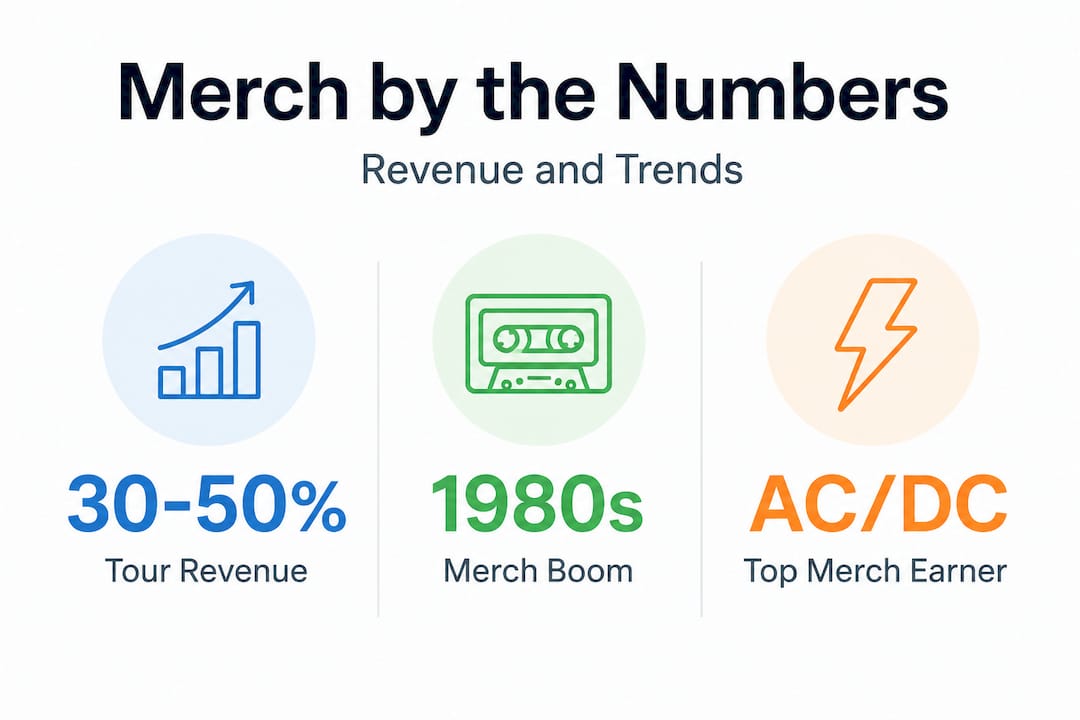
Once bands realised that merchandise could match or exceed ticket revenue, the entire music industry shifted. In the 1970s, bands like AC/DC pioneered a focus on making more from merch than ticket sales, treating the concert itself as a vehicle for selling branded products rather than the primary product.
This realisation changed how tours were structured, how venues were contracted, and how record labels approached their artists. The introduction of 360 deals in the 2000s, where labels took a percentage of merchandise revenue in addition to music sales, reflected just how significant this income stream had become.
| Revenue stream | Pre-1980s importance | Post-2000s importance |
|---|---|---|
| Album sales | Very high | Declining rapidly |
| Ticket sales | High | Steady but competitive |
| Merchandise | Secondary | Often primary for major acts |
| Streaming | Non-existent | Growing but low per-stream value |
| Licensing | Minimal | Significant for legacy bands |
The band tee trend insights reveal something fascinating about how fan behaviour drives commercial decisions. When a particular shirt design goes viral or appears on a celebrity, demand spikes almost overnight. Labels and band management now monitor these trends closely, using limited edition drops to create urgency and drive sales.
Key ways merchandise shapes fan identity and band economics:
- Limited editions create scarcity and drive secondary market prices upward almost immediately after release
- Official licensing protects designs and ensures quality, but also raises prices compared to bootleg alternatives
- Patches and pins serve as low-cost entry points for fans who cannot afford full shirts, building brand loyalty early
- Battle jackets function as living portfolios of a fan’s concert history, making them deeply personal and largely non-commercial
The merchandising alternatives landscape has also expanded significantly, with independent sellers, vintage specialists, and online marketplaces all competing for the collector dollar. This has made it easier than ever to find rare pieces, but also more important than ever to know how to verify authenticity.
Key statistic: Industry estimates suggest that for major touring acts, merchandise can account for between 30 and 50 per cent of total tour revenue, with some acts reporting merchandise income exceeding ticket revenue at specific shows.
Metal merch in modern collector culture
The traditions that started in the 1970s and 1980s are very much alive today. Battle jackets, customising, and patch trading remain at the heart of the metal community, connecting new fans to decades of history through physical objects rather than digital streams.
Social media has transformed how collectors find, share, and value pieces. Instagram accounts dedicated to vintage metal shirts have hundreds of thousands of followers. Reddit communities like r/WeAreTheMusicMakers and dedicated metal collector forums are active daily, with members posting finds, asking for authentication help, and trading rare pieces.
What to look for when buying or selling vintage merch today:
- Seller reputation: Look for established sellers with verifiable sales histories and genuine collector knowledge
- Detailed photography: Any serious listing should include multiple angles, close-ups of tags and prints, and natural light photos
- Provenance documentation: The more history a piece has, the better. Original purchase receipts, concert ticket stubs, or photographs from the era add significant value
- Community verification: Post potential purchases to collector forums before committing to high-value buys
- Condition grading: Understand the difference between deadstock (never worn), excellent, good, and worn condition before agreeing on a price
New fans seeking out vintage Metallica shirts and other original tour gear are not just buying nostalgia. They are connecting with a lineage. Wearing a shirt from a 1988 Metallica tour is a conversation starter, a history lesson, and a statement of values all at once.
Pro Tip: Store vintage shirts folded flat rather than on hangers. Long-term hanging stretches the collar and distorts the shape of older cotton. Acid-free tissue paper between folds prevents colour transfer and fabric degradation over time.
The metal merch guide is a practical resource for both newcomers and experienced collectors navigating today’s market. The fundamentals of authentication have not changed, but the tools available to collectors, from UV lights to fabric dating resources, have made the process more accessible than ever before.
How collectors keep old bands and designs alive matters too. Every time a rare shirt surfaces at auction or in a vintage shop, it generates conversation, research, and renewed interest in the band’s catalogue. Collectors are, in a very real sense, the archivists of heavy metal history.
Why the legacy of band merchandise matters more than ever
Here is something most articles about band merch miss entirely: this is not a hobby about objects. It is a practice of memory.
When you hold a shirt from a 1982 Iron Maiden tour, you are holding evidence that something real happened. Tens of thousands of people gathered in a room, felt the same music at the same volume, and walked out changed. The shirt is proof. Band merch and battle jackets represent personal stories and milestones within heavy music culture in a way that no streaming playlist or digital archive can replicate.
The commercial side of merchandise is real and important, but it has always been secondary to the cultural function. Fans did not queue outside venues in the rain to buy a shirt because they wanted an investment. They bought it because they wanted to carry that night home with them. The fact that some of those shirts are now worth thousands of dollars is almost incidental to their original purpose.
What concerns us most, having spent years in this space, is the growing tendency to treat vintage merch purely as a financial asset. When a shirt becomes a commodity first and a cultural artefact second, something essential is lost. The most meaningful collections we have seen belong to people who can tell you exactly where they were when they first heard the band on that shirt. The value is in the story, not the price tag.
Collectors who understand this tend to make better decisions, both financially and culturally. They buy pieces that mean something to them, they research the history behind what they own, and they share that knowledge with others. That is how heavy metal culture stays alive across generations.
Where to find authentic vintage band merch
Knowing the history and the authentication process is only half the work. Finding genuine pieces in today’s market requires trusted sources and a sharp eye.
At Vintage Metal, we specialise in exactly the kind of pieces this guide has been describing: original tour stock, deadstock shirts, and genuine ex-tour merchandise from the bands that defined heavy metal. Our collection includes some genuinely rare finds, including a rare Metallica 1992 tour shirt from the Don’t Tread on Me USA tour, which represents everything a serious collector looks for in a vintage piece. You can explore the full range of authenticated pieces in our vintage Metallica collection, or browse the broader Vintage Metal Store for shirts, patches, and memorabilia spanning decades of heavy metal history. Every piece is sourced with the same care and knowledge this guide has outlined.
Frequently asked questions
What makes a vintage band t-shirt valuable?
Age, rarity, official licensing, and association with a famous tour or concert all elevate a tee’s value, with collector value tied to rarity, provenance, and band legacy above all else.
Are patches and battle jackets as collectable as shirts?
Yes, DIY patches and battle jackets are highly collectable, often representing unique fan stories and the spirit of heavy metal in ways that mass-produced shirts cannot match.
How can I tell if a shirt is authentic or a reprint?
Check the tag manufacturer, stitching style, print texture, and fabric weight, then consult collector guides and buy only from sellers with verifiable reputations and detailed photography.
Why do some bands make more from merch than ticket sales?
For top acts, AC/DC among the first to gross more from merch than tickets, devoted fans and the appeal of tangible memorabilia create a demand that ticket pricing simply cannot match.
Recommended


