



Most fans walk away from a metal show clutching a shirt without realising that shirt may have done more for the band than their ticket ever did. Tour merch nets artists 40-50% of retail price after all costs, making it one of the most powerful income streams in the industry. For heavy metal fans, the story goes even deeper. These pieces are wearable history, community badges, and in many cases, serious investments. This guide breaks down the economics, the culture, the collector’s market, and how to build a collection that actually means something.
Table of Contents
- Why tour merch is central to the heavy metal scene
- How tour merch is designed and sold on the road
- What makes vintage tour merch so collectible and valuable?
- How to spot authentic tour memorabilia and avoid fakes
- The overlooked power of tour merch: it fuels both nostalgia and the future
- Where to find authentic vintage and modern metal tour merch
- Frequently asked questions
Key Takeaways
| Point | Details |
|---|---|
| Merch powers the music | Tour merchandise is a band’s financial backbone, often out-earning ticket sales. |
| Collectability drives community | Rarity and authentic design turn tour shirts into prized collector’s pieces among metal fans. |
| Knowledge protects collectors | Knowing how to spot real vintage merch saves you from fakes and maximises your investment. |
| Fans keep culture alive | Collectors don’t just inherit memories—they help preserve and propel heavy metal culture for the next generation. |
Why tour merch is central to the heavy metal scene
There is a reason the merch table at a metal show has a queue longer than the bar. For bands, merchandise is not a side hustle. It is often the financial backbone of an entire tour. Ticket revenue gets split between venues, promoters, and agents. Merch revenue, by contrast, flows much more directly to the artists. That economic reality shapes everything from setlists to touring schedules.
For fans, buying a shirt at the show is a rite of passage. It signals that you were there, that you belong, and that you take the music seriously. Metal culture has always placed enormous value on authenticity and commitment. A tour shirt is physical proof of both. It is no coincidence that shirts matter to collectors in ways that streaming plays or digital downloads simply cannot replicate.
The numbers back this up. Heavy metal merch accounts for 25% of all music-related apparel sales on key platforms, and metal fans consistently outspend fans of other genres at festivals. That loyalty is not accidental. It reflects a culture that treats the music as a lifestyle rather than background noise.
Here is what makes metal merch culture so distinct from other genres:
- Identity signalling: Wearing a Slayer or Pantera shirt communicates your values and your history to other fans instantly.
- Community building: Merch creates shared visual language at shows, festivals, and in everyday life.
- Financial support: Every purchase directly funds the band’s ability to keep touring and recording.
- Collectible legacy: Older pieces become artefacts that document a band’s history and a fan’s journey.
“The merch table is where the real transaction happens at a metal show. Not just money for a shirt, but identity for belonging.”
Understanding why vintage t-shirts matter to metal fans means understanding that these are not just garments. They are documents of a scene that has survived and thrived for decades on the loyalty of its community.

How tour merch is designed and sold on the road
Once you understand merch’s cultural significance, it is fascinating to see how much intentional design and business strategy goes into every shirt. The process is far more sophisticated than most fans realise.
Bands work with specialist merchandise companies that handle everything from graphic design and manufacturing to road logistics and sales analytics. Venue-exclusive and limited edition designs are a deliberate strategy. A shirt that is only available at one show on one night creates urgency and scarcity. Fans know that if they leave without buying, they may never see that design again.
Sales data collected across a tour is used to optimise future runs. Which designs sold out first? Which cities spent the most? Bands like Metallica have taken this further with pop-up shops and pre-announced exclusive drops that generate queues hours before doors open. This is retail strategy applied to rock and roll, and it works brilliantly.
Venue commissions also play a role. Most venues take a percentage of merch sales, sometimes as high as 30-35%. This pushes bands to price items higher or to create exclusive designs that justify a premium. It also makes genuinely tour-specific pieces rarer, because the economics only work when demand is high.
| Design type | Availability | Collector value |
|---|---|---|
| Venue-exclusive print | One show only | Very high |
| Tour-wide design | Full tour run | Moderate to high |
| Limited numbered edition | Set quantity | High |
| Standard band shirt | Ongoing | Lower |
Pro Tip: If you are at a show and you see a design labelled as venue-exclusive or night-specific, buy it immediately. These are the pieces that appear on resale platforms within weeks at two to three times the original price.
For collectors wanting to understand the full story behind these pieces, exploring the history of metal tour merch gives essential context. And for practical guidance on what to look for, iconic metal merchandise tips covers the details that separate serious collectors from casual buyers.
What makes vintage tour merch so collectible and valuable?
With that context, let us look at what drives collectors to pay serious money for certain pieces and how to spot genuine value in the market.
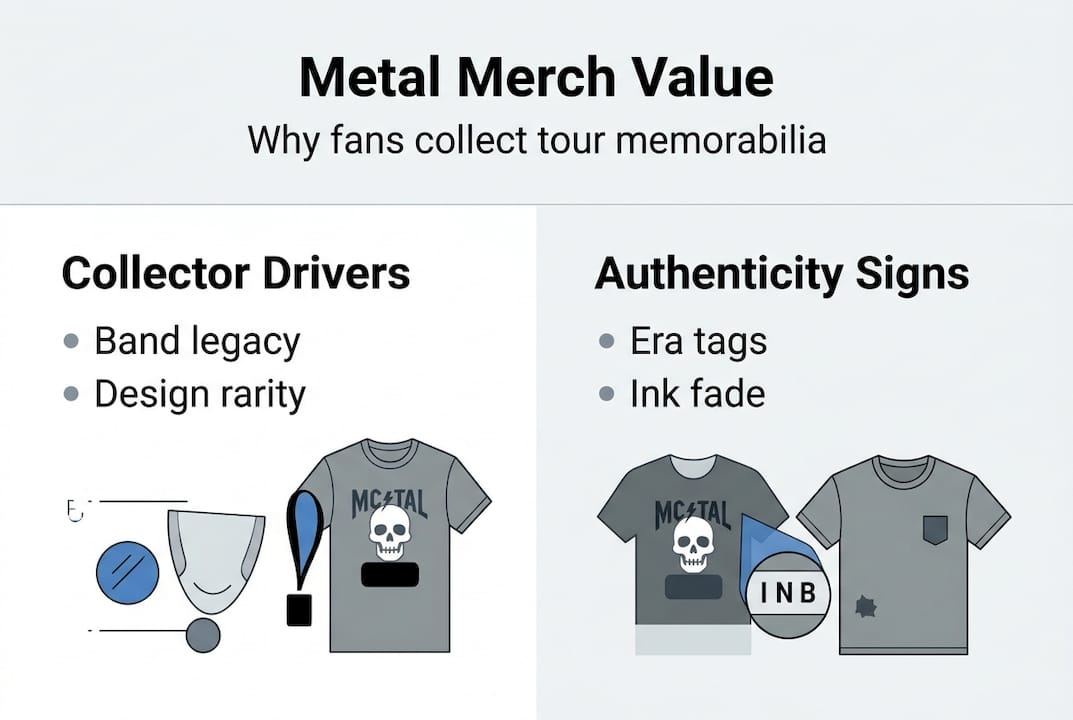
Vintage metal shirts average $102-$278 on resale, with Metallica consistently among the most sought-after bands. But the top end of the market is where things get genuinely remarkable. Rare pieces from disbanded lineups, televised tours, or shirts with printing errors have sold for well over AU$400, and in some cases, multiples of that.
Several factors determine where a shirt lands on the value spectrum:
- Rarity: How many were made, and how many survive in wearable condition?
- Band significance: Is this a band at the peak of their cultural moment, or a legendary act that no longer tours?
- Tour year: Tours tied to iconic albums or historic moments carry extra weight.
- Condition: Fading and cracking are expected on vintage pieces, but structural integrity matters.
- Design: Is this a widely recognised graphic, or a one-off that only hardcore fans would identify?
Authentication is where collectors either protect or lose their investment. Era-correct tags, ink fade patterns, and stitching styles are all indicators of genuine vintage pieces. Understanding what makes a shirt vintage is not just academic. It is the difference between paying $200 for a genuine artefact and paying $200 for a reproduction.
| Band | Average resale (AUD) | Peak recorded sale |
|---|---|---|
| Metallica | $180-$278 | $400+ |
| Iron Maiden | $120-$220 | $380+ |
| Slayer | $102-$190 | $350+ |
| Pantera | $110-$200 | $370+ |
For collectors focused on the 1990s era specifically, understanding why 1990s heavy metal tees appreciate in value reveals why that decade is particularly rich hunting ground. And for those ready to go deep, the expert guide to collecting rare 1990s tees is essential reading.
How to spot authentic tour memorabilia and avoid fakes
Once you grasp what drives value, you will want to make certain what is in your collection is the real thing. The reproduction market is active, and convincing fakes do exist.
Authentication relies on tags, stitching, ink fade, and provenance. Here is a practical process for evaluating any piece before you buy:
- Check the tag first. Era-correct tags are one of the most reliable indicators. Hanes, Fruit of the Loom, and Screen Stars all used specific tag designs during specific decades. Research what was standard for the year the shirt was supposedly made.
- Examine the print. Genuine vintage screen prints crack and fade in organic, uneven patterns. Reproduction prints often look too clean or show uniform cracking that has been artificially applied.
- Look at the blank. The weight, weave, and cut of the fabric itself changes across decades. Modern blanks used for reproductions often feel noticeably different from genuine 1980s or 1990s stock.
- Check the stitching. Single-needle stitching on the sleeves is a hallmark of older garments. Double-needle is more common on modern production.
- Ask for provenance. Tour photos showing the shirt being worn, original purchase receipts, or documented seller history all add credibility and genuine market value.
Red flags to watch for include near-perfect condition on a supposedly 30-year-old shirt, fonts that do not match the era, and sellers who cannot provide any background on where the piece came from.
Pro Tip: Cross-reference any shirt you are considering against documented examples in collector databases or auction archives. If the seller cannot tell you which tour the shirt came from, that is a significant warning sign.
For a broader framework on what qualifies as genuine memorabilia, the heavy metal memorabilia collector’s guide lays out the full picture clearly.
The overlooked power of tour merch: it fuels both nostalgia and the future
Here is something the mainstream music conversation consistently misses. Tour merch is not just about revenue or nostalgia. It is the connective tissue of an entire culture across generations.
Consider this: Metallica’s merch lines last 12 hours, generating up to £800,000 in a single night, and old tees from their early tours now outprice the original concert tickets by a factor of ten or more. That is not just a market anomaly. It is proof that physical memorabilia carries meaning that digital experiences cannot replicate.
Collectors are not simply archivists hoarding old fabric. They are the custodians of metal history. When a 19-year-old discovers a genuine 1988 tour shirt from the history of band shirts era and starts researching the band behind it, that is a new fan born from a physical object. The shirt did what an algorithm never could.
The real value of tour merch is not measured in resale prices alone. It lives in the stories attached to every piece, the shows attended, the lineups that no longer exist, and the music that shaped entire lives. Collectors who understand this are not just building portfolios. They are preserving the soul of the scene for whoever comes next.
Where to find authentic vintage and modern metal tour merch
If you are ready to track down your own piece of history, knowing where to look makes all the difference.
At Vintage Metal, we specialise in authenticated ex-tour stock and deadstock from iconic heavy metal tours. Every piece in our collection has been sourced and verified for authenticity, so you are not gambling on a reproduction. Whether you are after a specific era, a specific band, or just the best of what is available right now, our catalogue is built for serious collectors. Check out the Metallica 1992 tour tee as a prime example of what genuine tour stock looks like. Browse our vintage Metallica shirts or explore the full vintage shirt collection to find your next piece.
Frequently asked questions
Why is tour merch often more expensive than regular band shirts?
Tour merch is produced in smaller, exclusive limited edition batches and often features venue-specific designs or dates, making each piece rarer and far more collectible than standard band merchandise.
What should collectors look for to verify genuine tour memorabilia?
Key signs include period-correct tags and stitching, authentic ink fade patterns, a reputable seller history, and supporting documentation such as tour photos or original purchase receipts.
Why do heavy metal fans spend more on merch than fans of other genres?
Metal fans are among the most loyal in music, with 25% of music apparel sales attributed to the genre and a festival and touring culture that treats merch as a core part of the live experience rather than an optional extra.
How much can a rare vintage metal tour shirt resell for?
Vintage heavy metal shirts average $102-$278 on resale, with genuinely rare pieces from disbanded lineups or historic tours regularly exceeding AU$400 at auction.
Recommended


