



TL;DR:
- The 1990s heavy metal scene was marked by genre innovation, global success, and resilience against mainstream pressures. Iconic bands like Metallica, Pantera, and Sepultura reshaped metal’s sound and expanded its reach. Lesser-known acts such as Tool and Fear Factory further diversified and deepened the genre’s creative range.
1990s heavy metal icons are the bands and artists who drove metal’s evolution through a decade of commercial pressure, genre reinvention, and raw creative ambition. Metallica, Pantera, Sepultura, and Korn sit at the centre of this story, each reshaping what heavy metal could sound like and who it could reach. The 1990s were not a quiet period for metal. They were a period of brutal evolution, with the genre splitting into powerful subgenres rather than fading under grunge’s shadow. Understanding these key figures in 1990s metal means understanding how the genre survived, adapted, and grew stronger.
What are 1990s heavy metal icons?
1990s heavy metal icons are the bands and artists who led metal’s transformation during the decade, either through massive commercial success, genre innovation, or both. The term “heavy metal icon” is not an official industry classification. Music historians use it to describe acts whose influence outlasted their era and whose work defined what metal became next. The 1990s produced icons across multiple subgenres, from groove metal and nu-metal to death-doom and gothic metal.
The decade forced metal to evolve. Grunge pulled mainstream attention away from the polished sounds of 1980s metal, and the bands that thrived were the ones willing to strip back the gloss and get heavier, stranger, or more experimental. That pressure produced some of the most important music in metal’s history.
Which bands led the mainstream heavy metal movement in the 1990s?
The top heavy metal acts of the 1990s mainstream were Metallica, Pantera, and Sepultura. Each sold tens of millions of records and shifted the direction of the genre.
Metallica and the Black Album
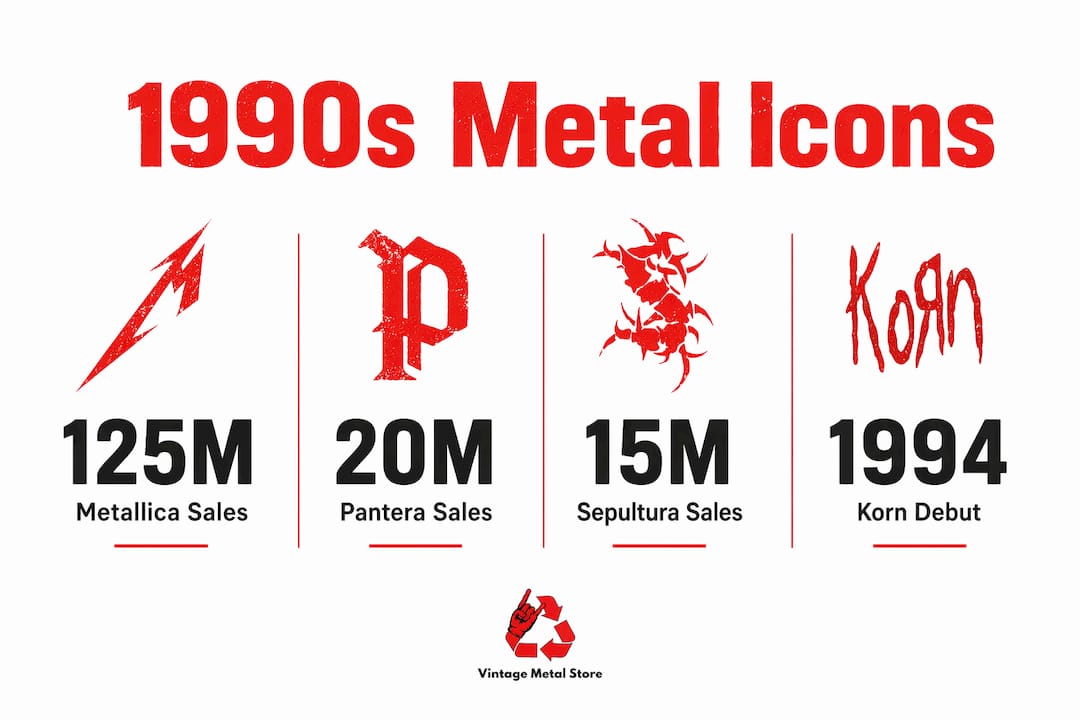
Metallica is the most commercially successful heavy metal band in history, with over 125 million records sold worldwide. Their 1991 self-titled album, known universally as the Black Album, was the engine of that achievement. It stripped away the technical complexity of their earlier thrash work and delivered a slower, heavier, more accessible sound. That shift divided hardcore fans but introduced metal to a global audience that had never engaged with the genre before.
Pantera’s groove metal revolution
Pantera redefined what heavy metal could feel like physically. Their shift away from 1980s glam aesthetics toward raw, groove-driven aggression was critical to metal’s survival in the 1990s. Albums like Vulgar Display of Power (1992) and Far Beyond Driven (1994) set a new standard for heaviness and attitude. Pantera sold approximately 20 million records worldwide, a figure that reflects both their commercial reach and their lasting cultural grip on the genre.
Sepultura’s global reach
Sepultura brought a perspective no American or British band could offer. The Brazilian band blended thrash, groove, and indigenous world music influences into a sound that felt genuinely new. Their 1996 album Roots incorporated Xavante tribal rhythms alongside crushing metal riffs. Sepultura sold almost 20 million records worldwide, proving that heavy metal’s centre of gravity had shifted beyond the United States and the United Kingdom.
Key traits shared by the top metal bands of the 1990s mainstream:
- Rejection of 1980s glam metal aesthetics in favour of raw, aggressive sounds
- Willingness to incorporate non-metal influences without losing heaviness
- Massive touring schedules that built loyal fanbases across multiple continents
- Albums that defined the sound of an entire subgenre, not just a single band
How did emerging subgenres and bands diversify 1990s heavy metal?
The 1990s heavy metal scene did not move in one direction. It fractured productively, with new subgenres pulling the genre into territory it had never explored before.
Korn and the birth of nu-metal
Korn pioneered the nu-metal genre with their 1994 self-titled debut, launching a wave of American heavy metal that defined the late 1990s. Their sound dropped traditional guitar solos entirely, replacing them with down-tuned seven-string riffs, hip-hop rhythms, and lyrics drawn from personal trauma. That combination felt genuinely shocking at the time. Nu-metal incorporated hip-hop and electronic elements to remain culturally relevant, and Korn’s role in changing metal’s audience composition was central to that shift. They brought in listeners who had grown up on rap and alternative rock, expanding metal’s demographic reach significantly.
The New Wave of American Heavy Metal
The New Wave of American Heavy Metal emerged as a direct response to commercial pressures. It drew on thrash and punk to restore metal’s credibility after the perceived softening of the mainstream. Bands within this movement prioritised aggression and technical skill over radio-friendly accessibility. This movement laid the groundwork for metalcore and modern extreme metal in the 2000s.
European bands and darker subgenres
European bands like Paradise Lost developed a completely different response to the decade’s pressures. Paradise Lost pioneered death-doom and gothic metal), creating atmospheric, melancholic sounds that had no American equivalent at the time. Their influence spread into symphonic metal and later into the broader gothic rock scene. This was a reminder that heavy metal’s evolution in the 1990s was not a purely American story.
Pro Tip: If you want to understand the full range of 1990s metal, listen to Pantera’s Vulgar Display of Power, Korn’s self-titled debut, and Paradise Lost’s Gothic back to back. The contrast shows you exactly how wide the genre’s range had become by the mid-1990s.
What cultural and musical legacy did 1990s heavy metal icons leave?
The famous heavy metal artists of the 1990s did not just make great records. They built the foundations that every subsequent metal subgenre has stood on.
The most significant legacy contributions, in order of their long-term impact:
- Groove metal’s bridge role. Pantera and Sepultura connected 1980s thrash to modern metal by stripping away excess and focusing on rhythm and power. Every metalcore and modern metal band that followed owes something to that shift.
- Nu-metal’s audience expansion. Korn and the nu-metal movement brought millions of new listeners into metal’s orbit. Many of those listeners later moved into heavier subgenres, sustaining the genre’s growth through the 2000s.
- Internationalisation of metal. Sepultura’s success proved that metal could carry regional cultural identity without losing global appeal. That opened the door for Scandinavian black metal, Brazilian death metal, and other regional scenes to gain international recognition.
- Collector culture around 1990s memorabilia. Tour shirts, backstage passes, and limited-edition merchandise from this era now carry serious value. The collector appeal of 1990s metal shirts has grown steadily as the decade recedes into history and original stock becomes rare.
“The 1990s did not kill heavy metal. They forced it to become something more interesting.” — widely held view among metal historians and critics.
The decade’s legacy is also visible in critical reassessment. Albums dismissed as commercial sellouts in the early 1990s are now recognised as genre-defining works. The Black Album is the clearest example. It was controversial on release and is now considered one of the most important metal records ever made.
Which lesser-known artists shaped the 1990s heavy metal scene?
The iconic metal musicians who dominated the charts were not the only ones who mattered. Several artists worked outside the mainstream and shaped the decade’s sound in ways that only became fully visible later.
Tool and progressive metal
Tool released Undertow in 1993 and Aenima in 1996, both of which blended progressive rock structures with metal heaviness and deeply psychological lyrics. They built one of the most devoted fanbases in metal history without ever chasing radio play. Their influence on progressive and art metal has been profound and lasting.
Fear Factory and industrial metal
Fear Factory fused metal with industrial and electronic production techniques, creating a sound that felt genuinely futuristic in the mid-1990s. Albums like Demanufacture (1995) influenced a generation of bands working at the intersection of metal and technology. Their approach to rhythm and machine-like precision became a template for industrial metal.
Underground black metal and death metal
The 1990s also saw black metal and death metal gain serious momentum outside the mainstream. Norwegian black metal in particular developed a distinct aesthetic and philosophy that generated enormous cultural controversy and equally enormous artistic influence. These underground scenes sustained hardcore fan communities and produced music that continues to influence extreme metal today.
Pro Tip: Exploring lesser-known 1990s metal acts is one of the best ways to understand the decade’s full creative range. Start with Tool’s Aenima and Fear Factory’s Demanufacture before moving into underground black and death metal releases.
| Artist | Subgenre | Key 1990s Release |
|---|---|---|
| Tool | Progressive metal | Aenima (1996) |
| Fear Factory | Industrial metal | Demanufacture (1995) |
| Paradise Lost | Death-doom / Gothic metal | Gothic (1991) |
| Sepultura | Groove / World metal | Roots (1996) |
| Korn | Nu-metal | Self-titled debut (1994) |
These artists complement the mainstream icons by showing that the 1990s heavy metal scene was never a single movement. It was a collection of parallel experiments, each pushing the genre in a different direction.
Key takeaways
The 1990s heavy metal icons, from Metallica and Pantera to Korn and Paradise Lost, transformed metal through genre innovation, global reach, and cultural resilience that continues to shape the music today.
| Point | Details |
|---|---|
| Mainstream icons drove global reach | Metallica, Pantera, and Sepultura each sold tens of millions of records and reshaped metal’s sound. |
| Subgenres expanded metal’s audience | Nu-metal, groove metal, and death-doom each brought new listeners and new ideas into the genre. |
| European bands added critical depth | Paradise Lost and others developed darker subgenres that influenced symphonic and gothic metal for decades. |
| Underground acts shaped long-term trends | Tool and Fear Factory built the foundations for progressive and industrial metal that followed in the 2000s. |
| Collector culture reflects lasting legacy | Original 1990s tour merchandise is now genuinely rare and carries real value for serious collectors. |
Why the 1990s still matter more than people admit
I have spent years around vintage metal culture, and the thing that still surprises me is how underrated the 1990s are in broader music history conversations. People talk about the 1960s and 1970s as the golden ages of rock, and they talk about the 1980s as the golden age of metal. The 1990s get treated as a messy transition period. That reading is wrong.
The 1990s were the decade when metal proved it could survive anything. Grunge threatened to make it irrelevant. Commercial pressure threatened to make it soft. The genre responded by producing Pantera’s Vulgar Display of Power, Sepultura’s Roots, and Korn’s self-titled debut within a few years of each other. That is not a genre in decline. That is a genre at full creative force.
What I find most interesting now is the collector dimension. The shirts and tour merch from this era are physical artefacts of a genuinely important cultural moment. A vintage Sepultura 1992 tour shirt is not just a piece of clothing. It is a document of a band at the peak of their creative power, on a tour that helped spread groove metal across the world. That context is what separates real vintage metal memorabilia from a reproduction.
The nostalgia for 1990s metal is not just sentiment. It is recognition that something genuinely significant happened in that decade, and that the people who were there for it understood it at the time.
— David
Authentic 1990s metal memorabilia at Vintage Metal Store
The legacy of 1990s heavy metal lives in the music and in the physical objects that surrounded it.

Vintage Metal Store carries original tour stock and dead stock from the bands that defined the decade. The Metallica 1992 tour tee is a direct link to the Black Album era, one of the most significant periods in metal history. For collectors who want the full picture, the vintage Metallica shirts collection brings together rare pieces from across the decade. These are not reproductions. They are original garments from the tours that built metal’s 1990s legacy. Browse the collection and wear the history.
FAQ
What are 1990s heavy metal icons?
1990s heavy metal icons are the bands and artists who defined and transformed heavy metal during the decade through pioneering new subgenres, achieving widespread commercial success, or both. Metallica, Pantera, Sepultura, and Korn are the most widely recognised examples.
Which band sold the most records in 1990s heavy metal?
Metallica is the most commercially successful heavy metal act in history, with over 125 million records sold globally. Their 1991 Black Album was the primary driver of that achievement.
What subgenres did 1990s heavy metal produce?
The 1990s produced groove metal, nu-metal, death-doom, gothic metal, industrial metal, and progressive metal, among others. Each subgenre had distinct representative bands and influenced the direction of metal in the 2000s and beyond.
How did Pantera influence 1990s heavy metal?
Pantera replaced glam metal with raw groove-oriented aggression, selling approximately 20 million records worldwide and establishing a template for heaviness that shaped metalcore and modern metal for decades.
Where can I find authentic 1990s heavy metal memorabilia?
Vintage Metal Store stocks original tour shirts and dead stock from 1990s metal bands, including rare Metallica and Sepultura pieces. The heavy metal memorabilia guide explains what to look for when assessing authenticity and value.
Recommended
- Iconic 1990s heavy metal shirts: collector picks – Vintage Metal Store
- 1990s Heavy Metal Shirts: 150% Value Surge & Iconic Designs – Vintage Metal Store
- Find rare 1990s heavy metal shirt examples with expert tips – Vintage Metal Store
- Essential 90s metal band shirts every collector needs – Vintage Metal Store


