



A vintage Metallica shirt from a 1991 European tour. A Nirvana tee from a small venue run. These aren’t just pieces of fabric — they’re artefacts. Rare shirts regularly fetch four and five figures at auction, with a Grateful Dead shirt once selling for over $17,000. Yet most collectors still struggle to separate genuine gold from overpriced reproductions. This guide breaks down exactly what drives the value of band tour merch, how to spot the real thing, and how to make smarter decisions whether you’re buying, selling, or building a serious collection.
Table of Contents
- What is band tour merch and why is it collectible?
- The anatomy of value: What drives the worth of tour merch?
- Real-world prices: Auction benchmarks and collector gains
- Spotting authenticity: Originals, reissues, and bootlegs explained
- Trends, timing, and collector psychology in heavy metal merch
- Build your collection with confidence
- Frequently asked questions
Key Takeaways
| Point | Details |
|---|---|
| Cultural relevance is key | Band tour merch from iconic moments or influential eras is consistently the most valuable to collectors. |
| Authenticity remains vital | Provenance, manufacturing details, and condition all determine real collector value and prevent costly mistakes. |
| Monitoring trends pays off | Collector psychology and cultural events can rapidly change the value of heavy metal merchandise, so timing matters. |
| Buy smart, sell smarter | Prioritise trusted sources and stay alert to market movements to build or profit from your collection safely. |
What is band tour merch and why is it collectible?
To understand why vintage band tour merch commands such loyalty and price, it’s essential to clarify what it actually is and what sets it apart in music memorabilia.
Band tour merchandise refers to apparel and items produced specifically for a concert tour, typically sold at the venue itself. These aren’t the same as the mass-market shirts you’d find in a chain store or on a band’s official website years later. Tour merch is tied to a moment — a specific run of dates, a particular album cycle, a city, a night. That specificity is exactly what makes it collectible.
Here’s what separates genuine tour merch from generic band merchandise:
- Venue exclusivity: Sold only at specific shows, not through retail channels
- Tour-specific graphics: Artwork, dates, and venues printed directly on the garment
- Limited production runs: Often printed in small batches to match expected crowd sizes
- Era-specific manufacturing: Tags, stitching, and fabric that reflect the decade of production
- Artist-approved designs: Created in collaboration with the band or their management for that tour only
Heavy metal sits in a category of its own when it comes to why vintage shirts are collectible. The culture runs deep. Metal fans have always treated merch as a badge of identity, not just a souvenir. Heavy metal fans buy more artist-specific merch at festivals than fans of genres like EDM or pop. That demand, combined with the raw scarcity of original tour stock, is what fuels the collector market. The advantages of second hand band shirts go beyond nostalgia — they represent access to pieces that simply can’t be reproduced.
The anatomy of value: What drives the worth of tour merch?
With band tour merch now clearly defined, it’s time to examine why some shirts end up on auction blocks while others barely move the needle in collector circles.
Value determinants for vintage tour merch include historical significance, rarity, condition, authenticity, and cultural relevance. Each of these factors interacts with the others. A shirt can be rare but culturally irrelevant, and it’ll sit unsold. A shirt can be culturally iconic but in terrible condition, and it’ll still attract buyers — just at a lower price point.
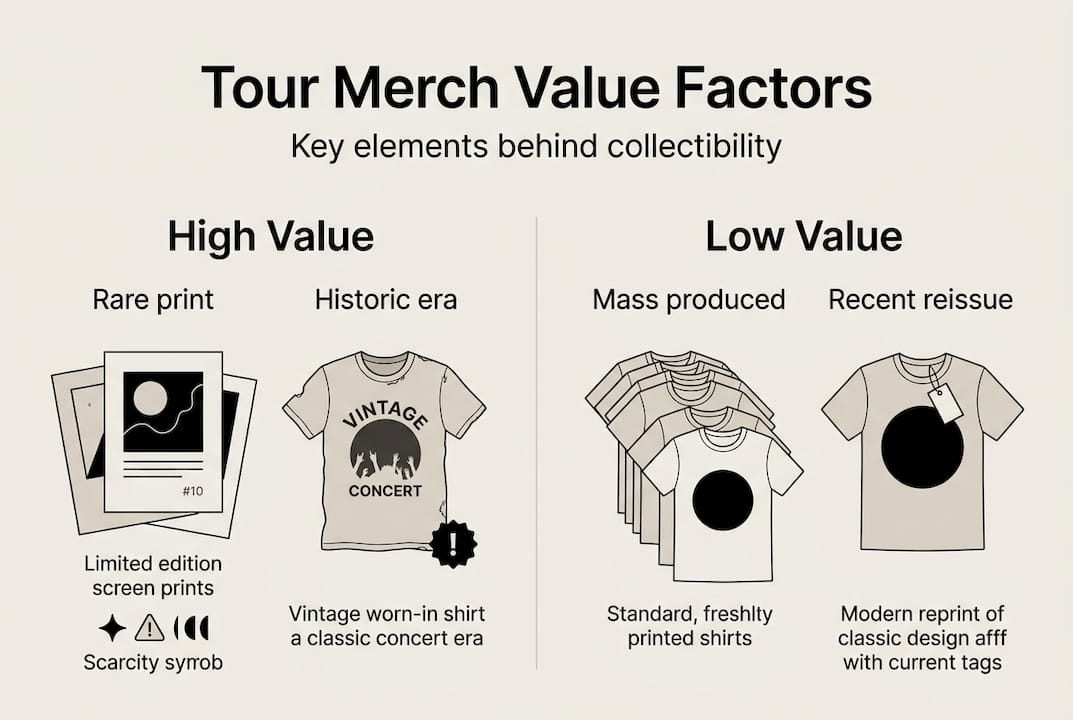
Here’s how the key factors stack up:
| Factor | High value indicator | Low value indicator |
|---|---|---|
| Historical significance | Defining tour, landmark album | Filler tour, no cultural moment |
| Rarity | Venue-only, small run | Wide retail distribution |
| Condition | Pristine or light authentic wear | Heavy damage, fading, staining |
| Authenticity | Original tags, correct stitching | Reproduction tags, modern print |
| Cultural relevance | Iconic band, era-defining moment | Obscure act, forgotten tour |
Condition is nuanced. Pristine shirts demand premiums, but light wear that’s clearly authentic can actually add character and story. What kills value is damage that suggests poor storage or heavy use without care.
For collectors focused on collecting rare 1990s heavy metal tees, the 1990s represent a particularly rich era. Bands like Pantera, Sepultura, and Slayer were at their commercial and creative peaks, producing tour merch that now sits firmly in the high-demand category. Scarcity without cultural impact results in low value — the band has to matter, not just the shirt.

Real-world prices: Auction benchmarks and collector gains
Understanding the theoretical influences on value is useful, but nothing cuts through the confusion like seeing what real collectors have recently achieved at auction.
Grateful Dead, Metallica, and Nirvana shirts fetch astronomical prices, with heavy metal shirts often sitting in the $100 to $160 range for standard examples, while rarities push well beyond that. Here’s a snapshot of what the market looks like:
| Band | Era | Shirt type | Approximate price range |
|---|---|---|---|
| Grateful Dead | 1970s | Vintage tour tee | $5,000 to $17,000+ |
| Metallica | 1980s to 1991 | Tour and album shirts | $300 to $2,500+ |
| Nirvana | Early 1990s | Pre-Nevermind era | $500 to $3,000+ |
| Slayer | 1980s | Reign in Blood era | $200 to $1,200 |
| Pantera | Early 1990s | Cowboys from Hell tour | $150 to $800 |
A Metallica Black Album 1991 tour shirt from the European leg is a prime example of how specificity drives price. The European run was shorter, the production smaller, and the cultural moment enormous. Similarly, a rare 1980s Metallica tour shirt from the Crash Course in Brain Surgery era represents the kind of pre-fame scarcity that serious collectors chase.
Prices can spike sharply after a band member’s death or a major pop culture moment. When a band suddenly re-enters public consciousness, demand surges faster than supply can respond.
Pro Tip: Focus your collection on bands with enduring influence and era-defining tours. A shirt from a band’s commercial peak, tied to a specific album cycle, will almost always hold or grow in value better than a shirt from a lesser-known run. Check collecting rare heavy metal tees for a deeper breakdown of which eras to prioritise.
Spotting authenticity: Originals, reissues, and bootlegs explained
Knowing what drives high prices only matters if you can reliably spot authentic pieces before you buy or sell.
Reissues and bootlegs can flood the market, temporarily depressing prices of originals and making it harder for buyers to trust what they’re purchasing. The good news is that originals leave behind physical evidence that’s difficult to fake convincingly.
Here’s a step-by-step checklist for verifying authenticity:
- Check the tag: Original 1980s and 1990s shirts use tags from manufacturers like Hanes, Fruit of the Loom, or Screen Stars. The tag style should match the era.
- Examine the print: Vintage screen printing has a specific texture and slight imperfection. Modern digital prints look too clean and sit differently on the fabric.
- Look at the stitching: Single-stitch construction is standard for shirts made before the mid-1990s. Double-stitching often indicates a later reproduction.
- Cross-reference tour dates: If the shirt lists tour dates, verify them against known setlists and tour records. Errors or anachronisms are red flags.
- Assess the fabric: Vintage cotton has a particular weight and feel. It softens with age in a way that modern pre-washed fabric doesn’t replicate.
- Ask for provenance: A credible seller should be able to explain where the shirt came from. Documented ownership history adds significant confidence.
“When buying high-value pieces, prioritise auction houses and verified platforms. They offer professional authentication and provenance documentation that private sellers simply can’t match.” — The Business of Vintage Music T-Shirts
Pro Tip: Always request detailed photographs before purchasing online. Close-ups of the tag, stitching, print texture, and any wear patterns tell you far more than a styled product shot. A proper vintage band shirt care guide will also help you preserve what you acquire. Understanding the advantages of second hand band shirts includes knowing how to assess condition before committing.
Trends, timing, and collector psychology in heavy metal merch
Beyond concrete authenticity and pricing tools, collectors also benefit from recognising how psychology and shifting trends shape the market — and knowing when to act.
Nostalgia is a powerful economic force. As the generation that grew up with 1980s and 1990s heavy metal reaches peak earning years, demand for merch from that era has climbed steadily. This isn’t random — it’s a predictable pattern tied to cultural memory and disposable income.
Market prices can spike after iconic deaths, with genre-wide surges also emerging around cultural moments — 90s nu-metal, for instance, saw renewed collector interest in 2025. Here’s what to watch for:
- Band member deaths: Demand for associated merch often surges within days and can sustain elevated prices for months
- Major anniversaries: A 30th or 40th anniversary of a landmark album frequently triggers renewed media coverage and collector activity
- Reunion tours: When a band announces a reunion, original tour merch from their classic era becomes immediately more desirable
- Pop culture crossovers: A band appearing in a major film, TV series, or viral moment can introduce their catalogue to a new generation of buyers
- Award recognition: Posthumous inductions or lifetime achievement awards often spark short-term price increases
Collector psychology also plays a role that goes beyond pure investment logic. Subcultural capital — the status that comes from owning a genuinely rare piece — matters enormously in tight-knit communities. A shirt isn’t just worth money; it’s worth credibility. Understanding what makes vintage shirts collectible means understanding both the financial and social dimensions of the market.
Scarcity alone isn’t enough. The history of band t-shirts shows clearly that cultural impact is the multiplier. A shirt from a band nobody remembers, even if genuinely rare, will never command the same prices as a shirt from a band that shaped a generation.
Build your collection with confidence
If this guide has sharpened your eye for what makes band tour merch genuinely valuable, the next step is finding pieces worth owning. At Vintage Metal, we specialise in authentic vintage heavy metal t-shirts sourced directly from ex-tour stock and deadstock from real heavy metal tours and bands.
Every shirt in our catalogue has been assessed for authenticity, condition, and collector relevance. Whether you’re after a Metallica Black Album 1991 tour shirt or a rare 1980s Metallica crash course shirt, you’ll find pieces with genuine provenance and real story behind them. Browse the full range at vintagemetal.com.au and add something meaningful to your collection today.
Frequently asked questions
What makes a band tour shirt truly rare?
A band tour shirt is considered rare if it was part of a small production run, sold only at specific venues, or tied to a landmark moment in music history. Rarity, historical significance, and exclusivity are the core value determinants that separate a genuinely scarce piece from a common release.
How can I tell if my vintage band shirt is an original or a reissue?
Check for original era-appropriate tags, assess the fabric weight and print texture, and cross-reference tour dates against verified records. Authenticity involves original tags, manufacturing details, and proven provenance from a credible source.
Do minor flaws or wear affect the value of band tour merch?
Light, authentic wear can add character and reinforce a shirt’s genuine age, but pristine examples generally command higher prices. Wear enhances story value if it’s clearly authentic, but damage from poor storage will reduce what a collector is willing to pay.
Why do shirts from certain tours or years suddenly spike in value?
Major anniversaries, band reunions, or significant cultural events — particularly band member deaths — can cause sharp increases in collector demand. Value can surge post-death or after a band re-enters mainstream consciousness through film, television, or viral media.
Where is the safest place to buy genuine vintage tour merch?
Trusted auction houses and verified specialist platforms offer the strongest protection for high-value purchases. Prioritise auction houses and verified platforms for confidence, as they provide professional authentication and documented provenance that private sellers typically cannot match.
Recommended


