



Yes, a “Made in USA” tag is a strong clue your shirt was made before the mid‑1990s, but it’s not proof on its own. Tag origin is one signal in a stack of evidence, and the smartest collectors read it alongside stitching, print ageing, and fabric content before they call anything authentic.
Here’s the five-point check to run before you trust a listing or hand over cash for a shirt in your hands:
- Hem stitch: single stitch leans older, and double stitch leans newer.
- Tag brand and logo era: Hanes, Fruit of the Loom and Screen Stars all changed their tag designs across the decades.
- Fabric content line: 50/50 blends and 100% cotton wording shifted over time.
- Copyright or licensing line beneath the graphic: gives you an earliest possible print date.
- RN or WPL number: when present, it’s a bonus trail back to the manufacturer.
Most mainstream tee production shifted offshore through the mid-to-late 1990s, which is why “Made in U.S.A.” on the tag carries real weight as a dating clue. It’s not a rubber stamp though, and Vintage Metal Store’s team treats it as one input among several when grading a piece for the racks.
Key Takeaways
A “Made in USA” tag is a genuine era clue for pre‑mid‑1990s manufacture, but it only becomes reliable evidence when stitching, print ageing and fabric content all tell the same story.
| Point | Details |
|---|---|
| Tag origin is a clue, not proof | “Made in U.S.A.” suggests pre‑mid‑1990s manufacture but needs supporting signals to confirm it. |
| Stitching beats tag reading | Single‑stitch hems are harder to fake convincingly than tag labels, so weigh them more heavily. |
| Copyright lines set a floor | A licensing date under the graphic gives the earliest possible print year, not the confirmed one. |
| Run the full signal stack | Check hem, tag, fabric, licensing text and print ageing together before grading confidence. |
| Vintage Metal Store inspects before listing | Every shirt is checked across tag, stitch and print condition prior to going up for sale. |
Table of Contents
- What a made in USA tag actually tells you
- How stitching, print ageing and copyright lines confirm or refute a tag
- A step‑by‑step way to check a listing before you buy
- Who’s behind this guide and where to dig deeper
- Why collectors overrate the tag and underrate the stitching
- Shop era‑checked tees without doing the detective work yourself
- Sources
- FAQ
What a made in USA tag actually tells you
A neck or care tag isn’t just a country label. It’s a small timestamp made up of several parts, and each one narrows the window a little further.
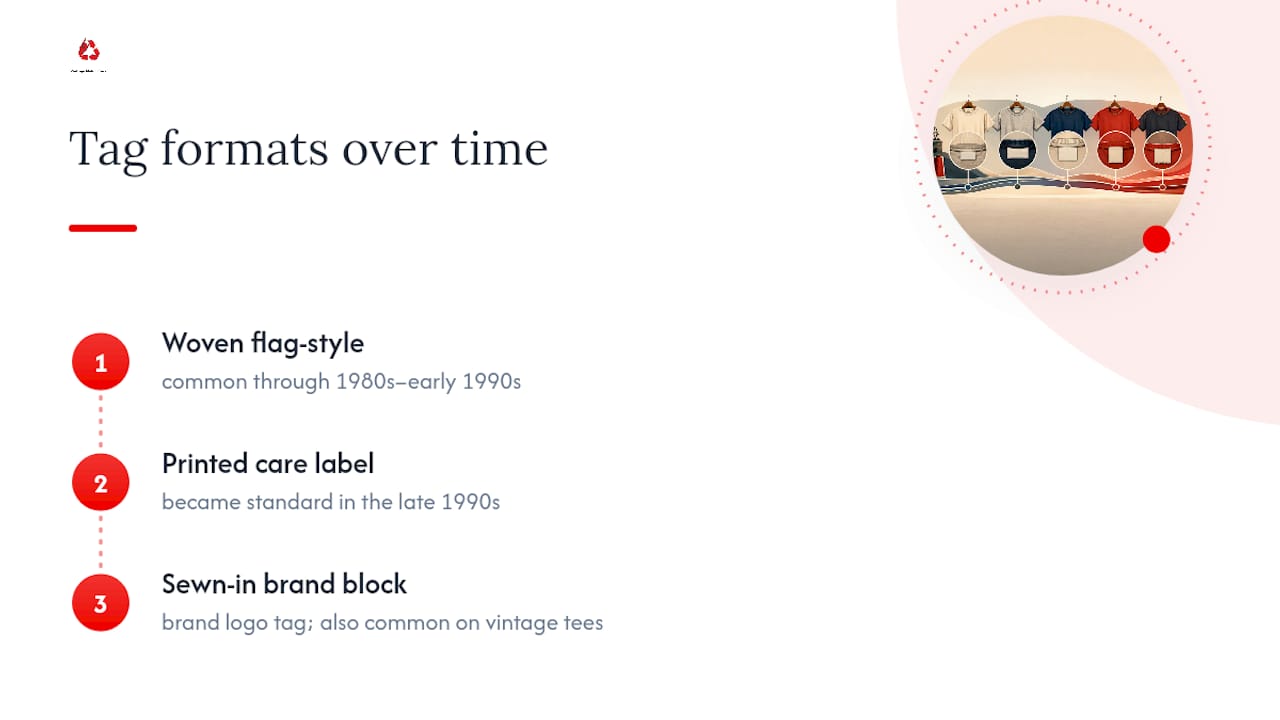
Most vintage band tees carry one of three tag formats: a woven flag-style tag sewn into the collar, a printed care label stitched flat against the neck seam, or a sewn-in brand block that doubles as the manufacturer’s logo. The format itself is a clue. Woven flag tags were common through the 1980s and early 1990s, while flat printed labels became more standard as production moved to larger overseas runs later in the decade.
Brand logos changed on a schedule
The blank manufacturers behind most vintage band shirts didn’t sit still. Logo redesigns, tagline changes, and even typeface swaps happened on a rough but traceable timeline, and that’s exactly what tag dating archives use to bracket production years.
- Hanes ran distinct tag styles through the 1970s, 80s and 90s, with “Made in U.S.A.” standard on most tags before the brand shifted a large share of production overseas.
- Fruit of the Loom used several logo variations across the decades, and older tags almost always paired the U.S. origin line with a heavier, boxier fabric weight.
- Screen Stars is a strong one for metal collectors specifically. It shows up constantly on 80s and early 90s tour merch, and its tag era is well documented in collector circles.
- Anvil kept U.S. manufacturing later into the 90s than some competitors, so a Made in USA Anvil tag doesn’t automatically mean pre‑1990.
- Tultex tags are common on mid‑to‑late 90s runs and often show the transitional period where U.S. and offshore production overlapped.
Fabric composition lines matter here too. A tag reading “50% cotton / 50% polyester” points toward the late 1970s through the 1980s, when that blend dominated mass-market tees for durability.
If the tag includes a small RN or WPL number, that’s worth a quick note before you move on to construction checks.
Pro Tip: Photograph the tag flat and straight on, with the whole thing in frame including any faded corners. A cropped or angled tag photo is one of the most common reasons collectors misjudge a listing.
How stitching, print ageing and copyright lines confirm or refute a tag
A tag never stands alone. Stitching and print condition either back up what the tag says or contradict it, and that contradiction is where fakes usually fall apart.
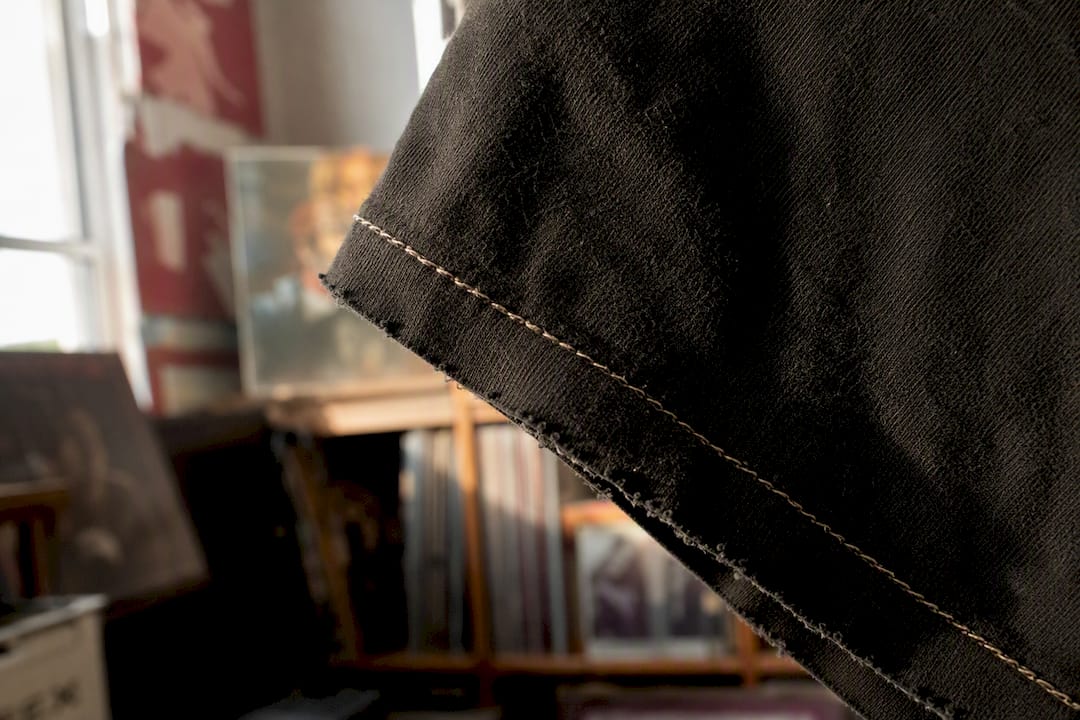
Single-stitch hems are the fastest visual test in the hobby. Single-needle hemming on the sleeves and bottom hem was standard before the mid‑1990s, after which double-needle hemming took over as the industry norm. The exception worth knowing: some smaller manufacturers kept single-stitch construction into the late 90s, so a single stitch alone doesn’t nail down a year, only a probable range.
Print ageing tells its own story, and it’s harder to fake convincingly than most sellers assume. Authentic plastisol prints from the 80s and 90s crack in a pattern that follows the fabric’s stress points, meaning the cracking runs along fold lines, across the chest where the shirt stretches, and around the collar. Artificial distressing usually looks too even, too deliberate, or concentrated in spots that don’t match how a shirt actually wears over 30 years.
Then there’s the copyright or licensing line printed beneath the graphic, usually in small type crediting the band, the tour, or the licensing company. This line gives you an earliest possible date for the artwork, not a confirmed print date. A shirt can carry a 1988 copyright and still have been printed and sold years later from leftover stock, so treat the line as a floor, not a fact.
The real skill is weighing signals as a set rather than trusting one:
- Consistent stack: single stitch, era-correct tag, matching copyright year, aged print cracking. That’s a coherent story.
- Inconsistent stack: double stitch with a 1985 tag, or pristine print with heavy artificial fading. That mismatch is the red flag, not any single detail.
Reproduction sellers have gotten better at mimicking single-stitch hems and older tag styles, which is exactly why no single feature should carry the whole verdict.
A step‑by‑step way to check a listing before you buy
Run this sequence every time, whether you’re scrolling photos online or holding a shirt at a market stall.
- Check the hem stitch first. Single or double, sleeve and bottom hem.
- Photograph the tag close up. Match the brand, logo, and wording against known era markers.
- Read the country and fabric lines. Note if “Made in U.S.A.” pairs sensibly with the fabric blend.
- Look for an RN or WPL number and any licensing text. These add a supporting layer when present.
- Assess print ageing against overall wear. Does the cracking pattern match where the shirt actually creases?
- Grade your confidence and decide. High confidence needs at least three aligned signals, not one.
If the tag is missing or looks like it’s been swapped, don’t walk away automatically. Lean harder on stitching, print ageing, and fabric weight, and ask the seller directly for provenance, purchase history, or where the shirt came from.
Three things should stop a purchase cold:
- A tag era that flatly contradicts the stitching (a 70s-style tag on a shirt with clean double-needle hems).
- Pristine, factory-fresh stitching sitting next to heavily “distressed” print that looks sandblasted rather than worn.
- A copyright date that postdates the tag’s known production window.
Pro Tip: Ask two things before you buy: “Can you photograph the tag flat with good light?” and “Is this from your own collection or resale stock?” The answers tell you almost as much as the photos.
Who’s behind this guide and where to dig deeper
This guide was put together by David, whose deeper collector’s guide to authentic vintage band tees walks through five expert checks in more depth than we’ve covered here.
Vintage Metal Store doesn’t list a shirt on tag origin alone. Every piece that reaches the store gets checked across tag, stitching, print condition, and fabric before it’s photographed and described, the same multi-signal approach serious authentication guides recommend for the whole hobby, not just tag reading.
For readers who want to keep building their eye:
- Original vs fake band t shirts: the collector’s guide
- Identifying bootleg metal tees: a collector’s guide
- Vintage vs reissue shirts: the collector’s guide
Why collectors overrate the tag and underrate the stitching
Here’s the uncomfortable bit most guides skip: the tag is the easiest part of a shirt to fake, and it’s the part most buyers check first and hardest. That’s backwards. A tag can be swapped in under a minute with a seam ripper and a needle. A hem’s stitch pattern, a print’s crack lines, and a fabric’s actual hand after decades of washing are far harder to convincingly reproduce.
The conventional advice, “check the tag for Made in USA,” treats origin like a yes/no switch. It isn’t. It’s context. A perfect tag on a shirt with suspiciously fresh stitching should worry you more than a missing tag on a shirt with everything else lining up.
If you take one thing from this guide, prioritise construction and print ageing over the label, and use the tag to confirm a story the shirt is already telling you, not to write that story from scratch. That’s the order Vintage Metal Store applies internally, and it’s the order that actually protects your money.
Shop era‑checked tees without doing the detective work yourself
Vintage Metal Store does the tag, stitch and print checking before a shirt ever goes on the site, so you’re not squinting at photos trying to settle a tag‑era mismatch on your own.

Every listing gets assessed against the same signal stack covered above, tag, stitching, fabric and copyright line, before it’s photographed and described. If you’re chasing something specific, the rare Metallica 1992 tour tee is a good example of an era‑checked piece with the provenance laid out plainly, or browse the full vintage Metallica shirts collection if you’re hunting a specific tour or era. Got a question about a tag, a stitch, or a print you’re unsure about? Reach out to the team before you buy elsewhere, that’s what the inspection process is there for.
Sources
- Vintage Band T-Shirts: Identification, Dating & Authentication Guide
- How to Identify a Real Vintage Band Shirt (Complete 2026 Authentication Guide)
- How To Authenticate Vintage T-Shirts | Keep It Classic
FAQ
What does a Made in USA tag actually prove?
It suggests the shirt was likely produced before the mid‑1990s, when most tee manufacturing shifted offshore, but it needs to align with stitching and print evidence to count as real proof.
Can reproduction shirts have fake Made in USA tags?
Yes. Reproduction sellers increasingly replicate older tag styles and even single‑stitch hems, which is why relying on the tag alone is risky.
Is single stitch always older than double stitch?
Single-stitch hemming was standard before the mid‑1990s, but some manufacturers kept using it into the late 90s, so treat it as a strong lean rather than a fixed cutoff.
What’s the difference between a copyright date and a print date?
The copyright or licensing line under the graphic marks when the artwork was created at the earliest, not necessarily when that specific shirt was printed.
Does Vintage Metal Store check tags before listing shirts?
Yes, every listing is assessed across tag, stitching, fabric and print condition as part of the store’s inspection process before it goes up for sale.
Recommended
- Collector’s guide to authentic vintage band tees: 5 expert checks – Vintage Metal Store
- Original vs fake band t shirts: the collector’s guide – Vintage Metal Store
- Understanding era-specific graphics on metal shirts – Vintage Metal Store
- Original vs reissue band tees: the collector’s guide – Vintage Metal Store


