



TL;DR:
- Ex tour stock shirts are licensed surplus merchandise remaining after a band’s tour concludes, often highly collectible due to their limited production. These shirts vary in print placement, color, size, and rarity, with front-and-back prints and limited editions being especially valuable. Authenticity is confirmed through production details like tags, copyright text, and print quality, making genuine ex-tour shirts desirable for serious collectors.
Ex tour stock shirts are officially licensed surplus tour merchandise remaining after a band’s live events conclude. The industry term is “ex-tour stock,” and it refers specifically to unsold inventory that was manufactured and licensed for a particular tour but never sold at the venue. These are not bootlegs, reprints, or standard retail tees. They are the real deal, with the production details to prove it. For collectors and heavy metal fans, understanding the types of ex tour stock shirts is the difference between building a meaningful collection and buying blind.
Spiral Direct describes their ex-tour collection as “surplus stock remaining after the conclusion of the band’s tour” with limited availability. That scarcity is not a marketing trick. It reflects how tour merchandise actually works: bands manufacture a fixed run, sell what they can at shows, and whatever is left becomes ex-tour stock. Gary Holt of EXODUS put it plainly, describing touring bands as “travelling pop-up stores” where t-shirt sales keep the whole operation financially viable. That context matters. Ex-tour stock is not leftover rubbish. It is the tail end of a carefully managed commercial operation, and that is exactly what makes it worth collecting.
1. What are the main types of ex tour stock shirts?
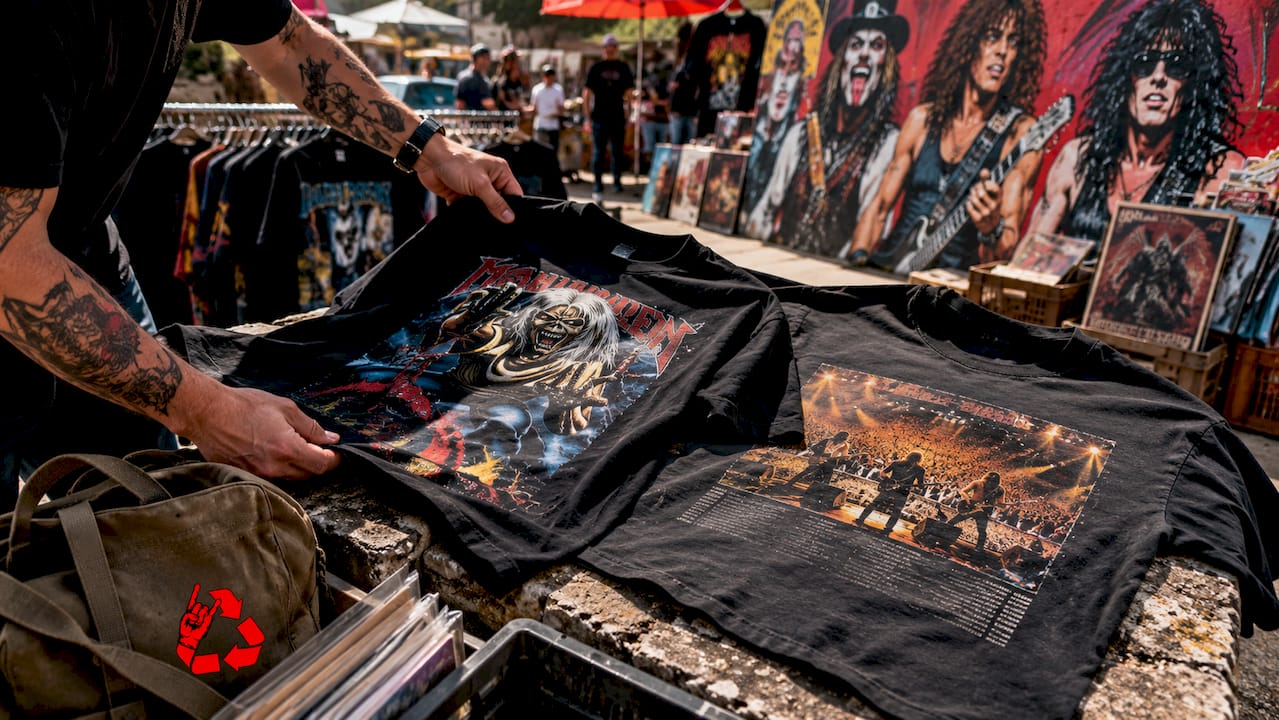
Ex tour stock shirts fall into several distinct categories based on print placement and design. Knowing these categories sharpens your eye at a glance.
- Single front print shirts. The most common format. One graphic on the chest, nothing on the back. These were typically the highest-volume items in any tour run, which means they appear most often as ex-tour stock. High volume does not mean low value, though. A single front print from a Metallica 1980s tour is still a serious collector piece.
- Front and back print variants. These are the most visually striking ex-tour shirts. A tour photo or band image sits on the front, while a logo, setlist, or artwork fills the back. Spiral Direct’s Bruce Springsteen Tour 24 E-Street shirt is a direct example, explicitly marketed as “Front & Back print” and labelled as ex-tour stock. Collectors prize these because the back print adds production cost, meaning fewer were made.
- Limited edition or special remainder prints. Some tours produced a small run of a variant design, perhaps for a specific city, a VIP package, or a one-off event. When these hit the ex-tour market, they carry the highest collector interest. The print itself is often identical to the standard run, but the quantity manufactured was far smaller.
- Sleeve and all-over print variants. Less common but highly sought after. These shirts feature additional artwork on the sleeves or a full-body graphic. They represent a premium production tier within any tour’s merchandise range.
Pro Tip: When browsing ex-tour stock, always ask the seller whether the shirt is a front-only or front-and-back variant. Back print shirts from the same tour often command a noticeably higher price because they were produced in smaller numbers.
Print placement is the first thing a serious collector checks. It signals production tier, approximate quantity, and relative rarity before you even look at the tag.
2. How colour and size variations define ex tour stock types
Colour is not just an aesthetic choice in tour merchandise. It is a production decision that directly shapes what ends up as ex-tour stock.
Black is the dominant colour in heavy metal tour merchandise. It accounts for the overwhelming majority of shirts produced for any given tour. White, grey, and washed variants exist but were typically produced in smaller quantities, making them rarer in the ex-tour pool. A white version of a Cannibal Corpse tour shirt, for example, is a genuinely uncommon find compared to the standard black run.
Tour inventory frameworks from MusicNSW confirm that design and size variations are tracked separately throughout a tour’s run, accounting for starting quantity, sales per show, and leftover stock. This means the ex-tour stock you encounter reflects very specific gaps in what sold. A venue in a smaller city might have moved every large and extra-large but left a stack of smalls. That is why certain sizes appear more frequently in ex-tour collections than others.
Size distribution in ex-tour stock follows a predictable pattern:
- Small (S) and extra-small (XS). These appear most often as ex-tour leftovers. Smaller sizes consistently undersell at live events, particularly in metal where the audience skews towards larger sizes.
- Medium (M). Medium sits in the middle of the demand curve. You will find it in ex-tour stock, but less frequently than small.
- Large (L) and extra-large (XL). These sell fastest at shows. Finding a large or XL in genuine ex-tour stock is a better result for most collectors.
- XXL and above. Bands often ordered fewer of these to begin with. When they appear as ex-tour stock, they can be surprisingly rare.
Pro Tip: If you wear a small or XS, the ex-tour market is genuinely your friend. You will find more options at lower prices than collectors in larger sizes. Use that to your advantage when hunting for specific tours.
Colour and size variations directly influence rarity and demand in the collector market. A black XL from a major tour is the most sought-after combination. A white small from the same tour is objectively rarer but may attract a narrower pool of buyers.
3. What production and authenticity markers identify genuine ex tour stock?
Authenticity is the foundation of any serious collection. Ex-tour stock carries specific production markers that separate it from reprints, bootlegs, and standard retail merchandise.
- Blank and tag era signals. The brand of the blank shirt underneath the print is one of the most reliable dating tools available. Fruit of the Loom, Hanes, and Screen Stars blanks each have distinct tag designs that changed across decades. A shirt claiming to be from a 1992 tour but carrying a post-2000 tag is not what it claims to be. Learning the tag timelines for major blank manufacturers is a non-negotiable skill for serious collectors.
- Licensing and copyright text. Genuine licensed tour merchandise carries copyright text, often printed inside the collar or along the hem. This text typically names the band, the licensing company, and the year. Ex-tour stock retains this text because it was manufactured to the same standard as on-tour stock.
- Screen print quality and ink feel. Authentic vintage tour shirts use plastisol inks that sit on top of the fabric with a slightly raised texture. Reprints and modern reproductions often use water-based inks that feel softer and sit flatter. Run your hand across the print. If it feels like part of the fabric rather than on top of it, ask more questions.
- Distribution timing and channel. Collectors cross-reference print placement, distribution timing, and blank/tag era to authenticate ex-tour stock. A shirt that appears in the market six months after a tour ends, sold through a licensed distributor, carries far more credibility than one appearing years later through an anonymous online listing.
- Pre-tour vs on-tour vs ex-tour distinctions. Pre-tour stock was manufactured before the tour began and sometimes sold through retail channels. On-tour stock was sold at venues during the run. Ex-tour stock is what remained after the final show. Each category has slightly different production and distribution characteristics that affect collector value.
Understanding these markers protects your investment. A genuine ex-tour shirt from a major metal band holds its value far better than a convincing reproduction, and the difference often comes down to details most buyers overlook.
4. Comparison of popular ex tour stock shirt types
The table below summarises the key differences across the main categories of ex-tour stock shirts. Use it as a quick reference when evaluating a potential purchase.
| Type | Design features | Relative rarity | Collector appeal |
|---|---|---|---|
| Single front print | One graphic on chest, plain back | Common | Moderate to high depending on band and era |
| Front and back print | Tour photo front, logo or artwork back | Less common | High, especially for iconic tours |
| Limited edition variant | City-specific, VIP, or event-only design | Rare | Very high |
| Sleeve or all-over print | Additional artwork on sleeves or full body | Rare | High among dedicated collectors |
| Colour variant (non-black) | White, grey, or washed colourway | Uncommon | High due to production scarcity |
Ex-tour stock scarcity directly drives retailer pricing and collector demand. The rarer the variant, the more aggressively collectors pursue it. A rare Metallica 1992 tour tee sits at the top of this hierarchy because it combines iconic band status, a specific tour era, and genuine production scarcity.
Different metal bands produce ex-tour stock with distinct characteristics. Metallica’s 1990s output favoured bold single-colour graphics on black blanks. Bruce Springsteen’s recent ex-tour items lean toward photographic front prints with detailed back artwork. Bands like EXODUS produced more straightforward logo-heavy designs that appeal to a specific thrash metal collector subgroup.
Pro Tip: The most overlooked ex-tour variants are colour alternatives in sizes that typically undersell. A white medium from a major tour often sits unsold simply because buyers default to black. That is your opportunity to acquire something genuinely uncommon at a fair price.
Key takeaways
Ex-tour stock shirts are defined by their production details, print placement, and size and colour distribution, making these factors the primary tools for identifying and valuing any piece in your collection.
| Point | Details |
|---|---|
| Print placement signals value | Front and back print shirts are rarer and command higher prices than single front prints. |
| Size distribution is predictable | Small and XS sizes appear most often as ex-tour leftovers because they undersell at live events. |
| Tag era confirms authenticity | Blank manufacturer tags are reliable dating tools that expose reprints and fakes. |
| Colour variants are undervalued | Non-black colourways were produced in smaller quantities and are often overlooked by buyers. |
| Scarcity drives collector value | Limited edition and city-specific variants sit at the top of the ex-tour rarity hierarchy. |
Why the type of ex-tour shirt you buy matters more than most collectors realise
I have been collecting vintage metal shirts for a long time, and the single biggest mistake I see new collectors make is treating all ex-tour stock as equivalent. They see the label, they confirm it is licensed, and they buy. That is not enough.
The type of shirt within the ex-tour category determines its long-term value far more than the band name alone. A front-only print from a Metallica stadium tour is a solid piece. A front-and-back print from the same tour, in a non-black colourway, in a size that rarely sold? That is a different conversation entirely. I have watched shirts like that appreciate significantly while standard black front-print versions from the same run stayed flat.
My advice to anyone building a collection is to learn the production hierarchy before you spend serious money. Understand what was made in volume and what was not. The collector’s guide to tour merch is a good starting point for understanding how leftover stock is sorted and categorised. From there, focus your search on the variants that most buyers walk past. That is where the real finds live.
— David
Find authentic ex tour stock shirts at Vintage Metal Store
Vintage Metal Store is Australia’s dedicated source for authentic vintage heavy metal tees, ex-tour stock, and dead stock from iconic metal tours. Every shirt in the catalogue is verified for authenticity, with production details checked before listing. Whether you are after a rare Metallica 1992 tour tee or want to browse the full range of vintage Metallica shirts available in Australia, Vintage Metal Store has you covered. Wear the legacy. Shop the collection now.
FAQ
What does “ex tour stock” mean on a shirt label?
Ex-tour stock is officially licensed surplus merchandise remaining after a band’s tour ends. It was manufactured for the tour but not sold at venues, making it genuine licensed product released through secondary channels.
Are ex tour stock shirts the same as vintage tour shirts?
Not always. Ex-tour stock refers to the release timing and distribution channel, while vintage describes the age of the garment. A recent ex-tour shirt is not vintage, but an ex-tour shirt from the 1990s is both.
How do I know if an ex tour stock shirt is authentic?
Check the blank manufacturer’s tag to confirm it matches the claimed era, look for copyright and licensing text on the garment, and verify the print quality by feel. Authentic ex-tour shirts carry plastisol ink prints with a raised texture.
Which types of ex tour stock shirts are most valuable?
Front and back print variants, limited edition city-specific designs, and non-black colourways from major metal tours carry the highest collector value due to their lower production quantities.
Where can I buy genuine ex tour stock shirts in Australia?
Vintage Metal Store specialises in verified ex-tour stock and vintage heavy metal merchandise for Australian collectors, with authenticated pieces from iconic bands and tours available online.
Recommended
- Tour stock shirts explained: Value, rarity and collector secrets – Vintage Metal Store
- The real value of tour stock shirts for collectors – Vintage Metal Store
- Ex tour shirts: value and authenticity in metal collecting – Vintage Metal Store
- Collecting tour shirts: their cultural value and impact – Vintage Metal Store


