



TL;DR:
- A collectible heavy metal t-shirt is defined by its age, design style, cultural significance, and material composition associated with a specific era. Authentic vintage shirts, especially those over 20 years old, carry distinct features such as print cracking, fabric weight, and era-specific labels, which help collectors verify authenticity. The highest value pieces come from the 1980s and 1990s, with demand driven by nostalgia, rarity, and provenance, making careful authentication and preservation essential for collectors.
A collectible t-shirt era is defined by the intersection of age, design language, cultural weight, and material composition specific to a period. For heavy metal collectors, the defining era in collectible t shirts is not simply about how old a shirt is. It is about what that shirt represents: which tour it came from, which band wore it into legend, and what the fabric and print reveal about when it was made. The industry standard threshold sits at 20 years or more to classify a piece as genuinely vintage, though platforms like Etsy and collector communities apply this benchmark differently. Understanding these criteria separates serious collectors from casual buyers.
Which decades define collectible heavy metal t-shirt eras?
The 1970s mark the true origin point of band merchandise as a collectible category. Early metal tees from this decade were fitted, made from poly-cotton blends, and carried simple front graphics tied to touring acts like Black Sabbath and Led Zeppelin. These shirts were functional first, collectible second. That scarcity is now their greatest asset.
The 1980s produced the most sought-after pieces in t-shirt collection history. This decade saw an explosion of bold back graphics, vivid colour printing, and tour-specific designs that bands like Metallica, Iron Maiden, and Judas Priest used to build visual identities as powerful as their music. Material and cut shifts across this era directly influence how collectors categorise and value pieces today.
The 1990s brought a complete aesthetic reversal. Grunge and hip-hop culture pushed shirts toward boxy fits and 100% cotton construction. Bands like Nirvana and Pantera released merch that matched this oversized, lived-in sensibility. These shirts feel different in your hands compared to 80s pieces. That tactile difference is one of the fastest ways to date a shirt without reading the label.
The early 2000s, often called the Y2K era, are now entering serious collector territory. Prices for authentic 90s pieces have pushed many collectors toward this next wave. The table below maps the key characteristics across each decade.
| Decade | Fabric | Fit | Print Style | Collector Status |
|---|---|---|---|---|
| 1970s | Poly-cotton blend | Fitted | Simple front graphics | Extremely rare |
| 1980s | Mixed blends | Standard | Bold back graphics, vivid colour | Highest demand |
| 1990s | 100% cotton | Boxy, oversized | Large front and back hits | Very high demand |
| Early 2000s | 100% cotton | Relaxed | Photographic prints, busy layouts | Emerging collectible |
How do design elements identify a collectible t-shirt’s era?
Design is the most reliable dating tool a collector has. Vintage-inspired graphic tees mimic decades of wear through faded colours, cracked prints, distressed fabric, and layouts that emphasise strong back graphics with minimal front hits. Authentic originals show these same traits, but the ageing is real rather than manufactured.

Typography is a precise era marker. The 1970s favoured sunset gradients and hand-drawn lettering. The 1980s leaned into bold, angular fonts with high-contrast colour fills. The 1990s adopted grunge-influenced distressed type and photographic imagery. Early 2000s shirts often used digital fonts and layered graphic compositions that look noticeably different from anything printed before 1998.
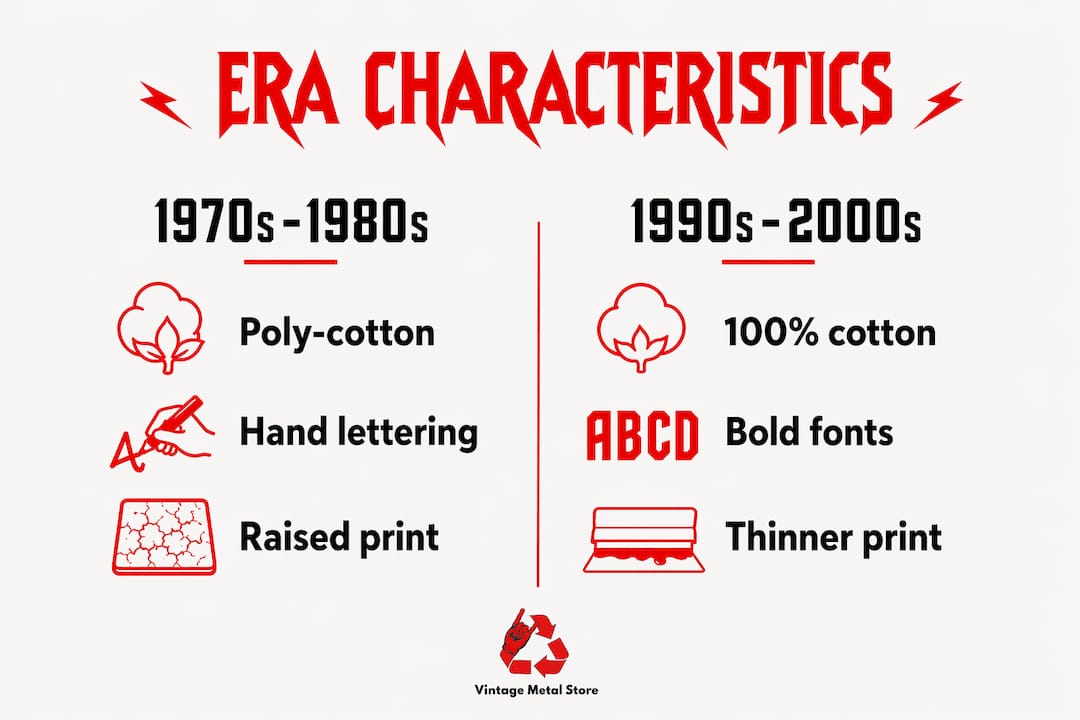
Screen printing is the defining production method for every collectible era up to the early 2000s. Authentic vintage metal shirts were screen printed, which means the ink sits on top of the fabric rather than being absorbed into it. Over time, screen print cracks in a distinctive pattern that digital printing cannot replicate. If a shirt claiming to be from 1989 shows no print cracking and has perfectly sharp edges, it is almost certainly a reproduction.
Pro Tip: Hold the shirt up to natural light and look at the print from an angle. Genuine screen printing from the 1980s and 1990s will show slight ink texture and micro-cracking invisible in flat photography. Reproductions look flat and uniform under this test.
| Feature | Authentic Vintage (Pre-2000s) | Modern Reproduction |
|---|---|---|
| Print texture | Raised, cracked over time | Flat, smooth |
| Colour saturation | Faded, uneven | Bright, uniform |
| Fabric weight | Heavier, often shrunk | Lighter, consistent |
| Label style | Single-colour, era-specific fonts | Modern multi-colour tags |
| Stitching | Thicker thread, chain stitch common | Thin, even machine stitch |
Why does nostalgia shape the value of collectible metal eras?
Nostalgia is not sentiment. It is a market force. Collectors in 2026 favour designs that evoke personal and cultural memory, especially from the 80s, 90s, and Y2K eras. This demand directly drives price and availability.
Metallica and Nirvana sit at the top of collector demand because their cultural reach extends far beyond dedicated fans. A 1992 Metallica “Black Album” tour shirt carries value to a metal purist, a fashion collector, and a cultural historian simultaneously. That crossover appeal is rare in any collectible category. You can explore why fans collect old shirts to understand how this cultural power translates into real collector behaviour.
Rarity amplifies nostalgia. A shirt from a single-night show at a small venue carries more weight than a shirt from a stadium run with 50,000 units printed. The story behind the shirt matters as much as the shirt itself. Collectors who can document provenance, whether through photographs, ticket stubs, or purchase receipts, hold pieces that command significantly higher prices.
“Demand for 1990s band tees has reached an all-time high, but the supply of authentic and high-quality pieces is dwindling, fuelling collector interest in emerging eras such as 2000s tees.”
The shift toward 2000s pieces is already underway. Smart collectors are acquiring early 2000s Slipknot, System of a Down, and Disturbed tour shirts now, before prices follow the same trajectory as 90s pieces. The window to buy at reasonable prices is closing.
- 80s metal tees: Highest prices, lowest supply, most faked
- 90s band shirts: Peak demand, iconic collector status, rapidly declining availability
- Early 2000s tees: Emerging collectible status, still accessible, strong upside
- Post-2010 tour stock: Deadstock and ex-tour pieces gaining attention from forward-looking collectors
Authentic vintage band tees also carry a distinctive personal identity that mass-produced fashion cannot replicate. Wearing a genuine 1988 Judas Priest tour shirt is a statement that no replica can match.
What practical steps help collectors identify a t-shirt’s era?
Authentication is a skill built through repetition and reference. These steps give you a reliable framework for assessing any piece you encounter.
- Check the label first. Single-stitch labels with era-specific fonts and single-colour printing are strong indicators of pre-2000s origin. Hanes, Fruit of the Loom, and Screen Stars labels each have documented style changes across decades that serve as dating references.
- Assess the fabric composition. Pre-1990s shirts often used poly-cotton blends. Post-1990 shirts shifted heavily toward 100% cotton. The feel and weight of the fabric tells you a great deal before you even look at the print.
- Examine the stitching. Chain stitching along the hem is a reliable marker of pre-1990s manufacture. Single-needle stitching became dominant through the 90s. This detail is rarely faked on reproductions.
- Scrutinise the print. Expert authentication checks include assessing print cracks, fabric composition, label details, and rarity indicators. Cracking should follow the natural stress points of the fabric, not appear uniform across the design.
- Research the tour or release. Cross-reference the shirt’s design against known tour programmes, concert photographs, and band archives. A shirt claiming to be from a 1984 tour should match the artwork and colour palette documented from that period.
Pro Tip: Build a physical reference collection of confirmed authentic pieces before spending serious money. Handling genuine shirts from each decade trains your eye and hands faster than any written guide.
Red flags to watch for include tags that look artificially aged, prints that show no cracking despite claiming 30-year-old origin, and designs that do not match documented tour artwork. Reproductions have become sophisticated, but they cannot replicate the specific way genuine vintage fabric ages and softens over decades.
For preservation, store shirts flat or rolled rather than hung. Hanging stretches the collar and shoulder seams over time. Keep pieces away from direct sunlight, which fades prints faster than normal wear. Preserving old band tees protects both their cultural significance and their financial value.
Key takeaways
The defining era in collectible t-shirts is determined by age, fabric, print technique, and cultural significance working together, not by any single factor alone.
| Point | Details |
|---|---|
| Era definition requires multiple factors | Age, fabric, print style, and cultural context together determine a shirt’s collectible era. |
| 1980s shirts hold peak collector value | Bold back graphics, screen printing, and iconic band associations make 80s tees the most sought-after. |
| 90s supply is critically low | Authentic 90s band tees are scarce; collectors are already moving toward 2000s pieces. |
| Authentication protects your investment | Label checks, fabric assessment, stitching type, and print cracking are the four core verification tools. |
| Nostalgia drives market prices | Cultural memory tied to bands like Metallica and Nirvana creates crossover demand beyond dedicated collectors. |
The detail that separates real collectors from casual buyers
I have spent years handling vintage metal shirts, and the single most underrated skill in this hobby is patience with provenance. Most collectors focus entirely on the shirt itself. The great ones focus on the story around it.
A shirt without context is worth its fabric and print. A shirt with a documented history, a photograph of it being worn at the show, a receipt from the merch table, or a clear chain of ownership, is worth multiples of that. The market has not fully priced this in yet, which means collectors who document their pieces carefully are building value that the broader market will eventually recognise.
The other thing I would push back on is the obsession with condition. A genuinely worn 1986 Metallica shirt with fading, cracking, and a small repair tells a more authentic story than a mint deadstock piece in a plastic sleeve. Both have value, but they are different kinds of value. The worn shirt carries lived history. That matters to a growing segment of collectors who want connection, not just investment.
The 2000s wave is real and it is happening now. I have watched the same pattern play out with 80s shirts in the 2010s and 90s shirts through the early 2020s. The collectors who moved early built extraordinary collections at reasonable prices. The ones who waited paid a premium for the privilege of being late.
— David
Wear the legacy: find your era at vintage metal store
If you are serious about building a collection that spans the defining eras of heavy metal merch, Vintage Metal Store is where authentic pieces live. Every shirt in the catalogue is sourced from real tour stock, deadstock, and verified second-hand collections. Nothing is reproduced. Nothing is artificially aged.
The rare 1992 Metallica tour shirt in the current collection is exactly the kind of piece that defines an era. It carries the print, the fabric, and the documented tour history that serious collectors look for. For a broader sweep across decades, the Metallica vintage shirt collection covers 80s, 90s, and Y2K pieces in one place. Shop Now and wear the legacy.
FAQ
What makes a t-shirt qualify as a collectible era piece?
A collectible era piece is defined by age of at least 20 years, distinct design characteristics tied to its period, and cultural significance. For heavy metal collectors, tour-specific origin and band legacy add further weight to that classification.
How do i tell an authentic vintage metal shirt from a reproduction?
Check the label font and colour, assess fabric weight and composition, examine stitching type, and look for natural print cracking at stress points. Reproductions typically show flat, uniform prints with no genuine fabric ageing.
Which decade produces the most valuable collectible metal tees?
The 1980s consistently produces the highest-value pieces due to bold graphic design, screen-print quality, and the iconic status of bands like Metallica, Iron Maiden, and Judas Priest active during that period.
Are early 2000s band shirts worth collecting now?
Yes. Supply of 90s tees is dwindling while demand remains high, pushing collector attention toward early 2000s pieces from bands like Slipknot and System of a Down before prices escalate.
How should i store vintage metal shirts to preserve their value?
Store shirts flat or rolled, away from direct sunlight and humidity. Avoid hanging, which stretches collar and shoulder seams over time and degrades the fabric structure of older pieces.
Recommended


