



A fan club edition shirt is a garment produced specifically for an official artist or band fan club, either gated behind active membership or released as a fan-style limited run tied to a tour, album cycle, or membership year. These are not standard merch table shirts. They carry provenance: a production context, an access model, and often explicit branding that marks them as belonging to a specific moment in a band’s history. For heavy metal collectors, that context is everything.
Three things separate a genuine fan club edition from regular tour merch:
- Membership access or gating — the item requires an active club login, verified membership, or a member-only checkout to purchase (e.g. Ten Club’s member-only product pages show language like “Current Pearl Jam Ten Club Members Only. 1 per order.”)
- Limited production tied to a specific run — shirts are produced in batches for a membership year, tour cycle, or album drop, not replenished indefinitely
- Unique club branding — club logos, sleeve patches, member-only notes, or back-print identifiers that distinguish the item from publicly available merch
Table of Contents
- What is a fan club edition shirt, and how does it differ from regular merch?
- How does fan club membership and access actually work?
- Why do fan club shirts matter so much in heavy metal culture?
- How do you authenticate a fan club edition shirt?
- Where can Australian fans realistically find fan club edition shirts?
- What determines the value of a fan club edition shirt?
- How do you store and preserve a fan club shirt?
- Key takeaways
- The real weight of a club shirt
- Vintage Metal Store: authenticated club and tour shirts for Australian collectors
- Useful sources
- FAQ
What is a fan club edition shirt, and how does it differ from regular merch?
Not every shirt labelled “fan club” is a true member-exclusive. There are three distinct types in circulation, and knowing the difference matters for collectors.
Member-gated editions require an active, paid membership to access. The checkout itself enforces the gate: you log in, your membership is verified, and only then can you purchase. Pearl Jam’s Ten Club operates this way, with explicit product-level gating and strict one-per-order limits. These are the shirts collectors prize most.
Public fan-style editions use the “fan club” label as an aesthetic or marketing device. Some artist stores release items branded as “Fan Club Edition” that are available to anyone. The Lionel Richie store’s Fan Club Edition tee is a documented example: the name signals fan identity, but there is no membership gate. Collectors must read the listing carefully.
Grassroots fan-made variants are produced by local supporter groups or fan communities for specific shows or regional clubs. Platforms like Custom Ink make this accessible. These shirts carry real cultural weight and can be highly collectible for local provenance, but authentication differs sharply from official club items.
- Official gated editions: highest provenance value, hardest to acquire
- Public fan-style editions: widely available, lower exclusivity
- Grassroots fan-made shirts: culturally significant, provenance is community-based
How does fan club membership and access actually work?
Official fan clubs follow a recognisable pattern. Here is the typical process for accessing member-only apparel:
- Join the club — pay an annual or one-off membership fee through the artist’s official site
- Verify your membership — confirm via email; some clubs issue a membership card or number
- Log in to the member store — access is gated behind your account; non-members see a locked or hidden product page
- Navigate the member section — exclusive apparel appears here, often with explicit “member-only” labelling
- Check out under the rules — one-per-order limits and non-coupon eligibility are common; member-exclusive items often include automatic discounts for logged-in members
Clubs typically refresh exclusive runs on a tour cycle or annual basis. A shirt tied to a specific membership year or tour leg will not reappear. For collectors, that window is the entire game.
Pro Tip: Set a calendar reminder for when your membership renews and when a band announces a new tour. The member store usually drops exclusive apparel in the weeks immediately following a tour announcement, and those runs sell out fast.
Why do fan club shirts matter so much in heavy metal culture?
Heavy metal has always been a culture of belonging. From the earliest days of the scene, unique paraphernalia like specialised shirts and pins functioned as in-group markers, signals that you were not just a casual listener but a committed member of a specific tribe. A Metallica club shirt from a particular membership year does not just represent the band. It represents a specific era, a touring cycle, a community of people who were paying attention at exactly that moment.
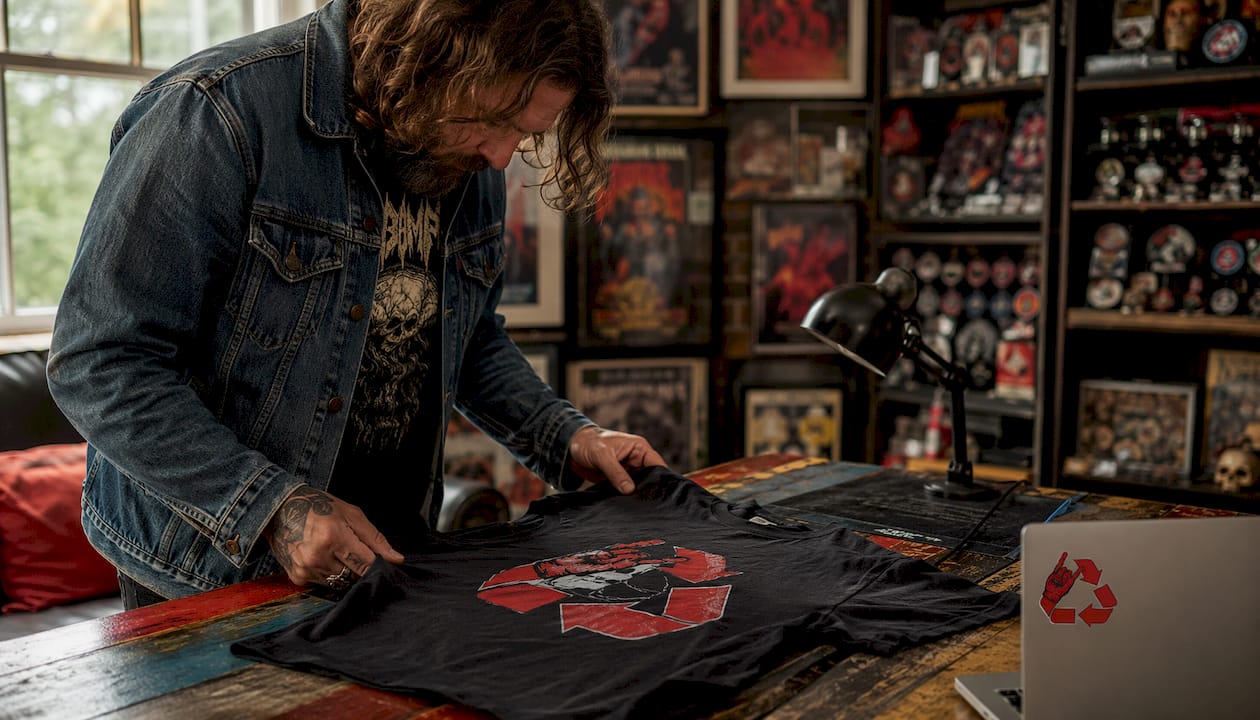
Metal collectors treat these items as small archival artefacts. The history of metal tour merch is inseparable from the history of the scene itself, and club shirts sit at the intersection of both. A shirt that was only available to verified members during a specific album cycle anchors provenance in a way that a general tour tee simply cannot. It tells you who had access, when, and why they cared enough to join.
How do you authenticate a fan club edition shirt?
Authentication is where collectors earn their knowledge. Use this checklist before purchasing any claimed fan club edition:
- Member-only checkout language — does the original listing or provenance documentation reference a login requirement or membership verification?
- Club logo or sleeve patch — official club editions typically carry distinct branding beyond the standard band logo; sleeve patches or back-print club identifiers are common design cues
- Limited-run or year/tour print — look for printed run identifiers, membership year text, or tour-specific dates on the garment itself
- Tag and label details — original club shirts often carry branded or tear-away labels; generic replacement tags are a red flag
- Non-coupon eligibility note — a recurring pattern on verified club pages; if the original listing noted this, it supports authenticity
- Provenance documentation — order confirmation screenshots, membership emails, or seller notes that trace the shirt back to its original purchase
When buying secondhand, request close-up photos of: the inside tag, the print edges, the sleeve or back club branding, and the wash tag. Generic tags, absent provenance, and mass “fan club” branding without any gating evidence are the three most common red flags for reprints or bootlegs.
Pro Tip: Ask the seller directly: “Can you provide the original order confirmation or membership email?” A genuine club shirt from a verified member will almost always have a paper trail. If the seller cannot produce any documentation, price accordingly.
Where can Australian fans realistically find fan club edition shirts?
Finding genuine fan club edition apparel in Australia takes a layered approach.
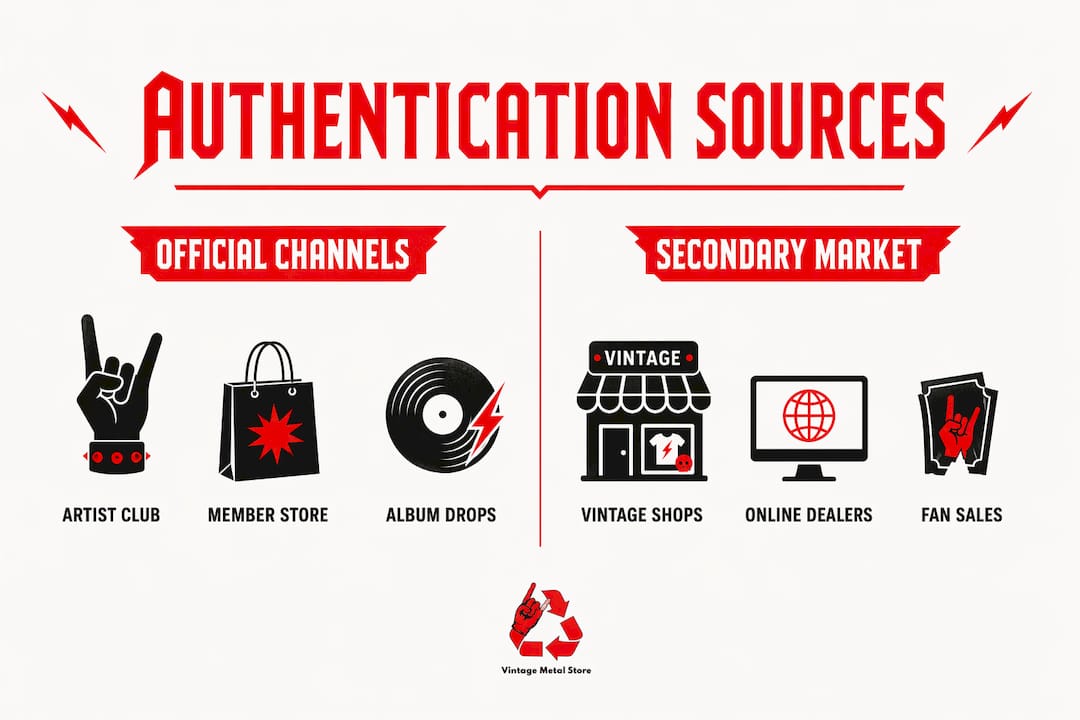
Official channels are the cleanest source but require active membership. Artist club stores, album-cycle drops, and official reissue channels give you authenticated access but demand you be in the right place at the right time. Most are US or UK-based, which adds shipping cost and time zone friction for Australian buyers.
Secondary market channels include vintage shops, speciality online dealers, auction listings, and fan-to-fan sales. Provenance varies widely. Price can reflect either genuine rarity or seller optimism.
Vintage Metal Store curates ex-tour and deadstock club shirts from heavy metal tours and bands, including authenticated Metallica club shirts from specific years. For Australian collectors, this is a direct path to verified inventory without the membership window problem.
| Channel | Accessibility | Authentication | Pricing | Scarcity |
|---|---|---|---|---|
| Official club store | Member-only | Highest | RRP + shipping | Very high |
| Secondary market | Open | Variable | Market-driven | High |
| Vintage Metal Store | Open | Curated/provenance noted | Collector-fair | High |
What determines the value of a fan club edition shirt?
Several factors push a club shirt into higher value territory:
- Production run size — smaller runs tied to a single membership year command more than open-edition fan-style releases
- Year and tour tie — shirts linked to landmark tours or albums carry a premium; a Metallica club shirt tied to a specific cycle is more sought-after than a generic fan-style tee
- Condition — mint or deadstock condition (unworn, original tags intact) can multiply value significantly over a worn example
- Provenance documentation — a shirt with its original order confirmation and membership email is worth more than an identical shirt without paperwork
- Print technique and club branding — screen-printed club logos, embroidered patches, and specialty inks age differently and are harder to replicate
- Club tier — some clubs offer tiered membership with higher-tier exclusive apparel; top-tier items are rarer by design
For Australian buyers, era-specific rarity is a key driver. Shirts from the 1980s and 1990s club cycles are genuinely scarce in the local market.
Pro Tip: Condition grading matters more than most buyers realise. A deadstock club shirt with intact tags and provenance documentation can be worth multiples of the same shirt in worn condition. Always grade condition honestly before pricing or purchasing.
How do you store and preserve a fan club shirt?
Preservation is straightforward when you treat the shirt as the archival object it is:
- Wash gently or not at all — if the shirt is deadstock or mint, consider skipping washing entirely; if washing is necessary, cold water, inside-out, on a delicate cycle
- Store flat in acid-free tissue — folding creates crease stress on prints; flat storage in acid-free tissue inside an archival box is the gold standard
- Use archival sleeves for display — if you want to display the shirt, archival polyethylene sleeves protect the print from UV and dust without trapping moisture
- Control humidity and temperature — store away from direct sunlight, in a stable environment; fluctuating humidity degrades both fabric and print
- Keep provenance documents with the item — store membership emails, receipts, and original tags in an archival envelope attached to or filed with the shirt
Pro Tip: Photograph the shirt in full, plus close-ups of the tag, print, and any club branding, before storing it. These photos become part of the provenance record and are invaluable if you ever sell or insure the item.
Key takeaways
Fan club edition shirts are among the most provenance-rich items in heavy metal collecting, and authentication separates genuine club exclusives from public fan-style releases.
| Point | Details |
|---|---|
| Definition | A fan club edition shirt is produced for an official artist club, either member-gated or released as a limited fan-style run. |
| Authentication essentials | Verify member-only checkout language, club branding, limited-run identifiers, and original tags before buying. |
| Where to buy in Australia | Official club stores require active membership; Vintage Metal Store offers curated ex-tour and deadstock club shirts with provenance notes. |
| Value drivers | Condition, provenance documentation, production run size, and tour/year tie are the primary value factors. |
| Vintage Metal Store | Stocks authenticated Metallica club shirts and ex-tour deadstock, making it a practical source for Australian collectors. |
The real weight of a club shirt
There is a tendency in collecting circles to focus on price and rarity as the primary measures of a shirt’s significance. That framing misses something. A genuine fan club edition shirt is a record of commitment: someone paid for membership, waited for the drop, and secured an item that was never meant for general sale. That act of participation is baked into the object itself.
What I find most interesting about the heavy metal club shirt market is how it resists the broader trend of “fan club” branding being diluted into a public aesthetic. The metal scene’s collector community is unusually rigorous about provenance. Fans here know the difference between a shirt that required a membership gate and one that borrowed the language for marketing purposes. That rigour is what keeps the category meaningful and why authenticated ex-tour and deadstock club shirts hold their value in ways that mass-market fan-style releases simply do not.
If you are building a collection, prioritise documentation over condition alone. A worn shirt with a clear provenance trail is a stronger acquisition than a mint shirt with no paper trail.
Vintage Metal Store: authenticated club and tour shirts for Australian collectors
Vintage Metal Store is where Australian collectors find the real thing: ex-tour stock, deadstock, and authenticated club shirts from heavy metal’s most significant eras, without the membership window or international shipping headache. The store’s catalogue includes authenticated Metallica club shirts from specific years, alongside rare tour pieces like the Metallica 1992 Don’t Tread on Me USA Tour shirt, each listed with condition notes and provenance detail. Before you buy, you can request additional photos of tags, print edges, and club branding directly through the store. Browse the full catalogue at Vintage Metal Store and get your hands on a piece of metal history.
Useful sources
- Pearl Jam Ten Club — official member club page showing gating model, member perks, and exclusive product access policies
- Ten Club 2026 Member First Show Shirt — product page example showing “Current Pearl Jam Ten Club Members Only. 1 per order.” language
- Keith Urban The Ville fan club — documents annual membership perks, member store access, automatic discounts, and one-per-order checkout rules
- Lionel Richie store Fan Club Edition tee — example of a publicly available item using “Fan Club Edition” labelling without a membership gate
- Fan circles blog on fan clubs — context on how the “fan club” label has broadened into a public aesthetic in some markets
- Wikipedia: Fan club — overview of fan club structures and the role of paraphernalia as membership markers
FAQ
What makes a fan club edition shirt different from a tour shirt?
A fan club edition shirt is tied to an official club membership or a gated member run, while a tour shirt is sold openly at shows or on general merch stores. The key difference is access: club editions require verified membership to purchase.
How do I know if a secondhand fan club shirt is genuine?
Look for member-only checkout language in the original listing, club-specific branding (logos, sleeve patches, limited-run text), and provenance documentation such as order confirmations or membership emails. Generic tags and absent paperwork are the most common red flags.
Where can Australian collectors buy authenticated fan club edition shirts?
Official artist club stores are the primary source but require active membership. Vintage Metal Store stocks curated ex-tour and deadstock club shirts, including authenticated Metallica club shirts, with provenance notes available for Australian buyers.
Are public “fan club edition” shirts worth collecting?
They can be, but they carry less provenance value than true member-gated editions. Verify whether the item required membership to purchase; if it was publicly available, price and collect it accordingly rather than treating it as a rare exclusive.
How should I store a fan club shirt to protect its value?
Store flat in acid-free tissue inside an archival box, away from direct sunlight and humidity fluctuations. Keep all provenance documents, including original tags and membership emails, filed with the item.
Recommended
- 7 Iconic Types of Heavy Metal T Shirts for Collectors – Vintage Metal Store
- Sample band t-shirts: Rare finds and collector value – Vintage Metal Store
- 7 Types of Vintage Band Tees Every Collector Should Know – Vintage Metal Store
- How to display collector shirts: the complete guide – Vintage Metal Store


