


TL;DR:
- Promo shirts, often overlooked, serve as lasting brand endorsements that outperform digital advertising in impressions and trust. Collectors value limited editions, event significance, and condition, recognizing their cultural and historical importance beyond mere fabric. High-quality design, fabric, and meaningful story elevate a promo shirt from disposable to collectible, confirming their vital role in marketing and memorabilia.
Most people assume a promo shirt is a flimsy freebie destined for the bottom of a drawer. That assumption is wrong, and it costs both marketers and collectors real money. A promo shirt, at its best, is a wearable endorsement that outlasts any digital ad campaign and builds brand trust in ways a banner ad never could. For collectors, particularly those in the heavy metal and tour apparel world, these shirts represent tangible connections to moments in music history. This article breaks down exactly what is a promo shirt, why they matter, and how to recognise genuine value when you see it.
Table of Contents
- Key takeaways
- What is a promo shirt, exactly?
- How promo shirts work as marketing tools
- Quality, design, and making a shirt that gets worn
- The collectible and intrinsic value of promo shirts
- My take: promo shirts deserve more respect
- Find rare promo shirts worth keeping
- FAQ
Key takeaways
| Point | Details |
|---|---|
| Promo shirts are branded garments | They carry logos or campaign messages and are given free or used in marketing programmes. |
| Marketing impact is measurable | A single shirt generates over 5,000 brand impressions at a fraction of a cent per impression. |
| Quality determines wearability | Higher-grade blanks and good print methods increase how long a shirt stays in rotation. |
| Collectors value story and scarcity | Limited runs and event significance matter as much as physical condition to serious collectors. |
| Not all promo shirts are equal | The use case, fabric, and design all determine whether a shirt becomes a kept piece or landfill. |
What is a promo shirt, exactly?
A promo shirt, short for promotional shirt, is a branded garment imprinted with a logo, campaign message, or event artwork, distributed free or as part of a marketing programme. The promo shirt definition spans everything from a basic corporate polo handed out at a trade show to a limited-edition tour tee pressed in a run of 200 copies and given only to crew members and press contacts.
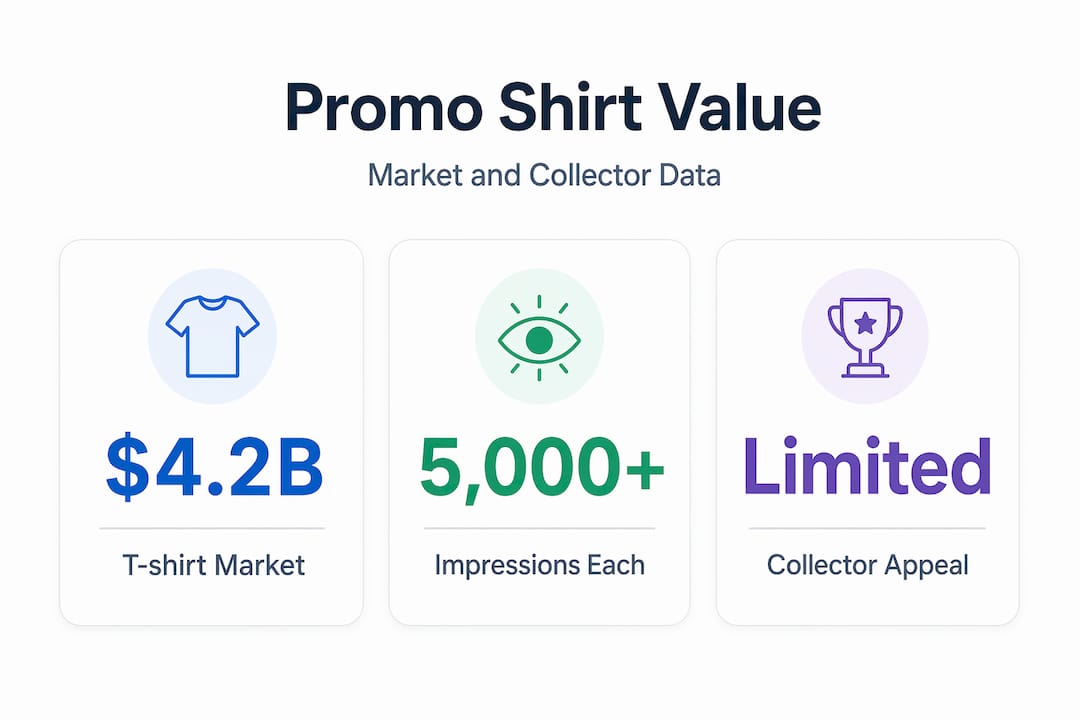
The most common form is the t-shirt. And the scale of that market is significant. T-shirts alone generate over $4.2 billion in annual sales as of 2025, making promotional apparel one of the most commercially active segments in the entire merchandise industry. Businesses, charities, record labels, touring bands, and political campaigns all rely on custom promotional t-shirts to communicate identity and build loyalty.
The table below shows how promo shirts fit across different contexts and audiences:
| Context | Common shirt type | Primary purpose |
|---|---|---|
| Corporate event | Polo or fitted tee | Staff identification and brand presence |
| Music tour | Heavyweight screen-printed tee | Fan engagement and revenue |
| Charity campaign | Light cotton tee | Awareness and donor recognition |
| Product launch | Retail-style branded tee | Consumer loyalty and social sharing |
| Band crew or press | Limited-run promo tee | Exclusivity and insider access |
What are promotional shirts used for beyond marketing? They function as uniforms, membership signals, and increasingly as collectible artefacts. In the heavy metal world especially, a shirt from a specific tour leg or a limited press-only run carries weight far beyond its fabric weight.
How promo shirts work as marketing tools
The marketing logic behind a promo shirt is straightforward but often underestimated. A single promo t-shirt is estimated to generate over 5,000 impressions across its lifetime, at a cost of under one-tenth of a cent per impression. No billboard, radio spot, or social media post comes close to that sustained exposure for the same outlay.
The reason is retention. Promotional products like apparel outperform radio and online ads in consumer engagement because they provide repeated exposure over years, not seconds. When someone actually wears a shirt, they carry a brand into the gym, onto public transport, and through every interaction of the day.
Here is what drives the marketing value of promo shirts specifically:
- Utility and comfort. About 80% of consumers say usefulness and comfort are the main reasons they keep and wear promotional shirts. A shirt that fits well and feels good gets worn. One that does not gets binned.
- Social endorsement. When someone chooses to wear a shirt in daily life, it becomes a wearable endorsement more effective than interruptive digital ads. People trust a peer wearing a brand far more than they trust a paid placement.
- Longevity over one-off impressions. Marketing professionals who get the most from promotional apparel focus on long-term exposure rather than single-event visibility.
- Physical presence. Unlike a digital ad that disappears when the budget runs out, a well-made promo shirt remains in circulation for years.
The uses of promo shirts extend beyond traditional advertising too. Bands use them to create community. Nonprofits use them to signal belonging. Tech companies use them to project culture to potential employees. Each of these is a different application of the same underlying principle: a shirt that people actually wear is a marketing channel that runs itself.
Pro Tip: When assessing the marketing value of a promo shirt programme, the single most important metric is not how many shirts you distribute. It is how many of those shirts get worn repeatedly. A run of 50 quality shirts worn daily beats a run of 500 cheap ones stuffed in a cupboard.
Quality, design, and making a shirt that gets worn
Not all promo shirts are built the same, and the gap between a shirt that gets worn and one that gets discarded comes down to three decisions: fabric, print method, and design intent.
Fabric and blank selection
The choice of fabric and intended use case greatly affects durability and how a promo shirt is perceived. Lightweight cotton works for single events where the shirt is essentially a badge for the day. Cotton and polyester blends hold up better under repeated washing and suit any shirt intended for ongoing wear.
Higher-grade, retail-fit blanks significantly increase long-term wear and reduce cost per impression compared to cheap alternatives. The biggest failure in promo shirt programmes is selecting cheap blanks that recipients discard immediately, which completely negates any marketing return on investment.
Print method comparison
| Print method | Best for | Durability | Perceived quality |
|---|---|---|---|
| Screen printing | Large runs, bold graphics | Very high | High |
| Embroidery | Polos, corporate wear | Very high | Premium |
| Direct to garment (DTG) | Small runs, photo-quality art | Medium | Medium to high |
| Heat transfer | Budget runs, short deadlines | Low to medium | Low to medium |
Screen printing suits large runs and bold, graphic-heavy designs. Embroidery signals a polished, professional look suited to corporate polos. For most heavy metal tour shirts and collectible promo apparel, screen printing on a heavy cotton blank is the gold standard.
Design pitfalls to avoid
Good design in a promo shirt prioritises aesthetics over information density. The most common mistake is cramming too much onto the chest: too many logos, too many sponsor names, too many colours. The result feels corporate and disposable. A clean, confident graphic with one strong visual focus is far more likely to be worn and to generate the impressions you are after.
Pro Tip: If you are designing promo t-shirts and find yourself adding a fourth line of text, stop. Every line of copy you remove increases the chance someone will actually wear the shirt in public.
The collectible and intrinsic value of promo shirts
For collectors, the question shifts from “will people wear this?” to “why does this particular shirt matter?” The promo shirt definition changes slightly in a collecting context. Here it refers to shirts produced for specific events, campaigns, or moments, often in limited quantities, that carry a story beyond the garment itself.
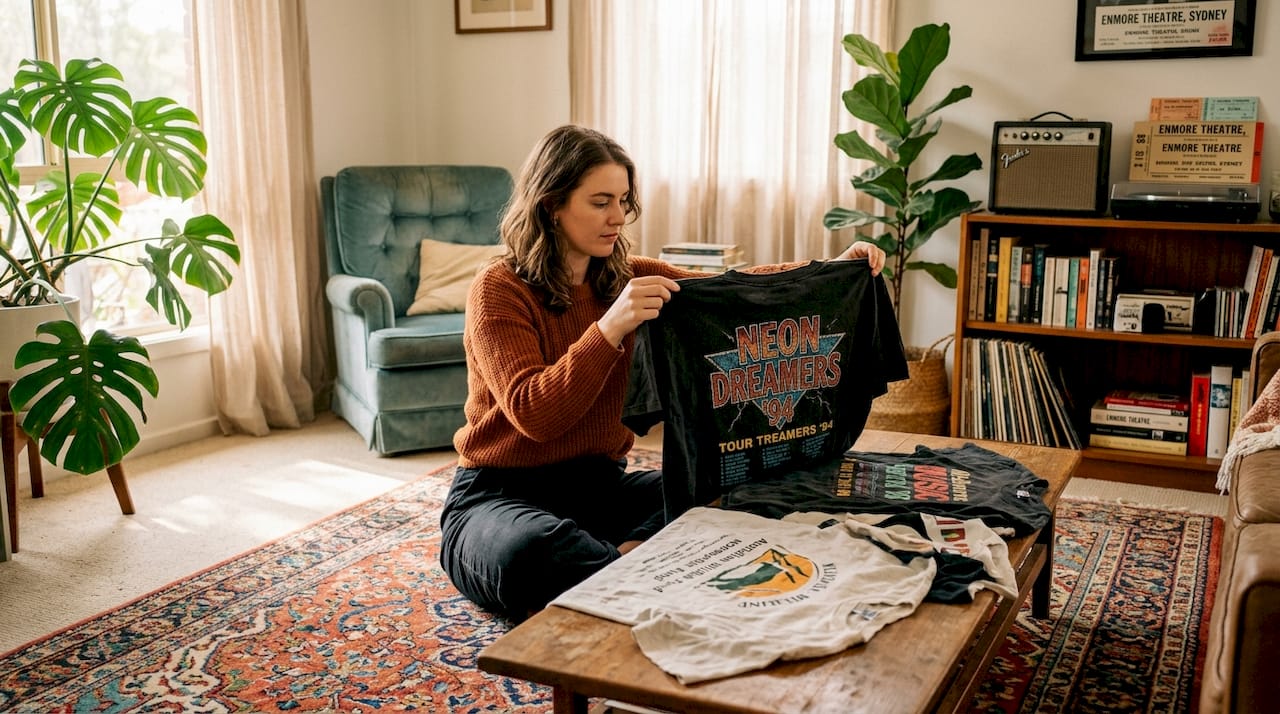
Collectors value the story, exclusivity, and event significance of promo shirts as much as physical quality. An internal corporate giveaway shirt holds almost no collector interest. A shirt pressed for the crew and press contacts of a major 1992 tour, in a run of a few hundred, is a different matter entirely.
When you are assessing a promo shirt for collectible value, look for these indicators:
- Limited production. The smaller the run, the more scarce the shirt and the greater the collector interest over time.
- Event or moment significance. A shirt tied to an iconic tour leg, a record release, or a culturally significant moment carries more weight than a generic branded piece.
- Physical condition. Condition matters for preservation and display. Deadstock or unworn shirts command a premium. Understanding top fabrics for vintage shirts helps you assess how well a shirt will hold up over time.
- Provenance and narrative. Where did the shirt come from? Who had it? A shirt with a documented chain of ownership, or one with a compelling origin story, is more valuable than an identical shirt with no history.
- Brand and band legacy. A promo shirt from a band at the peak of their cultural moment is worth more than one from a lesser-known act, all else being equal.
Collectors see value in promo shirts that mark iconic events or limited editions, particularly when the item carries a compelling narrative. The promo tees as crown jewels of the metal collecting world captures this exactly. These shirts are not memorabilia in the generic sense. They are primary sources from a specific cultural moment.
Spotting a meaningful promo shirt versus a generic one takes practice. Start by researching the tour, event, or campaign the shirt references. Cross-reference print dates, label placements, and construction details with known examples. If you are building a collection, use a resource like this guide to identifying dead stock heavy metal shirts to sharpen your eye.
My take: promo shirts deserve more respect
I have been around vintage and promo apparel long enough to say this with some confidence: treating a promo shirt as a throwaway is one of the most expensive mistakes in both marketing and collecting.
In marketing, I have seen brands spend thousands on digital campaigns that evaporate the moment the budget stops, while a well-made shirt pressed a decade earlier still circulates in the wild and generates genuine goodwill. The economics are not even close. A shirt that someone chooses to wear is worth more than ten ads they scroll past.
In collecting, I have watched people pass on shirts that looked unremarkable at first glance, only to see identical pieces sell at serious prices years later. The value was never about the fabric alone. It was about the moment the shirt represented and the scarcity that came with time.
What I have learned is that the best promo shirts share one quality regardless of era or context: they were made as if they deserved to be kept. A band that pressed a crew-only tee in heavy cotton with a striking hand-drawn graphic understood something that most corporate marketing departments still do not. The shirt has to earn its place in someone’s wardrobe. Once it does, it markets your brand for free, indefinitely.
The shirts that end up in collections, the ones people hunt for years to find, were never designed with collecting in mind. They were designed with genuine care. That is the lesson.
— David
Find rare promo shirts worth keeping
If this has sharpened your eye for what makes a promo shirt worth owning, the next step is finding the real thing. Com specialises in vintage heavy metal t-shirts, ex-tour stock, and deadstock from bands and tours that defined an era. These are not reprints or reissues. They are original promo and tour shirts in genuine condition, sourced from the people who were there.
The collection includes pieces like the rare Metallica 1992 tour tee, which is exactly the kind of limited-run promo shirt that ticks every collector value box. For anyone serious about this category, browsing the full range of vintage Metallica shirts is a solid starting point. Authentic. Scarce. Worth your attention.
FAQ
What is the promo shirt definition in plain terms?
A promo shirt is a branded garment printed with a logo or message and distributed free or as part of a marketing campaign. The term covers everything from corporate trade show tees to limited-run band shirts.
How many impressions does a promo shirt generate?
A single promotional t-shirt generates an estimated 5,000 or more brand impressions over its lifetime, at a cost of under one-tenth of a cent per impression, according to ASI’s 2026 ad impressions research.
What makes a promo shirt valuable to collectors?
Collectors prioritise event significance, limited production runs, physical condition, and the story behind the shirt. A shirt from an iconic tour moment in a small run is worth considerably more than a generic branded giveaway.
What print method is best for promo shirts?
Screen printing is the most durable and cost-effective method for large runs and graphic-heavy designs. Embroidery suits corporate polo shirts where a polished, premium look is the priority.
Why do some promo shirts get kept and others discarded?
Around 80% of consumers say comfort and usefulness determine whether they keep a promotional shirt. Higher quality blanks, a good fit, and strong design are the main factors that determine whether a shirt stays in regular rotation or ends up unused.
Recommended


