



TL;DR:
- Band merchandise began in 1956 with Elvis, establishing a commercial model based on licensed physical products.
- Modern merch, especially tour exclusives, holds high collector value and often surpasses music revenue for bands.
There’s a common assumption that band merchandise is just a T-shirt slapped with a logo to make a quick buck at the door. That assumption is wrong, and this guided tour of merch history will show you exactly why. From a 1956 Billboard report on Elvis lipsticks and stuffed hound dogs to tour-exclusive drops that sell out before the headliner hits the stage, merch has shaped heavy metal culture as profoundly as the music itself. What started as novelty trinkets is now a multi-layered economy of identity, community, and serious collector value.
Table of Contents
- Key takeaways
- The guided tour of merch history starts here: 1950s to 1970s
- Metal’s golden era: how the 1980s to 2000s built iconic aesthetics
- Modern merch economics and collector dynamics in the 2020s
- Merch as identity in heavy metal fan culture
- How to collect and preserve heavy metal merch
- My take on what metal merch actually means
- Find rare metal merch at Com
- FAQ
Key takeaways
| Point | Details |
|---|---|
| Merch predates metal by decades | Band merchandising began with Elvis in the 1950s, laying the commercial foundation metal bands would later dominate. |
| Tour exclusives hold the highest value | Items sold at specific venue stops command premium resale prices far above standard online merch. |
| Merch outpaces music revenue | For many metal bands, merchandise is the difference between a profitable tour and a loss-making one. |
| Collectors treat vintage merch as art | Rare vintage band shirts trade at prices that rival fine art, driven by scarcity and cultural weight. |
| Design and exclusivity drive community | Modern merch uses insider references and limited runs to deepen fan bonds beyond simple promotion. |
The guided tour of merch history starts here: 1950s to 1970s
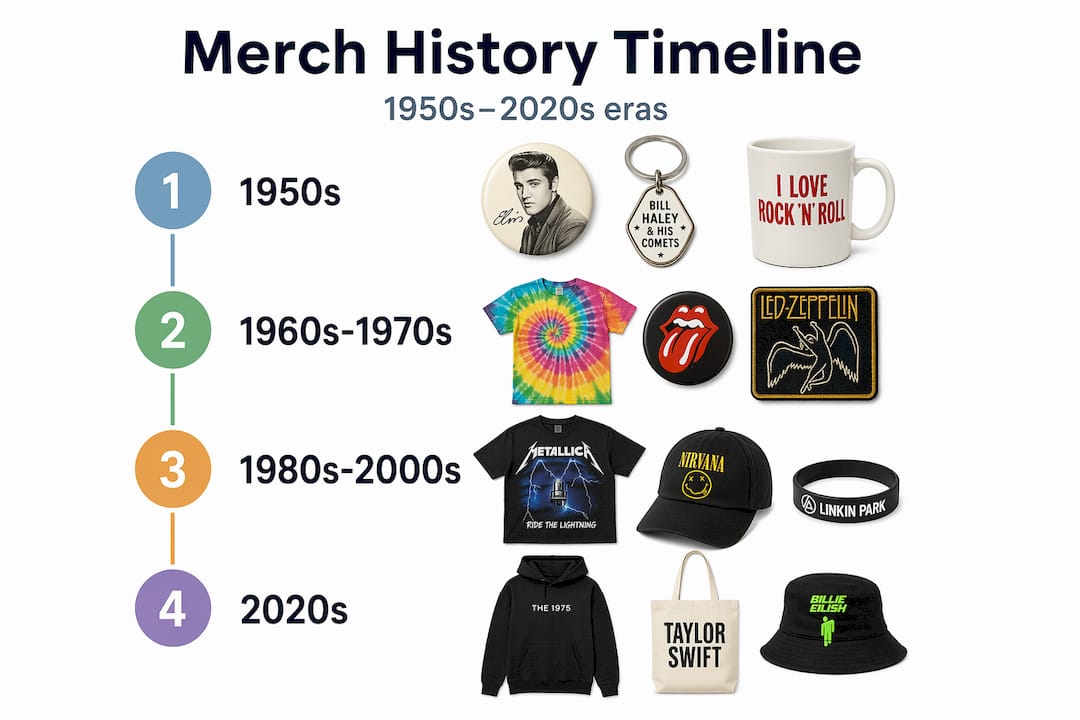
The story begins with Elvis. In 1956, band merch was born with lipsticks, wallets, and stuffed hound dogs bearing the King’s name. These weren’t touring afterthoughts. They were a commercial blueprint that nobody in rock had attempted at scale.
The Beatles accelerated everything in the early 1960s, though not without pain. Their management initially received only 10% of merch income due to catastrophically poor licensing deals. By 1964, after a brutal renegotiation, that share climbed to 46%. The lesson the industry learned: merch rights matter as much as recording rights.
The festival era of the late 1960s brought the band T-shirt into mainstream fan culture. Wearing a shirt wasn’t just a souvenir act. It was a declaration. You were there. You belonged to something.
Then came AC/DC, and the economics shifted permanently. By the late 1970s, AC/DC generated more profit from merchandise than from ticket sales on tour, an industry first that every band manager since has had to reckon with.
- Elvis proved that artist identity could be licensed into physical objects fans would purchase with genuine enthusiasm.
- The Beatles showed that licensing control is everything, and losing it costs millions.
- Festival culture transformed the band shirt into a social signal rather than just a souvenir.
- AC/DC proved that merch wasn’t a bonus revenue stream. It was the primary one.
Pro Tip: If you’re building a collection focused on the origins of the band merchandise history, look for Australian tour shirts from the mid-to-late 1970s. They’re scarce, genuinely historical, and still undervalued compared to their American equivalents.
Metal’s golden era: how the 1980s to 2000s built iconic aesthetics
The 1980s didn’t just change how metal sounded. They changed how metal looked, and the merch table was where that visual identity lived between albums. This is the era that matters most if you’re a collector with serious intent.
Graphic design became a weapon. The Ramones’ crest had already shown in the 1970s that a band logo could carry the same cultural weight as a national flag. Metal took that concept and made it more aggressive, more detailed, and more deliberately confrontational. Artists like Derek Riggs, who created Iron Maiden’s Eddie mascot artwork, turned shirt graphics into something you’d want framed.
- KISS expanded the definition of merch entirely. By the 1990s and 2000s, KISS had over 7,000 licensed products including condoms, caskets, and garden gnomes. That breadth is absurd, but it also proved that a band brand could stretch as far as the fan’s willingness to buy.
- Metallica turned merch into an identity system. Their catalogue of shirts, patches, and tour-exclusive designs across the “…And Justice for All” and “Black Album” eras created a tiered collector market that exists to this day.
- Tour-exclusive designs emerged as the holy grail. A shirt printed for a single leg of a tour, sold only at specific venues, became the item every collector wanted and most couldn’t get.
- The metal subculture used merch as a membership card. Wearing a Slayer shirt in 1987 was not subtle. It communicated exactly who you were and what you were willing to own publicly.
The role of merch in keeping metal bands solvent during the commercial dips of the early 1990s is under-discussed. When radio support vanished and record labels tightened budgets, merch kept tours alive. Merch profits often determined whether a tour was financially viable or a loss. That’s not a secondary consideration. That’s survival economics.
Pro Tip: When assessing shirts from this era, look at the tag first. Authentic early 1990s Metallica shirts typically feature Brockum or Giant tags. Reproductions almost never get the tag typography right. Understanding vintage shirt pricing comes down to knowing these details cold.
Modern merch economics and collector dynamics in the 2020s
The relationship between a metal band and its merchandise has never been more financially critical than it is right now. Physical music sales have collapsed. Streaming pays fractions of a cent per play. In 2026, merch revenue is the difference between a band sustaining itself and folding under financial pressure.
For collectors, this shift creates a fascinating tension. More merch is being produced, but the pieces with genuine long-term value are still the scarce ones.
| Merch type | Collector value | Availability |
|---|---|---|
| Vintage tour originals (pre-2000) | Very high | Scarce, requires sourcing expertise |
| Tour-exclusive current drops | High, increases over time | Limited to specific show dates |
| Standard online store merch | Low to moderate | Widely available, high print runs |
| Dead stock and ex-tour stock | Very high | Rare, specialist dealers only |
Tour-exclusive items sold at specific venue stops differ meaningfully from what lands in the web store. The scarcity is real, and so is the premium that follows in collector markets.
Modern merch design has also taken a sharp turn toward insider culture. The ‘IYKYK’ merch trend uses niche references and ironic humour to create pieces that only true fans will recognise. If you have to explain the shirt, the shirt is working exactly as intended.
- Vintage pieces that traded hands for $40 in the early 2000s now fetch hundreds, sometimes thousands of dollars.
- Collectors treat vintage merch with the same reverence reserved for fine art, and the market prices reflect it.
- Ex-tour stock and dead stock represent the rarest category. These are shirts that never sold at retail and retain original condition with original tags.
- The resale market has professionalised. Buyers now authenticate prints, screen-printing methods, and fabric composition before committing.
Merch as identity in heavy metal fan culture
There’s a reason metal fans wear their shirts to shows rather than leaving them in display cases. Merch in this culture is not decorative. It’s communicative.
“A band shirt in metal isn’t a piece of clothing. It’s a position statement. It tells a room full of strangers exactly what you value, who you’ve seen, and how far back your allegiance goes.”
This social function is what separates metal merch from merchandise in almost every other genre. A fan wearing a 1988 Slayer “South of Heaven” tour shirt at a show in 2026 is not just dressed. They are carrying a credential. Other fans clock it immediately. Conversations start. Friendships form.
The IYKYK insider approach deepens this further. Micro-merch with specific album references, regional tour dates, or obscure lyrics rewards the truly committed fan. If someone at a show spots your shirt and says “where did you even get that,” you’ve won the exchange.
Live shows remain the most powerful merch sales moment because the emotional context amplifies everything. You’re already charged by the music, already surrounded by your people. Buying that shirt becomes part of the experience itself, not an afterthought.
Design quality and exclusivity aren’t just commercial decisions. They signal to fans that the band takes the whole culture seriously. Bands that produce thoughtful, well-designed merch earn loyalty that transcends individual album cycles.
How to collect and preserve heavy metal merch
Collecting metal merch well requires knowledge, patience, and a few hard-learned habits. Here’s how to approach it seriously.
Finding authentic pieces:
- Prioritise tour merch value by learning which tags correspond to which years. Brockum, Giant, Hanes Beefy-T, and Alstyle tags each tell you something specific about era and origin.
- Ex-tour stock and dead stock are the categories worth chasing. These pieces were never consumer-worn and represent the closest thing to time-capsule condition.
- Specialist dealers who focus on vintage and ex-tour stock will almost always beat general resale markets on authenticity and fair pricing.
Buying at shows:
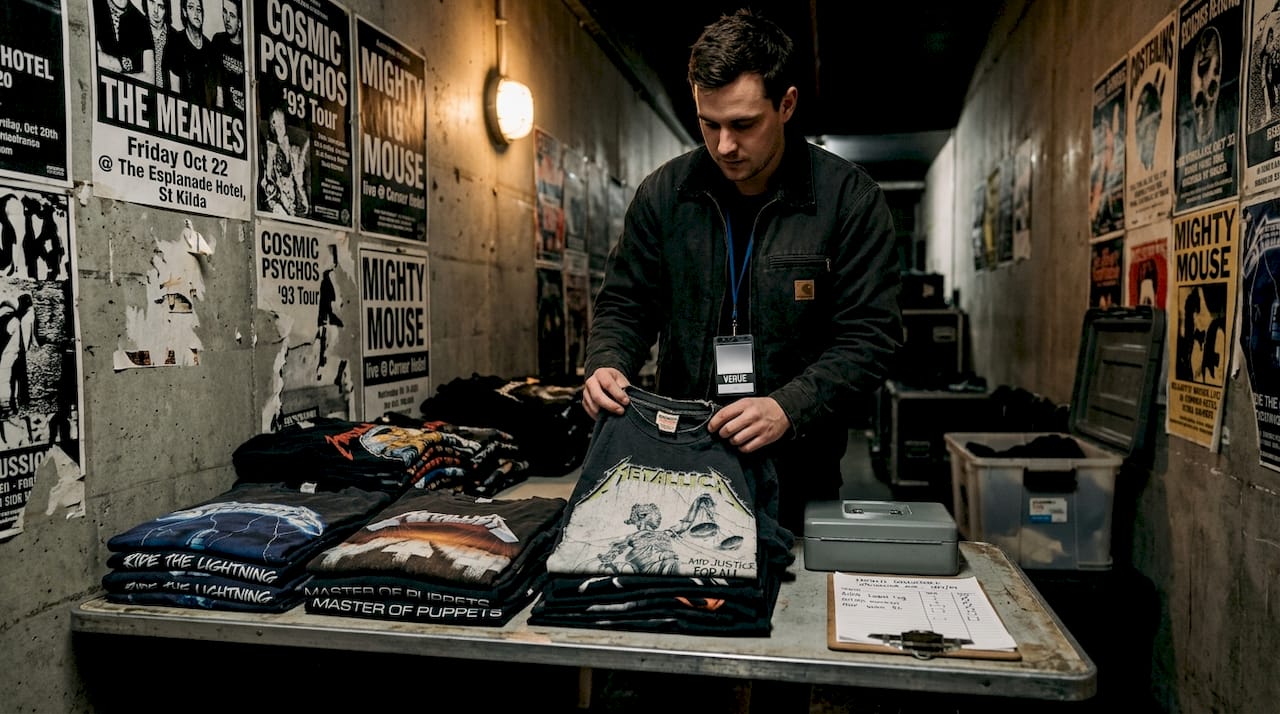
Arrive early at the merch table during shows. Limited designs sell out well before the headliner begins. This is not an exaggeration. At major tours, the most desirable pieces are gone within the first 45 minutes of doors opening.
Pro Tip: For preservation, store washed vintage shirts flat, not hanging. Hanging stretches the collar and distorts prints on thinner vintage fabric. For pieces you’re keeping as collector items, acid-free tissue paper inside a sealed garment bag with silica gel packets will maintain condition for decades. Full guidance on preserving old band tees is worth reading before you store anything valuable.
Evaluating rarity:
Cross-reference the tour dates printed on a shirt with documented setlists and tour schedules from that year. A shirt referencing a cancelled leg of a tour, or a venue that only hosted one show, is rarer than its print run suggests.
My take on what metal merch actually means
I’ve spent years watching this market evolve, and the thing that strikes me most is how badly misunderstood merch still is, even by people who love it.
Most commentary treats merch as a byproduct of music. I think that’s completely backwards. For metal specifically, the merch is often the primary artefact of a band’s cultural moment. Albums get reissued, remastered, and streamed into infinity. A shirt made for a specific 1989 tour date at a specific venue is irreplaceable. It’s a physical record of a moment that existed once.
What I’ve found genuinely surprising is how the economics have pushed bands to take design more seriously. When merch is your primary income, you stop treating it like an afterthought. The quality of metal merch design in 2026 is, in many ways, better than it was in the 1990s, even though the 1990s pieces are worth more. The scarcity drives the value, but the intent drives the culture.
My honest view on where this goes: the collector market for vintage and ex-tour metal merch will keep tightening. Supply is finite. The generation that grew up with this music has disposable income now. And a genuine 1992 Metallica tour shirt will always be worth more than a reprint, no matter how good the reprint is.
— David
Find rare metal merch at Com
If this merch history walkthrough has sharpened your appetite for the real thing, Com carries the kind of stock that actually matters to serious collectors. The range includes vintage and ex-tour Metallica shirts spanning their most commercially explosive era, alongside dead stock and tour originals from across the metal canon.
For collectors who understand the difference between a genuine 1992 tour piece and a later reprint, the rare Metallica 1992 tour tee currently listed is exactly the kind of find this guided merchandise exploration leads you toward. Authentic, documented, and in genuine collector condition. Stock at this level moves fast. If you see it, treat it like the merch table at the show.
FAQ
When did band merchandise first appear?
Band merch originated in 1956 with Elvis Presley, whose licensed products included lipsticks, wallets, and stuffed toys. The commercial model expanded dramatically with The Beatles in the 1960s.
Why is tour-exclusive merch worth more than standard merch?
Tour-exclusive items are produced in limited quantities for specific shows or venues, meaning supply is genuinely finite. Collector demand combined with scarcity drives resale value far above standard web-store stock.
How do I identify an authentic vintage metal shirt?
Check the inner tag first. Tags from specific manufacturers like Brockum or Giant correspond to particular eras and confirm authenticity. Print method, fabric weight, and label typography all provide further verification.
What makes dead stock and ex-tour stock so valuable?
Dead stock and ex-tour pieces were never sold at retail or consumer-worn, meaning they retain original condition and tags. This represents the closest available equivalent to a time-capsule piece from that era.
Is merch more important than music sales for metal bands today?
For most metal bands in 2026, yes. Merch revenue sustains financial viability in an era where physical music sales have largely collapsed and streaming income remains minimal.
Recommended


