



TL;DR:
- Vintage heavy metal T-shirts from the 1980s and 90s require gentle, inside-out washing to preserve fragile prints and fabric. Proper drying, ironing, and storage practices are essential to prevent damage, fading, and corrosion of metal hardware. Consistent careful maintenance ensures these collectibles withstand time as authentic cultural artifacts rather than mere clothing.
You’ve got a 1989 Metallica “And Justice For All” tour tee, or maybe a Slayer “Reign in Blood” original print. These aren’t just shirts. They’re irreplaceable artefacts from a specific moment in music history, and the wrong wash cycle can destroy them in minutes. Heavy metal t shirt maintenance tips aren’t common knowledge, and most generic fabric care advice is written for fast fashion, not forty-year-old screen prints on single-stitch cotton. This guide covers exactly what you need to know to wash, dry, iron, and store your vintage band tees without losing a thread of their original character.
Table of Contents
- Understanding your t shirt: fabric, prints, and hardware
- Washing techniques that protect prints and fabric
- Drying and ironing: avoiding heat damage
- Special care for metal hardware and mixed materials
- Storage best practices to preserve shape and prevent damage
- Why mastering maintenance is key to preserving heavy metal t shirt heritage
- Find rare vintage heavy metal t shirts at Vintage Metal Store
- Frequently asked questions
Key Takeaways
| Point | Details |
|---|---|
| Use cold water | Always wash vintage heavy metal t-shirts in cold water to protect fabric and saves prints from fading. |
| Air dry flat | Avoid heat by drying shirts flat in a well-ventilated area to maintain shape and print quality. |
| Turn inside out | Washing inside out shields printed designs from mechanical agitation in the wash cycle. |
| Store properly | Use acid-free tissue and controlled humidity storage to prevent mildew and creasing over time. |
| Special metal care | Close snaps and wash metal-adorned tees gently to avoid corrosion and preserve hardware. |
Understanding your t shirt: fabric, prints, and hardware
Let’s start by exploring what your shirt is made from and why these details matter for care.
Vintage heavy metal tees from the 1980s and early 1990s were typically built on heavyweight single-stitch cotton, often in the 180 to 200 GSM range. That cotton has aged. It’s softer and more brittle than it was when it came off the press in New Jersey or Birmingham. It shrinks more easily, distorts under heat, and loses its shape faster than modern ringspun tees. Understanding this helps you realise that standard t shirt care tips simply don’t apply here.
The screen-printed graphics are the other critical variable. Vintage shirts often use heavyweight cotton and aged screen prints that require gentler care to preserve both fabric and artwork. Plastisol ink, the standard for band tees of that era, sits on top of the fabric rather than soaking into it. Over decades, it becomes prone to cracking and flaking if you treat it roughly. Water-based prints from some bootleg or later tour runs are even more fragile.
Some shirts also include metal hardware, including rivets, snaps, or even small metal studs on collars and sleeves. These elements are often overlooked in care routines, and they’re the first things to corrode or cause snags in a wash cycle. Understanding why vintage t-shirts matter as cultural artefacts helps frame just how much attention each of these components deserves.
Key material considerations for vintage heavy metal tees:
- Single-stitch construction at the sleeve and hem indicates pre-1994 manufacture and signals extra fragility
- Plastisol screen prints are thick and sit proud of the fabric surface, making them vulnerable to heat and abrasion
- Faded or cracked ink means the print is already compromised and needs the gentlest possible care
- Metal hardware can rust, tarnish, or snag surrounding fibres if not fastened and dried correctly
Washing techniques that protect prints and fabric
Now that you know your shirt’s materials, let’s cover washing methods to protect those features.
The single most important step in any step by step cleaning heavy metal shirts routine is this: turn the shirt inside out before it touches water. Turning a garment inside out shields the print from mechanical abrasion and directs detergent to the cotton interior where it’s needed. This one habit alone will significantly slow print degradation.
Step-by-step washing process for vintage band tees:
- Turn the shirt fully inside out and fasten any hardware
- Place it in a mesh laundry bag to reduce machine agitation
- Set your machine to a cold, delicate cycle (maximum 30°C)
- Add a small amount of mild, pH-neutral detergent (Woolite or equivalent)
- Remove promptly at cycle end; never leave sitting wet in the drum
For your most prized pieces, hand washing is genuinely worth the extra few minutes. Fill a basin with cold water, add a few drops of gentle detergent, submerge the shirt, and gently agitate the fabric without twisting or wringing. Cold water wash cycles using mild detergent and gentle settings preserve fabric integrity and print vibrancy in ways that a standard hot wash simply cannot.
What to avoid outright:
- Biological detergents with enzymes that break down cotton fibre over time
- Fabric softeners, which coat fibres and gradually degrade ink adhesion
- Overloading the machine, which causes shirts to rub aggressively against each other
- Scrubbing or rubbing prints directly; for spot cleaning, blot gently with a damp cloth
For spot treatment on small stains, try a tiny amount of diluted detergent applied with your fingertip, left for two minutes, then blotted away. Avoid going directly over print areas wherever possible. For more detail, our vintage band shirt care guide covers specific stain scenarios in depth.
Pro Tip: If you’re unsure about a detergent’s pH level, test it on the inside hem seam with a small amount of water. If the fabric feels stiff or tacky after drying, switch to something milder. Our collector’s guide to vintage shirts has a breakdown of detergents that work well for aged cotton. You can also find helpful general advice on how to care for graphic tees to keep designs looking sharp.
Drying and ironing: avoiding heat damage
Washing right is crucial, but so is drying and ironing without exposing your shirt to damaging heat.
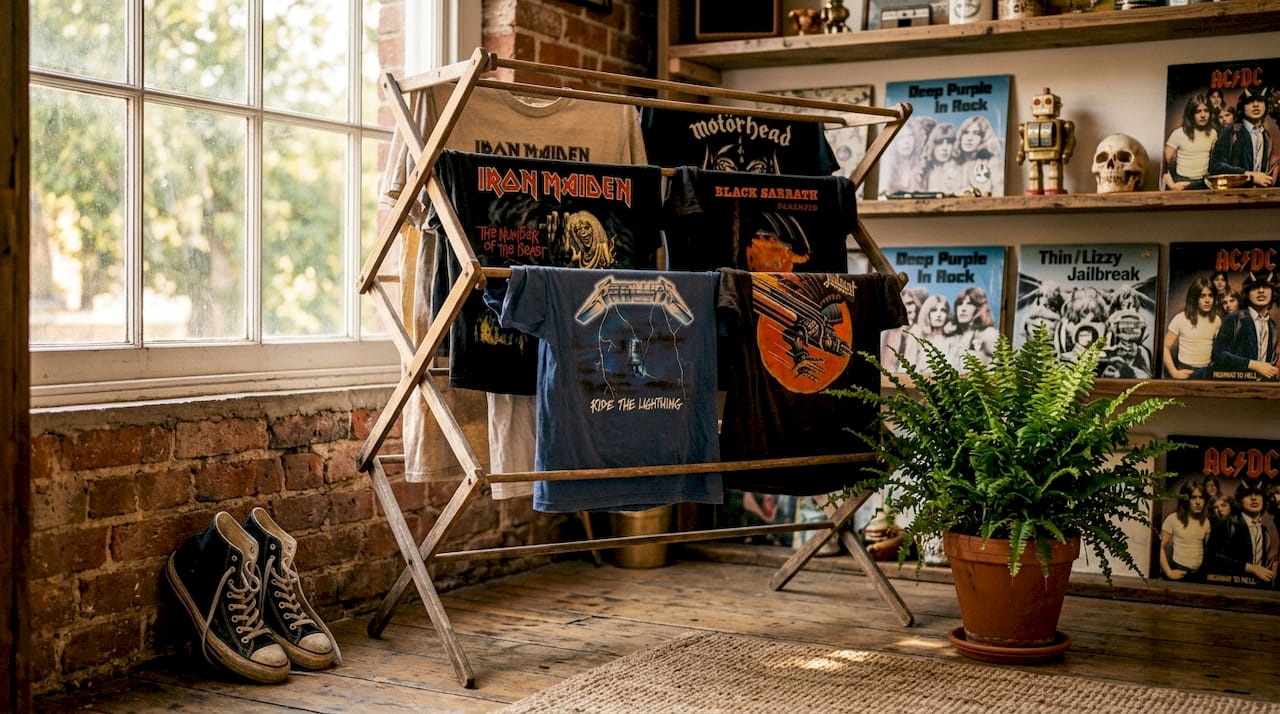
Heat is the enemy of vintage tees. Full stop. Heat exposure accelerates shrinkage, fading, and cracking of both fabric and screen prints, and that damage is cumulative and permanent. A shirt that has survived 35 years can be significantly aged by a single high-heat dryer cycle.
Best drying practices for preserving old heavy metal shirts:
- Air dry flat on a clean towel or drying rack, reshaping the shirt while damp
- Never hang a wet vintage tee by the shoulders; the weight of wet cotton will permanently stretch the collar and distort the cut
- If you must use a dryer, remove shirts while still damp and lay flat immediately to finish drying
- Always select the lowest heat setting available and add a dry towel to reduce tumble stress
- Keep dryer time under ten minutes if you use one at all
You can also find excellent guidance on storing vintage metal shirts after the drying process is complete.
For ironing, the rule is simple: never iron directly over a screen print. The heat will melt or further crack plastisol ink, and with aged prints that’s often irreversible. Turn the shirt inside out, place a pressing cloth (a clean cotton tea towel works perfectly) between the iron and the fabric, and use the lowest heat setting your iron allows. A handheld garment steamer held a few centimetres from the fabric is an even safer option for removing creases without any contact at all.
Pro Tip: If you’re storing a shirt long term and want to remove fold creases before display or photography, a steamer on the outside of the shirt held at least 10 cm away is your safest tool. Never steam directly over old ink.
Special care for metal hardware and mixed materials
Besides fabric, many vintage tees feature metal hardware that requires tailored maintenance.
Metal rivets, snaps, and studs were common on 1980s and early 1990s tour merchandise, especially for bands leaning into the aesthetic of the era. These details are part of what makes certain shirts so visually striking, but they introduce real maintenance complexity. Close fasteners before washing, wash inside out on mild detergent at max 30–40°C, and air dry with metal exposed to airflow to reduce corrosion risk significantly.
Step-by-step care for shirts with metal hardware:
- Fasten all snaps and buttons before washing to prevent snagging adjacent fabric
- Turn the shirt inside out to protect both the print and the hardware surface
- Use a pH-neutral detergent with no bleach or optical brighteners
- Wash at or below 40°C on a gentle cycle
- Air dry with the hardware-bearing areas exposed to airflow, not pressed against a flat surface
For storage, metal hardware needs particular attention. Avoid plastic bags, use silica gel packs, and apply humidity control to prevent tarnishing and corrosion. Plastic bags trap moisture against metal surfaces, and that’s exactly the environment corrosion thrives in. A breathable cotton garment bag with two or three silica gel sachets is a much better choice. For more on long-term housing of these shirts, see our detailed guide on how to store vintage metal t shirts.
Storage best practices to preserve shape and prevent damage
After use and cleaning, proper storage is essential to further extend your shirt’s life.
The way you fold and house a vintage tee between wears determines how much damage accumulates over time. Most collectors underestimate this. A shirt worn twice a year but stored poorly will deteriorate faster than one worn monthly but stored correctly.
| Storage method | Effect on fabric | Effect on print | Recommended? |
|---|---|---|---|
| Plastic bag, sealed | Traps humidity, encourages mildew | Ink can stick and peel | No |
| Wire hanger, long term | Stretches collar and shoulders | No direct impact | No |
| Folded in acid-free tissue, box | Maintains shape, absorbs minor moisture | Cushions print panel from pressure | Yes |
| Breathable garment bag, hanging | Good airflow, no moisture trapping | Low abrasion risk | Yes for display rotation |
| Direct sunlight location | Degrades cotton fibres over months | Fades ink rapidly | No |
Store vintage shirts folded in acid-free tissue boxes, control humidity around 50–55%, avoid direct light, and ensure good airflow. The acid-free tissue prevents the slow transfer of acids from cardboard or regular paper onto the cotton fibres, which causes yellowing and brittleness over time.
Humidity above roughly 55% raises the risk of mildew and dark spots; cooler, stable temperatures and breathable containers protect fabric and prints. A small hygrometer (the kind used for cigar humidors, available cheaply online) placed in your storage area tells you exactly where your humidity sits.
Key storage rules for preserving old heavy metal tees:
- Fold with the print panel facing outward to avoid fold-line cracking across the ink
- Place a sheet of acid-free tissue at every fold to cushion the crease
- Store away from exterior walls in climates with seasonal temperature swings
- Check stored shirts twice a year for any signs of mildew, insect activity, or colour transfer
Pro Tip: For your most valuable pieces, consider archival polyester sleeves (the kind used for vinyl records) as an additional barrier. They protect against dust and handling while remaining breathable enough to avoid humidity build-up.
Why mastering maintenance is key to preserving heavy metal t shirt heritage
Most people who care about heavy metal shirt care tips are thinking about wearability. That’s valid. But the collectors who take it most seriously are thinking about something else entirely: permanence.
A 1984 Iron Maiden “Powerslave” tour tee is not a replaceable item. No amount of money guarantees you’ll find another in the same condition, from the same run, with the same provenance. When the print cracks beyond recognition or the cotton splits at the hem from repeated high-heat drying, that specific piece of history is gone. Not diminished. Gone.
What experienced collectors understand, and what casual owners often miss, is that maintenance decisions compound. One aggressive wash doesn’t ruin a shirt. But ten of them over five years absolutely will. The same is true with storage. A shirt left in a plastic bag for two summers in a humid garage ages more in that time than it would in twenty years of correct storage.
Consistent gentle care is how collectors ensure their prized shirts look as iconic decades later as on the day they first bought them. That’s not hyperbole. It’s a practical outcome of the right habits applied consistently.
There’s also a generational consideration that doesn’t get discussed enough. The shirts being sold and collected today, original ex-tour stock and genuine deadstock from the 1980s and 1990s, are approaching the age where museum-level thinking is genuinely appropriate. Archivists working with textiles use acid-free storage, controlled humidity, and minimal handling. These aren’t exotic measures. They’re practical, affordable steps that any serious collector can implement at home. Understanding why vintage t-shirts matter as cultural objects makes the effort feel less like a chore and more like stewardship.
The shirts that survive in the best condition fifty years from now will be the ones whose owners treated them less like clothing and more like the artefacts they truly are.
Find rare vintage heavy metal t shirts at Vintage Metal Store
For collectors looking to expand their collection with responsibly cared-for vintage tees, here are some top picks from Vintage Metal Store.

Every piece in the vintage heavy metal shirts collection is sourced from genuine ex-tour stock and deadstock, with provenance information provided wherever possible. If you’re looking for a specific era or band, the vintage Metallica shirts Australia selection is a strong starting point, with original prints in varying grades of condition to suit different collecting goals. For something genuinely rare, the rare Metallica 1992 tour tee is the kind of piece you store properly from day one. Each listing includes condition notes to help you plan your care approach before the shirt even arrives.
Frequently asked questions
How often should I wash my vintage heavy metal t-shirts?
Wash vintage t-shirts only when genuinely necessary, roughly every three to five wears, since frequent washing accelerates wear and airing between wears keeps them fresh without damage.
Can I use a dryer for my vintage band shirts?
Avoid tumble drying wherever possible; air drying is safest and if a dryer is used, select the lowest heat setting and remove the shirt while still slightly damp to prevent shrinkage and print cracking.
How should I store vintage heavy metal t-shirts long term?
Store in acid-free tissue-lined boxes in cool, dry conditions with humidity held around 50–55%, since proper storage avoids mildew, fading, and creasing with breathable containers and controlled humidity.
What special care do shirts with metal hardware need?
Close all fasteners before washing, use mild pH-neutral detergent at low temperatures, air dry with airflow around the metal parts, and avoid plastic storage bags, as metal hardware requires specific washing and storage to prevent corrosion and fabric damage.
Recommended
- How to Store Vintage Metal T Shirts for Lasting Quality – Vintage Metal Store
- How to store vintage metal shirts for lasting quality – Vintage Metal Store
- How to restore heavy metal tee prints: Expert care – Vintage Metal Store
- Collector’s guide to vintage heavy metal t-shirts: spot, value, collec – Vintage Metal Store


