



TL;DR:
- Band merchandise is a key revenue stream that exceeds streaming royalties for small and mid-cap artists. Merch items, especially design-led streetwear, generate significant income, build fan loyalty, and promote community identity. Effective merch strategies involve quality products, fan co-creation, multiple sales channels, and real-time inventory management.
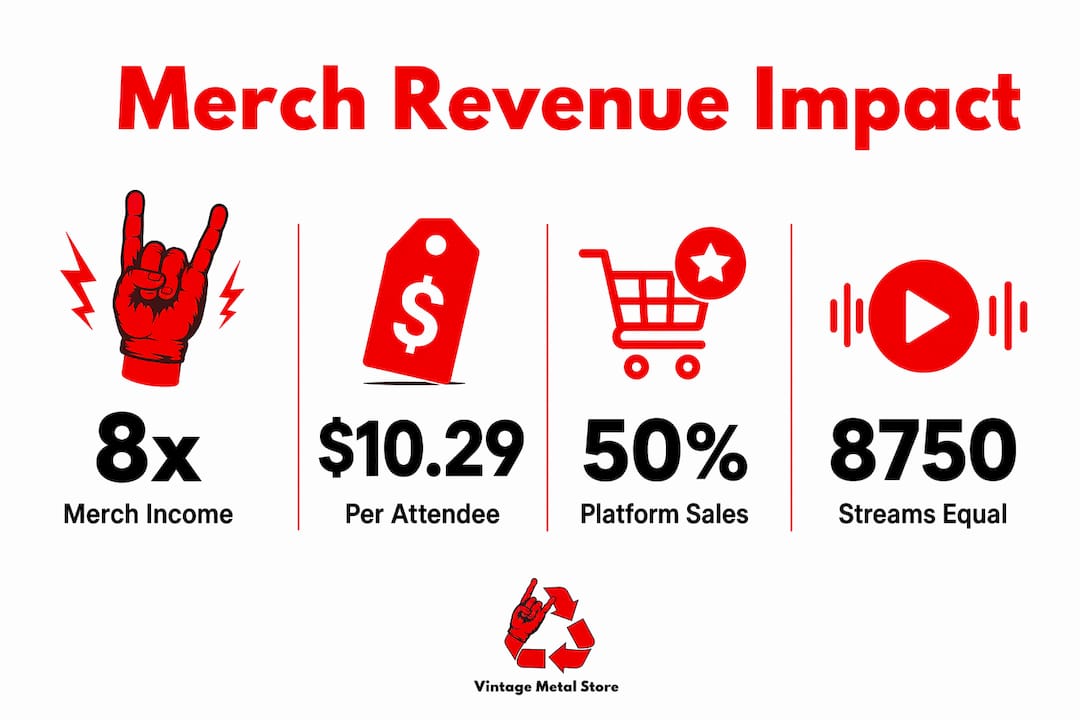
Band merchandise is defined as the primary revenue channel separating financially stable musicians from those who struggle to cover tour costs. The importance of merch to bands has never been clearer. A single $35 T-shirt generates artist revenue equivalent to approximately 8,750 Spotify streams. That comparison alone reframes how bands should think about their income. Streaming pays fractions of a cent per play. A well-run merch table pays the van hire, the fuel, and the accommodation. For musicians, band managers, and anyone serious about music as a business, understanding how merch works is not optional. It is foundational.
How does merchandise generate revenue compared to other income sources for bands?
Merch outperforms streaming royalties by a margin that most musicians do not fully appreciate until they see the numbers side by side. Average merch revenue per head at live shows reached $10.29 in 2025, marking a 14% increase from the previous year. That figure compounds across every show on a tour, making the merch table one of the most reliable income sources a band controls directly.
Small to mid-cap artists generate 8x more gross merch revenue at shows than from a full year of streaming royalties. That gap is not a quirk of the current market. It reflects a structural reality: streaming platforms retain the majority of revenue before artists see a cent, while a merch sale at the venue table puts money directly into the band’s pocket.
Ticket sales carry their own financial drag. Venue fees and logistics eat into ticket revenue in ways that bands cannot easily control. Merch is one of the few income levers a band can actually adjust. You set the price, you choose the product, and you keep the margin. That control matters enormously when you are trying to make a tour financially viable.
Merchandise also accounts for roughly 50% of transactions on platforms like Bandcamp, with cumulative fan spending exceeding $625 million. That figure confirms merch is not a side activity. It is a primary business channel.
| Income source | Artist control | Revenue per fan interaction |
|---|---|---|
| Streaming royalties | Very low | Fractions of a cent per stream |
| Ticket sales | Low | Reduced by venue fees and logistics |
| Venue merch table | High | Average $10.29 per attendee |
| Web store | High | Average basket size around £55 |
Pro Tip: Price your flagship T-shirt at a point that reflects quality, not just cost. Fans who pay more feel more invested in the product and the band.
In what ways does merchandise strengthen fan engagement and community?
Merch is tangible proof of fan loyalty. A fan wearing your shirt at the supermarket is a walking endorsement that no algorithm can replicate. The role of merchandising in metal culture has always been about identity as much as income. Fans use merch to signal who they are, what they value, and which communities they belong to.

The shift in what fans actually want to wear has been significant. Fans increasingly prefer design-led, wearable streetwear over generic logo-centric band T-shirts. A shirt with a striking back graphic and minimal front branding gets worn to the pub, to the gym, and to work. A shirt that screams the band name in oversized block letters stays in the drawer.
Fan co-creation in merch design increases willingness to spend and builds stronger community connection. When fans feel they had input into a design, or when a band responds to community feedback on colourways and cuts, the purchase becomes an act of participation rather than a transaction. That shift is powerful.
The cultural dimension of merch runs deep, particularly in heavy metal. Vintage tour shirts from the 1980s and 1990s carry the weight of history. They connect the wearer to a specific moment, a specific show, a specific era of music. The band merchandise history of heavy metal is inseparable from the culture itself.
- Merch creates a shared visual language among fans at shows and in everyday life.
- Limited edition drops generate urgency and reward loyal fans who act quickly.
- Wearable, design-led pieces extend the band’s reach far beyond the venue.
- Community-focused designs, such as city-specific or tour-specific prints, deepen local fan bonds.
- Low-cost items like stickers give hesitant buyers an easy entry point into the merch ecosystem.
Merch is the one thing a fan can take home that proves they were there. Streaming playlists are invisible. A shirt from the night Metallica played your city in 1992 is a physical piece of history you can wear.
What are modern strategies bands use to maximise merch sales?
Product selection is the foundation of a strong merch strategy. Treating merch items like streetwear drops with minimal front branding and high-impact back graphics outperforms traditional tour-date tees. Bands that prioritise quality blanks and intentional design maintain profit margins over 50%. That margin is achievable, but only when the product justifies a premium price point.
Understanding custom branded merchandise as a branding tool, not just a product, changes how bands approach design decisions. Every item carries the band’s visual identity into the world. The design brief should reflect that responsibility.
- Lead with your strongest design. Place your best-looking item at eye level on the merch table. First impressions drive impulse purchases at shows.
- Include a low-cost conversion item. Stickers and branded accessories ensure even hesitant fans leave with something. A fan who buys a sticker tonight may buy a shirt next tour.
- Choose the right production model. Print-on-demand suits newer bands avoiding inventory risk. Bulk ordering suits established acts chasing better margins per unit.
- Offer flexible payment options. Platforms like Klarna and Afterpay have become expected by younger fans shopping online. Removing payment friction increases conversion rates on web stores.
- Run your web store as a serious retail channel. Stock it consistently, photograph products well, and treat it with the same attention you give your social media presence.
Pro Tip: Offer a bundle deal at the merch table, such as a shirt plus a sticker for a fixed price. Bundles increase average transaction value without requiring fans to make a harder spending decision.
How do different sales channels affect merchandise performance?
Each sales channel produces a different fan behaviour, and understanding that difference helps bands stock and price merch correctly. The emotional high of a live show drives fast, instinctive purchases. A fan who just watched a blistering set is primed to spend. That emotional state does not carry over to online shopping the next morning.
Median basket size varies significantly by channel. Venue merch tables average £30 per transaction due to emotional post-show purchases. Web stores average £55 because fans browse more carefully and often add multiple items. TikTok Shop drives high-volume impulse buys typically below £40. Each channel rewards a different product mix and pricing approach.
| Sales channel | Average basket size | Fan behaviour | Best product type |
|---|---|---|---|
| Venue merch table | £30 | Emotional, impulsive | Hero item plus one low-cost add-on |
| Web store | £55 | Considered, deliberate | Full range with bundles |
| TikTok Shop | Below £40 | Impulse, trend-driven | Limited drops and visual items |
Data from social commerce platforms enables real-time inventory and marketing adjustments, allowing bands to reorder popular merch in under 72 hours during tours. That speed matters. Running out of your most popular size on night three of a ten-night run is a costly mistake that data-driven inventory management prevents.
Poor sizing data and shipping logistics frequently disappoint fans buying from band web stores, particularly those based overseas. Fixing this is straightforward: collect sizing data from early sales, use a reliable fulfilment partner, and communicate shipping timelines clearly. The economics behind tour shirts show that fan trust, once lost through a bad purchase experience, is hard to rebuild.
Key takeaways
Band merchandise is the most controllable and financially significant revenue stream available to touring musicians, outperforming streaming royalties by a factor of eight for small to mid-cap artists.
| Point | Details |
|---|---|
| Merch beats streaming income | Small to mid-cap artists earn 8x more from show merch than a full year of streaming royalties. |
| Design quality drives sales | Design-led, streetwear-style items outperform logo-centric tees and support margins above 50%. |
| Channel mix matters | Web stores average £55 per basket versus £30 at venue tables; stock and price accordingly. |
| Fan co-creation builds loyalty | Involving fans in design decisions shifts merch from a purchase to a community act. |
| Low-cost items convert hesitant buyers | Stickers and small accessories ensure every fan leaves with something, building long-term loyalty. |
Why merch strategy is the real test of a band’s business sense
I have watched bands pour everything into their sound and almost nothing into their merch, then wonder why they cannot afford to tour again. The importance of music merchandise is not a marketing concept. It is a survival mechanism.
The bands that treat merch as an afterthought, ordering a box of shirts the week before a tour and hoping for the best, consistently underperform. The bands that approach it like a retail business, with considered design, proper inventory planning, and multiple sales channels, build financial resilience that keeps them on the road.
What surprises most musicians when they look closely at the numbers is how quickly merch revenue compounds. A consistent $10 per head across a 200-person show is $2,000 in a single night. Run twenty shows and that becomes $40,000. No streaming deal comes close to that for an independent artist.
The other thing I would push back on is the idea that vintage and second-hand merch competes with new band merch. It does not. A fan who collects vintage tour shirts from the 1980s and 1990s is often the same fan who buys new merch at every show. The collector value of old band shirts actually reinforces the cultural weight of merch as a whole. It tells younger fans that what they buy today might be worth something significant in thirty years. That is a compelling reason to buy.
— David
Rare and authentic vintage metal merch at Vintage Metal Store
If you love the history behind band merchandise, Vintage Metal Store is where that history lives. The collection spans genuine ex-tour stock and deadstock from some of the most iconic heavy metal tours ever staged.
The rare Metallica 1992 tour tee is exactly the kind of piece that defines what great merch looks like: bold graphics, real tour provenance, and the kind of wearability that has kept it relevant for over thirty years. For collectors and devoted fans, the full vintage Metallica shirts collection at Vintage Metal Store covers everything from 1980s club tees to 1990s arena tour stock. These are not reproductions. They are the real thing. Shop now and wear the legacy.
FAQ
Why is merch more profitable than streaming for bands?
A single $35 T-shirt generates artist revenue equivalent to approximately 8,750 Spotify streams. Merch sales at shows also put money directly into the band’s hands, without platform fees reducing the return.
How much do bands typically earn from merch per show?
Average merch revenue per attendee at live shows reached $10.29 in 2025. Across a full tour, that figure adds up to a substantial and reliable income source.
What types of merch sell best at live shows?
Design-led items with strong back graphics and quality blanks outperform traditional logo-centric tees. Low-cost items like stickers also perform well as conversion tools for hesitant buyers.
How does fan co-creation affect merch sales?
Fan co-creation in merch design increases willingness to spend and builds stronger community connection. When fans feel involved in the design process, the purchase becomes an act of participation rather than a simple transaction.
Should bands use print-on-demand or bulk ordering?
Print-on-demand suits newer bands who want to avoid inventory risk. Established acts benefit from bulk ordering, which delivers better margins per unit and supports higher-volume tour sales.
Recommended


