



TL;DR:
- US and EU tour shirts differ primarily in fit, regional design details, and official merchandising policies, impacting collector value. EU shirts are slimmer with specific city lists and stricter no-return policies, while US shirts are looser with North American tour details and more flexible purchase terms. Accurate verification depends on garment specifications, regional city lists, and official store information, not just the front graphic.
The difference between US and EU tour shirts is defined by fit, print details, and region-specific merchandising rules that directly affect collector value. These are not interchangeable garments. A Metallica shirt from the 1992 US leg and its European counterpart can differ in cut, city lists, print placement, and even stitch density, making each a distinct artefact for serious collectors. Understanding these distinctions is the difference between building a collection with genuine regional significance and accumulating shirts that look similar but carry none of the provenance.
What is the difference between US and EU tour shirts?
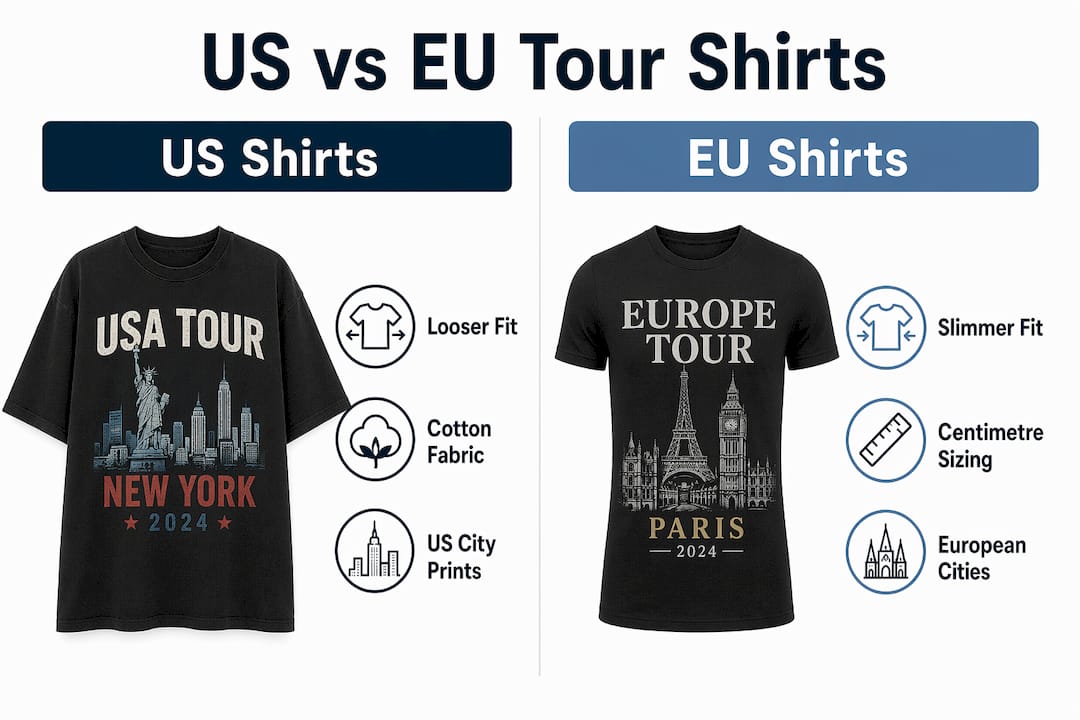
The core difference between US and EU tour shirts sits across three areas: sizing, design content, and the merchandising policies that govern how you buy them. Fabric quality at the base level is often comparable, with both regions using 100% cotton as standard. The distinctions that matter to collectors are in the details.

EU tour shirts are typically slimmer in cut and carry design elements tied to the European leg of a tour, including European city names, dates, and venue lists. US shirts reflect the North American itinerary and are cut to a looser, more generous fit. These are not minor variations. For a collector, a shirt listing Hamburg, Berlin, and Stockholm on the back is a fundamentally different object from one listing Chicago, Detroit, and Los Angeles.
The merchandising policies surrounding each region also diverge significantly. EU official stores operate under stricter no-refund and no-exchange conditions, while purchase limits and shipping timeframes are codified into product listings. This affects how you plan cross-region purchases and what recourse you have if something goes wrong.
How do sizing and fit differ between US and EU tour shirts?
EU t-shirts run slimmer and use centimetres for garment measurements, while US sizing tends toward a looser, boxier fit measured in inches. This is not a minor calibration difference. A US XL can sit closer to an EU XXL in chest width, and the sleeve length and body length proportions shift accordingly. For collectors who also wear their shirts, this matters immediately. For those buying to preserve, it affects how the garment photographs and displays.
The table below shows approximate size conversions that apply across most official tour merchandise:
| US size | EU size | Chest (cm) | Chest (inches) |
|---|---|---|---|
| S | S/M | 88–96 | 34–38 |
| M | M/L | 96–104 | 38–41 |
| L | XL | 104–112 | 41–44 |
| XL | XXL | 112–120 | 44–47 |
| XXL | 3XL | 120–128 | 47–50 |
These conversions are approximate and vary by manufacturer, but the pattern holds across most official tour stock. EU cuts also tend to have a shorter body length relative to chest width, which gives them a more fitted silhouette compared to the dropped hem common on US tour shirts.
Pro Tip: Before buying a US tour shirt from an EU seller or vice versa, always request the actual garment measurements in centimetres rather than relying on the size label. A shirt labelled XL means something different depending on which side of the Atlantic it was printed.
The fit difference is especially relevant for vintage and deadstock pieces from the 1980s and 1990s, where sizing conventions were even less standardised than today. A vintage Slayer or Iron Maiden shirt from a European tour leg will often run noticeably narrower than its US equivalent from the same year.
What design and print differences exist between US and EU tour shirts?
Design content is where the real collector value diverges. EU and US tour shirts from official channels often differ primarily in city lists, print placement, and fit type rather than base fabric. The back of a tour shirt is essentially a regional document. It records where the band played, and that list is unique to each leg of the tour.
For heavy metal collectors, this is significant. A Metallica shirt from the European leg of the Black Album tour carries a different set of cities from its US counterpart, and that specificity is part of what makes it collectible. The front graphic may be identical, but the back tells a different story. Print placement can also vary, with some EU pressings positioning the tour date list differently or using a different font treatment.
Key design differences to look for between US and EU tour shirts:
- City and venue lists on the back reflect the specific tour leg and are the clearest regional identifier
- Print placement can vary, with some EU shirts positioning graphics higher on the chest or using a different back layout
- Fit type is often noted in official EU listings as standard or oversized, with the oversized cut being more common in recent EU pressings
- Collar construction differs, with some EU pressings specifying a 1x1 baby rib collar not found on standard US stock
- Stitch density is called out in some EU official listings as a quality marker, with high-stitch density fabric and ring-spun cotton noted on premium EU tour tees
The counterfeit risk is real and concentrated in the EU market. Non-official EU tour shirt listings often claim “premium fabric” without providing any verifiable garment specifications. No brand name, no stitch count, no collar type. That absence of metadata is itself a red flag. Genuine official merchandise, whether from the US or EU, will always carry specific production details. If a listing cannot tell you what cotton weight or collar construction the shirt uses, treat it as suspect.
For collectors focused on verifying tour shirt authenticity, the design details are the primary evidence. The graphic alone is not enough.
How do merchandising policies and purchasing experiences vary?
The purchasing experience for US versus EU tour shirts differs in ways that directly affect collector risk. Understanding these differences before you buy cross-region saves money and frustration.
-
Return and exchange policies. EU tour merch operates under strict no-refund and no-exchange conditions, with returns accepted only under specific circumstances, requiring proof and approval within 30 days. US policies vary by retailer but are generally more flexible. When buying EU official stock from overseas, you carry that risk with no safety net.
-
Currency and pricing. EU tour shirts are priced in euros with separate shipping terms for non-EU addresses. Currency conversion and international shipping costs can push the landed price of an EU shirt significantly above its listed price, which affects the economics of cross-region collecting.
-
Order quantity limits. EU official stores impose purchase limits, typically capping orders at 10 units per customer. This is designed to maintain exclusivity and prevent bulk resale. US stores may apply similar limits but the thresholds and enforcement differ.
-
Shipping timeframes. EU official listings specify dispatch dates tied to the tour schedule. A shirt listed as shipping on or about a specific date means your order is held until that window opens. US stores typically ship from existing stock with shorter lead times.
Pro Tip: When purchasing EU tour shirts from outside Europe, factor in the no-exchange policy before ordering. If sizing is uncertain, buy from a seller who can confirm actual garment measurements rather than relying on the size label alone.
The practical implication for collectors is that cross-region purchases carry more risk than buying within your own market. The EU’s stricter return conditions mean a sizing error or print defect is harder to resolve. Buy with full information or accept the risk.
Which factors should collectors prioritise when choosing between US and EU tour shirts?
Collector value in US versus EU tour shirts lies more in design and metadata differences than in base garment quality. Official merch metadata including materials, fit type, stitch count, and return policies are the primary identifiers for genuine regional variants. A shirt’s region is confirmed by its specifications, not just its label.
When assessing a US or EU tour shirt for your collection, prioritise these factors:
- Official source verification. Genuine US and EU tour shirts come from official band stores or authorised tour merchandise vendors. Third-party listings without verifiable provenance carry significant authenticity risk, particularly for EU variants where counterfeit tour shirts are common.
- Garment specifications. Look for cotton weight, collar type, and stitch density in the product listing. EU official stock frequently specifies ring-spun cotton and rib collar construction. If these details are absent, the shirt’s authenticity is unconfirmed.
- Tour leg documentation. The city list on the back is the most direct evidence of regional origin. Cross-reference the cities against known tour itineraries to confirm the shirt matches the correct leg.
- Condition and print integrity. For vintage stock, assess print cracking, fading, and collar wear. These affect value but also help date the shirt. EU and US pressings age differently due to fabric and print process variations.
- Seller credibility. For vintage and deadstock pieces, check the seller’s track record with authenticated tour stock. The vintage tour shirt checklist approach applies here: treat every purchase as requiring evidence, not assumption.
The grey market for EU tour shirts is particularly active, and listings that lack official specifications should be treated with scepticism. A shirt described only as “European tour” without city names, dates, or garment specs is not a collector piece. It is an unknown.
Key takeaways
The difference between US and EU tour shirts is confirmed through garment specifications, regional design content, and official store policies, not by label or visual similarity alone.
| Point | Details |
|---|---|
| Sizing runs differently | EU shirts use centimetres and cut slimmer; US shirts are looser and sized in inches. |
| Design content is the key differentiator | City lists, print placement, and fit type vary by tour leg and define regional collector value. |
| EU policies are stricter | No-refund and no-exchange conditions apply to EU official merch, increasing cross-region purchase risk. |
| Metadata confirms authenticity | Check cotton type, stitch density, and collar construction to verify genuine official stock. |
| Counterfeit risk is real | EU listings without garment specifications are a red flag; always verify through official channels. |
Why the details matter more than most collectors realise
I have handled a lot of tour shirts over the years, and the single most common mistake I see collectors make is treating US and EU variants as equivalent because the front graphic looks the same. The front is almost always identical. The differences are in the back print, the cut, and the paper trail behind the garment.
The EU market has a particular problem with listings that use regional language to imply authenticity without providing any actual evidence. “European tour shirt” is not a specification. It is a marketing phrase. The collectors who build genuinely valuable collections are the ones who ask for the garment measurements, check the city list against the actual tour itinerary, and understand that a strict no-exchange policy means they need to be certain before they buy.
I also think the sizing difference is underestimated as a collector consideration. A vintage EU pressing from a 1980s Judas Priest or Black Sabbath tour will fit nothing like a US shirt from the same era. If you are buying to wear, that matters. If you are buying to preserve, it affects how the shirt sits on a hanger or in a frame. These are not trivial details.
The significance of tour dates on the back of a shirt is something I come back to constantly. Those city names are the provenance. They are what separates a collectible from a reprint.
— David
Find authentic US and EU metal tour shirts at Com
Com stocks genuine vintage and deadstock heavy metal tour shirts from both US and EU tour legs, including original ex-tour stock with verifiable provenance. If you are building a collection and need shirts with confirmed regional origin, the rare Metallica 1992 US tour tee is a strong example of authenticated US tour stock with original sizing and print intact. For a broader selection, the full vintage Metallica shirts collection covers multiple eras and tour legs. Every piece at Com comes with the garment details collectors need to make informed decisions.
FAQ
What is the main difference between US and EU tour shirts?
The primary difference is in sizing, regional design content such as city lists and print placement, and the merchandising policies that govern official purchases. EU shirts run slimmer and carry European tour leg details; US shirts are cut looser and reflect the North American itinerary.
Do US and EU tour shirts use different fabric quality?
Base fabric is often comparable, with both regions using 100% cotton as standard. EU official listings sometimes specify higher-grade details like ring-spun cotton and high-stitch density fabric, which can indicate a premium production run distinct from standard US stock.
How do I verify whether a tour shirt is genuinely from the EU or US leg?
Check the city list on the back against the known tour itinerary for that leg, and confirm garment specifications including cotton type, collar construction, and print placement match official store listings. Listings without these details cannot be verified as authentic regional variants.
Are EU tour shirts harder to return or exchange than US shirts?
EU official tour merchandise operates under strict no-refund and no-exchange conditions, with returns accepted only under specific circumstances within 30 days. US policies are generally more flexible, making cross-region purchases from EU official stores higher risk for collectors uncertain about sizing.
Why do tour shirt differences matter for heavy metal collectors?
Regional variants represent distinct production runs tied to specific tour legs, making them separate collectible objects rather than duplicates. The city list, fit type, and garment specifications are the evidence of regional origin, and that provenance is what drives collector value over time.
Recommended
- Collecting tour shirts: their cultural value and impact – Vintage Metal Store
- How to avoid counterfeit tour shirts: collector’s guide – Vintage Metal Store
- Collectible tour shirts guide for metal collectors – Vintage Metal Store
- The real value of tour stock shirts for collectors – Vintage Metal Store


