



TL;DR:
- A concept tee is an intentional garment that communicates a specific idea, philosophy, or cultural message through its design. Authentic examples use heavy-weight organic cotton and limited production runs, with high-quality printing, making them highly collectible. These tees have evolved from protest shirts to streetwear and hold cultural and psychological significance for wearers and collectors alike.
A concept tee is defined as an intentional, idea-driven garment where the design serves a specific philosophical, cultural, or personal theme rather than chasing aesthetic trends. Unlike a standard graphic tee, a concept tee starts with an idea. The image, text, and fabric all exist to communicate that idea. For collectors and fashion enthusiasts, understanding the concept tee meaning separates genuine wearable art from mass-produced noise. Vintage Metal Store sees this distinction every day: a great metal tour shirt is never just a shirt. It carries a moment, a movement, and a message.
What is a concept tee and how does it differ from a graphic tee?
A concept tee starts with intention. The design process begins with a specific theme, philosophy, or cultural statement before any sketching begins. The visual is subordinate to the concept. A standard graphic tee, by contrast, starts with a trend, a logo, or a licensed image. The difference is the direction of thinking.

That distinction shows up in materials too. Quality concept tees use heavy-weight fabrics like 280 gsm GOTS-certified organic cotton, well above the 150–180 gsm range common in mass-market shirts. Heavier fabric holds its shape across years of wear and washing. It also signals that the maker invested in the garment’s longevity, not just its price point.
Pricing reflects that investment. Premium concept tees typically sit in the $50–$75 range. That figure covers quality cotton, limited production runs, and printing techniques that avoid the thick, plasticky finish you find on cheap screen prints. Collectors who understand intentional style and quality recognise these markers immediately.
Pro Tip: When assessing a conceptual T-shirt design, flip it inside out. A quality print will show clean edges and no cracking. A cheap plasticky print will already be peeling at the seams.
| Feature | Concept tee | Standard graphic tee |
|---|---|---|
| Design starting point | Theme or idea | Trend or logo |
| Fabric weight | 280 gsm organic cotton | 150–180 gsm mixed cotton |
| Production volume | Limited or on-demand | Mass produced |
| Print technique | Vintage-style inks, fine detail | Thick screen print |
| Price range | $50–$75+ | $15–$30 |
| Longevity | Designed to last seasons | Follows fashion cycles |
How did concept tees evolve from protest shirts to streetwear?
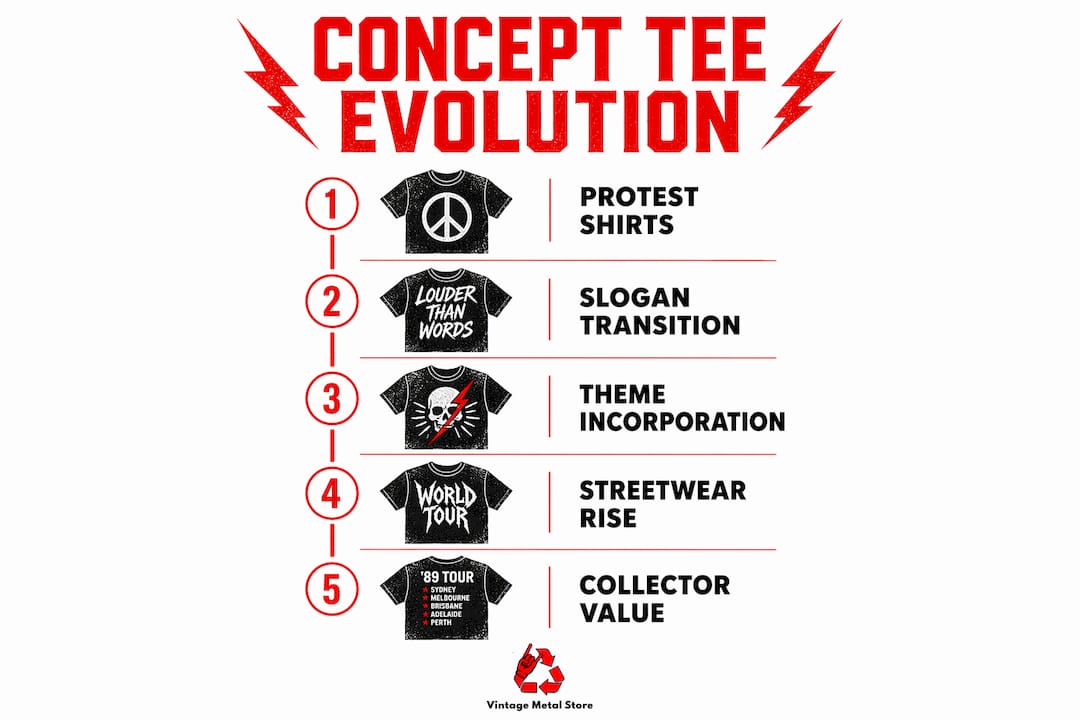
The slogan T-shirt has over 70 years of history as a tool for protest and self-expression. What began in the 1960s and 70s as a cheap, accessible medium for political messaging became the foundation for the concept-driven tees collectors prize today. The evolution was not accidental. It followed social movements that needed a wearable voice.
Key moments in that history include:
- 1960s–70s protest culture: Anti-war and civil rights movements adopted the plain tee as a canvas for slogans. Cost and visibility made it the perfect medium for grassroots messaging.
- AIDS crisis activism: Shirts bearing direct, confrontational text became tools of public grief and political pressure in the 1980s. The medium carried weight because the stakes were real.
- Katharine Hamnett’s political tees: The British designer wore an oversized tee reading “58% DON’T WANT PERSHING” to meet Margaret Thatcher in 1984. That single moment proved a T-shirt could command a room.
- 1990s streetwear: Skate and hip-hop culture absorbed the slogan tee and pushed it toward identity and subculture branding. The message became personal, not just political.
- 2000s to present: Designers began treating the tee as a medium for philosophical and cultural themes, not just slogans. The concept tee as a recognised form emerged from this shift.
The transition from simple slogan to sophisticated theme is the critical step. A slogan tells you what someone thinks. A concept tee shows you how they see the world.
What cultural and psychological significance do concept tees hold?
Wearing a concept tee transfers internal identity to an external public self, making the garment an extension of the wearer that invites social interaction, both connection and conflict. That is a significant function for a piece of clothing. It means the tee is doing social work every time you wear it.
“Concept tees are communication tools intentionally crafted to express personal narratives, allowing wearers to project identity without speaking. They highlight values, humour, cultural affiliations, and philosophies.” — Definition of Statement Tees
The cultural power of concept tees derives from what researchers call ‘guttersnipe rhetoric’: the medium, context, and wearer identity are as important as the print message itself. A Metallica tour shirt worn by someone who was at that show carries entirely different weight than the same shirt on someone who bought it online last week. Context is meaning.
For collectors, this is the core of the appeal. You are not just acquiring a garment. You are acquiring a cultural artefact that communicates a stance, a memory, or a philosophy. The psychology of intentional style confirms that people read these signals immediately and form judgements about shared values and identity.
Pro Tip: If you are building a collection, document the provenance of each shirt. Where it came from, who wore it, and what tour or moment it represents. That context multiplies the cultural value of every piece.
How to recognise authentic concept tees and why quality matters for collectors
Authentic concept tees share a set of identifiable characteristics. Knowing them protects you from overpaying for mass-market shirts dressed up with a clever print. The design process is the first test: true concept tees start with a theme before any visual work begins. If the design looks like it could be swapped onto any shirt without losing meaning, it is not a concept tee.
Here is what to look for when assessing a piece:
- Theme-driven design. The visual and any text should be inseparable from a specific idea. Remove the concept and the shirt should feel incomplete, not just plain.
- Heavy-weight organic cotton. Look for 280 gsm or higher. Feel the fabric. Lightweight, thin cotton signals mass production.
- Quality print technique. Vintage-style inks and fine-detail printing age well. Thick plasticky prints crack and peel. Collectors prioritise print quality alongside fabric weight.
- Limited or on-demand production. Concept tees are rarely overproduced. A shirt available in unlimited quantities at a chain retailer is not a concept tee by any meaningful definition.
- Price point above $50. Below that threshold, the economics of quality fabric and limited printing do not work. Genuine concept tees reflect their production costs.
For collectors focused on heavy metal shirt aesthetics, these same principles apply directly. The best vintage metal tees were made in limited runs, on heavy cotton, with artwork that was inseparable from the band’s identity and moment in time.
| Quality marker | What to look for | Red flag |
|---|---|---|
| Fabric weight | 280 gsm organic cotton | Thin, lightweight cotton |
| Print finish | Fine detail, vintage-style inks | Thick, raised plasticky surface |
| Production run | Limited or on-demand | Mass retail availability |
| Design intent | Theme-first, concept-driven | Trend or logo-driven |
| Price | $50+ | Under $30 |
How to style and care for concept tees in your collection
Concept tees reward a different approach to styling than fast-fashion graphic tees. The goal is to let the message lead. Pairing a strong conceptual T-shirt design with loud competing elements dilutes the communication. Keep the rest of the outfit considered and restrained.
Practical guidance for collectors and enthusiasts:
- Let the tee be the focal point. Pair with dark denim, simple trousers, or a plain overshirt. The concept tee carries the visual weight.
- Avoid overwashing. Wash inside out in cold water. High heat degrades both the fabric and the print. Caring for old T-shirts correctly extends their life by years.
- Store flat or folded, not on hangers. Heavy cotton stretches at the shoulder when hung long-term. Folded storage preserves the shape.
- Rotate your collection. Wearing the same shirt repeatedly accelerates wear. Rotating pieces keeps each one in better condition and gives you more opportunities to communicate different ideas.
- Document what you own. Photograph each piece, note its origin, and record any provenance details. For second-hand metal tees, provenance is a significant part of the value.
The longevity of a concept tee is tied to its meaning rather than aesthetics or fleeting trends. That is the practical argument for caring for these pieces properly. A well-maintained concept tee from the 1990s is worth far more, culturally and financially, than a neglected one from last year.
Key takeaways
A concept tee is defined by its design intent: the idea comes first, and every material and visual choice serves that idea.
| Point | Details |
|---|---|
| Design intent is the defining factor | A concept tee starts with a theme or philosophy, not a trend or logo. |
| Fabric weight signals quality | Authentic concept tees use 280 gsm organic cotton, well above mass-market standards. |
| Cultural context multiplies value | The wearer’s identity and provenance are as important as the print itself. |
| Limited production drives collector appeal | Genuine concept tees are rarely overproduced, which protects their exclusivity and value. |
| Care preserves meaning and money | Cold washing, flat storage, and documented provenance extend both condition and cultural worth. |
Why concept tees matter more now than ever
I have been around vintage metal tees long enough to know that the best ones were always concept tees, even before anyone used that term. A Metallica “Don’t Tread on Me” tour shirt from 1992 is not just a band shirt. It is a document of a specific cultural moment, a philosophy printed on cotton, worn by people who meant it.
What strikes me about the current conversation around concept tee fashion is how collectors are finally articulating what they already knew instinctively. The shirts that hold their value, the ones people refuse to sell, are always the ones with a clear idea behind them. The artwork is inseparable from the message. The fabric was made to last. The run was small enough that wearing one meant something.
The mistake I see enthusiasts make is treating concept tees as a separate category from vintage metal tees. They are not. The greatest metal tour shirts were concept-driven from the start. The imagery, the typography, the colour choices all served a specific cultural and philosophical statement about the band, the era, and the audience. That is exactly the definition of a concept tee.
My honest advice: stop thinking about your collection as shirts and start thinking about it as a record of ideas. What does each piece say? What moment does it represent? What would be lost if it disappeared? Answer those questions and you will know exactly which pieces deserve your care and your money.
— David
Vintage concept tees worth wearing and collecting
The principles behind concept tee fashion are alive in every great vintage metal shirt. At Vintage Metal Store, the collection is built around exactly that idea: shirts that carry a real message, made in limited runs, on quality cotton, from tours and bands that meant something.
The rare Metallica 1992 tour tee is a perfect example. It is a concept tee by every measure: theme-driven artwork, limited original production, and a cultural weight that no reprint can replicate. Browse the full range at Vintage Metal Store and you will find shirts that collectors recognise immediately as the real thing. These are not fast-fashion graphic tees. They are wearable history, and they are waiting for someone who understands the difference.
FAQ
What is a concept tee in simple terms?
A concept tee is a T-shirt designed around a specific idea, philosophy, or cultural theme rather than a trend or logo. The concept drives every design decision, from the artwork to the fabric choice.
What makes a T-shirt conceptual rather than just graphic?
A conceptual T-shirt starts with an intention before any visual work begins. The design is inseparable from the idea it communicates. A standard graphic tee can swap its image without losing meaning; a concept tee cannot.
How much do quality concept tees cost?
Quality concept tees typically cost between $50 and $75, reflecting the use of heavy-weight organic cotton, limited production runs, and fine-detail printing techniques.
Are vintage metal tour shirts a type of concept tee?
The best vintage metal tour shirts qualify as concept tees. They were produced in limited runs, on quality cotton, with artwork that expressed a specific cultural and philosophical identity tied to the band and the moment.
How do I care for a concept tee to preserve its value?
Wash inside out in cold water, store flat rather than on hangers, and document the shirt’s provenance. These steps preserve both the fabric and the cultural context that gives the piece its collector value.
Recommended
- Master rare tee terminology: The collector’s guide – Vintage Metal Store
- Inside band tee drops: exclusive merch hype and collecting – Vintage Metal Store
- Why 1990s band tees remain iconic for collectors – Vintage Metal Store
- How to Style Vintage Metal Tees with Authentic 90s Vibes – Vintage Metal Store


