



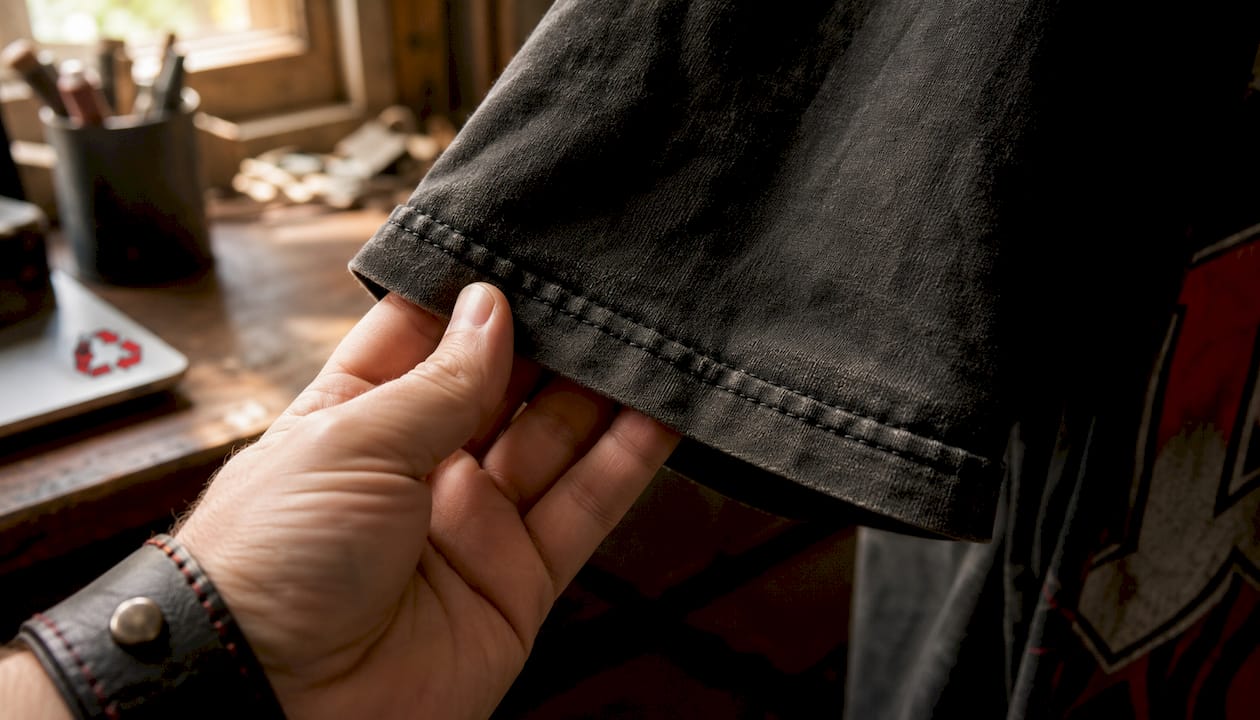
A single-stitch shirt is a vintage tee finished with one visible row of stitching at the sleeve cuffs and bottom hem. That single line, rather than the two parallel rows you see on modern tees, is the fastest way to confirm you’re holding something made before the mid-1990s. For heavy metal collectors, it’s the first thing to check on any tour shirt claiming to be from the golden era of 80s and 90s metal.
Why does it matter so much? Because single-stitch construction was standard through the 1980s and phased out by roughly the mid-1990s, making it a reliable era marker. It also pairs with the thinner, softer cotton blanks of that period, giving those shirts the relaxed drape and faded colour that no modern reprint can fully replicate. Tens of thousands of auction listings now use “single stitch” as a searchable keyword, which tells you exactly how seriously the collector market takes it.
Quick check: flip the sleeve cuff and the bottom hem. One line of stitching on both? Likely vintage. Two parallel lines? Post-mid-90s construction.
- Single stitch = one visible thread line on sleeve and bottom hems
- Era signal: common through the 1980s, largely gone by 1994–1996
- Pairs with thinner, softer 50/50 or open-end cotton blanks
- Structural puckering along the seam is a natural ageing sign, not a flaw
- Always combine stitch check with tag, print and provenance for a solid authentication
Table of Contents
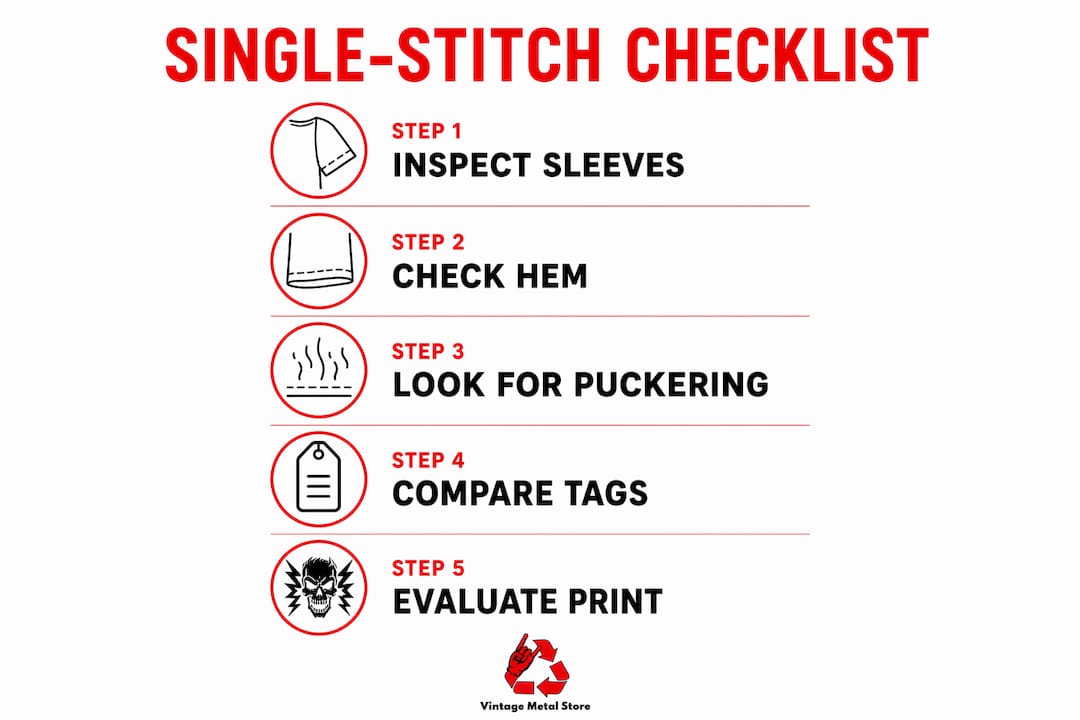
- How to identify single-stitch shirts with a hands-on checklist
- Why factories used single stitch and when they switched
- What single stitch signals to heavy metal collectors
- How to spot reprints, retags and altered shirts
- How single stitch affects price and value
- How to care for and preserve single-stitch vintage shirts
- Dating tricks and spot checks from David at Vintage Metal Store
- The cultural weight of single-stitch shirts in the Australian metal scene
- Brands and manufacturers behind single-stitch shirts in Australia
- What makes Australian single-stitch shirts different
- Key takeaways
- Why single-stitch pieces are central to what we do at Vintage Metal Store
- Genuine single-stitch heavy metal tees, sourced and verified
- Useful sources
- FAQ
How to identify single-stitch shirts with a hands-on checklist
The sleeve cuff is your first stop. On a genuine single-stitch tee, you’ll see one continuous thread line running along the hem edge. Double-needle construction leaves two parallel rows, slightly apart, with a ridge between them. The bottom hem tells the same story.
- Sleeve cuff: one thread line = single stitch; two parallel lines = double-needle
- Bottom hem: must match the sleeve; mismatched hems are a red flag (see Section 5)
- Neckline: many vintage tees use a blind stitch or single-needle finish at the collar fold
- Flip test: turn the shirt inside out and check the interior stitch path; single-stitch shows a looped chain or lock-stitch pattern, not a flat coverstitch
- Fabric cues: thinner cotton, open-end yarn texture, and natural puckering along the seam all support a vintage read
- Photo requests from sellers: close-ups of the sleeve edge, inside hem, collar fold, and tag area
Structural puckering, that gentle wave along the seam caused by decades of thread contraction, is one of the most reliable age indicators. Modern machines produce flat, tight hems that simply don’t develop this texture.
Pro Tip: Always verify that sleeve and bottom hem match. A single-stitched sleeve paired with a double-needle bottom hem is a strong sign the shirt has been re-hemmed.
Why factories used single stitch and when they switched
Single-needle chain-stitch and lock-stitch were the industry standard for lightweight knit garments through the 1980s. The mechanics suit the fabric: single-needle seams can stretch considerably without snapping, which works well with the natural give of jersey knit cotton. That flexibility is part of why so many 30-year-old tour shirts are still intact.
The shift happened fast. By roughly the mid-1990s, most large garment factories had moved to dual-needle coverstitch machines. The reasons were straightforward:
- Coverstitch machines run faster, cutting production time per unit.
- Double-needle hems are more rigid, which reduces post-wash distortion on heavier modern blanks.
- Trade and supply-chain changes in the early 1990s pushed factories toward higher-volume, lower-cost production runs.
- Thinner vintage blanks were gradually replaced by heavier ringspun cotton, which suits the stiffer coverstitch finish.
The trade-off was the relaxed drape. The industry shift to double-needle sped up production but cost the soft, lived-in quality that collectors now pay a premium to find. Understanding jersey knit behaviour helps explain why that drape is so hard to replicate on modern fabric.
What single stitch signals to heavy metal collectors
Single-stitch construction tells a collector three things at once: the shirt is likely pre-mid-90s, it was made on the original blanks of that era, and it hasn’t been re-hemmed. For a heavy metal tour tee, that combination is the foundation of authenticity.
- Era authenticity: stitch type aligns with the 1980s–early 1990s production window
- Original blanks: vintage 50/50 and open-end cotton blanks are thinner and softer than modern ringspun alternatives
- Natural drape: the relaxed silhouette photographs well and wears differently from modern tees
- Colour fade: original dyes on thinner blanks fade in patterns that reprints can’t match
- Puckered hems: structural puckering is an aesthetic collectors actively seek, not a defect
The market reflects this. Tens of thousands of listings now tag “single stitch” as a descriptor because it drives search visibility and buyer confidence. But the hype cuts both ways.
Pro Tip: Pair your stitch check with tag condition, print technique (plastisol vs. water-based ink) and provenance. All three aligning with the claimed era is a much stronger signal than stitch alone.
How to spot reprints, retags and altered shirts
Some modern manufacturers deliberately replicate single-stitch details on boutique reissues, so stitch type alone is not proof of age. Here’s what to watch for:
- Mismatched stitch types: single-stitched sleeve, double-needle hem = likely re-hemmed
- Perfectly flat hems: no puckering on a claimed 30-year-old shirt is suspicious
- Modern tag designs: fonts, barcodes, care symbols and country-of-origin labels all changed across the 1990s
- Polyester-heavy blanks: modern reissues often feel heavier and stiffer than original 80s stock
Seller questions to ask before buying:
- Where did you source this shirt? (gig, estate sale, ex-tour stock?)
- Can you send high-res photos of the inside hem, tag area and collar fold?
- Has it been altered, repaired or re-hemmed?
- What’s the wash history?
- Is there any supporting provenance — receipts, gig photos, previous owner details?
For re-hemming and retagging checks, look for tiny, evenly spaced modern needle holes alongside the original stitch line, inconsistent stitch length, and thread colour that doesn’t match the rest of the hem. These are the tells that separate a genuine piece from a dressed-up repro. A practical guide to fabric authenticity checks can help sharpen your eye for textile-level details.
How single stitch affects price and value
Single stitch is a positive multiplier, not a standalone price driver. Condition, graphic rarity, size and provenance are usually the decisive factors. A single-stitch shirt with a faded, cracked print and no provenance will often sell for less than a well-documented double-needle tee from a sought-after tour.
- Graphic: tour-specific artwork, date listings and rare colourways command the biggest premiums
- Condition: fading is acceptable; holes, staining and print loss reduce value sharply
- Size: larger sizes (XL, XXL) from the 80s–90s are scarcer and often fetch more
- Provenance: documented ex-tour stock or deadstock adds real value
- Country of origin: Australian-pressed or locally distributed shirts carry extra significance for local collectors
For Australian collectors, iconic 1990s heavy metal shirts from bands that toured here carry a local premium. Shipping condition matters too: shirts that have spent decades in Australian climates can show distinctive fade and wear patterns.
Pro Tip: Use stitch type plus condition and provenance together to set a realistic price band. Stitch alone won’t justify a top-tier price; all three signals together will.
How to care for and preserve single-stitch vintage shirts
- Wash cold, always. Hot water causes seam shrinkage of approximately 5–8% and can distort original hems permanently.
- Turn inside out before washing. Protects the print and reduces friction on the hem stitching.
- Gentle cycle only. Aggressive agitation stresses single-needle seams more than coverstitch.
- Air dry flat. Tumble drying accelerates fabric thinning and can pull single-stitch hems out of shape.
- Store flat or folded in breathable boxes. Acid-free tissue between folds prevents dye transfer and crease damage. Keep away from direct light and moisture.
For minor repairs:
- Reinforce weak hems with hand-sewn lockstitch using matching cotton thread
- Stabilise fraying edges with tiny interior backstitches rather than modern overlocking, which changes the hem profile
- For significant damage, consult a textile conservator before attempting repairs yourself
Single-stitch seams distribute lateral tension differently from rigid coverstitch, which means they can handle gentle wear well. The goal is to avoid the stresses, heat and chemicals that accelerate ageing beyond the natural patina collectors value.
Dating tricks and spot checks from David at Vintage Metal Store
Cross-checking three signals at once is the fastest way to build confidence: stitch type, tag style, and print technique. When all three align with the claimed era, the shirt is almost certainly genuine. When one is off, dig deeper before committing.
When I’m assessing a heavy metal tour tee, the first thing I do is fold back the sleeve and check the cuff under good light. One clean stitch line, a bit of natural puckering, and a tag that matches the era — that’s the combination that tells me I’m holding something real. If the hem is suspiciously flat or the tag looks too crisp, I slow down and ask more questions. Single stitch is a great starting point, but it’s the full picture that closes the deal.
Pro Tip: Ask sellers for a photo of the inside hem with the shirt held up to natural light. The shadow and texture of genuine single-stitch puckering is almost impossible to fake in a photo.
For what makes a shirt vintage, the combined signals approach is the standard among serious collectors. A single cue is a hint; three aligned cues are a verdict.
The cultural weight of single-stitch shirts in the Australian metal scene
Australia’s heavy metal scene was firing hard through the late 1980s and into the 1990s. Bands like AC/DC, Rose Tattoo, and international acts including Metallica, Slayer and Iron Maiden all toured here, leaving behind merch that was pressed and distributed locally or brought in as ex-tour stock. Those shirts were made on the same single-stitch blanks as their US and UK counterparts, and many have stayed in Australian collections ever since.
For local collectors, a single-stitch tour tee from a band that played the Sydney Entertainment Centre or Festival Hall in Melbourne carries a specific cultural weight that goes beyond the garment itself. It’s a physical record of a night, a scene, and an era. The fabric types used in 1990s band shirts reflect the production standards of that moment, and Australian-distributed shirts sometimes show regional label variations that make them distinct from US pressings.
Brands and manufacturers behind single-stitch shirts in Australia
During the 1980s and early 1990s, the dominant blank suppliers for band merch globally were Fruit of the Loom, Hanes, and Screen Stars, all of which used single-stitch construction as standard. In Australia, locally distributed merch was often printed on the same blanks imported through US and UK licensees, though some Australian tour merch was pressed domestically on locally sourced stock.
Screen Stars (a Fruit of the Loom brand) is one of the most commonly encountered tags on genuine 80s–90s metal tees. Hanes Beefy-T shirts from this era are another reliable single-stitch blank. Both brands shifted to double-needle construction through the mid-1990s, so their tag evolution is a useful dating tool in its own right. Australian collectors should also watch for locally printed shirts with no major brand tag, which were common for smaller domestic tours and club shows.
What makes Australian single-stitch shirts different
Australian-market single-stitch shirts have a few quirks worth knowing. Locally distributed tour merch from the late 1980s and early 1990s sometimes carries Australian care labels alongside the standard US blank tag, a dual-tag configuration that’s a strong provenance signal for local collectors. Screen printing quality varied between Australian and US pressings, with some domestic runs using slightly different ink formulations that produce a distinct fade pattern over time.
Climate also plays a role. Shirts stored in Australian conditions, particularly in Queensland or coastal areas, often show a characteristic yellowing of the cotton and a specific softening of plastisol prints that differs from shirts stored in drier US climates. These regional ageing signatures are increasingly recognised by experienced collectors as part of the iconic 90s band shirt styles that define the era in this market.
Key takeaways
Single-stitch construction is the most reliable era marker for vintage heavy metal tees, but it only tells the full story when read alongside tag style, print technique, fabric weight, and provenance.
| Point | Details |
|---|---|
| Single-stitch era | Common through the 1980s, phased out by roughly the mid-1990s. |
| Top ID check | One thread line on both sleeve cuff and bottom hem confirms single-stitch construction. |
| Seam stretch | Single-needle seams can stretch up to around 30% without snapping, unlike rigid coverstitch. |
| Value multiplier | Single stitch raises desirability only when paired with strong graphic, condition, and provenance. |
| Vintage Metal Store | Stocks genuine single-stitch era heavy metal tees with provenance disclosure and condition grading. |
Why single-stitch pieces are central to what we do at Vintage Metal Store
The collector community has sharpened its eye considerably over the past decade. Buyers know what to look for, and they’re right to be demanding. Single-stitch construction isn’t a marketing term for us at Vintage Metal Store; it’s a sourcing criterion. When a shirt comes in, the stitch check happens alongside the tag read and the print inspection. If those three signals don’t align, the shirt doesn’t make the cut.
Provenance matters just as much. Ex-tour stock and deadstock pieces with documented history are the ones worth paying for, and that’s what we prioritise. The goal isn’t to move volume; it’s to put genuine pieces in the hands of collectors who’ll appreciate them. If you’re ever unsure about a piece you’ve found elsewhere, reach out. Honest assessment is part of what this community deserves.
Genuine single-stitch heavy metal tees, sourced and verified
Vintage Metal Store carries ex-tour stock and deadstock heavy metal shirts from the 1980s and 1990s, including pieces from the single-stitch era. Every listed item comes with condition grading and provenance disclosure so you know exactly what you’re buying.
If you’re after a specific band, tour year, or size, contact David directly. For a taste of what’s available right now, the rare Metallica 1992 tour tee is a genuine single-stitch era piece with full provenance. Browse the full vintage Metallica collection or explore all current stock to find your next piece of metal history.
Useful sources
- What Does ‘Single-Stitch’ Mean on a Vintage Shirt? — Yiume: technical definition, era timeline, puckering as an age marker, and wash behaviour.
- The Differences Between Single Stitch and Double Stitch — ThriftCon: clear visual comparison, fabric pairing notes, and market listing behaviour.
- What Is a Single Stitch Shirt? — TshirtGrowth: value signals and the case for multi-signal authentication.
- What Is a Single Stitch T Shirt? — ManufacturingClothes: reissue warnings and re-hemming indicators.
- What Is a Single Stitch Shirt and Why Does It Matter? — Crescendo Apparel: seam stretch mechanics and durability characteristics.
- How to Check Fabric Authenticity — fabric-fabric.com: practical textile tests useful for hands-on authentication.
Cross-check multiple sources and multiple signals. No single guide, including this one, replaces a careful hands-on inspection of the actual garment.
FAQ
What does single stitch mean on a vintage shirt?
Single stitch refers to one visible row of stitching along the sleeve cuffs and bottom hem, a construction method standard before the mid-1990s and now used as a key authenticity marker for vintage tees.
How do you tell single stitch from double-needle at a glance?
Flip the sleeve cuff: one thread line is single stitch, two parallel lines with a ridge between them is double-needle. Both hems should match on an unaltered shirt.
Does single stitch make a vintage metal tee more valuable?
Single stitch raises desirability as a positive multiplier, but condition, graphic rarity, size and provenance are usually the decisive price drivers.
Can modern shirts fake single-stitch construction?
Yes. Some boutique reissues replicate single-stitch details, so always combine stitch type with tag style, print technique, fabric weight and provenance before authenticating a piece.
Where can I buy genuine single-stitch heavy metal shirts in Australia?
Vintage Metal Store stocks verified ex-tour and deadstock heavy metal tees from the single-stitch era, with condition grading and provenance disclosure on every listed item.
Recommended
- How to display collector shirts: the complete guide – Vintage Metal Store
- Spot genuine dead stock shirts: A collector’s guide – Vintage Metal Store
- Why fans collect old shirts: Cultural power of vintage metal tees – Vintage Metal Store
- How to organise your heavy metal shirt collection: 4 steps – Vintage Metal Store


