



TL;DR:
- Layered verification is essential for authenticating vintage band t-shirts because relying on a single detail can be deceiving.
- Modern reproductions often mimic key features like stitch type and tag design, requiring collectors to assess multiple clues simultaneously.
You pull up a listing for a 1993 Metallica tour tee. Single-stitch hem, cracked print, faded tag. It looks right. But seasoned collectors know that trusting any one of those details in isolation when distinguishing original vs fake band t shirts is exactly how you get burned. The vintage heavy metal market has never been more flooded with convincing reproductions, and the gap between a genuine 90s tour shirt and a quality bootleg has never been narrower. This guide gives you the layered verification framework collectors actually use to protect their money and their credibility.
Table of Contents
- The importance of layered verification for vintage band t-shirts
- Understanding stitching and tag era clues
- Print colour, cracking and texture: reading the ink
- Natural wear and distress consistency: the fabric tells a story
- Practical checklist for identifying original vs fake 1990s heavy metal band t-shirts
- Why layered verification matters more than ever in the evolving vintage band tee market
- Explore rare vintage heavy metal t-shirts at Vintage Metal Store
- Frequently asked questions
The importance of layered verification for vintage band t-shirts
Single-stitch construction was the industry standard through the late 80s and into the early 90s. Ask most people how to spot fake band tees and that is the first thing they will mention. The problem is that modern reproduction manufacturers know this too, and they replicate it without hesitation.
Layered verification is key because treating any single test as definitive is the biggest misconception in vintage collecting. A fake can pass the stitch test. It can also pass the soft-hand fabric test. What it almost never does is pass all the tests simultaneously and coherently.
The clues you need to read together include:
- Tag era and design consistent with the shirt’s claimed production year
- Stitch type and condition relative to overall garment wear
- Print cracking patterns that follow actual body stress lines
- Copyright marks and licensing text matching known era formats
- Natural wear consistency across fabric, seams, collar, and underarms
Fakes reveal themselves by mixing signals from different decades. A shirt with a 1991 tour design, a mid-90s tag format, and a print that shows no tactile texture is sending three contradictory stories at once. Authentic vintage band tees tell one consistent story across every detail.
“The goal is not to find one smoking gun. The goal is to find five clues that all agree with each other.”
Pro Tip: Before evaluating any detail individually, step back and ask whether the shirt tells a coherent story. If even two elements feel mismatched, keep looking.
Understanding stitching and tag era clues
Stitching type gives you a starting point, not a verdict. Single-stitch, where one visible line of thread joins the hem and sleeves, was common before the mid-1990s but the transition to double-stitch varied by manufacturer and was not a clean industry-wide cutover. Some brands were still running single-stitch well past 1995.
Here is how to use stitching as part of a wider dating method:
- Identify whether the shirt is single or double stitch by examining the sleeve and bottom hem closely under natural light.
- Note the thread colour and whether it shows age-consistent fading against the body fabric.
- Check stitch tension for the minor irregularities that come from older industrial machines, not the uniform tension of modern automated sewing.
- Cross-reference stitch type against the tag era to see whether both date to the same period.
- Look at whether the stitching wear matches the overall condition of the shirt.
Tags are your most concrete dating tool when used correctly. The Screen Stars tag design timeline is a well-documented example: the blue oval with white lettering ran from approximately 1984 to 1993, while the rectangular mid-90s tag marks a clear transition point. Knowing these windows lets you cross-reference a tag design against the shirt’s claimed tour year.
| Tag brand | Design variant | Approximate date range |
|---|---|---|
| Screen Stars | Blue oval, white lettering | 1984 to 1993 |
| Screen Stars | Rectangular tag | Mid-1990s onward |
| Fruit of the Loom | Single colour block tag | Late 1980s to early 1990s |
| Hanes Beefy-T | Burgundy label, white text | Late 1980s to mid-1990s |
Photograph tags in natural light and compare them against established references like Defunkd, which catalogues tag variants with verified year ranges. Blank tags or modern-style printed tags on a shirt claiming 1991 provenance are immediate red flags. Use vintage shirt dating keys and heavy metal t-shirt era details to build your reference library.
Pro Tip: Save a dedicated folder of tag reference images sorted by brand and year. After examining twenty verified originals, mismatched tags jump out instantly.
Print colour, cracking and texture: reading the ink
Plastisol ink, the standard for screen-printed band merch throughout the 80s and 90s, behaves in a very specific way as it ages. It bonds to the cotton fibres and then, over decades of washing and wearing, begins to separate and crack at the points of greatest physical stress: across the chest, along the shoulder line, at the fold points near the collar.
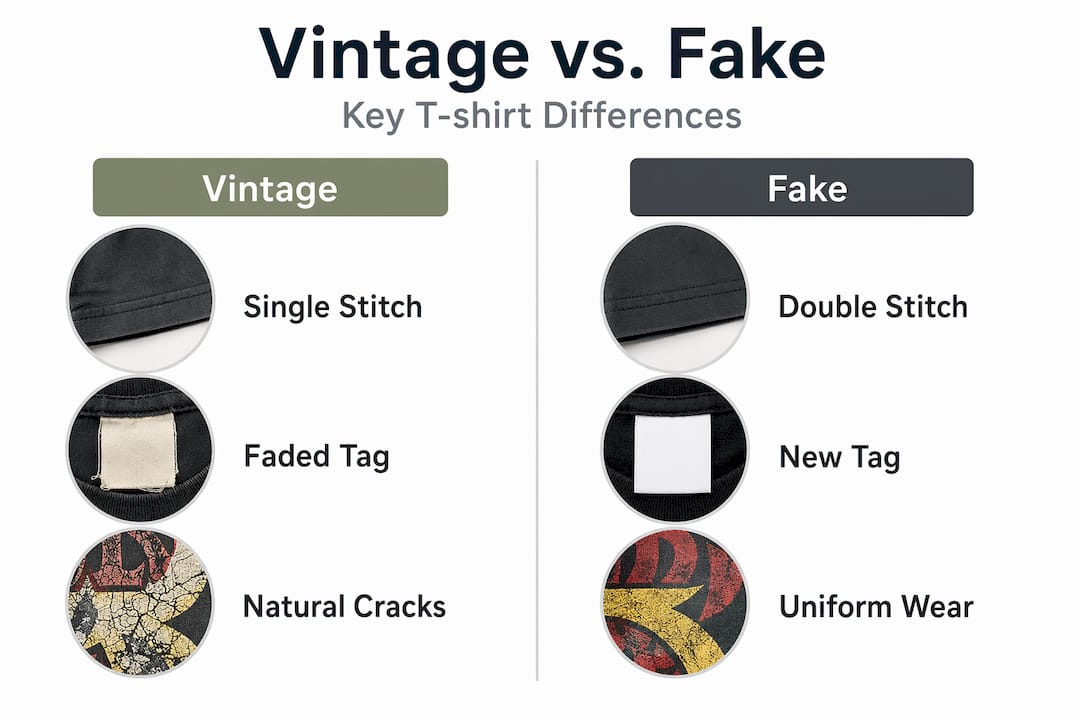
What you are looking for in authentic band-tee print ageing is cracking that follows the logic of a body that has been living in the shirt. The cracks radiate outward from stress points. The ink edges show gradual fading where the plastisol has worn thin. And critically, the texture is tactile. Run a finger across the print inside the shirt and you should feel raised layers where separate colours were laid down in sequence.
Modern reproductions most often use DTG (direct-to-garment) printing or contemporary plastisol applications that produce flat, smooth surfaces with little to no raised texture. When they attempt to fake ageing, the cracking tends to be:
- Uniform and symmetrical, lacking the organic randomness of real wear
- Overly dramatic, with deep splitting that would have required decades of hard use
- Surface-only, with no corresponding fabric softening or thinning underneath the print
- Missing layering, appearing as a single flat image rather than built-up ink layers
| Feature | Authentic vintage print | Reproduction print |
|---|---|---|
| Texture | Raised, layered, tactile | Flat, smooth, uniform |
| Cracking pattern | Follows body stress lines | Symmetrical or printed on |
| Colour edges | Gradual fading at perimeter | Sharp or artificially faded |
| Inside of shirt | Visible ink bleed-through | Clean or faint ghost |
Screen-print texture and hand-apparent ageing versus flat modern digital prints is one of the most reliable distinctions experienced collectors use. Slight off-register colour layering, where different ink passes show barely-there misalignment, is another strong indicator of original band merchandise produced with genuine period screen printing.
Pro Tip: Hold the shirt up to a strong single-direction light source and look across the print surface at an angle. Raised plastisol layers catch the light in a way that flat DTG prints simply cannot replicate.
“If the print looks perfect, be suspicious. Thirty years of washing and wearing never leaves a print looking perfect.”
Natural wear and distress consistency: the fabric tells a story
Fabric ages with logic. Cotton softens unevenly, thinning first in the areas that experience the most friction: the underarms, the inside collar band, the lower front where a belt sits. Real vintage garments show this progression naturally, and it is almost impossible to convincingly fake because it requires actual time.

Pristine stitching paired with heavy distressing is a classic fake sign. If the side seams look nearly new but the print is dramatically cracked and the collar looks destroyed, the shirt is sending inconsistent ageing signals. Genuine wear accumulates gradually and logically across every part of the garment.
Equally telling is synthetic uniform fading, which reproduces manufacturers often achieve through chemical washing or mechanical distressing. Instead of the uneven, sun-and-soap-faded look of a shirt worn to actual concerts, you get a shirt that fades at the same rate across the entire surface.
Look for these signs of genuine wear:
- Collar softening that is subtle and uneven rather than collapsed or freshly frayed
- Underarm thinning visible as slight fabric translucency in natural light
- Thread fading in seams that matches surrounding fabric, not thread that looks newer than the body
- Pilling or bobbling in friction zones consistent with fabric fibre type and age
- Soft hand throughout the body, particularly in areas away from the print
Pro Tip: Check the back collar and shoulder seam carefully. These areas take real wear from bags and seats over decades, and reproductions rarely bother distressing them convincingly.
Practical checklist for identifying original vs fake 1990s heavy metal band t-shirts
When you are evaluating a shirt from an online listing or at a market, this checklist consolidates everything above into a reliable routine. Effective counterfeit identification improves significantly when you use macro photography alongside consistent date verification.
- Request photos in natural light covering front, back, tag, collar, both side seams, and the underside of the print.
- Examine the tag and cross-reference its design against dated reference databases for the claimed production year.
- Check stitch type and condition and verify they are consistent with the shirt’s overall wear.
- Feel the print texture by asking the seller to confirm screen print presence or, when buying in person, running a fingernail lightly across the ink.
- Verify tour dates and venues printed on the shirt against known band history. A 1991 tour listing venues that were not on that actual itinerary is an immediate problem.
- Assess wear consistency across collar, underarms, seams, and print for logical, unified ageing.
- Evaluate the seller for feedback history, willingness to provide detail photos, and pricing relative to known rarity.
Price points that are too low for a shirt’s claimed rarity, seller reluctance to provide close-up photos, or mismatched tour dates are the three most common red flags in online transactions.
| Red flag | What it may indicate |
|---|---|
| Price well below market | Reproduction or seller uncertainty about authenticity |
| No tag photos available | Tag does not match claimed era |
| Uniform fading across fabric | Chemical or mechanical artificial distress |
| Tour dates not matching history | Incorrect or fictional licensing claim |
| Refused detail photo requests | Seller aware of authentication problems |
Use the vintage band tee collector’s checklist and practical buying tips to sharpen your process before every purchase.
Pro Tip: Run a reverse image search on the listing photos. Reproductions are often photographed using the same stock images recycled across multiple sellers.
Why layered verification matters more than ever in the evolving vintage band tee market
Here is the uncomfortable truth about the current market: the best modern reproductions are genuinely impressive. Modern reproductions replicate popular authenticity tells including single stitch, artificial distress, and tag designs with increasing accuracy. A collector relying on a single-stitch test in 2026 is working with a 1990s methodology against a 2020s problem.
What advanced fakes often fail in are the details sellers choose not to photograph: the inside of the print, the tension of the seam thread, the way the collar sits after thirty years of washing. Requesting those macro photos is not being difficult. It is being competent.
The other truth is that expertise is accumulated through layered authentication practice, not through reading a single article including this one. Handle verified originals whenever you can. Build relationships with collectors and sellers who have established reputations. Learn what a 1991 Slayer tour shirt feels like in your hands, not just what it looks like in a photo.
Modern reproductions have their place. They let people wear iconic artwork without destroying irreplaceable originals. But in a collecting context, calling them what they are preserves the integrity of vintage heavy metal authenticity for everyone in the market. Patience and healthy scepticism are not obstacles to collecting. They are what separates serious collectors from buyers who learn expensive lessons.
Explore rare vintage heavy metal t-shirts at Vintage Metal Store
Every shirt in our collection has been through the same layered verification process this article describes: tag era, stitch type, print texture, wear consistency, and provenance. We do not list shirts we cannot authenticate.

If you are searching for genuine 90s tour stock, check out the Metallica 1992 Don’t Tread On Me USA tour tee, a verified example of the kind of original band merchandise that defines the era. Our vintage Metallica shirts collection and broader rare vintage heavy metal concert shirts catalogue covers dead stock, ex-tour pieces, and hard-to-find originals across the genre. Detailed product photos, honest condition descriptions, and knowledgeable support come standard.
Frequently asked questions
Is single-stitch construction proof that a band t-shirt is vintage?
No. Single stitch increases probability but is not a standalone verdict for vintage authenticity, because modern reproductions replicate this feature easily. It must be read alongside tag era, print texture, and wear consistency.
How can I tell if the print on a band t-shirt is genuinely old or artificially distressed?
Authentic vintage prints show natural cracking following stretch zones with raised screen-print texture, unlike the uniform, flat, or printed-on cracking found in most reproductions. Feel the ink surface inside the shirt.
Why are neck tags important when verifying vintage band t-shirts?
Neck tags provide precise dating clues through era-specific design changes. Screen Stars tag variants can narrow a shirt’s production window to within a few years, making them one of the most useful tools in authentication.
Can artificial distressing fool experienced collectors?
Yes, but sophisticated reproductions falter in unseen details like seam condition and print backs that sellers rarely photograph. Requesting macro photos of these areas is the most effective countermeasure.
What practical steps should I take before buying a vintage band t-shirt online?
Request close-up photos of tags, inside seams, and print texture, then compare dates and seller reputation against known references. Be cautious of any seller who cannot or will not provide those images.
Recommended
- 7 Types of Vintage Band Tees Every Collector Should Know – Vintage Metal Store
- 7 Iconic Types of Heavy Metal T Shirts for Collectors – Vintage Metal Store
- Sample band t-shirts: Rare finds and collector value – Vintage Metal Store
- Fabric types in 1990s band shirts: a collector’s guide – Vintage Metal Store


