



TL;DR:
- Finding authentic 1990s heavy metal tour shirts in Australia requires verified measurements and documented provenance. Reputable sellers like Vintage Metal Store offer curated inventory with clear photos and cross-referenced tour dates, reducing guesswork. Authenticity depends on multiple signals, including tag type, printing techniques, and accurate tour back prints, with condition and provenance heavily influencing value.
Authentic 1990s heavy metal tour shirts are still out there in Australia. You can find them, but the search rewards collectors who know exactly what to ask for. Start with three actions: request pit-to-pit and full-length measurements before committing to any purchase; ask for close-up photos of the tag, collar seam, and print surface; and confirm the seller’s return policy and payment protections upfront. Specialist Australian sellers like Vintage Metal Store list curated ex-tour and deadstock pieces with detailed provenance notes, which cuts the guesswork considerably. Under Australian Consumer Law, enforced by the ACCC, a seller who misdescribes a garment’s age or authenticity is legally required to offer a remedy. Knowing that gives you real leverage. Curator David brings collector guides and tour-date cross-referencing to every listing here, so you’re not flying blind.
- Request pit-to-pit, full length, and sleeve measurements in writing.
- Ask for photos of the tag, hem stitch, collar, and print under angled light.
- Confirm returns policy and pay by credit card or a protected method.
Table of Contents
- What to request from every seller before you buy
- Where to find 90s tour shirts in Australia
- How do you authenticate a 1990s tour shirt?
- How does condition affect the price of 90s tour shirts?
- How to buy safely online in Australia
- How to store and care for vintage tour shirts
- How long does it take to track down a rare 90s tour shirt?
- Why do 1990s tour shirts matter to collectors?
- Vintage Metal Store: curated Australian source for 90s metal tour shirts
- Key takeaways
- The thing most collectors get wrong
- Useful sources and further reading
- FAQ
What to request from every seller before you buy
A solid pre-purchase checklist saves you from expensive mistakes. Work through these in order before you commit.
- Measurements first. Ask for pit-to-pit (armhole seam to armhole seam across the chest), full body length from collar seam to hem, and sleeve length. Vintage sizing is inconsistent and tag sizes can be wildly misleading on 90s cotton. Deadstock pieces may also shrink on a first wash, so treat measurements as your primary fit guide.
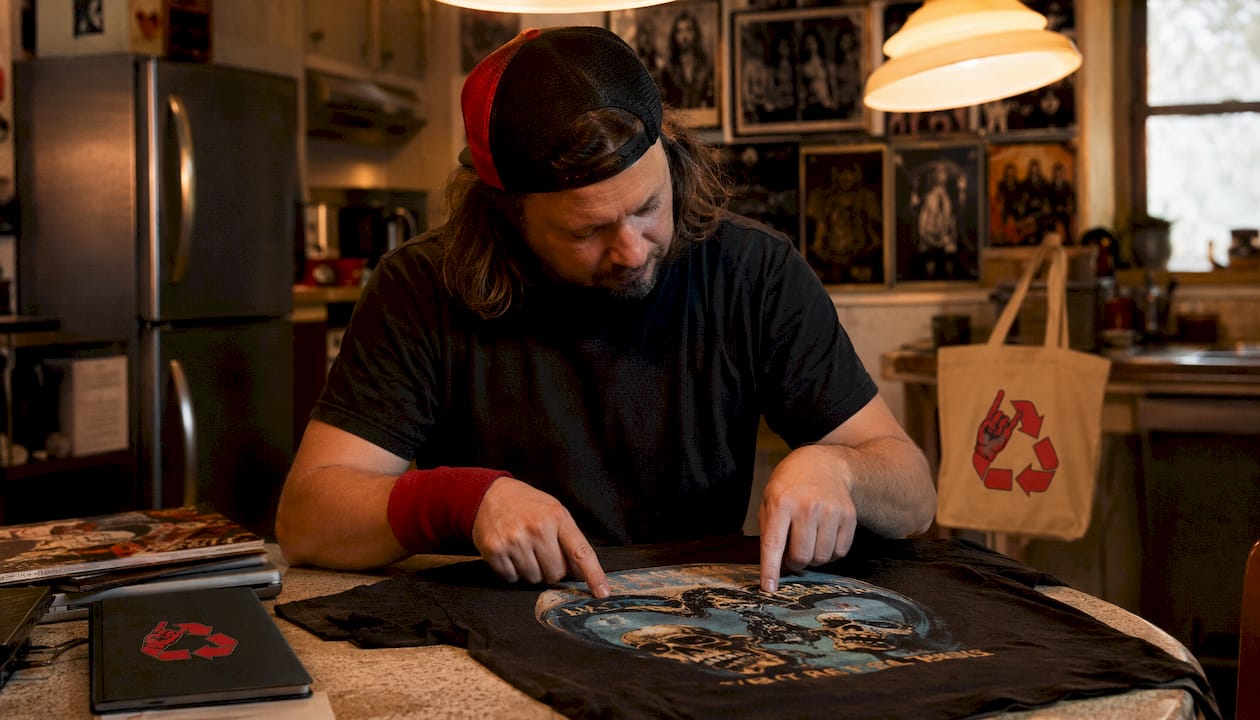
- Photo checklist. Front and back full shots, a close-up of the tag (both sides), collar and hem stitching, and the print surface photographed under angled light to reveal ink texture and crack lines.
- Seller vetting. Check listing age, total feedback count, and whether the seller has a stated return policy. Bonus points if they can supply original provenance: a ticket stub, a photo of the original owner wearing the shirt, or a dated receipt.
- Provenance documentation. If a seller claims concert provenance verbally, ask them to confirm it in the marketplace message thread. A timestamped chat screenshot is lightweight evidence that holds up if a dispute arises later.
Pro Tip: Save every seller message thread as a PDF immediately after purchase. If a dispute lands with your payment provider, timestamped chat records showing the seller’s authenticity claims are your strongest evidence.
Also see the vintage tour shirt checklist on Vintage Metal Store’s blog for a printable version you can paste directly into a seller message.
Where to find 90s tour shirts in Australia
The best sources for finding vintage tour shirts in Australia split across online and in-person channels.
Online sources to prioritise:
- Specialist Australian vintage band-shirt stores with curated catalogues and provenance notes (Vintage Metal Store being the obvious starting point for heavy metal).
- Australian eBay listings filtered to “vintage,” “single stitch,” “tour tee,” “deadstock,” and “ex-tour.” Combine band name + tour year + city or leg + “tour dates” for tighter results.
- Facebook collector groups and Discord servers dedicated to Australian metal and vintage band merch. Members often post before listing publicly, and group reputation polices quality.
- Depop and local classifieds for opportunistic finds, though authentication support is thinner.
Search terms that work: try variations like [band] 1994 tour shirt back print, [band] concert tee deadstock, [band] ex-tour stock Australia, and 90s metal tour dates tee. Set saved searches and alerts on every platform you use so new listings reach you automatically rather than requiring daily manual checks.
In-person sources: record fairs, music memorabilia swap meets, and op shops in inner-city suburbs tend to yield the most. Arrive early at fairs. Op shops near universities or in areas with older demographic turnover are worth a targeted sweep on weekday mornings when new stock hits the floor.
How do you authenticate a 1990s tour shirt?
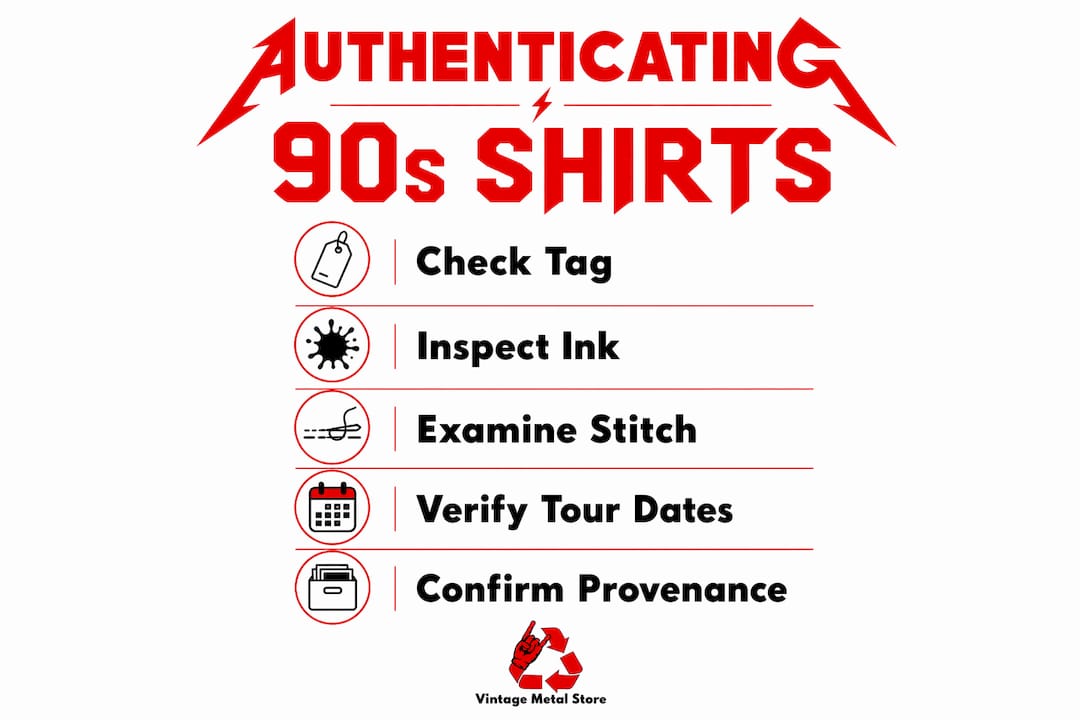
Authentication requires a holistic approach: no single feature proves a shirt is genuine. Check every signal together.
| Feature | Expected 90s signal | Reproduction warning sign |
|---|---|---|
| Tag | Era-correct maker (Screen Stars, Fruit of the Loom 90s cut, Hanes Beefy-T) with correct font and country of origin | Modern tag fonts, “Made in Bangladesh/Cambodia” on pre-2000 designs |
| Stitching | Single-stitch hem and collar on early-to-mid 90s pieces | Double-stitch hem on a shirt claimed as pre-1995 |
| Print / ink | Plastisol ink with natural micro-cracks along stress lines, uneven fading following wear patterns | Uniform fading, artificially distressed cracks, DTG (digital) texture |
| Fabric | Mid-weight cotton, softened with age, slight yellowing on white areas | Stiff, bright-white cotton suggesting recent manufacture |
| Back print | Tour dates listing cities and venues matching the actual tour itinerary | Generic or incorrect dates, fonts inconsistent with era |
| Logo | Band logo matching the era’s known graphic evolution | Updated post-90s logo on a shirt claimed as 90s |
A single-stitch hem is a useful indicator for late-80s and early-90s shirts, but modern reproductions sometimes copy it. Cross-reference the tag type against multiple verified originals with the same graphic to date a shirt reliably. Tour-date back prints are among the strongest provenance signals: if the dates, venues, and cities match a documented tour itinerary, that’s hard to fake convincingly.
How does condition affect the price of 90s tour shirts?
Original tour shirts from the 1990s can sell for hundreds or even thousands of dollars depending on rarity and condition. Age alone does not equal value. Concert-only merch consistently commands a premium over retail merch because it ties directly to a live event rather than a retail distribution chain.
Value drivers, ranked:
- Concert-only provenance (sold at the venue, never restocked)
- Tour significance (iconic album cycle, landmark Australian leg)
- Band demand and graphic desirability
- Condition: deadstock (unworn, tags intact) sits at the top; worn but well-preserved follows; faded, pilled, or repaired pieces sit lower
- Preserved original tags
| Type | Distribution | Scarcity | Typical collector premium |
|---|---|---|---|
| Concert-only tour shirt | Venue merch table only | High: production tied to tour length | Significantly higher |
| Retail tour shirt | Chain stores, mail order | Moderate: wider print run | Moderate |
| Deadstock (unworn) | Either channel | Very high: few survive unused | Highest of all |
Negotiation tips: fading, small holes, or cracked print are legitimate grounds to negotiate down. Intact tags and documented provenance justify paying a premium. If a seller cannot provide measurements or clear tag photos, factor the authentication risk into your offer.
How to buy safely online in Australia
- Pay by credit card or a protected method. Credit cards offer chargeback rights under Australian banking rules. Avoid direct bank transfer for any vintage purchase from an unknown seller.
- Know your rights under Australian Consumer Law. If a seller describes a shirt as “authentic 1990s tour merch” and it turns out to be a reproduction, that is a misrepresentation. The ACCC’s framework gives you the right to a remedy: a refund, replacement, or repair.
- Insist on insured tracked shipping with signature on delivery for any piece worth more than a modest sum. A one-off vintage garment cannot be replaced if it goes missing in transit.
- Red flags to walk away from: unusually low price from a brand-new account, pressure to pay by direct bank transfer only, listing photos that don’t match the description, and sellers who can’t answer basic measurement questions.
How to store and care for vintage tour shirts
Proper storage protects both the fabric and the resale value.
- Fold in acid-free tissue and store in a breathable garment bag away from direct sunlight. UV exposure fades plastisol ink faster than almost anything else.
- Keep storage temperature stable and humidity low. Damp conditions accelerate fabric degradation and mould growth on natural cotton.
- Spot-clean where possible. If a full wash is unavoidable, hand-wash in cold water with a gentle detergent and lay flat to dry. Never tumble-dry a vintage cotton shirt.
- For display, use a UV-filtering frame or a padded hanger behind glass. Avoid pinning directly through the fabric.
- Minor seam repairs by a professional conservator are acceptable and rarely affect value significantly. DIY repairs with mismatched thread, however, can reduce collector appeal noticeably.
The fabric types guide on Vintage Metal Store’s blog covers expected ageing behaviour for the cotton weights common in 90s heavy metal merch.
How long does it take to track down a rare 90s tour shirt?
Common items from well-documented tours can surface within days or weeks if you have alerts set across multiple platforms. Rare concert-only shirts from a single Australian leg of a 90s metal tour can take months to years. That’s not discouraging. It’s the nature of a market where production was tied to a specific tour cycle and many shirts were lost or discarded over the decades.
- Set saved searches on every platform you use and check them weekly rather than daily to avoid alert fatigue.
- Contact specialist dealers directly and ask them to flag you when a specific item comes in. A short, specific want-list email to a curated store like Vintage Metal Store is often more productive than passive searching.
- Monitor consignment listings: sellers sometimes hold pieces for months before listing publicly.
Why do 1990s tour shirts matter to collectors?
90s tour shirts are cultural artefacts because many designs were produced in short, tour-specific runs and then retired permanently. There were no online storefronts to restock from. Once a tour ended, the design was gone. Natural attrition over three decades has shrunk the surviving supply further, which is why demand keeps climbing.
- Concert-only shirts: produced for a specific tour leg, sold at the venue, never reprinted.
- Retail shirts: wider print run, available through stores and mail order, more common today.
- The limited tour production model means each surviving shirt represents a specific moment in music history.
For a deeper look at which 1990s heavy metal shirts collectors prize most, the iconic 1990s heavy metal shirts guide is worth bookmarking. For the cultural reasoning behind the collector obsession, see why 1990s band tees remain iconic.
Vintage Metal Store: curated Australian source for 90s metal tour shirts
For Australian collectors who want to skip the uncertainty of general marketplaces, Vintage Metal Store is the specialist option. The catalogue focuses on vintage and ex-tour heavy metal shirts, with individual listings that include pit-to-pit and length measurements, clear photos of tags and print surfaces, and provenance notes where available. David’s involvement in curation means tour-date cross-referencing is part of the process, not an afterthought.
A rare Metallica 1992 tour tee is one example of the kind of authenticated, documented piece the store carries. Australian collectors can also find local-band history through pieces like the Toxicon Australian metal band shirt, which represents the domestic scene that rarely surfaces on international platforms. Browse the full catalogue or reach out directly to ask about specific bands, tour years, or sizes you’re hunting.
Key takeaways
Tracking down authentic 90s tour shirts in Australia requires verified measurements, documented provenance, and a reputable seller with clear return protections.
| Point | Details |
|---|---|
| Measurements are non-negotiable | Always request pit-to-pit and full length; vintage tag sizes are unreliable guides. |
| Provenance beats condition alone | Concert-only shirts command a premium; documented tour provenance justifies higher prices. |
| Authentication needs multiple signals | Check tag era, plastisol ink cracks, stitching, and logo evolution together, not in isolation. |
| Rare finds take time | Common items surface in days to weeks; rare tour-only shirts can take months or years to locate. |
| Vintage Metal Store | Curated Australian catalogue with measurements, tag photos, and David’s tour-date verification. |
The thing most collectors get wrong
The conventional wisdom says single-stitch hems are the gold standard for authenticating 90s shirts. They’re not. Reproductions have been copying single-stitch construction for years. The real authentication work happens when you cross-reference the tag maker against the known production timeline for that specific band’s merch, then check whether the back-print tour dates actually match a documented itinerary. A shirt that lists a 1994 Australian tour leg with the correct venues and sequence is far harder to fake than one that simply has a single-stitch hem and an old-looking tag.
The other thing collectors underestimate is how much provenance shifts the price ceiling. A well-worn shirt with a ticket stub from the original show will consistently outperform a cleaner shirt with no story. Condition matters, but context matters more. If you’re building a serious collection, spend as much energy documenting the provenance of what you already own as you do hunting new pieces. That documentation is what separates a collection from a pile of old shirts.
Useful sources and further reading
Vintage Metal Store resources:
- All Shirts catalogue: browse the full curated inventory.
- Cross-referencing tour date shirts: David’s guide to matching back-prints to documented tour itineraries.
- Iconic 90s band shirt styles: construction and style details for the decade.
Australian consumer protection:
- ACCC (Australian Competition and Consumer Commission): accc.gov.au for your rights when a product is misdescribed online.
- Australian Consumer Law framework: covers misrepresentation, refund rights, and remedies for online purchases.
Further reading:
- Vintage poster styles by decade at ArtFuzz.com: useful context for understanding 1990s visual culture and how it shaped band merch aesthetics.
FAQ
How do I know if a 90s tour shirt is authentic?
Check the tag maker, plastisol ink cracking along stress lines, stitching style, and whether the back-print tour dates match a documented itinerary. Authentication requires multiple matching signals, not a single feature.
What should I pay for a 1990s heavy metal tour shirt?
Prices range from modest sums for common worn pieces to hundreds or thousands for rare, concert-only deadstock. Provenance, band demand, and graphic desirability drive the premium end.
Are vintage tag sizes reliable for fit?
No. Vintage sizing is inconsistent and 90s cotton can shrink on a first wash. Always use pit-to-pit and length measurements as your primary fit guide.
What payment method is safest for buying vintage shirts in Australia?
Credit card is the safest option because it provides chargeback rights under Australian banking rules. Avoid direct bank transfer with unknown sellers.
How long will it take to find a specific rare tour shirt?
Common items can surface within days to weeks with saved searches active. Rare concert-only shirts from a specific tour leg may take months or years to locate.
Recommended


