



Print fade is the gradual deterioration of ink or printed graphics on fabric — the physical breakdown of colour, texture, and clarity that happens to a band tee over years of washing, sunlight, heat, and wear. For collectors of vintage heavy metal shirts, understanding print fade is the difference between spotting a genuine 1990s tour relic and overpaying for a distressed reprint.
Three things to know immediately:
- Visual and tactile signs: faded colour saturation, fine surface cracking (crazing) in plastisol prints, or a soft, washed-into-the-fabric look in water-based inks
- Why it matters: print condition directly affects authenticity, provenance, and resale value — and fragile aged prints can deteriorate fast with poor handling
- First action when buying: ask the seller for close-up photos of the print surface, the neck tag, and the hem stitching before committing
Key takeaways
Print fade is a physical ink deterioration process — understanding it protects your investment and sharpens your eye for authentic vintage metal shirts.
| Point | Details |
|---|---|
| What print fade is | Gradual ink and colour breakdown on fabric from UV, heat, washing, and abrasion |
| Top causes to watch | Hot washing, tumble drying, direct sun, and bleach accelerate fade fastest |
| Authentication checks | Single-stitch hems, era-correct tags, and natural crazing direction confirm genuine vintage |
| Core care rule | Wash cold inside out, dry flat in shade, and store folded in a cool dark space |
| Restoration caution | Avoid solvent fixes and heat pressing; consult an AICCM-registered conservator for rare pieces |
| Vintage Metal Store | Lists genuine vintage heavy metal tees with close-up print condition photos for confident buying |
Table of Contents
- What causes print fade on vintage band t-shirts?
- How do different inks age, and what should you look for?
- How do you tell a genuine vintage print from a modern reprint?
- How does print fade affect collectibility and value?
- How to slow or prevent further print fade
- Stabilising, repairing, or restoring faded prints
- Should you preserve the current fade or let it age further?
- Why print fade matters more than most collectors realise
- Where to find well-documented vintage metal tees in Australia
- Sources
- FAQ
What causes print fade on vintage band t-shirts?
UV exposure, heat, mechanical abrasion, and chemical exposure are the four main drivers. The Guardian reports that washing and sunlight are the most common culprits, with experts recommending hand washing inside out and drying in the shade to slow print loss.
- Hot-water washing and tumble dryers: heat breaks down ink polymers and shrinks fabric fibres, pulling the print apart from the inside
- Prolonged sun exposure: UV radiation bleaches pigments and causes “shoulder ghosting” — a pale shadow where the shirt hangs on a hanger in direct light
- Machine agitation and friction: drum tumbling and spin cycles physically abrade the print surface, lifting ink edges and accelerating crazing
- Bleach and strong detergents: alkaline chemicals strip pigment and weaken the cotton weave beneath the print, causing bad damage rather than good fade
Pro Tip: Australian UV intensity is among the highest in the world, which means outdoor drying on a sunny Sydney or Brisbane afternoon can bleach a print faster than months of indoor storage. Always dry vintage tees on a shaded rack. Never dry them on a Hills Hoist in full sun.
How do different inks age, and what should you look for?
Different printing methods age in recognisably different ways, and knowing which you are looking at tells you a lot about a shirt’s history and fragility.
Plastisol is the dominant ink type on vintage metal tees from the 1980s and 1990s. It sits on top of the fabric rather than soaking in, so it ages by developing micro-cracks and crazing — a fine network of fissures that follows the knit ribs of the cotton. Collectors often prize this texture as an authenticity cue; it creates a character that modern reprints struggle to replicate convincingly. Heavy crazing with lifting edges or flaking chunks, however, signals structural ink failure.
Water-based and discharge inks penetrate the fabric fibres rather than coating them. When these prints fade, the result is softer and more uniform: colours wash out gradually without cracking, and the graphic takes on a bleached, almost vintage-photograph quality. There is no raised texture to feel.
DTG (direct-to-garment) digital prints produce a flat, uniform finish. Fading tends to be even across the print surface with no cracking, and the ink can develop a slightly chalky or faded-poster look over time.
| Print type | How it ages | Key tactile cue |
|---|---|---|
| Plastisol | Micro-cracking, crazing, possible flaking | Raised texture, brittle feel |
| Water/discharge | Soft, even colour washout | Flush with fabric, no texture |
| DTG/digital | Uniform flat fade, chalky tone | Flat, no crack lines |
A sticky or melted residue on the print surface usually indicates heat damage from an iron or press applied directly to the ink.
How do you tell a genuine vintage print from a modern reprint?
Not all faded or cracked prints are genuinely old. Many modern reprints intentionally distress graphics with enzyme washes and chemical cracking to simulate decades of wear. Authentication experts identify single-stitch hems, tactile plastisol micro-fissuring, and chronological tag alignment as reliable markers — but warn that no single check is definitive.
Use this checklist when buying:
- Single-stitch hems: pre-1996 shirts almost universally use single-needle stitching at the sleeve and bottom hems; double-stitch is a modern production tell
- Era-appropriate neck tag: the tag brand, font, and material should match the shirt’s claimed era — a 1991 Slayer tour tee with a post-2000 tag construction is a red flag
- Plastisol crazing direction: genuine crazing follows the knit rib lines of the cotton; chemically induced cracking tends to be more uniform and random
- Copyright line and artwork alignment: original tour shirts carry specific copyright text; reprints often omit or alter it
- Side seams and knit type: many vintage tees are tubular-knit with no side seam; modern blanks almost always have side seams
Pro Tip: Ask the seller for five specific photos: a macro shot of the print cracks, the neck tag laid flat, the hem stitching close-up, the back-neck area (fade pattern here is hard to fake), and the inside of the shirt showing wash-wear marks. A seller with a genuine vintage piece will have no hesitation.
How does print fade affect collectibility and value?
Tasteful, even ageing that preserves the design’s readability can increase a shirt’s desirability. Structural damage that obscures the artwork usually reduces it. The distinction matters enormously at the point of sale.
- Rare tour shirt, light even crazing: a 1992 Metallica tour tee with soft plastisol crazing and intact colour reads as authentically aged — collectors pay a premium for this
- Common reprint with heavy flaking: ink chunks lifting off the print surface destroy both the visual and the story; buyers discount heavily or walk away
- Collar and stitch integrity: a shirt with a perfect print but a rotted collar or unravelling hem is worth less than one with gentle fade and solid construction
- Fabric rot: yellowing, thinning, or holes in the cotton body are bigger value killers than gentle print fade
When negotiating price, factor in whether a print is stable (crazing but not flaking) or actively deteriorating. A stable faded print on a rare shirt holds value; an actively flaking print on a common shirt does not. Restoration that involves repainting or reprinting over original ink almost always reduces collector value, even when it looks better visually.
How to slow or prevent further print fade
The single most effective habit is low-frequency, cold-temperature washing inside out, combined with drying away from direct sunlight. British GQ advises cold gentle cycles or hand washing for precious vintage tees, and warns against tumble drying to protect both prints and garment shape.
- Limit washes — wear your tee once more before washing; every wash cycle is mechanical stress on the print
- Turn inside out before any wash, every time
- Use cold water on the gentlest machine cycle, or hand wash in a basin
- Choose a neutral, pH-balanced detergent — avoid anything with optical brighteners or bleach agents
- Skip the tumble dryer entirely; heat is the fastest way to accelerate crazing and colour loss
- Dry flat or on a shaded rack, never in direct sun and never on a wire hanger that distorts the shoulders
- Iron on reverse only, never directly on the print surface, and use a pressing cloth
| Do | Don’t |
|---|---|
| Wash cold, inside out | Use hot water or bleach |
| Hand wash for precious pieces | Machine wash on a heavy cycle |
| Dry flat in shade | Tumble dry or dry in direct sun |
| Use neutral detergent | Use enzyme or brightener detergents |
| Store folded in dark, cool space | Hang long-term on wire hangers |
Pro Tip: For long-term storage of vintage metal tees, aim for a cool, dark environment with moderate humidity, maintaining a suitable relative humidity and temperature conducive to textile preservation. Fold rather than hang for storage; hanging stretches the knit and stresses the print over time. Acid-free tissue between folded shirts prevents dye transfer.
Stabilising, repairing, or restoring faded prints
Small stabilising measures can help preserve what remains, but invasive restoration risks destroying both the value and the original character of a vintage shirt. The Vintage Metal Store restoration workflow guide outlines the key decision points between stabilising and intervening.
Safe household stabilisation steps:
- Gentle surface cleaning: a soft, dry brush to remove loose surface debris — never wet-scrub a cracked plastisol print
- Support patches for fabric rot: apply an acid-free cotton patch to the inside of the shirt to stabilise thinning areas without touching the print face
- Avoid solvent-based products marketed as “ink restorers” — most soften aged plastisol unevenly and accelerate flaking
- Document before touching anything: photograph the print in natural light before any intervention
What not to do:
- No bleaching of any kind, even spot treatment near the print
- No heat pressing over original ink to “re-bond” it — this causes irreversible adhesion failure
- No overpainting with fabric paint unless you are documenting the change and the shirt is not a collector piece
Pro Tip: To find a qualified Australian textile conservator, contact the Australian Institute for the Conservation of Cultural Material (AICCM) and ask for a conservator with textile specialisation. Request a written condition report before any work begins, and ask specifically whether proposed treatments are reversible.
Should you preserve the current fade or let it age further?
Prefer preservation for rare, high-value items. Embrace further ageing for common shirts you intend to wear regularly. The decision comes down to rarity, intended use, and whether any treatment you apply can be undone.
- Rarity: a one-tour pressing from a 1989 Australian leg of a major metal tour warrants careful preservation; a widely distributed shirt from a large run does not demand the same caution
- Resale plans: if you intend to sell, stable and documented condition beats any DIY intervention
- Structural integrity: a shirt with compromised fabric needs stabilisation regardless of print condition
- Reversibility: only apply treatments that can be undone — irreversible changes permanently alter provenance
- Sentimental use: a shirt you wear to gigs can age naturally; one you display or store for investment should be protected
For wearable shirts with gentle fade, the minimal intervention is simply correct washing and storage. Wear it, enjoy it, and let the legacy deepen.
Why print fade matters more than most collectors realise
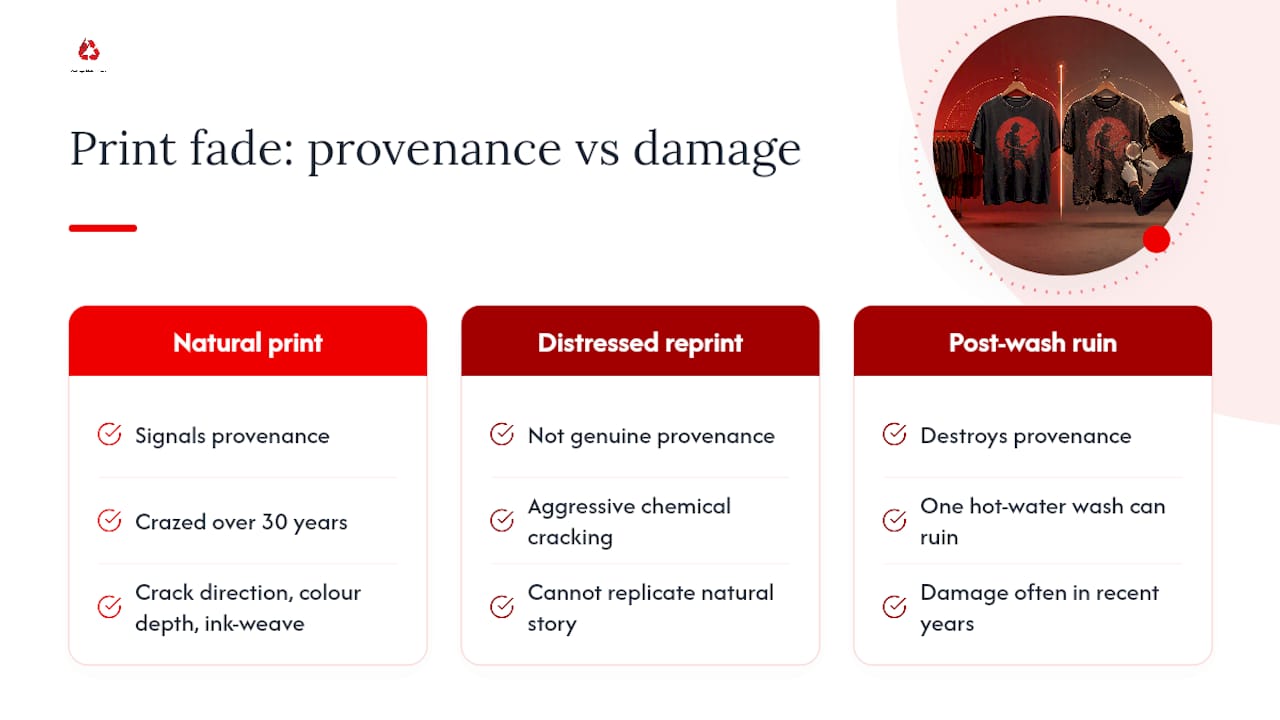
There is a tendency in the vintage metal community to treat print fade as purely cosmetic — something that either looks cool or doesn’t. That framing misses the real issue. Print condition is provenance. A plastisol print that has crazed naturally over 30 years of careful ownership tells a story that no distressed reprint can replicate, and experienced buyers read that story in the crack direction, the colour depth, and the way the ink sits against the weave.
What gets underestimated is how quickly the wrong single wash can collapse a stable aged print into active deterioration. A shirt that has survived since 1991 in reasonable condition can be ruined in one hot-water cycle. The Vintage Metal Store preservation guide documents this pattern repeatedly: shirts arrive in stable condition, and the damage that reduced their value happened in the last few years of ownership, not the first three decades.
The other underrated point is that “good fade” and “bad damage” are not always obvious at a glance. Learning to distinguish them — the soft uniform washout of a water-based print versus the aggressive chemical cracking of a distressed reprint — is the skill that separates a confident collector from one who gets burned on a purchase.
Where to find well-documented vintage metal tees in Australia
Vintage Metal Store specialises in genuine vintage and second-hand heavy metal band tees, including rare ex-tour and deadstock shirts from major metal acts and Australian tours. Every listing documents print condition with close-up photography so you can assess fade, crazing, and ink integrity before you buy.

Whether you are chasing a rare 1992 Metallica tour shirt or browsing the full vintage Metallica collection, each piece comes with honest condition notes. You can also contact the store directly to request additional print close-ups or a condition assessment before purchasing. Shop the collection at Vintage Metal Store and wear the legacy with confidence.
Sources
- Caring for vintage T-shirts: ‘If you want it for a long time, treat it that way’ | Fashion | The Guardian
- How to clean a vintage T-shirt: A guide to washing, removing stains, and storing them safely | British GQ
- A Guide to Fading on a Vintage Graphic Tee
- How to Tell If a Vintage Shirt Is a Reprint: The Expert Guide – Yiume
FAQ
What is print fade on a band t-shirt?
Print fade is the gradual deterioration of ink or printed graphics on fabric caused by UV exposure, heat, washing, and abrasion. On vintage heavy metal tees, it appears as colour loss, plastisol crazing, or a soft washed-out look depending on the ink type.
How do I tell good fade from print damage?
Good fade is even, preserves the design’s readability, and includes natural plastisol crazing that follows the fabric’s knit ribs. Bad damage includes bleach spots, large flaking chunks, or ink loss that obscures the artwork.
Does print fade increase or decrease a shirt’s value?
Light, even ageing on a rare tour shirt can increase desirability and collector value. Heavy flaking, ink loss, or damage that obscures the graphic typically reduces value, especially when combined with fabric rot or collar deterioration.
How do I prevent further print fade on a shirt I own?
Wash cold inside out on a gentle cycle or by hand, use a neutral detergent, skip the tumble dryer, and dry flat in the shade. The Vintage Metal Store preservation guide outlines a full 10-step routine for band shirts.
When should I consult a professional conservator?
Consult an AICCM-registered textile conservator when a shirt has active fabric rot, significant ink instability, or when any proposed treatment would be irreversible. Always request a written condition report before work begins.
Recommended
- Why preserve old band tees? Value, culture and know-how – Vintage Metal Store
- Collector’s guide to vintage heavy metal t-shirts: spot, value, collec – Vintage Metal Store
- Collector’s guide to authentic vintage band tees: 5 expert checks – Vintage Metal Store
- How to restore heavy metal tee prints: Expert care – Vintage Metal Store


